

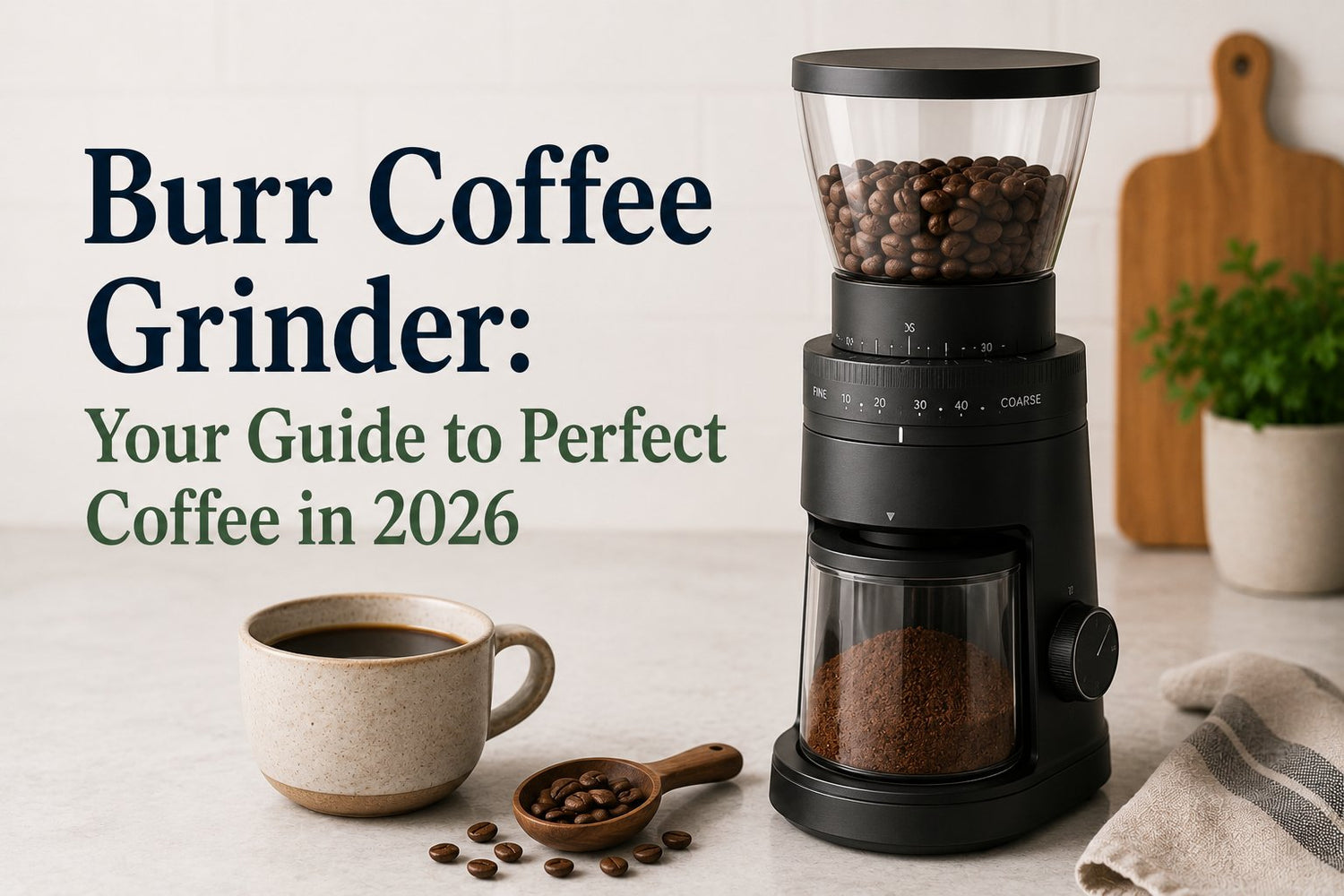
You bought good beans. You cleaned the brewer. You even started measuring more carefully. But your coffee still changes from one morning to the next. One pot tastes flat, the next tastes harsh, and the espresso you hoped would feel café-worthy comes out thin or stubbornly bitter.
That's the point where many people assume they need better beans or a more expensive machine. In a lot of kitchens, the main issue sits between the bag of coffee and the brewer: the grinder.
For home cooks, renters, and small offices, a burr coffee grinder often makes a bigger practical difference than people expect. It doesn't just grind coffee. It gives you control. It helps your French press taste fuller, your drip coffee taste cleaner, and your espresso behave more predictably. It also raises very ordinary questions that coffee forums often skip, like where this thing will live, how loud it is at 6:30 a.m., and whether one grinder can handle more than one brew style without turning your counter into a mess.
Table of Contents
- The Secret to Better Coffee Is Not the Beans
- What Makes a Burr Grinder Different
- Exploring Burr Types Conical vs Flat
- Matching Grind Size to Your Brew Method
- How to Choose the Right Burr Grinder
- Simple Maintenance for Lasting Performance
- Sizing and Storage for Your Kitchen
The Secret to Better Coffee Is Not the Beans
A customer in a kitchen shop will often tell me the same story. They bought a nicer coffee, maybe from a local roaster, and for a few days it seemed promising. Then the routine fell apart. One morning the cup was too sharp. The next it was muddy. Nothing felt repeatable.
Most of the time, the brewer isn't the first thing I'd blame. The beans might be good. The kettle might be fine. The missing piece is often the grinder.
Coffee extraction depends on water moving through grounds evenly. If the particles are all over the place, the brew will be all over the place too. That's why a burr coffee grinder matters so much in real life. It gives you more consistent grounds, which gives you a better chance at a balanced cup, whether you're making drip before work or trying to top an iced drink with homemade foam after reading a guide on how to make cold foam.
What people usually notice first
The first improvement usually isn't some dramatic tasting-note revelation. It's consistency.
- Less guesswork: You stop wondering why the same beans taste different every day.
- More useful adjustments: If the coffee tastes sour or weak, you can change the grind and expect a meaningful result.
- Better fit across brew methods: One grinder can help you move from drip to pour-over to French press with less frustration.
Practical rule: If your coffee is unpredictable, look at your grinder before you replace your brewer.
A lot of buyers think grinders are enthusiast gear. They're not. They're basic kitchen tools with a direct job: make the brewing step more even and more repeatable. That matters just as much in a condo kitchen as it does in a coffee bar.
What Makes a Burr Grinder Different
The biggest difference is simple. A burr grinder mills coffee. A blade grinder chops it.
The modern burr coffee grinder traces its lineage to the 15th century in Turkey or Persia, with a key milestone in 1799 when Richard Dearman, an English blacksmith, is credited with a design using two revolving abrasive surfaces. That design produced a more consistent particle size with less frictional heating than blade grinders, which is why burr grinding still matters for cup quality today, as described in this history of coffee grinder development.
A simple way to picture it
Think of a blade grinder like a tiny food processor. It spins fast and smacks beans into random pieces. Some bits become powder. Some stay chunky. You can shake it and pulse it, but you're still chopping, not controlling.
A burr coffee grinder works more like a pepper mill. Two burrs sit at a set distance from each other. Beans pass through that gap and get crushed into a more uniform size.

If you want a more direct side-by-side breakdown, this guide on burr grinder vs blade grinder is useful as a shopping companion.
Why uniform grounds matter so much
When your grinder makes both dust-like fines and large chunks, water treats them differently. The fine bits give up flavour quickly. The larger pieces extract more slowly. You end up with a cup that can taste bitter and weak at the same time, which confuses people because it seems contradictory. It isn't. It's uneven extraction.
Burr grinders are preferred when consistency is the goal because they're built to hold an adjustable grinding gap. That gives you a steadier particle size and helps reduce the extra heat associated with rougher chopping methods.
Here's what that means in your kitchen:
| Grinder style | How it works | Common result in the cup |
|---|---|---|
| Blade grinder | Chops beans with a spinning blade | Less even extraction, more unpredictability |
| Burr grinder | Crushes beans between burrs set to a chosen gap | More repeatable brewing and clearer adjustment control |
Uneven coffee grounds don't just change flavour. They make troubleshooting harder because every brew starts from a different baseline.
That's why people often feel they suddenly got “better” at making coffee after buying a burr grinder. In many cases, they didn't become more skilled overnight. The tool ceased introducing as much chaos.
Exploring Burr Types Conical vs Flat
Once you decide on a burr grinder, the next question is usually conical or flat. Often, guides on this topic become too technical, too quickly. For most households, the useful question is not which burr shape wins an online debate. It's which one suits your routine, your noise tolerance, and your brew habits.
The two main categories are conical burrs and flat or wheel burrs. Conical burrs generally run at a slower rotating speed, while flat burrs use a higher rotation speed, as explained in this overview of burr grinder types and calibration.

How conical burrs behave
Conical burr grinders are common in home kitchens for a reason. They often feel straightforward to live with.
Many buyers like them because they can suit a broad range of daily brewing needs without feeling overly fussy. If your household switches between drip during the week and a slower weekend pour-over, a conical design often feels like a practical fit.
A current example is the HAMILTON BEACH PROFESSIONAL 80405 Conical Burr Digital Coffee Grinder, which is described as providing precise, uniform grind for ideal coffee flavour. Its snapshot also notes automatic operation, grind-by-amount controls, a built-in scale, and a digital screen that lets users grind to ounces or grams.
How flat burrs behave
Flat burr grinders are also common, especially when buyers want a grinder that can be tuned carefully for more demanding brewing routines. Because flat burrs use a higher rotation speed, shoppers often compare them closely on heat, sound, and grind range.
That doesn't make them automatically better. It makes them different.
For a home user, flat burrs may make sense if:
- Espresso is a serious priority: You care about very fine adjustments and repeatable shots.
- You don't mind a more technical workflow: You're comfortable learning the grinder, not just using it.
- Counter space is still manageable: Some models are compact, but many buyers still need to think through height and footprint.
Flat versus conical matters. But in a condo kitchen, noise, cleanup, and whether the grinder fits under the cupboard can matter just as much.
What about steel and ceramic
Buyers often get stuck here because product pages throw out burr material without context. The material matters, but not in isolation.
Steel burrs are commonly associated with efficient grinding and a sharp cutting action. Ceramic burrs are often discussed for durability and heat management. For many households, though, the more practical decision is still this: does the grinder produce a grind range that suits your brew methods, and is it pleasant enough to use every day?
If your use is mostly drip, pour-over, and the occasional espresso-style experiment, don't let burr material distract you from the basics. A grinder that fits your counter, your schedule, and your cleaning tolerance is usually the smarter buy than one with impressive specs you'll hate living with.
Matching Grind Size to Your Brew Method
A burr grinder helps because it lets you change burr spacing with control. That spacing is what determines whether your grounds come out fine or coarse, and small changes affect extraction in a very noticeable way.
Experts recommend calibrating by closing the burrs until they just touch, often making a brief chirping sound, then backing off slightly. That zero point gives you a repeatable reference for adjustments, as explained in this deep dive on grinder burr calibration.
Start from a true zero point
Many people get frustrated because they adjust a grinder randomly, without knowing where the burrs begin. If your grinder allows calibration, finding that near-contact point gives you a reliable starting place.
That matters most when you switch between brew methods. If you brew drip on weekdays and espresso on weekends, a real reference point makes it much easier to return to settings that worked before.
If you're pairing your grinder with an espresso setup, especially an automatic or semi-automatic machine, it helps to understand the machine side too. This guide to a De'Longhi espresso machine automatic is useful if your coffee station is moving in that direction.
Grind Size and Brew Method Reference Chart
| Grind Size | Visual Cue | Best For | Extraction Notes |
|---|---|---|---|
| Coarse | Rough, chunky pieces like cracked peppercorn size | French press, cold brew | If too coarse, coffee can taste thin or sour |
| Medium-coarse | Slightly smaller, still clearly defined particles | Some pour-over methods, immersion hybrids | Useful when brew time feels too heavy at medium |
| Medium | Even grains, similar to table salt in feel | Drip coffee makers, many pour-over brewers | Often the starting point for balanced everyday coffee |
| Medium-fine | Noticeably tighter texture, but not powdery | Some cone brewers and stronger filter styles | Can increase body and intensity if medium tastes weak |
| Fine | Soft texture, approaching powder | Espresso, moka-style brewing | Too fine can push bitterness and slow water flow |
| Extra-fine | Very powdery | Very specialised uses | Easy to over-extract if used in the wrong brewer |
A quick note on terminology. A coffee grinder and a food grinder are not the same tool. For example, the Hamilton Beach Stand Mixer Grinder Attachment turns a mixer into a food grinder and includes sausage and kibbe tools with multiple grinding plates. Useful in the kitchen, yes. Suitable for coffee, no.
How to adjust by taste
You don't need to memorise technical jargon to dial in a cup. Taste gives you the clues.
- If coffee tastes sour or weak: Try grinding a bit finer.
- If coffee tastes harsh or bitter: Try grinding a bit coarser.
- If brew time changes wildly: Check whether the grinder setting moved or whether old grounds are affecting the result.
- If espresso stalls: The grind may be too fine, or the dose may be too compact.
Start with the recommended range for your brew method, then change only one thing at a time. That keeps the result readable.
A burr coffee grinder earns its place. You're not just producing grounds. You're building a repeatable system.
How to Choose the Right Burr Grinder
At 6:30 on a weekday morning, the wrong grinder feels bigger than it is. It wakes the apartment, throws grounds across the counter, and takes up the space where the toaster should go. The right one fits your coffee habits and your kitchen, especially in Canadian homes where condo counters are tight, storage is limited, and one appliance often needs to serve more than one person.
A burr grinder is a daily-use tool, like a good tap or a reliable kettle. You notice its size, noise, and mess every single day. That is why the smartest choice usually comes from your routine first, then the spec sheet.
Choose for your routine first
Start with the coffee you make on ordinary mornings.
If your household brews a full pot before work, look for speed, easy controls, and a grind bin that does not feel fiddly. If you rent and store appliances in a cabinet, footprint and weight matter as much as grind quality. If a small office shares one grinder, simple settings and quick cleanup often matter more than fine adjustment for one person's occasional espresso experiment.
The YouTube video linked earlier, a discussion of real-life grinder use cases for Canadian households, is useful for one specific reason. It shows the kinds of situations buyers run into after purchase, such as switching between brew styles, placing a grinder in a small kitchen, and dealing with everyday noise in shared spaces.
A practical buying filter looks like this:
- Primary brew method: Daily drip, French press, pour-over, espresso, or a mix.
- Number of users: One person, a family, or a shared office kitchen.
- Where the grinder will live: On the counter, on a coffee cart, or in a cupboard between uses.
- Tolerance for noise and stray grounds: A real issue in condos, open kitchens, and workspaces.
Features that matter in real kitchens
Specs matter, but only if they solve a problem you have.
Capacity and workflow
A solo coffee drinker may be happier grinding one dose at a time. A household with two or three coffee drinkers may prefer a hopper that can handle back-to-back brewing without feeling slow. In a studio or office, workflow matters even more. If one person needs three minutes to figure out the settings, everyone else waits.
Settings and ease of adjustment
Stepped grinders work like clearly marked notches on a stovetop dial. They are easy to repeat, which is helpful for households where more than one person uses the machine. Grinders with finer adjustment offer more control, but they can also feel fussy if your goal is dependable morning coffee rather than hobby-level tweaking.
Noise and counter footprint
This is often overlooked, yet it decides whether a grinder stays out or gets shoved into a cupboard. A loud machine can be irritating in an apartment with thin walls. A wide machine can crowd a narrow counter in a rental kitchen. Good coffee is not much comfort if the grinder makes the room harder to live in.
Cleanup and static
Some grinders leave a light dusting of coffee around the chute and bin. That is common. The question is whether the design keeps the mess manageable. Smooth surfaces, a bin that removes easily, and fewer tight corners all make a difference because they shorten cleanup from a chore to a quick wipe.
GrifGlo is mentioned here as a factual example of a brand that organizes kitchen buying guidance around fit and everyday use. That approach is useful if you are comparing tools by storage, usability, and cleanup, not only by coffee terminology.
Three common buyer profiles
The renter with limited counter space
Choose a compact grinder with simple controls and a shape that stores easily. Lower noise and tidy operation usually matter more here than having the finest espresso range.
A conical burr grinder often suits this setup because many models are smaller and straightforward to use.
The all-purpose household
This is the classic mixed-use home. Drip on weekdays, pour-over on weekends, maybe cold brew in summer, and occasional interest in espresso. In that case, look for a broad grind range, settings that are easy to return to, and a machine that does not punish you with a long cleanup every time you switch methods.
The small office or studio
Shared spaces need clarity. Pick a grinder with controls people can understand at a glance, enough capacity for several users, and a design that does not scatter grounds around the coffee station. The best office grinder is often the one nobody has to explain.
The best burr coffee grinder for your home or workplace is the one that fits the space, the budget, and the people using it every day.
The same buying logic shows up in other kitchen tools too. A good salt and pepper grinder for everyday cooking is chosen for feel, adjustment, cleanup, and storage, not just for what looks impressive on paper.
Simple Maintenance for Lasting Performance
A grinder that handles fresh coffee every day will collect oils, fine particles, and stale residue. If you ignore that buildup, your coffee starts tasting duller and your adjustments feel less reliable.

The quick clean that actually helps
You don't need a complicated ritual. You need a small habit.
After regular use, empty loose grounds from the catch bin, wipe the area around the chute, and brush away visible coffee dust. That alone helps prevent old grounds from mixing into the next brew.
A few practical habits make a big difference:
- Brush the burr area: A small dry brush helps remove coffee particles before they compact.
- Empty the grounds bin fully: Don't let yesterday's grounds sit in corners.
- Wipe the exterior: Oils and static attract more mess over time.
- Keep the bean hopper clean and dry: Old fragments can affect flavour.
If your coffee station sheds grounds around the base, a small hand vacuum can make the routine easier. The BLACK+DECKER DUSTBUSTER HLVC320J01 AdvancedClean™ Slim Cordless Hand Vacuum is described in the catalogue snapshot as a slim cordless hand vacuum with a high-performance motor, extra-wide nozzle, and a dustbin that removes quickly for emptying.
When to do a deeper clean
Every so often, the burr area needs more than a surface brush. Follow your grinder's manual, remove accessible parts carefully, and clean out packed grounds and oily residue. If the manufacturer allows grinder-cleaning tablets, those can be part of the routine too.
Old coffee oils don't just smell stale. They can push stale flavour into fresh beans.
If you want a visual walkthrough before opening up your grinder, this video gives a useful cleaning reference:
The goal isn't perfection. It's keeping the burr coffee grinder clean enough that it still behaves like the precision tool you bought.
Sizing and Storage for Your Kitchen
A grinder can be excellent on paper and still feel annoying at home. That usually happens because nobody thought through placement, storage, or the daily mess around it.
In smaller kitchens, a coffee setup works best when it's compact, easy to reset, and simple to wipe down. If the grinder blocks a cupboard door or has to be moved every single morning, you'll notice that long before you notice subtle flavour differences.
Make the coffee station easy to live with
Choose a spot with enough clearance for pouring beans in and removing the grounds bin comfortably. Keep the grinder near the brewer if you can, but not so tight that cords, lids, and filters pile up around it.
A simple station often includes:
- One tray or mat: This catches loose grounds and defines the coffee zone.
- A nearby bean container: Keep it easy to reach so refilling doesn't become a chore.
- A cleaning brush within reach: If it lives in a drawer across the room, you won't use it.
- Cable control: A loose cord makes a small counter feel cluttered fast.
Small-space fixes that work
Static is one of the most common irritations. Grounds cling to the bin, the chute, and the counter. You don't need a dramatic solution. You need a setup that contains the mess and makes wipe-downs quick.
Noise also matters more in shared spaces than many coffee guides admit. If you live with light sleepers or work in a small office, try to choose a grinder known for easy daily use rather than one that prioritises enthusiast-level tweaking. And if you're storing the grinder in a cupboard between uses, measure the shelf height and depth before buying.
For a tidy setup, many of the same principles from this guide on how to organize kitchen cabinets apply to coffee gear too. Group related items, reduce reaching, and avoid storing frequently used tools behind rarely used ones.
A practical grinder should make mornings easier, not more complicated. If you're comparing home, kitchen, and organisation tools with that same real-world lens, GrifGlo publishes decision-friendly guides that focus on fit, usability, and everyday routines for households, rentals, and small business spaces.



Leave a comment
This site is protected by hCaptcha and the hCaptcha Privacy Policy and Terms of Service apply.