

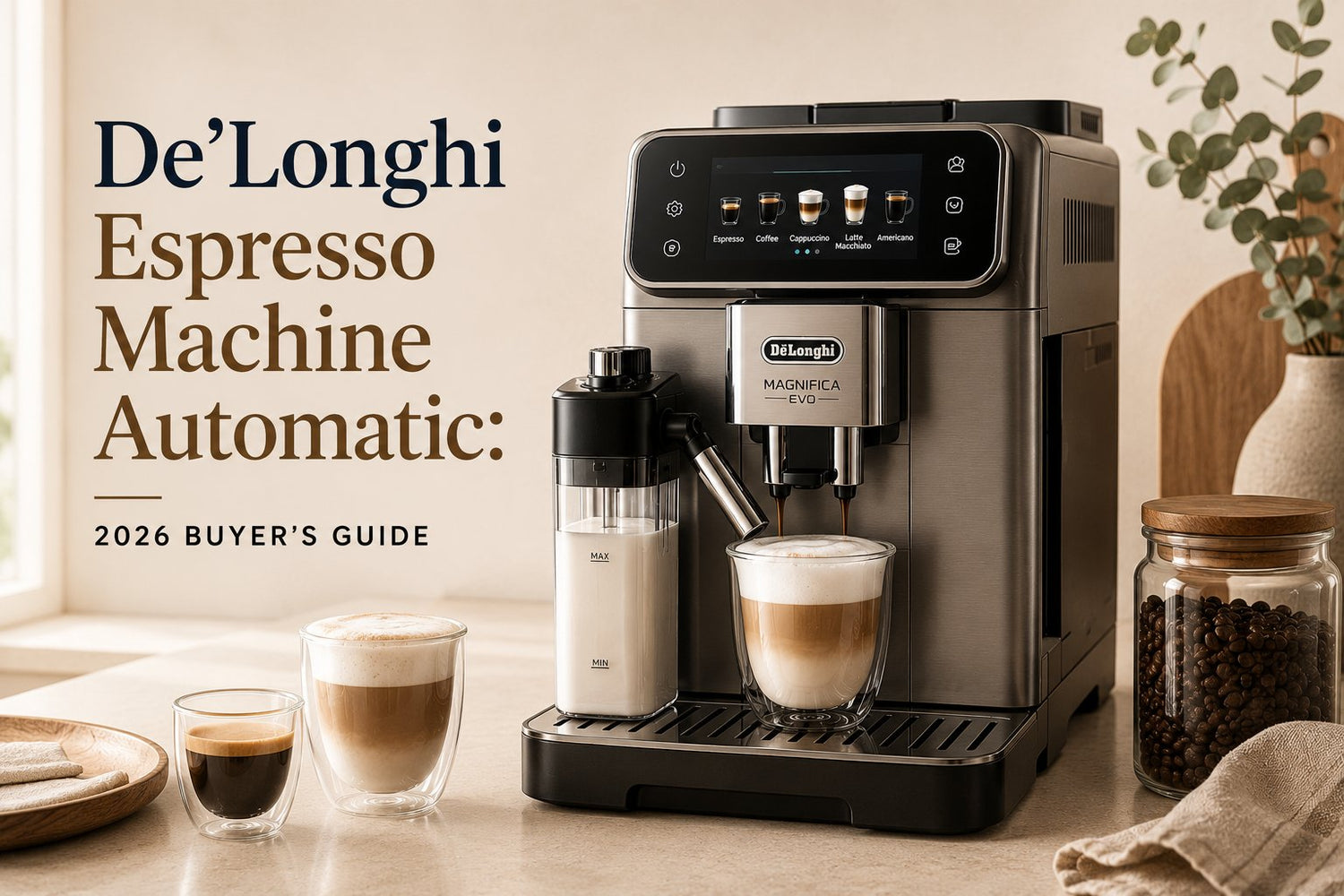
You're probably in the same spot as most buyers who start looking at a De'Longhi automatic espresso machine. You want café-style coffee at home, you don't want to learn a full barista workflow, and you definitely don't want to spend good money on a machine that becomes a daily cleaning project.
That's where the category gets confusing. De'Longhi uses the word automatic across a wide range of machines, but not all “automatic” machines save you the same amount of effort, and not all of them ask for the same level of maintenance in return. Some are straightforward bean-to-cup workhorses. Some add one-touch milk drinks and profile settings. Some add enough convenience features that the machine starts to feel like a small appliance system rather than a coffee maker.
A good choice comes down to fit. Not just drink quality, but how often you make milk drinks, how much counter space you have, how patient you are with cleaning, and whether convenience matters more to you than hands-on control. If you're building a practical coffee setup around the rest of your kitchen, it also helps to think in terms of routine, not just features, much like the broader home bar essentials approach to setting up a space you'll use.
Table of Contents
- Your Path to Effortless Home Espresso
- Decoding Automatic vs Super Automatic Machines
- Key Features of De'Longhi Automatic Machines
- Navigating the De'Longhi Product Lines
- Sizing and Capacity for Your Real-World Kitchen
- Long-Term Maintenance and Reliability Tips
- How to Choose the Right De'Longhi Machine for You
Your Path to Effortless Home Espresso
It is 6:45 a.m., the kitchen is still half-dark, and you want a drink that tastes good without pulling out a grinder, tamper, knock box, and milk pitcher. That is the primary appeal of a De'Longhi espresso machine automatic setup. It cuts the morning workload, but it also changes what you have to live with after the cup is made.
After testing a lot of home espresso machines, I'd put the buying question this way: convenience is easy to sell, but ownership is where the right machine proves itself. A model that makes one-touch lattes sounds great on day one. Six months later, the better machine is often the one with a cleaning routine, milk system, and water tank setup that still fit your schedule and your counter.
De'Longhi has built much of its reputation around that easier, button-driven experience, especially in its bean-to-cup range. The marketing point is speed and less hands-on prep. The practical question is whether that saved effort at brew time is worth the extra rinsing, descaling, and milk-system care that comes with higher automation.
Practical rule: Buy the machine you will maintain without resentment, not the one with the longest drink list.
A good starting point is to match the machine to your actual routine, not your ideal coffee fantasy. Households that drink straight espresso or black coffee can often live happily with fewer automated milk parts. Buyers who make cappuccinos every day may save time with integrated milk, but they need to accept more daily cleaning. If your kitchen already feels crowded, it also helps to review a few home bar essentials for a functional coffee setup before choosing a larger bean-to-cup machine.
Three questions narrow the field fast:
- What do you drink on weekdays? Espresso, coffee, cappuccino, latte, or a mix.
- How much effort do you want before the drink starts? Some buyers are fine steaming milk by hand. Others want one button and done.
- What maintenance will you be able to keep up with? More drink presets and milk automation usually mean more rinsing, wiping, and periodic deep cleaning.
That is the path to effortless home espresso for most buyers. Choose the level of automation that saves time without adding a maintenance routine you will start avoiding.
Decoding Automatic vs Super Automatic Machines
Monday morning is where these labels stop being marketing terms. One machine asks you to grind, tamp, steam, and clean before you are fully awake. Another gives you a drink from one button, then asks for more rinsing and milk-system care later in the day. That difference is what buyers need to understand before they spend De'Longhi money.

What your role looks like
Semi-automatic, automatic, and super-automatic machines do not ask for the same kind of work.
- Semi-automatic machines leave espresso prep in your hands. You grind, dose, tamp, start the shot, and steam milk yourself.
- Fully automatic machines handle more of the brewing process and often let you program drink volume, but milk is still partly manual on many models.
- Super-automatic machines usually grind, dose, brew, and on many models froth milk with little input beyond choosing the drink.
In real use, this is less about prestige and more about labor. A semi-automatic can produce excellent coffee, but it asks for attention every time. A super-automatic trades some hands-on control for speed, repeatability, and less mess during the drink-making part of the routine.
What changes after the first week
The significant gap shows up after the novelty wears off.
A semi-automatic machine suits buyers who enjoy adjusting grind, dose, and milk texture. It rewards practice, and it can be satisfying if making coffee is part of the hobby. It also creates more steps, more accessories, and more opportunities for a rushed morning to go wrong.
A fully automatic or super-automatic De'Longhi fits a different household. It is built for people who want dependable coffee with fewer decisions. That convenience has a cost beyond the purchase price. More internal parts, automatic rinsing cycles, drip tray dumping, descaling, and milk-path cleaning all become part of ownership.
That is the trade-off many buyers miss.
If you drink straight espresso or long coffee, a simpler automatic machine often makes more sense because it avoids the extra milk-system upkeep. If your home runs on cappuccinos and lattes, a super-automatic can save real time each day, but only if someone in the house will keep up with cleaning.
Higher automation lowers the skill required for each drink and raises the amount of maintenance you need to tolerate.
A quick comparison
| Machine type | What you do | What the machine does | Best for |
|---|---|---|---|
| Semi-automatic | Grind, prep, brew, steam milk | Controls pressure and extraction basics | Buyers who want control and do not mind the routine |
| Fully automatic | Fill, select settings, handle some manual milk work | Automates more of the brew cycle | Buyers who want convenience without full bean-to-cup complexity |
| Super-automatic | Add beans and water, press a drink button, clean the system regularly | Grinds, doses, brews, and often froths milk | Busy homes, shared kitchens, and repeat drink habits |
The right choice depends on what kind of effort you want to spend. Some buyers would rather work before the shot. Others would rather clean after it. Choose the machine whose daily burden fits your actual routine, because total ownership cost includes your time and patience, not just the price on the box.
Key Features of De'Longhi Automatic Machines
A good automatic espresso machine earns its place on busy mornings, not in a spec sheet. With De'Longhi, the useful differences usually come down to four things: how well it grinds, how quickly it heats, how much milk work it takes off your hands, and how much cleaning that convenience adds back into your week.

Grinder and brew system
The built-in grinder is one of the main reasons to buy a De'Longhi automatic instead of a pod machine. Fresh grinding improves aroma and body, but only if the machine gives you enough adjustment to deal with different beans.
On entry and mid-range De'Longhi models, the practical benefit is not just that the grinder is built in. It is that you can fine-tune extraction when a dark roast runs too slowly or a lighter bean tastes thin. Machines with limited adjustment tend to flatten those differences, which is fine for convenience-first buyers but frustrating if you like to change beans.
The brew group matters too. De'Longhi's removable infuser design is one of the more owner-friendly choices in this category because you can rinse it outside the machine. That does not make maintenance disappear, but it does reduce the long-term grime that builds up in harder-to-access systems.
Heating and day-to-day speed
Heating performance shapes how the machine feels to live with. De'Longhi commonly uses Thermoblock heating, which is designed to bring water up to brewing temperature quickly instead of keeping a large boiler hot all day.
In a real kitchen, that usually means less standing around before the first coffee and less hesitation between drinks. It also helps keep the machine compact, which is one reason these units fit more easily into smaller layouts than many bulky bean-to-cup rivals. If counter space is already tight, the same logic behind organising crowded kitchen zones with under-sink storage ideas applies here. A machine that fits your routine and your available space will get used more often.
Milk systems and the real convenience trade-off
Milk is where features start affecting ownership cost, not just drink variety. A manual steam wand gives you fewer parts to wash and usually fewer things to break. It also asks more from you every morning. Automatic milk systems save time per drink, especially in homes that make cappuccinos back to back, but they bring more rinsing cycles, more tubing to clean, and more chances for neglected milk residue to become a problem.
That trade-off is worth stating plainly.
Buyers who mostly drink espresso, americano, or black coffee often do better with a simpler De'Longhi machine and manual frothing, if they need milk at all. Buyers who want one-touch flat whites and lattes every day may save enough time with an automatic milk carafe to justify the extra upkeep.
Some newer De'Longhi machines also let you adjust milk foam more precisely, which matters if you care about texture instead of just temperature. De'Longhi outlines those drink and milk-system differences across its automatic espresso machine range.
Interface and daily friction
Controls are easy to underestimate in the store. They become very important after a month of ownership.
Simple buttons and dials are often the better choice for one or two regular drinks because they reduce menu hunting. Larger displays and saved drink settings make more sense in shared households where one person wants espresso, another wants a latte, and nobody wants to reset the machine each time. I usually steer frequent solo espresso drinkers toward simpler controls and families toward clearer display-led models.
The best feature set is the one you will still appreciate after the novelty wears off. On an automatic machine, that usually means fewer unnecessary steps, easier cleaning access, and enough drink control to match how you really drink coffee.
Navigating the De'Longhi Product Lines
De'Longhi's range gets easier to sort once you group the machines by how they fit into daily life. I would not choose between Magnifica, Dinamica, and PrimaDonna by headline features alone. The better question is how much work you want the machine to save, and how much cleaning, menu use, and upfront cost you are willing to accept in return.
That trade-off shapes ownership more than the brochure does.
The broad personalities of the range
Magnifica is usually the sensible entry point. It tends to suit buyers who want bean-to-cup coffee with fewer extras to maintain, simpler controls, and a price that stays closer to the middle of the category. In real kitchens, that often means less fiddling and fewer parts to wash, especially if you stick to espresso, long coffee, or occasional milk drinks.
Dinamica sits a step higher on convenience. This is often the range I suggest for households that use one-touch recipes several times a day and want a more polished interface without going all the way to De'Longhi's premium tier. You pay more, but the value is clearer if two or three people use different drink settings and want the machine to remember them.
PrimaDonna targets buyers who want the full automatic experience. More drinks, more personalisation, and a more screen-led setup can be useful, but they also add cost and usually increase cleaning time. That is the part many buyers underestimate. Premium automation is only a good buy if you will use it often enough to justify the extra maintenance and higher replacement-part costs over time.
If your kitchen already feels crowded, setup matters too. The same thinking behind practical under-sink storage ideas for busy kitchens applies here. A machine that looks impressive but disrupts your routine every morning is the wrong fit.
De'Longhi Automatic Espresso Machine Lines Compared
| Product Line | Ideal User | Key Features | Milk System |
|---|---|---|---|
| Magnifica | Buyer who wants dependable bean-to-cup coffee without excess complexity | Straightforward automation, core drink options, easier daily learning curve | Varies by model, from manual frothing to automatic milk systems |
| Dinamica | Household that wants more one-touch variety and easier custom drink access | More convenience-focused design, broader recipe selection, more polished interface | Commonly more automation-focused |
| PrimaDonna | Buyer who wants premium automation and accepts more upkeep | High-end interface, wider customisation, flagship positioning | Advanced automatic milk handling |
What usually works best
For many households, Magnifica remains the safest place to start. It covers the core job well and usually keeps the total cost of ownership under better control. Lower purchase price is part of that, but so is the simpler ownership routine.
Dinamica earns its place in homes where convenience gets used daily. If the household makes cappuccinos and lattes morning and evening, faster milk drinks and saved preferences can justify the step up. If those drinks are occasional, the extra spend often sits idle.
PrimaDonna makes sense for the buyer who knows they want premium automation and will use the added control. Otherwise, it can turn into an expensive way to make the same two drinks with more cleaning prompts and more systems to manage.
A pricier De'Longhi usually buys more automation, not automatically better value.
Sizing and Capacity for Your Real-World Kitchen
The usual failure point shows up on day three, not day one. The machine looks great on the counter, then you realise the bean lid hits the cabinet, the water tank only comes out at an awkward angle, and refills turn the morning routine into extra work.

Counter space is more than width
A De'Longhi automatic may look compact from the front and still claim too much working room once it is in place. Depth matters. So does the space above the machine for opening lids and removing the water tank. I tell buyers to measure three things before they shop: counter width, counter depth, and cabinet clearance.
Leave room to use the machine, not just park it. You need space to fill beans, slide out the drip tray, empty the grounds container, and wipe around the sides. If the machine sits tight against a wall or under a low cabinet, routine jobs become annoying fast. That annoyance is part of ownership cost, even if it never appears on the price tag.
This same planning mindset helps with other countertop appliances too, especially if you are already trying to improve airflow and layout with an air purifier for kitchen use. Good appliance placement reduces friction every day.
Capacity changes how often the machine interrupts you
Buyers often treat water tank size and bean hopper size as spec-sheet details. In practice, they shape the daily experience. Small capacity means more trips to the sink, more top-ups, and more chances to postpone making coffee because the machine needs attention first.
For one or two espresso drinkers, a smaller machine can be the smarter fit if counter space is tight and milk drinks are occasional. For a household making several coffees before work, larger water and bean capacity saves time every week. That is the trade-off. A bigger machine usually asks for more space, but it cuts down on interruptions.
Milk drink households should also check access, not just volume. A removable milk carafe or easy-to-rinse parts matter more than a slightly larger tank if cappuccinos are part of the routine.
A simple way to size the machine to real use:
- Small kitchens or solo users should prioritise easy access and modest footprint over maximum drink variety.
- Couples and families should pay close attention to water tank size, hopper capacity, and how easy it is to refill without moving the machine.
- Shared spaces need clear controls and enough capacity to avoid constant emptying and refilling.
Accessories count too
The machine is only part of the footprint. Beans, cups, filters, descaler, milk jugs, and cleaning supplies all compete for the same area. A setup that spreads across the counter feels harder to live with, even if the machine itself is well sized.
I recommend assigning a defined coffee zone before buying. If there is no clean place for supplies, ownership starts to feel cluttered and more demanding than expected.
That is why compact, purpose-built tools tend to work better than bulky extras you rarely use. The same logic applies outside the kitchen. A small item such as the Car Safety Hammer & Cutter earns its place by staying accessible without getting in the way. Your coffee setup should do the same. Keep the tools you use often within reach, and store the rest elsewhere.
Long-Term Maintenance and Reliability Tips
Buyers' experiences with a De'Longhi automatic machine diverge: they either remain content or begin to regret their purchase. The machine can make coffee at the press of a button, but ownership is never one-button. Someone still has to clean it.

What actually needs attention
Hard water, milk residue, old grounds, and neglected brew units cause most of the headaches people blame on the machine itself. De'Longhi troubleshooting guidance emphasises mineral build-up, descaling cycles, brewing-unit cleaning, and priming as recurring maintenance steps in this De'Longhi troubleshooting and care guide.
That matters even more in hard-water areas. More automation doesn't remove maintenance. It often creates more places where residue and scale can build up.
Here's the routine I recommend people expect before buying:
- Daily basics. Empty the drip tray if needed, clear used grounds, and rinse milk components if your machine has them.
- Weekly cleaning. Wipe down the machine properly and remove any user-accessible brew components for rinsing if your model allows it.
- Regular descaling. Don't postpone this. Scale is one of the fastest ways to make an expensive machine behave like a broken one.
- Occasional lubrication and inspection. Moving parts need care, especially in machines with removable brew groups.
Reliability is tied to serviceability
One of the better signs in De'Longhi's favour is that its machines have long included hidden diagnostic menus and usage counters in models such as the ECAM 23.210 and ECAM 350.15, showing totals for coffees made and machine use. A service walkthrough discussing these menus also references anecdotal service-community expectations of about 15,500 to 20,000 cups with regular cleaning and maintenance, in this video on De'Longhi statistics and service access.
I treat that cup figure carefully because it's anecdotal, not a formal guarantee. Still, the broader point is solid. De'Longhi has designed these machines with serviceability and maintenance tracking in mind, not only front-end convenience.
A reliable super-automatic isn't a machine that never needs care. It's a machine that stays recoverable when you do the care on time.
For a visual walkthrough, this maintenance video helps show what ongoing care looks like in practice.
If you already know you dislike cleaning fiddly components, that's not a minor preference. It should shape the machine you choose. A simpler espresso setup often wins for owners who want less upkeep, just as an easier-to-maintain appliance tends to win in other kitchen categories such as cleaning an air fryer properly.
The maintenance trade-off no one should ignore
The more milk automation, app functions, custom profiles, and internal systems you add, the more ownership shifts from “make coffee” to “manage a coffee appliance.” That's not bad. It just needs to be honest.
For some households, one-touch cappuccinos are worth every rinse cycle. For others, a simpler bean-to-cup model with fewer extras is the smarter buy because it gets used more and resented less.
How to Choose the Right De'Longhi Machine for You
At 6:45 a.m., the wrong espresso machine shows its flaws fast. If you want one black coffee before work, a feature-heavy model with extra menus and a milk circuit to rinse can feel like overkill. If two people want lattes back to back, that same machine may save time and arguments.
Start with your weekday routine, because that is what determines whether a De'Longhi automatic machine feels helpful or annoying after the first month.
Start with your drinks
Drink choice should drive the purchase.
If you mainly make espresso, lungo, or americano-style drinks, keep the machine simple. You will spend less upfront, clean fewer parts, and get to coffee faster. In real use, that often matters more than having a larger screen or a longer list of recipes.
Milk changes the equation. Households that make cappuccinos and lattes every day usually benefit from one-touch milk preparation, even though it adds cleaning. The trade-off is straightforward. More convenience in the cup usually means more rinsing, more milk components, and more attention after each session.
Match the machine to the household
A machine for one early riser should not be chosen the same way as a machine for a busy family kitchen.
For solo use, simple controls and fast startup usually matter more than user profiles. For shared use, profile memory, clear drink buttons, and a larger water tank start to earn their keep. I have seen plenty of buyers pay for advanced customization they never touch, then get irritated by the extra prompts and maintenance steps.
Use this shortlist:
- Choose simpler automation if you want fast coffee, fewer removable parts, and less menu digging.
- Choose more advanced automation if multiple people use the machine and milk drinks are part of the daily routine.
- Skip premium features if you are paying mainly for a display upgrade rather than functions you will use every week.
Be honest about budget and ownership
De'Longhi's range runs from relatively accessible machines to premium models that cost several times more. The bigger mistake is focusing only on purchase price.
Ownership cost shows up in descaling supplies, water filters, milk-system cleaner, and time. Time is the part buyers underestimate. A machine that makes excellent drinks but adds ten extra minutes of rinsing and reassembly across the day can become a weekend machine instead of an everyday one.
A practical way to decide:
- Write down the drinks you make on weekdays.
- Remove any feature that will sit unused most of the month.
- Give extra weight to easy cleaning and easy refilling.
- Buy for your real kitchen habits, not the coffee-bar fantasy.
Storage and workflow matter too. If your counter is already crowded, the right choice may be the machine with the easier-access water tank or bean hopper, not the machine with the longer feature list. The same routine-first logic used in comparing pantry storage containers for airtight storage, stacking, and modular kitchen organization applies here.
The right De'Longhi espresso machine automatic setup should reduce friction in your morning. If it asks for more care than you are willing to give, choose a lower level of automation.
If you want help comparing home and kitchen products in a more practical way, GrifGlo publishes decision-focused guides built around fit, routine, and real-world usability rather than feature overload.

Leave a comment
This site is protected by hCaptcha and the hCaptcha Privacy Policy and Terms of Service apply.