

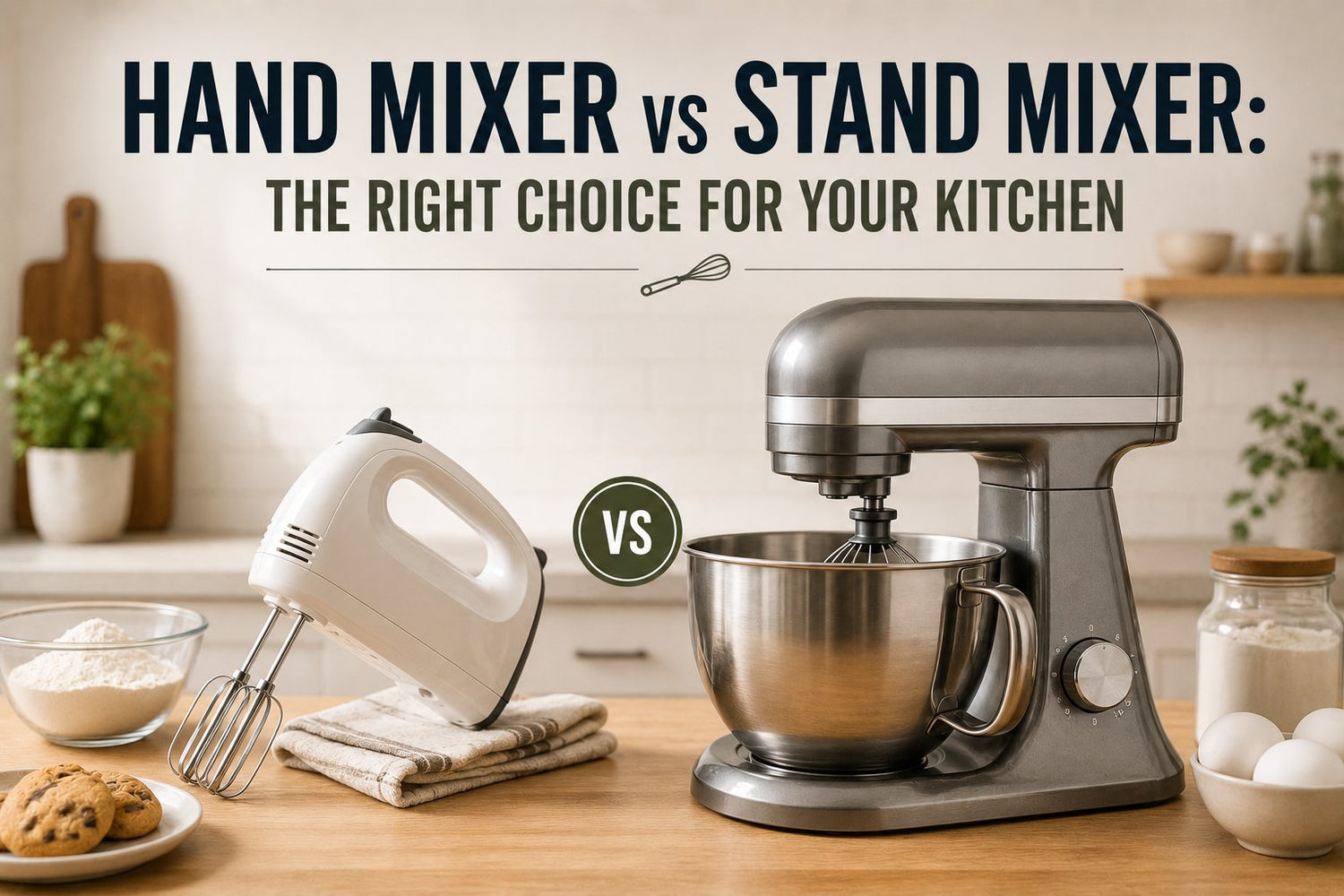
You're probably deciding between two very different kinds of regret.
One is buying a stand mixer that looks impressive, then realising it lives on your counter like a small piece of gym equipment you barely use. The other is buying a hand mixer, saving money and space, then hitting a wall the first time you try a bread dough, a thick cookie batch, or a long mixing session that leaves your shoulder annoyed before the dough is ready.
That's why the hand mixer vs stand mixer question isn't really about which machine is “better”. It's about which hidden costs you're willing to live with. Money matters, of course. But so do storage, comfort, cleanup, and the frustration of using the wrong tool for the kind of baking you do. A compact kitchen changes the answer. So does a weekly bread habit. So does the difference between “I bake birthday cakes a few times a year” and “I make dough on Sundays without fail.”
If you're building a kitchen that fits your real routine, not an idealised one, it helps to think of your mixer the same way you'd think through the rest of your kitchen essentials list. The right choice should earn its space.
Table of Contents
- Choosing Your Perfect Baking Partner
- Hand Mixer vs Stand Mixer at a Glance
- A Detailed Feature and Performance Showdown
- Which Mixer Fits Your Cooking Style
- Evaluating Cost Storage and Durability
- Your Final Decision A Practical Checklist
Choosing Your Perfect Baking Partner
A lot of people start this decision in the same place. They've outgrown whisking by hand, they're tired of uneven batters, and they want one machine that makes baking feel easier instead of messier.
But the right answer changes quickly once real life enters the room. A renter with one good drawer and very little counter depth doesn't shop the same way as someone who bakes bread every weekend. A family that makes holiday cookies in large batches has different needs than someone who mostly whips cream, beats eggs, and mixes cake batter a few times a month.
That's where the debate usually gets unhelpful. Most comparisons stop at power versus portability. In practice, the choice is more personal than that. A stand mixer saves effort during long, heavy mixing jobs. A hand mixer saves space, money, and cabinet stress. Both are useful. Both can be the wrong purchase.
Buy for your most common task, not your most ambitious one. If you only make bread twice a year, that matters. If you make it every week, that matters even more.
The hand mixer vs stand mixer decision gets much easier when you ask a few blunt questions. What do you bake? How often? Where will the appliance live when it's not in use? And will you resent lifting it, storing it, or holding it after the novelty wears off?
Hand Mixer vs Stand Mixer at a Glance
For a quick answer, start here. One doesn't always need a long technical breakdown to know which way to lean.

| Feature | Hand Mixer | Stand Mixer |
|---|---|---|
| Typical price | $30 to $70 in the cited market examples, with high-performing options as low as $30 | $100 to $400+, with entry models starting around $100 |
| Motor power | Typically 200 to 400 watts depending on source and model range | Typically 300 to 660 watts depending on source and model range |
| Best for | Whipping cream, eggs, cake batter, lighter cookie dough, quick jobs | Bread dough, thick batters, larger cookie batches, longer hands-free mixing |
| Storage | Compact, portable, easy to tuck into a drawer or small cabinet | Heavy, stationary, usually needs dedicated counter or cabinet space |
| Weight and footprint | Often under 3 pounds in one cited comparison | Around 20 pounds in cited comparisons |
| User effort | You hold it the whole time | The machine does the mixing while you work on something else |
| Batch handling | Better for small to medium bowls and shorter mixing tasks | Better for larger bowls and repeated baking sessions |
The big trade-off is simple. A hand mixer gives you flexibility and low friction. A stand mixer gives you power and endurance.
For many kitchens, a hand mixer covers the jobs that happen most often. That's why it appeals to people who keep appliances tightly edited, much like the way some shoppers compare practical single-use decisions such as burr grinder vs blade grinder. The goal isn't to own the bigger machine. It's to own the one that solves your recurring problem.
A stand mixer earns its keep when your recipes regularly push past light batters. If dough, stiff mixtures, or large-volume baking show up often, the extra size starts to make sense.
One practical note. Mixers also create secondary messes, especially flour dust and stray sugar on counters. That's where a compact cleanup tool such as the BLACK+DECKER DUSTBUSTER HLVC320J01 AdvancedClean™ Slim Cordless Hand Vacuum can fit naturally into a baking setup. The available product snapshot describes quick cleaning, an extra-wide nozzle, and a dustbin that removes quickly for emptying.
A Detailed Feature and Performance Showdown
A mixer shows its strengths when the recipe stops being easy. Whipped cream and cake batter flatter almost any machine. Brioche dough, dense cookie batches, and long mixing times expose the hidden costs fast. That cost might be arm fatigue, lost counter space while a large machine lives out permanently, or the annoyance of stopping midway because the tool is out of its depth.
A visual comparison helps before getting into the details.

Power and motor performance
Power matters most once mixtures turn heavy. According to Best Buy Canada's hand mixer versus stand mixer guide, stand mixers in the Canadian market typically run from 300 to 575 watts, while hand mixers typically run from 220 to 400 watts. The same source notes that hand mixers may strain with just 2 pounds of stiff dough, while stand mixers handle that task easily.
In real use, the more important difference is how that power arrives. Stand mixers keep applying force without asking you to fight the bowl. Hand mixers can do a surprising amount, but thick dough pushes them into a tiring cycle of repositioning, scraping, and waiting for the motor to catch back up. In a small kitchen, that extra effort is not minor. One hand holds the mixer, the other steadies the bowl, and your workspace gets crowded fast.
If bread dough is part of your routine, buy for that job first. A hand mixer that barely manages ambitious baking usually ends up feeling expensive for the wrong reason. You save money at checkout, then lose time and patience every week.
That difference is easier to see in motion.
Capacity and batch size
Capacity is not only about how much fits in a bowl. It is about how much work feels reasonable before the process becomes awkward.
A hand mixer gives you flexibility because it works with the bowls you already own. That is useful for small batches, side tasks, and recipes that need two separate mixtures. The trade-off shows up when volume increases. Large bowls shift around, batter climbs the beaters, and mixing evenly takes more attention from you.
A stand mixer handles bigger batches with less supervision, which changes the feel of a baking session. Double cookie dough, enriched bread, or several layers of cake become straightforward instead of cramped. That convenience has its own cost, though. A larger machine claims shelf room, cabinet height, or permanent counter space. In compact kitchens, that footprint can be more burdensome than the purchase price.
The bowl is only part of the story. Real capacity is the amount of mixing you can do before you start changing the recipe, the batch size, or your own expectations to suit the machine.
If you bake in heavier ceramic or glass vessels, it helps to match the mixer to the bakeware you use. This ceramic baking dish guide is useful for sorting out that part of the setup.
Attachments versatility and control
Attachments matter less than people assume. The better question is how often you will use them well enough to justify the larger machine.
A hand mixer usually covers the basics with less hassle. Beaters for cake batter and frosting. Whisks for cream or egg whites. Sometimes dough hooks, though those tend to be the first point where a lighter machine feels strained. Cleanup is quick, setup is minimal, and that simplicity makes a difference on weeknights.
A stand mixer gives steadier results under load. The flat beater creams butter and sugar more evenly during longer runs. The whisk handles volume well because you are not chasing the bowl by hand. The dough hook is the clearest separator for bakers who make bread often. You get sustained kneading without turning your shoulder and wrist into part of the machine.
Control feels different too. A hand mixer is active work. You guide the beaters, adjust the angle, and keep ingredients from collecting in dead spots. A stand mixer asks for setup and scraping, but once it is running, consistency is easier to maintain. For occasional baking, that may not matter much. For repeated batches, it often does.
Which Mixer Fits Your Cooking Style
The easiest way to choose is to stop shopping by appliance category and start shopping by kitchen life. The same machine can feel brilliant in one home and completely inconvenient in another.

The occasional baker in a small flat
This person makes cupcakes for birthdays, brownies on weekends, maybe whipped cream during the holidays. Counter space is scarce. Storage is tighter than it looks. Every appliance has to justify itself.
A hand mixer usually wins here. It's easier to pull out, easier to put away, and far less likely to become a permanent obstacle on the counter. For light tasks, it's the lower-friction tool.
But there's one hidden drawback people underestimate. The ergonomic cost can be real in cramped kitchens. According to KitchenAid Canada's discussion of stand mixers and hand mixers, limited counter depth in small kitchens can force awkward hand positions and increase shoulder strain by an estimated 35% compared with using a stand mixer at an optimal height.
That doesn't mean every small-space cook should buy a stand mixer. It means “compact” doesn't always equal “comfortable.”
The bread and pastry person
This cook doesn't need encouragement to make ambitious recipes. Dough shows up often. So do enriched batters, repeated cookie batches, and recipes that demand patience.
A stand mixer fits this routine better because it removes the most irritating part of serious baking. It handles the sustained work. You're not gripping a machine through a long knead or fighting thick dough while trying not to overheat the motor.
If your recipes regularly ask more from the machine than from you, a stand mixer is usually the more honest purchase.
This is also the person most likely to regret a compromise buy. They may start with a hand mixer for budget reasons, then spend months adapting around its limits. Smaller batches. Shorter mixing. Avoiding bread. That's not savings if it changes what you cook.
The host rental kitchen or small business setup
Think short-term rental owners, frequent hosts, or small food operations that need dependable prep tools without turning the kitchen into storage overflow. In these situations, the answer gets more nuanced.
A hand mixer suits lighter shared-use kitchens because it's easy to store, simple to understand, and less intimidating for occasional users. If the kitchen mostly supports pancakes, boxed cakes, whipped toppings, and quick baking, that's enough.
A stand mixer becomes the better fit when volume, consistency, and repeatability matter. If the kitchen regularly serves groups, handles heavier recipes, or supports more structured prep, the machine's footprint starts to feel less like clutter and more like infrastructure.
For people organising a compact but functional appliance lineup, it also helps to compare how often each tool gets used alongside staples like the best blender for smoothies. In smaller homes, buying one appliance often means not buying another.
Evaluating Cost Storage and Durability
The true cost of a mixer often shows up after checkout. It shows up when a heavy machine keeps stealing prep space, when a cheap one struggles through thick cookie dough, or when your wrist is tired before the batter is ready.

The upfront spend is only part of the cost
Homes & Gardens' comparison of hand mixers and stand mixers notes that capable hand mixers can start around $30, while entry-level stand mixers start around $100. That gap matters if you bake a few times a month and mostly make cakes, frosting, whipped cream, or lighter batters.
For that kind of use, a hand mixer is often the smarter buy. Lower price. Less storage pressure. Less guilt if it sits unused for a week or two.
The more expensive mistake is buying for the lower price tag instead of the job. A hand mixer that bogs down on stiff dough, thick cookie batter, or frequent batch baking can cost more in the long run because it slows you down, wears you out, and may need replacing sooner. I see this a lot with ambitious bakers in small kitchens. They save money up front, then start adjusting recipes to suit the machine instead of buying a machine that suits the recipes.
Storage has a cost too
A stand mixer does not just need room. It needs good room.
If it lives on the counter, it permanently takes one of the most useful work zones in the kitchen. If it lives in a base cabinet, you have to be willing to lift it out often enough that ownership still feels practical. In a small flat or galley kitchen, that lifting and shuffling becomes part of the decision.
Hand mixers are easier to live with. They fit in a drawer, a cabinet bin, or a small appliance shelf, and that changes how often they get used. Tools that are easy to grab tend to earn their keep.
A simple storage test helps here:
- If you can give a stand mixer dedicated counter or low-shelf space, the size is less of a burden.
- If every appliance already competes for limited cabinets, a hand mixer usually fits real life better.
- If lifting a heavy appliance in and out sounds annoying now, it will feel worse after the novelty wears off.
Before adding another appliance, it helps to assess your current storage setup. A practical guide to organizing kitchen cabinets for small appliances and baking tools can make it clear whether you have room for a stand mixer or are just hoping to find room later.
Durability depends on workload, not labels
Both types can last well if they are used for the jobs they handle best.
A hand mixer usually holds up fine with whipped cream, cake batter, mashed potatoes, frosting, eggs, and occasional cookie dough. Problems start when it is asked to do long mixing sessions over and over, especially with dense mixtures that make the motor strain and force you to hold steady resistance in your hand the whole time. That is not only harder on the machine. It is harder on the person using it.
Stand mixers usually justify their size through repeat heavy work. Bread dough, large batches, thick batters, and frequent baking put less physical strain on you because the machine carries the load. That matters more than shoppers expect, especially in cramped kitchens where bowl stability, elbow room, and awkward body position can make hand mixing more tiring than it sounds on paper.
The durability question is simple. Buy the light machine for light work, or buy the heavier machine because your baking demands it. The wrong mixer wears out your patience first, and the motor usually follows.
Your Final Decision A Practical Checklist
By this point, the choice is usually less mysterious. Users often already know which machine fits. They just need permission to choose the practical answer instead of the aspirational one.

Choose a hand mixer if most of these sound like you
- You bake lightly and irregularly. Cakes, whipped cream, brownie batter, frosting, and occasional cookies are your normal jobs.
- Storage is tight. You want the mixer out of sight when you're done.
- Your budget matters more than maximum power. You'd rather spend less and cover the basics well.
- You value quick setup and cleanup. Fewer parts, less lifting, less commitment.
A hand mixer is often the right answer for sensible kitchens. It doesn't need to be glamorous to be useful.
Choose a stand mixer if these sound more familiar
- You make bread or dense doughs often. That alone can justify the larger machine.
- You bake in bigger batches. Cookies for gatherings, repeated prep, or heavier mixtures make hands-free mixing far more appealing.
- You want consistency. You'd rather let the machine work while you prep the next step.
- You have a realistic home for it. A dedicated cabinet or stable counter spot changes the equation completely.
A stand mixer is worth it when it removes a recurring pain point, not when it serves as décor.
Choose neither for now if your habits are still unclear
Sometimes the smartest purchase is a delayed one. If you rarely bake and mostly use a whisk, don't force an appliance decision because the category feels like a kitchen milestone.
Wait until your routine asks for help. Then buy the machine that solves the actual problem. That's the difference between a useful tool and an expensive placeholder.
One final filter helps. Ask yourself which frustration would bother you more:
- holding a mixer during longer tasks,
- storing a heavy machine all year,
- paying more upfront,
- or being unable to handle ambitious recipes comfortably.
Your answer usually settles the hand mixer vs stand mixer debate faster than any spec sheet.
If you're comparing tools for a real kitchen, not an ideal one, GrifGlo publishes decision-focused guides across home, kitchen, organisation, and everyday appliances so you can sort through trade-offs, narrow the field, and buy for your everyday life.


Leave a comment
This site is protected by hCaptcha and the hCaptcha Privacy Policy and Terms of Service apply.