

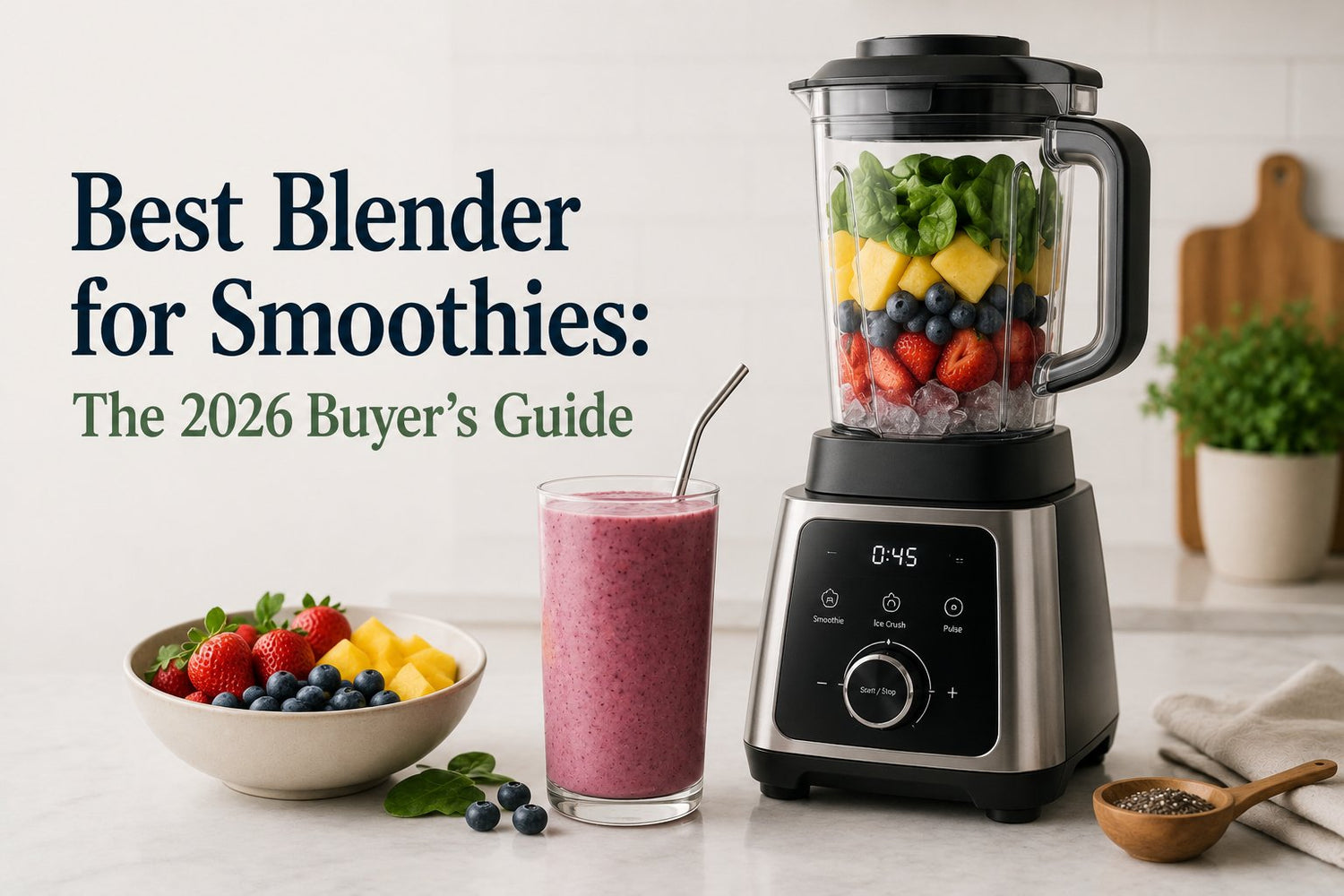
You're probably here because your current blender keeps leaving spinach threads, berry seeds, or icy chunks in what was supposed to be a quick, drinkable breakfast. That's the usual breaking point. A machine that was fine for soups or the occasional milkshake starts failing the moment you ask it to handle frozen fruit every morning.
The mistake most shoppers make is assuming the best blender for smoothies is the strongest one they can afford. In real kitchens, that's rarely true. A single person in a flat with limited cupboard space needs something very different from a family making weekend batches. Noise, jug size, cleanup, and whether the blender lives on the counter or gets shoved into a cabinet matter just as much as power.
I've tested enough kitchen gear to know this pattern well. The blender that gets used daily isn't always the one with the most intimidating motor. It's the one that fits your routine without becoming a hassle. If you're still sorting out what deserves space in your kitchen, a practical kitchen essentials list helps frame where a blender belongs.
A useful clue comes from Healthline's smoothie blender roundup, which splits the market by use case, including best overall, best high-power, best single-serve, and best large-batch. That divide makes sense. Smoothie blenders aren't one-size-fits-all any more, and that's good news if you'd rather buy once and buy sensibly.
Table of Contents
- Finding Your Perfect Smoothie Blender
- What Really Matters in a Smoothie Blender
- Top Smoothie Blenders by Category for 2026
- Choosing for Your Kitchen and Lifestyle
- Is a High-End Blender Worth the Investment
- Real-Life Smoothie Scenarios
- Blender Maintenance and Longevity Tips
Finding Your Perfect Smoothie Blender
One often starts shopping after one bad glass. The banana is smooth enough, but the kale isn't. The frozen berries turn into slush around the edges and stay stubborn in the middle. Then the lid, the pouring, and the cleanup somehow make the whole “healthy habit” feel like work.
That's why the right question isn't “What's the most powerful blender?” It's “What blender fits the way I make smoothies?” A commuter who blends a single breakfast shake has different needs from someone making a jug for the whole household. A compact personal blender can be the smartest choice in one kitchen, while a larger machine with better vortex action is the obvious fit in another.
The best choice depends on your routine
If you mostly blend yoghurt, banana, protein powder, and soft fruit, you don't need to shop like you're outfitting a juice bar. If your standard mix includes frozen mango, nut butter, ice, and fibrous greens, the machine has to work harder and the design matters more.
The blender that earns a permanent spot on the counter is usually the one that feels easy at 7 a.m.
A useful way to think about it is this:
- Single-serve drinker: prioritise a smaller cup, fast rinse-out, and easy storage.
- Daily green smoothie fan: prioritise smoother texture and stronger blending action.
- Family or batch prep household: prioritise container volume and comfortable pouring.
- Small kitchen owner: prioritise cabinet height, footprint, and noise.
What doesn't work
Oversizing is a common mistake. Huge jars can be awkward for small portions, and very powerful machines can feel excessive if your ingredients are basic. The reverse is just as frustrating. Personal blenders often struggle once frozen ingredients become the norm.
The best blender for smoothies should match your ingredients, your kitchen, and your patience for cleaning. That's the standard worth using.
What Really Matters in a Smoothie Blender
Specs don't help much if you can't translate them into daily use. A blender can look impressive on paper and still annoy you every morning. For smoothies, I care less about marketing language and more about whether the machine blends fibrous ingredients cleanly, pours without mess, and washes up without a fight.

A quick comparison before you shop
| Blender factor | Why it matters for smoothies | Best for |
|---|---|---|
| Motor strength | Helps with frozen fruit, ice, and fibrous greens | Daily smoothie drinkers using tougher ingredients |
| Jar size | Determines whether small portions blend cleanly or family batches fit comfortably | Singles, couples, or larger households |
| Blade and jar design | Affects vortex formation and texture consistency | Anyone who hates leafy bits |
| Noise | Decides whether you'll use it early morning | Flats, shared homes, parents |
| Cleanup | Determines whether the blender becomes a daily habit or a weekend tool | Everyone |
Power that helps and power that's wasted
There is a practical floor for smoothie performance. Independent smoothie blender guidance commonly sets at least 750 watts and a 40 fl oz-plus container as a useful baseline for smoothie use, while some guidance points to 45,000+ RPM as a high-speed spec linked with stronger frothing and better breakdown of fibrous ingredients.
That doesn't mean more is always better. It means there's a point below which smoothies become inconsistent, especially with ice and greens. Above that point, the gains depend on what you blend.
If you're familiar with coffee grinders, it's similar to the difference discussed in this burr grinder vs blade grinder guide. Raw power matters, but design and consistency matter just as much. A blender with decent power and a well-shaped jar often beats a stronger machine with poor flow.
Practical rule: Buy for your toughest regular ingredient, not your easiest one.
If your hardest daily ingredient is frozen banana, your needs are modest. If it's kale, ice, and frozen berries together, that changes the calculation.
Jar shape, blades, and cleanup
Blade design is hard to judge from a product photo, but the result is obvious in the glass. Good smoothie blenders pull ingredients downward and keep them moving. Bad ones create dead zones. You stop the machine, scrape the sides, shake the jar, and start over.
Jar size matters more than many buyers expect. A large jug sounds flexible, but oversized containers can struggle with small quantities. Personal cups solve that problem but limit batch size and usually don't pour as neatly into multiple glasses.
Material is mostly about convenience. Plastic jars are lighter and easier to lift when full. Glass feels sturdier to some people, but it adds weight, and that matters if you make smoothies daily.
Cleanup often decides whether a blender stays in rotation. Dishwasher-safe parts help. So do simple controls and fewer seals. Even outside the blender category, ease of cleaning is what separates a useful prep tool from one that gets ignored. The Hamilton Beach 10 Cup Stainless Steel Food Processor - 70730C is a good example of how appliance design can favour easy-clean dishwasher-safe parts and straightforward use, even though a food processor isn't a smoothie substitute.
The best blender for smoothies is often the one that blends your usual ingredients smoothly, fits your storage, and doesn't leave you dreading the washing up.
Top Smoothie Blenders by Category for 2026
Monday morning is when blender rankings fall apart. A parent making two quick smoothies before school needs something very different from a solo runner blending a post-workout shake in a small flat. The right pick depends less on bragging-rights power and more on batch size, storage, cleanup, and how often the machine will get used.

Best overall
For buyers who want one premium machine to handle smoothies, soups, nut butters, and thicker blends without much fuss, RTINGS names the Vitamix Ascent X5 as the best blender it has tested. That tracks with how high-end Vitamix models usually perform in daily use. They process fibrous ingredients well, recover from heavy use better than cheaper motors, and waste less time on stop-and-scrape blending.
It earns the top all-round spot because it does several jobs well enough to justify the space it takes up.
Why this category makes sense:
- Smooth texture: Better suited to kale, frozen fruit, seeds, and thicker blends
- Broader use: Easier to justify if the blender will also handle sauces, soups, or prep work
- Long-term value: A stronger fit for households that blend often, not just on weekends
The trade-off is obvious. Machines in this class cost more, sound louder, and take up real room on the counter.
Best for professional-level power
Some buyers do need more than an all-purpose blender. Thick smoothie bowls, frozen ingredients straight from the freezer, and repeated back-to-back blending put real strain on a machine. In that case, power matters, but control matters just as much.
The best blenders in this category usually have variable speeds, a jar shape that keeps ingredients circulating, and a base with enough weight to stay planted during dense blends. Those details change the experience more than headline wattage does. A strong motor with a poor jar design still leaves chunks behind.
This category is best for people who already know they push a blender hard.
Best personal and portable
A personal blender works best when speed and footprint matter more than batch size. The HAMILTON BEACH Blend Now Portable Cordless Blender fits that role well. It is built for single servings, easier storage, and lower-effort use than dragging out a full-size blender for one drink.
That makes it a smart choice for:
- Protein shakes
- Softer fruit smoothies
- Office or gym use
- Small kitchens with limited counter space
It is a narrower tool, and that is the point. Portable units are convenient because they stay in their lane. Ask one to crush lots of ice or turn fibrous greens into a perfectly smooth drink every day, and the limits show up fast.
Best budget-friendly full-size option
Budget picks are worth buying only if they solve a real kitchen problem without adding a new one. The HAMILTON BEACH Wavestation Express Dispensing Blender Silver Metallic - 58620CR is a practical example. It is $29.99, currently in stock, and the feature set is clear: 700-watt peak power, a 48-ounce Durablend jar, stainless steel blades, and 9 blending functions.
For routine smoothies, that mix makes sense. You get a full-size jar for more than one serving, simple controls, and a lower entry price than premium machines. The dispensing design will appeal to some households, especially if pouring from a heavy jar feels awkward.
Best suited to:
- Couples or small families
- Buyers replacing an older basic blender
- Shoppers who want a bigger jar without paying for top-tier power
The trade-off is performance ceiling. It is a value pick, not a heavy-duty green smoothie machine.
Best for large household batches
Large-capacity blenders earn their keep only if you regularly make multiple servings at once. Otherwise, they become another bulky appliance to store, wash, and work around. For families, meal preppers, or anyone blending breakfast for more than one person, the extra jar space can save time and reduce repeat blending.
I would also look at kitchen flow here, not just capacity. A bigger blender means more cabinet clearance, more sink space, and more visual clutter on the counter. If your kitchen already struggles with overflow, better pantry storage container setups for small kitchens can free up enough room to make a full-size blender practical.
The right category is the one that fits your actual routine. A smaller blender used five days a week is a better buy than a huge machine that looks impressive and stays in the cupboard.
Choosing for Your Kitchen and Lifestyle
The wrong blender can be technically good and still be a bad purchase. That happens all the time. People buy a powerful machine, use it for a week, then stop because it's too loud, too tall for the cupboard, or too awkward to clean before work.

The blender you'll actually use
Noise is the first lifestyle filter I'd apply. Testing notes collected by The Spruce Eats point out that some strong blenders are fairly loud when crushing ice, and recent roundups continue to show interest in compact designs that prioritise cabinet height, dishwasher cleanup, and noise tolerance over raw power.
That matters more than spec sheets admit. If you live in a flat, share a kitchen, or make smoothies before anyone else is awake, a thunderous blender becomes a negotiation with the whole household.
A blender that wakes the house often gets used less, even if it blends beautifully.
Storage is the second filter. Measure the height under your cabinets. Check whether the jug handle catches on shelves. Think about where the cord goes and whether the base is heavy enough to feel annoying to move.
If your kitchen already feels cramped, better pantry storage containers may do more for your daily routine than buying the biggest appliance you can fit.
When size beats strength
Compact blenders have a clear advantage in smaller homes. They're easier to store, easier to lift, and often easier to clean. For one person making one smoothie, that can outweigh the performance gap.
Full-size blenders still make sense if you need flexibility. They're better for multiple servings, thicker blends, and recipes that need room to circulate. But they only pay off if your routine demands that capacity.
The best blender for smoothies should fit where you live, not just what you blend.
Is a High-End Blender Worth the Investment
Sometimes yes. Often no. The answer depends less on brand prestige and more on whether your ingredients and habits justify the jump.
What premium machines do better
High-end blenders usually earn their reputation through smoother texture, stronger handling of fibrous ingredients, and less struggle with thick mixtures. If you make green smoothies every day, use frozen fruit heavily, or want one machine for smoothies plus broader kitchen tasks, premium performance is easier to justify.
They also tend to feel more composed during blending. Better flow, less stopping to scrape, and a more polished user experience matter when the machine gets used constantly.
The extra spend makes sense for people who:
- Blend daily or more than once a day
- Use kale, seeds, frozen berries, and ice together
- Care a lot about ultra-smooth texture
- Want one blender to cover more kitchen jobs
When spending less is the smarter move
The case for a budget or personal blender is stronger than many “best of” lists admit. Recent testing highlighted by RTINGS' budget blender coverage and personal-blender results cited alongside it show that top budget and personal options can excel at everyday smoothie tasks. That shifts the buying logic. Many shoppers can prioritise container size, ease of use, and convenience over premium horsepower.
Most people don't need café-level blending power for banana, yoghurt, oats, and protein powder.
A cheaper blender is usually enough if your smoothies are simple and your expectations are realistic. Softer fruit, milk, yoghurt, nut butter, and powder blends are much easier than dense frozen combinations or fibrous greens.
Where budget machines start to show their limits:
- Thick green smoothies
- Repeated ice crushing
- Large frozen chunks
- Demanding daily use over time
If your routine lives mostly outside those situations, paying for the top shelf model may buy more motor than you'll ever use.
Real-Life Smoothie Scenarios
A blender choice becomes much clearer when you tie it to a real moment in the day instead of a spec sheet.

The fast weekday shake
You wake up late, need breakfast in minutes, and want something you can drink on the move. This is personal-blender territory. A smaller cup, fewer parts, and quick rinsing matter more than brute strength. Protein powder, milk, banana, and nut butter are easy work for this type of machine.
If you like coffee-shop textures at home, ideas from this how to make cold foam guide pair nicely with a fast smoothie setup because both depend on tools that are easy to use before the day gets busy.
The stubborn green smoothie
Now switch to spinach, kale, frozen mango, and ice. With these ingredients, weaker blenders often leave strings and flecks. A stronger full-size machine with better circulation pays off because it cuts down on stopping, scraping, and reblending.
For a visual look at smoothie prep in action, this video is helpful:
The family batch and the dessert detour
Weekend breakfast is different again. You're blending several servings, pouring into multiple glasses, and probably using more frozen fruit. A larger jar becomes the practical winner because it saves repeating the job.
The same logic applies after dinner when smoothies turn into frozen desserts. Thick fruit blends and milkshake-style recipes are more comfortable in a full-size blender with enough room to move ingredients around, making jar volume matter as much as motor strength.
One routine, three different needs. That's why the best blender for smoothies is really a matching exercise.
Blender Maintenance and Longevity Tips
A blender usually dies early for boring reasons. People overload it, leave residue sitting in the jar, or run thick mixtures without enough liquid. A few small habits make a bigger difference than most buyers expect.

Daily habits that protect the motor
Load the jar with some logic. Liquid first usually helps the blades catch quickly. Softer ingredients next. Frozen items last. That reduces strain at startup and improves circulation.
Don't let the machine grind away uselessly if ingredients are stuck. Stop, stir, add a small amount of liquid if needed, and restart. Running a stalled blend for too long is hard on the motor and frustrating for you.
A short checklist helps:
- Add liquid first: This gives the blades something to pull immediately.
- Cut large frozen pieces down: Smaller pieces are easier on the drive system.
- Use pulses for tough starts: It helps ingredients settle into the blades.
- Avoid overfilling: More capacity on paper doesn't mean better blending in practice.
Simple cleaning that prevents wear
The easiest cleanup method is still the most effective for everyday use. Rinse the jar soon after blending, add warm water with a little washing-up liquid, blend briefly, then rinse again. It prevents residue from drying onto the sides and around the blade base.
For deeper cleaning, separate removable parts when the design allows and dry them thoroughly before reassembling. If your container is plastic, avoid harsh scrubbing that clouds the surface over time.
If you're already building better cleaning habits across the kitchen, this guide on how to clean food storage containers follows the same principle: quick attention after use is easier than rescuing stuck-on residue later.
Clean the blender right after you pour. Waiting even ten minutes makes the job worse.
A well-chosen blender should last longer because you're more willing to use it properly and clean it straight away.
GrifGlo helps shoppers compare practical home and kitchen essentials with a focus on fit, usability, and real-life buying decisions. If you're narrowing down appliances, storage, or everyday prep tools, browse GrifGlo for decision-friendly guides and organised product categories.

Leave a comment
This site is protected by hCaptcha and the hCaptcha Privacy Policy and Terms of Service apply.