

You open the freezer to grab one thing. A bag of peas falls out, a mystery container is frozen to the shelf, and the chicken you were sure you had has disappeared into the back corner. That kind of freezer isn't full. It's unmanaged.
A well-organised freezer doesn't need to look styled for a photo. It needs to help you find dinner fast, use what you already bought, and stop turning good food into forgotten ice bricks. The fix isn't more random bins. It's a system.
If your fridge is chaotic too, the same zone-based thinking applies in the fresh-food side of the kitchen, as shown in this guide on how to organize your fridge with bins and zones. The freezer just needs a colder, stricter version of that logic.
Table of Contents
- Your Freezer Isn't a Black Hole It's a System Waiting to Happen
- The Great Freezer Edit Preparing for a Fresh Start
- Creating Your Freezer Blueprint Zones and Layout
- The Right Tools for the Job Containers and Labelling
- Adapting the System for Your Freezer and Lifestyle
- Keeping It Organized A Simple Maintenance Routine
- Enjoy Your Newfound Freezer Freedom
Your Freezer Isn't a Black Hole It's a System Waiting to Happen
Most freezer problems look different on the surface but come from the same root issue. There's no assigned home for anything. Food gets shoved where it fits, older items disappear underneath newer ones, and every grocery trip adds another layer.
That's why learning how to organize freezer space properly isn't really about tidying up. It's about building a repeatable system that works on rushed weeknights, after big grocery shops, and during those weeks when nobody has time to decant anything into matching containers.
What freezer chaos usually looks like
A disorganised freezer usually has a few predictable traits:
- Buried staples: frozen vegetables, bread, broth, and proteins end up hidden under bulky packages
- Duplicate buying: you can't see what you have, so you buy it again
- No rotation: older food sits untouched while new food gets used first
- Wasted shape: oversized boxes and awkward bags take up more room than the food itself
Practical rule: If you have to dig, lift, or guess every time you open the freezer, the problem isn't capacity. It's layout.
A good freezer feels more like a file system than a storage pit. You should be able to open it and know where breakfast items live, where proteins live, where batch-cooked meals live, and which items need using first.
The system that actually works
The method is simple: edit, zone, contain, maintain.
First, remove what shouldn't be there. Then assign zones based on how your household cooks. After that, use the right containers and labels so categories stay visible. Finally, keep it running with small check-ins instead of one giant annual cleanout.
This is what turns a freezer from a source of friction into a working part of meal planning.
The Great Freezer Edit Preparing for a Fresh Start
The hardest part is the part often rushed. They shift a few things around, throw away one sad bag of leftovers, and call it organised. That never lasts.
The Home Edit recommends a system built around edit your items, designate zones, customize your system, label categories, and plan meals, and it starts by pulling everything out, discarding freezer-burned food, and using clear storage so inventory stays visible, as outlined in The Home Edit's freezer organisation guide.

Empty everything first
Take everything out. Not half. Not the top layer. Everything.
Use coolers or insulated bags if needed, especially if you're working slowly. Put items on the counter in rough groups as they come out. Meat with meat, vegetables with vegetables, fruit with fruit, prepared meals with prepared meals.
This does two useful things at once. It shows you what you own, and it exposes how much space is being wasted by poor packaging, broken bags, and food you forgot existed.
Sort before you decide
Once the freezer is empty, sort into four decision groups:
-
Keep and refile
Food you recognise, use, and want to keep. -
Use soon
Odd quantities, open bags, and items that still have a place but shouldn't stay buried. -
Discard
Freezer-burned food, mystery items, and anything nobody in the household is realistically going to eat. -
Repack
Bulky boxes, torn bags, and awkward packaging that needs a better container before it goes back.
The edit matters because an organised freezer full of unwanted food is still a bad system.
Be honest here. If you've moved the same unloved container around for months, it isn't “still useful.” It's clutter with frost on it.
If you do a lot of reheating, baking, or quick meal assembly, it helps to think about the whole kitchen flow while sorting. For example, an appliance such as the NINJA FT205CO Digital Air Fry Pro Countertop 10-in-1 Oven - Factory serviced with Home Essentials warranty is designed for multiple cooking functions and convenient storage, so it makes sense to group freezer foods by how you'll cook them later, not just by ingredient type.
Clean the space before food goes back
Wipe the interior fully before restocking. Remove crumbs, sticky residue, and loose ice if your freezer allows for that safely. A clean interior gives containers a stable surface and stops old spills from freezing in layers.
Then pause before refilling it. This is the moment to decide what the freezer is for in your home. Bulk meat storage, meal prep, children's snacks, bread backup, smoothie packs, emergency dinners. If you don't define its jobs, the chaos comes straight back.
A freezer reset works best when you stop treating the space like overflow and start treating it like inventory.
Creating Your Freezer Blueprint Zones and Layout
Once the freezer is edited, the next job is strategic. Every category needs a home, and that home should match how often you use it.
Whirlpool recommends taking an inventory, updating it as items are added or used, storing items vertically so they're easier to see and reach, using freezer-safe bins to create layers, drawers, and zones, grouping by expiration or purchase date so older food is used first, and placing the most-used items most accessibly, as explained in Whirlpool's guide on how to organise a freezer.

Build zones around how you cook
Don't organise by vague intention. Organise by repeated behaviour.
If your household reaches for frozen berries every morning, they need a quick-grab breakfast zone. If you batch-cook soups and pasta sauce, create a prepared meals zone. If you buy meat in larger quantities, give proteins a dedicated area that can handle heavy turnover.
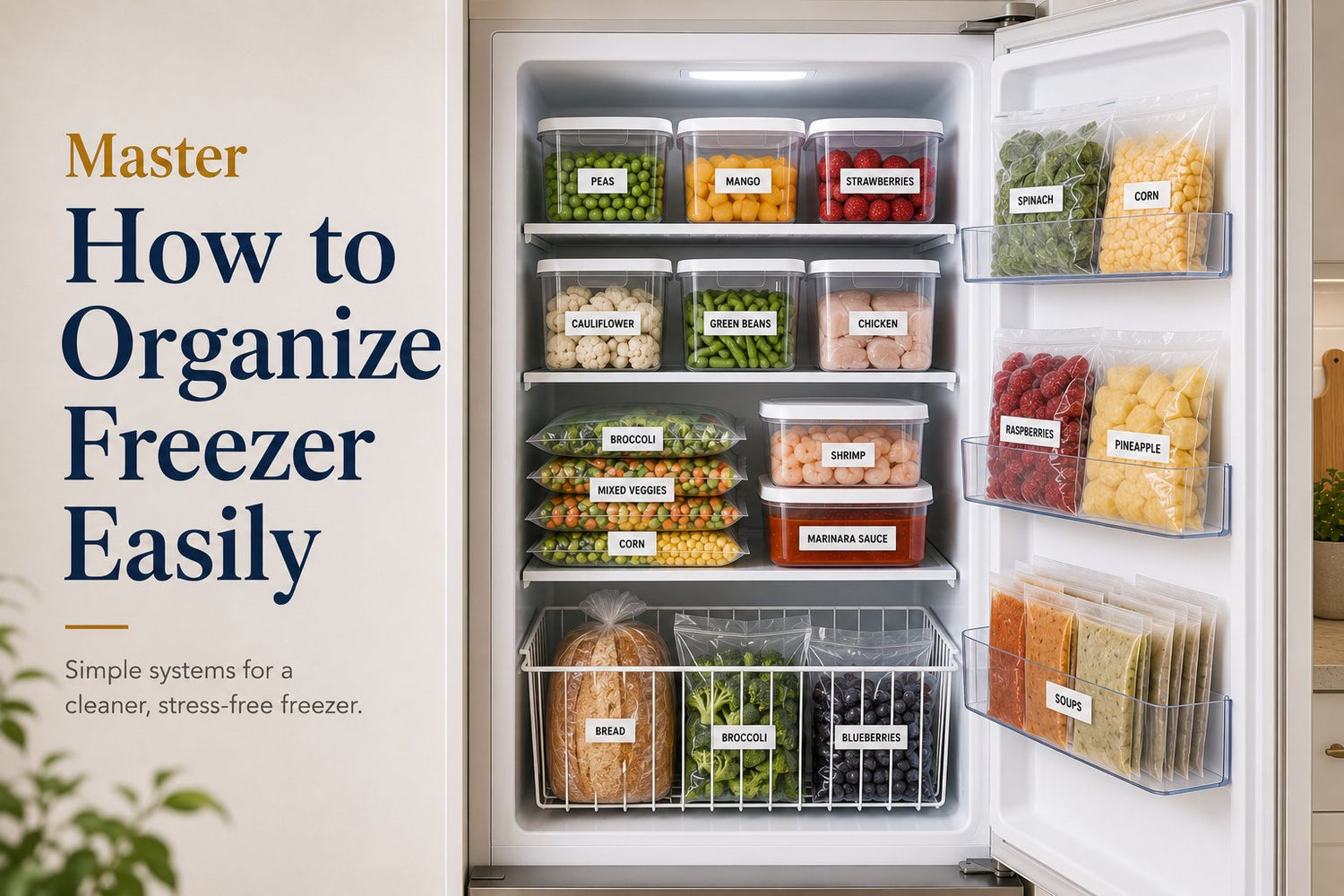
Useful freezer zones often include:
- Everyday vegetables: peas, mixed veg, spinach, corn
- Breakfast items: berries, waffles, smoothie packs, bread
- Proteins: chicken, fish, mince, burgers
- Prepared meals: soups, chilli, cooked rice, leftovers
- Baking and extras: butter, pastry, nuts, stock, ice
The exact categories don't matter as much as consistency. A category only works if everyone in the household can recognise it and return things to it.
For choosing containers that support that kind of zoning in the rest of the kitchen too, this comparison of airtight vs stackable vs modular pantry storage containers is useful because the same trade-off applies in freezers: visibility, stackability, and shape matter more than matching sets.
Layout rules for upright and chest freezers
An upright freezer works best like shelving in a small stockroom. Use eye-level and upper shelves for high-turnover foods. Put heavier or less frequently used categories lower down. Stand packs vertically where possible so you can scan labels instead of lifting stacks.
A chest freezer needs layers and access planning. The top area should hold what you use most often. Deep storage is for backup stock, not everyday items.
What doesn't work:
- piling loose bags on top of each other
- leaving food in oversized retail boxes
- giving premium access to things you use twice a year
- mixing categories in the same pile “just for now”
A small example from outside the freezer makes the point. An Automatic Egg Dispenser Rack – Rolling Storage Holder uses a gravity-fed design and a compact footprint so eggs stay visible and easy to access. Freezer organisation works on the same principle. Items people can see and reach get used. Items buried behind clutter don't.
Here's a visual walkthrough of zone-based placement in action:
The best freezer layout reduces decisions. You shouldn't have to think hard to put food away.
The Right Tools for the Job Containers and Labelling
Buying organisers before you know your categories is how people end up with expensive plastic that doesn't fit the freezer. Tools matter, but only after the layout is clear.
The right setup usually uses a mix of bins, bags, containers, and flat packs. One type won't solve everything.
Choose containers by food type not by trend
Here's the practical comparison I use most often.
| Container Type | Best For | Space Efficiency | Reusability |
|---|---|---|---|
| Clear freezer-safe bins | Grouping categories like vegetables, snacks, or proteins | Medium to high | High |
| Freezer bags | Portioning meat, fruit, bread, and odds and ends | High | Low to medium |
| Flat freezer bags laid or filed upright | Soups, sauces, cooked beans, mince, stock | High | Low to medium |
| Rigid containers with lids | Leftovers, batch cooking, delicate foods | Medium | High |
| Original retail boxes | Short-term holding only | Low | Low |
Flat packs are one of the biggest upgrades for small freezers. Freeze soups, sauces, curry, stock, or cooked mince in meal-sized portions, let them freeze flat, then file them upright once solid. That shape wastes less space than bulky tubs and makes it easier to see what you have.
Clear bins work best for loose categories. A vegetable bin, a breakfast bin, and a meal bin are easier to maintain than a shelf full of unrelated packages sliding into each other.
For a deeper look at material options, this guide to freezer food storage containers helps sort out where rigid containers make sense and where bags are more practical.
Label so your future self can actually use the system
Labelling is where most systems either become durable or collapse. The Home Edit notes that adhesive labels are preferred because they hold up better in moisture than marker-written notes. That matters in a freezer, where condensation and frost quickly make casual labelling unreadable.
Your label should answer three questions:
- What is it
- When did it go in
- How much is there
“Soup” isn't enough. “Tomato soup, 2 portions” is useful. So is “Cooked chicken, taco filling.” Your future self shouldn't have to thaw something to identify it.
A simple tool trick helps here. If you use magnetic storage on the outside of the freezer to hold labels, a pen, and a running inventory sheet, you're much more likely to keep the system going. GrifGlo offers decision-friendly guides for practical home organisation gear, and that kind of external accessory setup is one of the few upgrades that improves follow-through because the tools stay attached to the job.
Write labels before the item goes into the freezer, not after. Once it freezes, good intentions usually end there.
Adapting the System for Your Freezer and Lifestyle
A freezer system has to match the appliance and the people using it. Advice that works for a family with a garage chest freezer won't fit a renter with one narrow drawer above the fridge.
Most generic freezer advice falls apart. It gives tidy tips, but not enough operational thinking.

Chest freezer habits that prevent lost food
For a chest freezer, the most effective workflow is to fully empty and classify contents first, then repack by access frequency and container type, using clear bins or baskets for like items, labels facing up, and a dedicated quick-access zone near the top. The operating logic is FIFO, first in, first out, so older stock goes to the top and gets used before quality declines, as described in The Organized Mama's advice on how to organise a chest freezer.
That means a chest freezer should never be one open cavern of loose food. It needs lift-out structure.
A practical setup looks like this:
- Top quick-access layer: vegetables, breakfast items, weeknight proteins
- Middle baskets: grouped categories such as beef, chicken, prepared meals
- Bottom storage: long-term bulk items and less frequent purchases
- Exterior inventory: a running list of what's inside, updated when things go in or out
If you're deciding between materials for bins or containers in a chest freezer, this breakdown of glass vs plastic food storage containers is useful because weight, break risk, and stackability matter more in deep storage than they do on a shelf.
Small freezers family freezers and shared kitchens
A family freezer benefits from access by user as well as by food type. Children's snacks should be easy to spot. School lunch backups should be separate from dinner proteins. If one area empties faster than others, that's a sign to widen that zone and shrink something less active.
A renter's small freezer needs discipline with shape. Flat packs, tight categories, and fewer duplicates matter more than pretty containers. In tiny freezer drawers, every awkward package creates dead space. Trim the packaging, keep labels outward, and don't let “miscellaneous” become a category.
A shared kitchen needs obvious labels and low-friction rules. If multiple adults use the freezer, categories must be simple enough that nobody has to ask where frozen fruit belongs. If a system requires explanation every week, it's too fussy.
A freezer system is successful when the busiest person in the household can still follow it half-asleep after groceries.
Keeping It Organized A Simple Maintenance Routine
A freezer doesn't stay organised because you did one heroic cleanout. It stays organised because the reset turns into a routine.
This part should be boring. That's a good sign. The less dramatic the upkeep, the more likely it is to last.
The routine that keeps chaos from returning
Use first in, first out as a normal habit. New food goes behind or below older food in its category. Older food moves forward where you'll see it first.
Then give the freezer a short tidy-up on a regular basis. You don't need a major overhaul. You need a quick refile.
A strong maintenance routine includes:
- Refiling loose items: put wandering bags back into their zones
- Checking labels: rewrite anything unreadable before it becomes a mystery
- Updating inventory: mark off what's gone and add what's new
- Pulling forward older food: make the next meal decision easier
If your bins and containers are getting sticky, cloudy, or awkward to reuse, this guide on how to clean food storage containers helps keep the tools part of the system working properly too.
Why maintenance matters beyond appearance
In real Canadian home conditions, where energy costs vary, freezer organisation is tied to efficiency as well as usability. A well-organised freezer with good air circulation runs more efficiently, and advice that ignores access patterns and sustainability misses part of what makes a system workable in everyday life, as noted in Lowe's article on ways to organise a freezer.
That matters anywhere, not just in one region. When food is easy to see, easier to rotate, and quicker to retrieve, the freezer does its job better. You open the door for less time. You keep categories moving. You stop buying duplicates because something vanished under a pile of ice cream and stock.
A small monthly tidy beats a massive annual purge every time.
Enjoy Your Newfound Freezer Freedom
A working freezer system isn't fancy. It's reliable. You edit what no longer belongs there, zone the space by how your household really eats, contain food in shapes that fit the appliance, and maintain it with quick resets.
That's how you waste less food, make meal prep easier, and stop dreading the search for one simple ingredient. Perfection isn't the goal. Control is. Once your freezer starts behaving like a clean, readable food library, everyday cooking gets much easier.
If you're building a more practical kitchen setup, GrifGlo is a useful place to compare home, kitchen, and organisation essentials through straightforward guides that focus on fit, function, and real-life use rather than endless product lists.


Leave a comment
This site is protected by hCaptcha and the hCaptcha Privacy Policy and Terms of Service apply.