

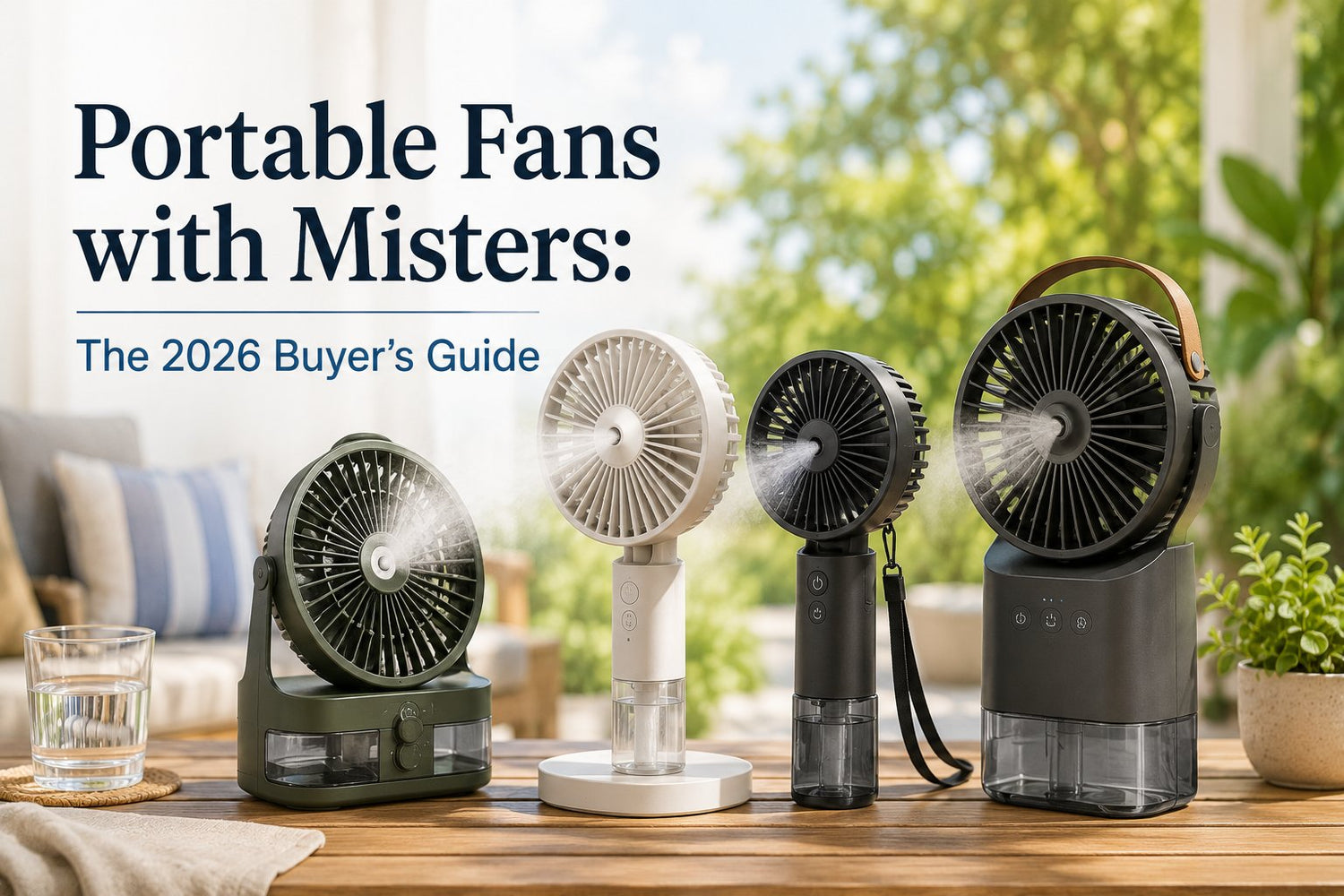
It's late afternoon, the patio furniture is hot to the touch, and the breeze you were hoping for never arrived. You plug in a regular fan, point it your way, and get exactly what you expected. More moving hot air. On a condo balcony in Toronto, a back deck in Winnipeg, or a small café patio in Kelowna, that kind of cooling only goes so far.
That's where portable fans with misters start to make sense. They don't just push air across your skin. They add water in a controlled way so the air can feel cooler around you, which is a very different result from a plain fan. Interest in portable cooling keeps growing too. Technavio projects the global portable fan market will grow by USD 984.2 million from 2024 to 2029, at a 5.5% CAGR, which tells you this isn't a niche one-off category anymore.
For Canadian shoppers, the question isn't whether misting fans exist. It's whether a given model will work where you live and in the space you use. A fan that feels useful on a dry Calgary patio can feel much less impressive on a humid balcony in southern Ontario. If you're already comparing heat-control options for everyday spaces, GrifGlo's guide to an air purifier for kitchen use shows the same practical idea. Match the appliance to the room and the prevailing conditions, not just the product headline.
Table of Contents
- The End of Just Pushing Hot Air Around
- How Misting Fans Create Real Coolness
- Key Features to Compare Before You Buy
- Choosing the Right Fan for Your Canadian Space
- Maintenance and Safety Essentials
- Your Final Misting Fan Buyer Checklist
The End of Just Pushing Hot Air Around
A standard fan helps most when the room or outdoor air is already somewhat comfortable. Once the air itself feels warm and heavy, airflow alone reaches its limit. That's why people often say a fan is running but they still feel sticky, tired, and overheated.
Portable fans with misters solve a different problem. They create a cooler microclimate close to where people sit, stand, or work. That might mean one chair on a balcony, a dining table on a deck, or a spot beside the grill where someone is stuck in the hottest part of the yard.
The comfort gap regular fans can't fix
On dry days, the difference can feel immediate. On more humid days, the improvement depends more on the quality of the mist and the strength of the airflow. That's why shoppers who only compare fan size or battery type often end up disappointed. They bought portability, but not necessarily effective cooling.
Practical rule: Buy a misting fan to cool people in a specific zone, not to “air-condition” an entire outdoor space.
This category has expanded because people want flexible cooling that moves with them. Apartment dwellers want something compact. Homeowners want relief on a patio without installing a permanent system. Small businesses want a mobile option for temporary seating areas or work zones.
Why Canadian buyers need a different lens
Canadian weather isn't one thing. A unit that performs nicely in dry prairie heat may behave differently in coastal humidity or on a muggy evening in southern Ontario. The key is not asking whether portable fans with misters work in theory. It's asking where, when, and how they work best for your climate and footprint.
That's the gap most generic buying advice skips.
How Misting Fans Create Real Coolness
The cooling effect is easiest to understand if you think about stepping out of a pool or lake. When water on your skin starts to evaporate and air moves across it, you feel cooler. A misting fan uses that same basic principle, but it tries to make that evaporation happen in the air around you rather than leaving big droplets sitting on your skin, chair cushions, or table.

If you've ever used a steamer, you already know how much output quality matters. The same way steam performance changes with design, misting performance changes with droplet size, delivery, and airflow. That's also why build details matter in appliances discussed in guides such as how to use a garment steamer.
Why mist feels cooler than air alone
A traditional fan mostly gives you a wind-chill effect. It can make you feel better, but it doesn't actively create the same kind of cooling zone a misting setup can.
A misting fan adds tiny water particles into moving air. When those particles are fine enough, they evaporate quickly and pull heat from the surrounding air in the process. That's the part shoppers should focus on. Fast evaporation is the whole game.
This is why a poor misting fan can be annoying instead of refreshing. If the droplets are too large, they don't disappear quickly enough. They land on surfaces, leave damp spots, and can make you feel sprayed rather than cooled.
Not all mist is the same
There are major differences between low-end and higher-performance designs. Some units use simpler spray methods that create a more visible, wetter stream. Others use atomizing systems that push water into much finer droplets.
One portable solar-powered model, for example, uses a 270 PSI (18.6 BAR) pump with four nozzles, and ExtremeMist's product details show why pressure matters. Higher atomization pressure helps create a finer mist with wider coverage, which improves the chance that water evaporates before it settles.
A separate reviewed consumer model took a different route. It used dual 20 mm ultrasonic plates oscillating at 1.7 million times per second to create about 11-micron mist, with airflow up to 8 m/s and 870 m³/h, while a 1.3 L tank lasted up to 12 hours depending on mist setting in the review demonstration on YouTube. That combination highlights an engineering trade-off: mist fineness, airflow, and runtime all pull against each other.
Finer mist usually feels better because it evaporates faster. But producing that mist well takes better engineering than simply attaching a spray function to a small fan.
There's also a place for fan-only products when mist doesn't fit the situation. A compact unit like the F23 Handheld Rurbo Mini Personal Fan uses a six-blade wind-collecting air duct and an aircraft engine-inspired design to channel more concentrated airflow. That won't replace a misting fan outdoors in heavy heat, but it can make sense for personal airflow where carrying water isn't practical.
Key Features to Compare Before You Buy
Spec sheets can make different fans look similar when they aren't. The easiest way to shop well is to translate each feature into a real-use question. Where will it sit? How often will you move it? How long do you need it to run before a refill or recharge becomes annoying?

Start with power and placement
The first split is battery-powered versus plug-in.
Battery models are easier to place. You can move them to a picnic table, a balcony corner, or the far end of a yard without planning around cords. That freedom matters if you rent, entertain outdoors, or want a fan you can bring along for temporary use.
Plug-in models usually make more sense when the fan stays in one spot. A deck, garage doorway, or workshop wall area is often a better fit for a corded unit because you don't have to think about charging cycles.
If you already shop portable gear for function rather than novelty, the same portability logic shows up in products like the HAMILTON BEACH 51182JC Blend Now Portable Cordless Blender. Its cordless design and shatterproof 16 oz. jar are useful because they match mobile use. A misting fan should be judged the same way. Portability only matters if the design still makes sense once you carry and use it.
For buyers comparing connected appliances more broadly, smart home devices with Alexa can help frame another practical point. Convenience features are secondary if the core job isn't matched to the room.
A quick visual can help while you compare options:
Tank size, runtime, and coverage
Many shoppers misread product descriptions. A larger tank sounds better until you lift the unit, refill it, or try to store it in a small space.
Here is the trade-off:
| Feature | Smaller portable unit | Larger portable or commercial-style unit |
|---|---|---|
| Mobility | Easier to carry and reposition | Harder to move, even with wheels |
| Refill frequency | More frequent | Less frequent |
| Footprint | Better for balconies and tight corners | Better for open patios or work zones |
| Coverage style | Personal or small-zone cooling | Broader area cooling |
One useful benchmark comes from a self-contained portable model documented by Big Ass Fans. It can cool about 200 square feet for approximately 5 hours from a 10-gallon reservoir, while a larger commercial portable misting fan in the same category uses a 30-inch fan and refillable tank and is aimed at commercial outdoor spaces, sporting events, and industrial sites, as shown on the Big Ass Fans product page. That tells you something important. “Portable” can mean anything from apartment-friendly to event-grade equipment.
If the fan needs two hands, a parking spot, and a storage plan, it's portable in the catalogue sense, not in the everyday household sense.
Control, noise, and handling
Mist output control is often more important than anticipated. You want to adjust for changing conditions, especially in Canada where one afternoon can feel dry and the next can feel heavy and damp. A fixed-output mist function is less forgiving.
Look closely at these practical details:
- Mist adjustment: Lets you dial back output when the air already feels humid.
- Airflow direction: A fan that tilts or oscillates is easier to aim around seating and tables.
- Noise character: Some fans don't sound loud on paper but create an irritating pitch in close quarters.
- Handle and base design: A good carry handle and stable base make a bigger difference than fancy styling.
For small spaces, quiet operation often matters as much as cooling. On a balcony, you're sitting close to the fan. In a workshop, steady white noise may be fine. In a café or conversation area, it can become part of the experience for everyone nearby.
Choosing the Right Fan for Your Canadian Space
The biggest mistake shoppers make is buying for the product category instead of the space. Portable fans with misters aren't all solving the same problem. A balcony setup, a family patio, and a garage work area ask for different balances of size, mist quality, power source, and coverage.

A second factor matters just as much as square footage. Local humidity. Bob Vila notes that misting fans are “especially effective” in hot-dry or moderately humid conditions, which matters a lot in Canada because a dry Calgary afternoon and a humid day in southern Ontario won't reward the same product in the same way.
Small balcony or condo setup
This is the hardest environment to shop for well because every compromise shows up fast. There's limited floor space, neighbours may be close by, and there often isn't much room for a big tank or broad spray pattern.
For a balcony, prioritise:
- Compact footprint: The base shouldn't eat up your walking space.
- Gentler mist control: Too much output in a confined area can feel clammy.
- Battery use or tidy cord management: Especially useful where outlets are awkward.
- Easy refill routine: Small tanks are acceptable if filling them isn't a chore.
In humid city conditions, think of a balcony misting fan as a personal comfort tool, not a patio-wide cooler. It should make one chair or one side table area feel better. If you expect it to cool the whole balcony enclosure, you'll likely be underwhelmed.
Storage matters here too. Renters often need something that can be tucked into a closet or corner when summer ends. The same practical thinking that helps in compact home organisation also shows up in GrifGlo's pantry storage racks guide. The right item isn't just functional when in use. It also has to live somewhere the rest of the year.
Backyard patio and family deck
A suburban deck or patio gives you more flexibility. You can usually accept a wider base, a larger tank, or a corded model if it buys you steadier performance.
Portable misting fans tend to make the most sense for households. You can place them near a dining table, by the barbecue zone, or beside lounge seating. In dry to moderately humid conditions, the improvement feels more natural because the mist has room to disperse and evaporate before everything gets damp.
A good patio unit usually needs three things working together:
- Enough airflow to project cooling past the front grille
- Mist output control so you can adapt to changing humidity
- A tank size that doesn't force constant refills during normal use
If you host often, think about how the fan will interact with furniture layout. One well-placed unit often works better than a larger awkward one pointed in the general direction of everyone.
Garage, workshop, and small business use
These spaces call for a different standard. You're not only trying to feel cooler while sitting still. You may be moving around, working, unloading, or serving customers in an area that builds heat through the day.
That changes the buying priorities:
- Durability first: Handles, wheels, and housing quality matter more here.
- Longer uninterrupted operation: Refill and recharge interruptions are more noticeable.
- Broader airflow: The cooling zone has to follow movement, not just one seat.
- Less concern about visual bulk: Utility matters more than appearance.
A workshop fan can be ugly and still be the right choice. A balcony fan can be powerful and still be the wrong one.
For dry inland areas, stronger misting units can feel much more effective. In more humid regions, they still help, but the win often comes from airflow plus moderate mist, not maximum output.
Maintenance and Safety Essentials
A misting fan combines moving parts, water, and in many cases a rechargeable battery. That combination isn't difficult to manage, but it does require better habits than a plain desk fan.

Keep water systems clean
Any unit with a tank or misting path can collect residue over time. Mineral buildup affects nozzles and mist quality. Stale water can leave odours and make the fan less pleasant to use.
Keep the routine simple:
- Empty standing water: Don't leave old water sitting in the reservoir between uses longer than necessary.
- Wipe the tank regularly: A clean reservoir helps prevent residue and film.
- Check the nozzles: If mist output changes, inspect for blockage before assuming the fan is failing.
- Dry before storage: Off-season storage should start with an empty, dry unit.
These habits are similar to caring for other household items that hold moisture or residue. GrifGlo's guide on how to clean food storage containers reflects the same basic principle. If moisture sits, performance and cleanliness usually get worse, not better.
Charge and store with care
Battery-powered units need extra attention. In September 2025, IcyBreeze recalled about 22,600 Buddy portable misting fans after reports that the units could overheat while charging and ignite. The U.S. Consumer Product Safety Commission said there were 7 overheating reports, including 2 fires, involving units with a 1.5-litre water tank, a 10,000 mAh lithium-ion battery, and claimed runtime of up to 7 hours on battery power, according to the CPSC recall notice.
That doesn't mean battery misting fans are unsafe across the board. It means charging guidance isn't optional.
Use a few common-sense rules:
- Use the specified charger: Mixing chargers is a bad shortcut.
- Charge where you can monitor the unit: Don't hide it behind cushions or in direct sun.
- Inspect for damage: Cracked housings, frayed cords, or battery swelling are stop signs.
- Store indoors when not in season: Protect batteries and electronics from extreme conditions.
Safety is part of product quality. A fan that cools well but charges poorly is not a good buy.
Your Final Misting Fan Buyer Checklist
By the time individuals narrow their options, they aren't choosing between a good fan and a bad fan. They're choosing between a fan that fits their space and one that only looked good on the product page. This checklist helps separate those two outcomes.
Questions to answer before you buy
Run through these in order:
- Where will it live most of the time? Balcony, patio, garage, and café seating all push you toward different sizes and power setups.
- Is your local summer air usually dry, mixed, or humid? The more humidity you deal with, the more you should care about mist fineness and output control.
- Are you cooling one person or a zone? Personal relief and area cooling are not the same purchase.
- Do you want mobility or duration? Small units move more easily. Larger tanks reduce refill hassle.
- Will noise bother you? For close seating areas, sound quality matters more than many shoppers expect.
- How willing are you to maintain it? A fan with a tank and nozzles needs cleaning discipline.
The simplest way to narrow the shortlist
If you're down to two or three models, stop comparing marketing language and compare trade-offs.
Choose the model that gives you the right answer to these practical prompts:
| Question | Lean toward this type |
|---|---|
| I need something for one chair or a small balcony | Compact portable unit with adjustable mist |
| I want regular use on a family patio | Mid-size unit with stable base and manageable tank |
| I need utility for a garage or small commercial setting | Larger, more durable unit with broader airflow |
| I mostly want airflow and occasional portability | Fan-only compact unit may be the better fit |
The right portable fan with mister should feel proportionate to your space. Not oversized, not underpowered, and not built around a feature list you'll never use. If the unit matches your climate, your footprint, and your tolerance for refilling and maintenance, you'll feel that decision on the first hot day instead of regretting it by the second.
GrifGlo helps shoppers compare practical home and lifestyle gear with clearer buying guidance, including cooling, organisation, kitchen, and everyday-use products. If you're sorting through options and want decision-friendly recommendations without digging through huge catalogues, browse GrifGlo for guides built around real-life use.


Leave a comment
This site is protected by hCaptcha and the hCaptcha Privacy Policy and Terms of Service apply.