


You're warming soup while the rest of dinner comes together, but the lid you've found rocks on the rim. Leave it off and the soup thickens more than you wanted. Put it on and you're watching the edge for a boil-over. A saucepan with lid should make this ordinary job easier, not give you another thing to manage.
Table of Contents
- Why a Saucepan with Lid Matters
- How the Lid Changes Everyday Cooking
- Comparing Saucepan Materials and Safety
- Saucepan Sizes and Capacity Chart
- Stovetop Oven Use and Daily Cooking Jobs
- Choosing a Saucepan for Your Kitchen
- Where to Buy and What to Do Next
Why a Saucepan with Lid Matters
A rental kitchen can have a cupboard full of cookware and still lack a useful covered saucepan. The pan is there, but its lid belongs to something wider. Another lid almost fits, provided nobody bumps the handle.
That's a different problem from needing another pot. You need a working pair, a vessel suited to your cooking and a lid designed to sit properly on it. Buying them together removes the guesswork, but only if the listing clearly says the lid is included.
Start with the job you actually do
Think about the last meal that made your current pan frustrating. Perhaps you wanted to keep soup from losing liquid, but the only available lid left a gap. Or you covered a sauce that needed to thicken and wondered why it stayed watery.
Those situations call for different actions, not necessarily different cookware. A useful purchase starts with understanding what covering the pan changes, then choosing a vessel that suits your food and stove.
The practical questions are straightforward:
- Cooking control: Do you mostly want to hold moisture in, or do you frequently reduce sauces?
- Food contact: Will tomatoes, citrus, or other acidic ingredients be regular visitors?
- Working capacity: Are you reheating lunch, feeding a household, or preparing sauces in a small café?
- Kitchen fit: Will the base suit the burner, and can you store the pan with its lid?
A household cook might want a dependable daily pan. A renter might need something compact enough for a crowded cupboard. An office or small service kitchen might value a repeatable choice that different people can use without confusion.
Practical rule: Choose the pan and lid as a working set, not as separate objects that happen to share a cupboard.
You don't need a large collection to solve those problems. You need a clear match between the cooking job, the surface inside the pan, and the heat underneath it. Start with the part that's easiest to underestimate: the lid.
How the Lid Changes Everyday Cooking
A lid slows heat and moisture loss. Think of it as a roof over the pan, or the cover on a travel mug. It doesn't stop everything escaping, but it changes how readily warmth and steam leave.
Natural Resources Canada's guidance on cooking energy use recommends using lids, matching cookware to the cooking element, and choosing flat, smooth-bottomed pans that maintain full contact. These features work together, rather than compensating for one another.
The illustration shows the basic idea.
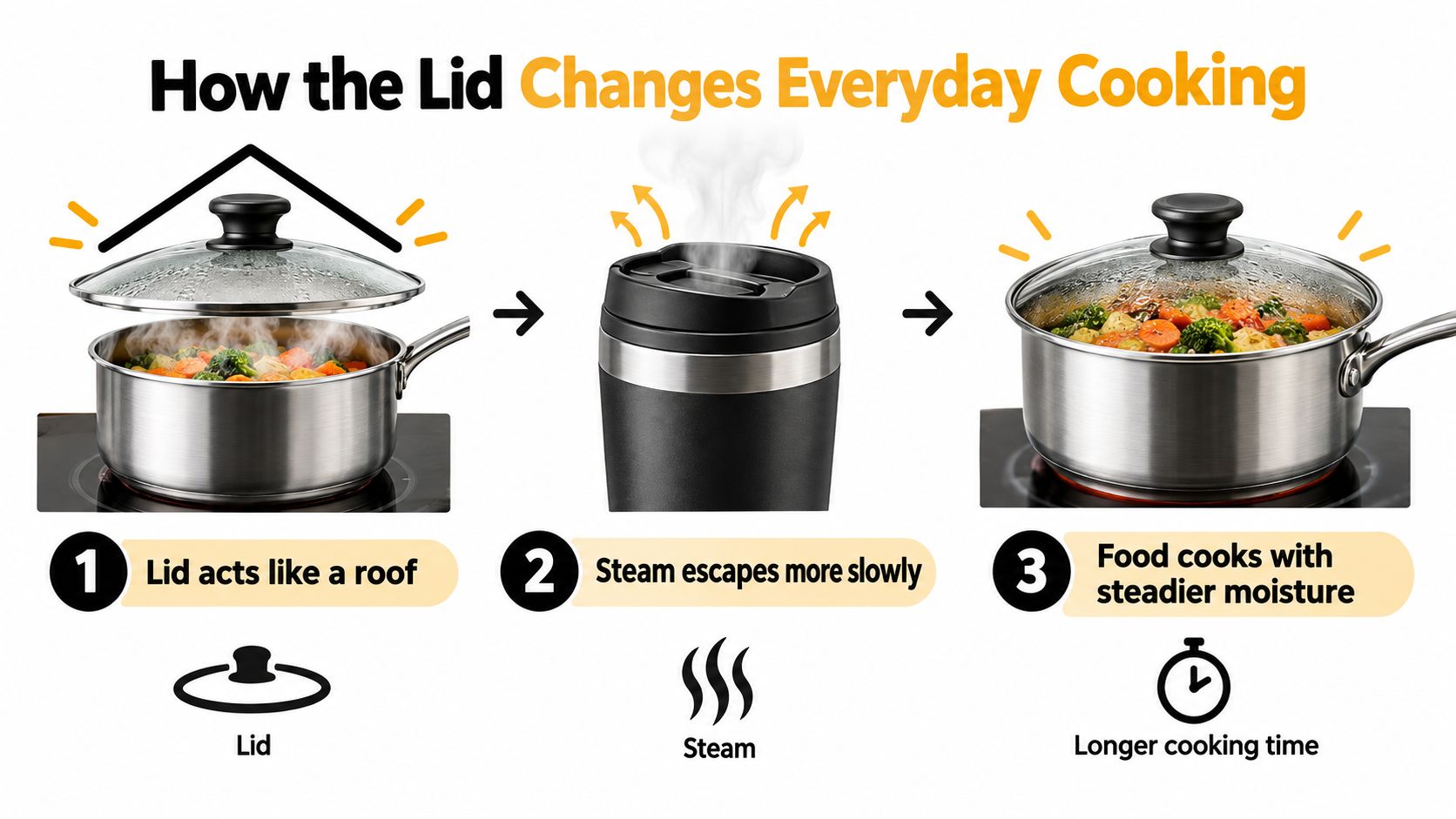
What happens underneath the cover
In plain language, a lid limits heat carried away by moving air and escaping water vapour. A flat base helps heat move consistently from an electric element into the pan. A warped base can't provide the same contact, and an undersized pan leaves part of the element heating the surrounding space.
That's why the useful benchmark is a close-fitting lid plus a rigid, flat base matched to the element. A heavy-looking lid alone doesn't make an unsuitable pan efficient.
Use the cover deliberately:
- While heating liquid: Put the lid on and watch for the liquid approaching a boil.
- At a simmer: Lower the heat rather than leaving the burner at the setting used to heat the cold liquid.
- When reducing: Remove the lid so evaporation can do the work you want.
- For residual-heat cooking: Use retained heat only where the recipe and cooking method allow it, rather than assuming every dish will finish safely without active heat.
A lid is useful for boiling, simmering and steaming, but it isn't a substitute for attention. If the contents climb towards the rim, adjust the heat and uncover as needed. Don't treat vigorous bubbling as proof that the pan is working better.
If an earlier cooking mishap has left residue behind, the guide to cleaning burnt pots and pans addresses that separate problem. Heat control is about how you cook; surface condition requires its own inspection.
Comparing Saucepan Materials and Safety
Turn your attention from escaping steam to the surface touching your food. A well-fitting lid can improve cooking control, but it can't correct an unsuitable or damaged interior.
Use this comparison as a starting point, then read the material description of the actual pan.
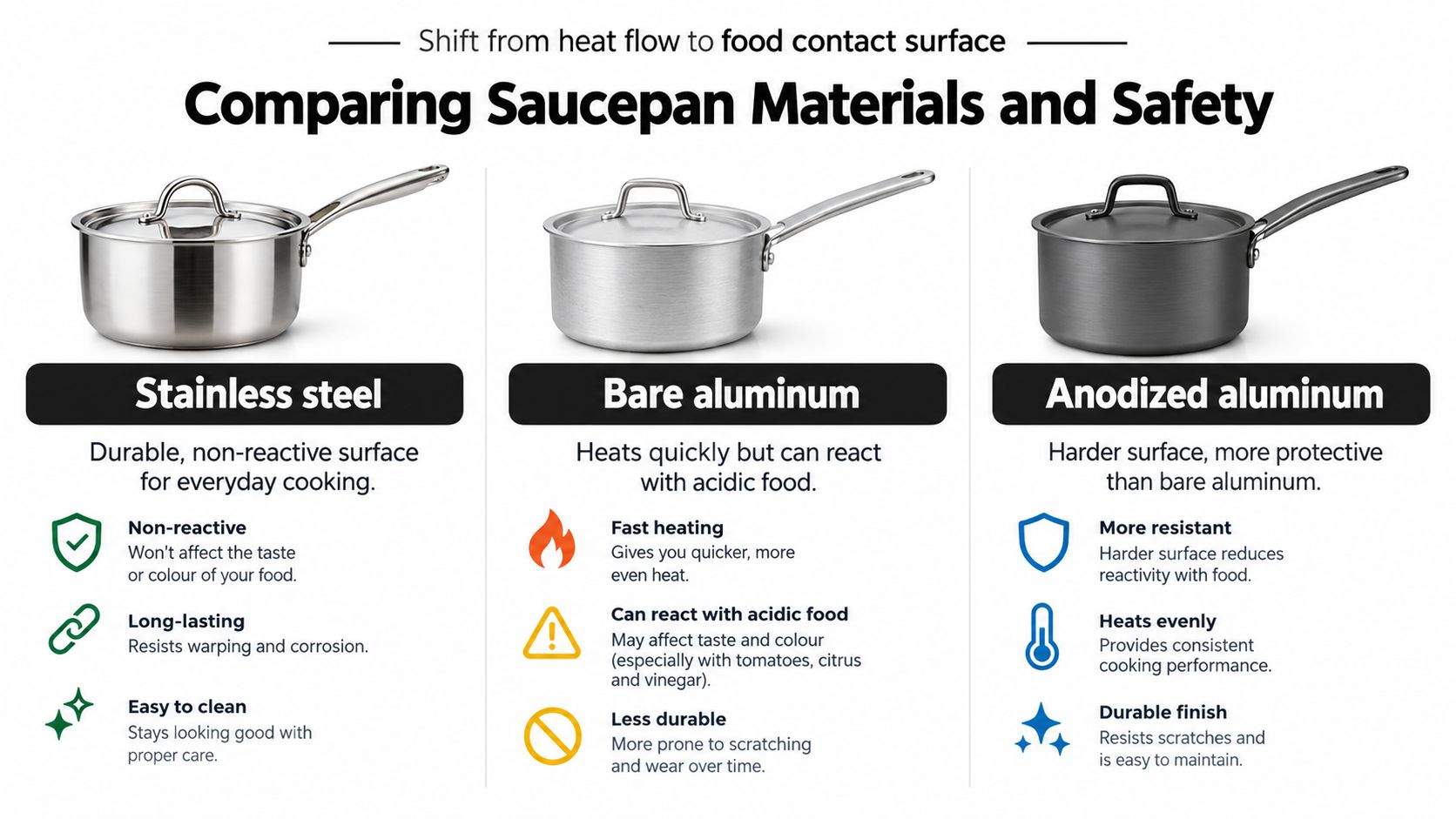
Compare the cooking surfaces
Health Canada's cookware safety guidance explains that worn, pitted or scratched aluminum can transfer aluminum into food more readily. Some aluminum cookware manufactured outside North America can also transfer lead, and acidic or salty foods can increase transfer through reactions with exposed metal.
That makes tomatoes, citrus products and sauerkraut useful examples when considering your routine. The concern isn't whether you occasionally cover the pan. It's what those ingredients contact inside it.
| Material | Food-contact consideration | Practical buying approach |
|---|---|---|
| Stainless steel | An alternative to exposed aluminum for routine cooking | Confirm the stated interior material |
| Bare aluminum | Surface wear and acidic or salty ingredients require attention | Inspect carefully and consider how you cook |
| Anodized aluminum | Anodization reduces aluminum transfer, particularly with foods such as tomatoes and rhubarb | Choose an intact anodized layer |
For frequent acidic cooking, stainless steel or intact anodized aluminum is the more useful shortlist. Anodized aluminum shouldn't be treated as interchangeable with bare aluminum, and a damaged protective surface shouldn't be ignored because the pan still holds liquid.
The guide to anodized aluminum cookware can help you interpret that distinction while comparing product descriptions.
Separate material from product purpose
Stainless steel appears in other stovetop vessels, but matching metal doesn't mean matching function. The HAUZ AKL1695 Whistling Stovetop Stainless Steel Kettle 2L, for example, is a kettle for heating water, not a saucepan substitute for sauces or soup.
The accompanying video offers another visual reference while you consider cookware construction.
For aluminum, the handling rules belong with the material choice: use low-to-medium heat, hand-wash with mild detergent, choose non-metal utensils, and don't store acidic food in the pan. Deep scratches, pitting or substantial wear are replacement signals, not cosmetic details.
Canadian historical production records also show stainless steel gaining ground within a broader cookware category. That's useful background, not proof of a modern product's quality. Judge the individual saucepan by its stated construction and condition.
Saucepan Sizes and Capacity Chart
Capacity works like a measuring jug: it describes how much a vessel holds, not how comfortably you'll perform every cooking task. Start with the amount you prepare, rather than a label such as compact or family.
For a person reheating soup, a large pan may be awkward to wash and store. For a household heating pasta water, a very small saucepan may be the wrong tool altogether. Don't force every job into a saucepan just because it comes with a lid.
Saucepan with Lid Size Guide
These are qualitative planning ranges, not measured product specifications. Check the maker's stated capacity and dimensions before buying.
| Size band | Planning capacity | Typical job | Best fit |
|---|---|---|---|
| Small | A modest serving or small quantity of sauce | Reheating soup, preparing a little gravy, cooking eggs | Solo cooks or a dedicated sauce pan |
| Medium | An everyday shared quantity | Soup, side dishes, routine household cooking | Households wanting a daily-use pan |
| Larger saucepan | A more generous batch with working room | Larger portions, shared meals, service preparation | Shared kitchens or small hospitality operations |
A café may find a small sauce pan and a larger volume pan more useful than several near-duplicates. An office kitchen may need only the size that matches its actual food preparation, rather than a full domestic set.
A short-term rental host has another consideration: guests need to understand the equipment without searching through a cupboard. Clear differentiation between smaller and larger cookware is more practical than stocking pans that look almost identical.
Check the shape as well as the capacity
Advertised volume doesn't describe everything. Pans with the same stated capacity can differ in height, opening width and pouring comfort, so compare dimensions and handling as well.
Use these physical checks alongside the chart:
- Base fit: Look for a base suited to the element, without a large mismatch in either direction.
- Working space: Leave room for stirring and normal movement of the contents rather than planning to cook at the rim.
- Handle clearance: Check that the handle won't crowd neighbouring burners on a small stove.
- Lid seating: Make sure the cover belongs to that pan and sits securely.
The distinction between rim width and base width can be confusing when shopping online. The guide to measuring frying pan size provides useful measurement context, although you'll still need the saucepan's own specifications.
Choose for the quantity you cook most often. Occasional larger jobs may belong in another vessel rather than determining the size of your daily saucepan.
Stovetop Oven Use and Daily Cooking Jobs
Dinner often asks the same saucepan to do different things. You might heat water with the lid on, lower the burner for a gentle simmer, then uncover a sauce because you want it thicker. The useful skill is recognising when the job has changed.
For steaming vegetables, use equipment designed to support the food above the water and follow its instructions. For a gravy that needs reducing, leave the cover off. The correct lid position follows the recipe, not a rule that covered is always better.
Check the whole pan before oven use
A saucepan that works on the stovetop isn't automatically suitable for the oven. Check what the manufacturer says about the body, handle, lid and lid knob, including any differences between covered and uncovered use.
A listing that calls the body oven-safe leaves an important question unanswered if it says nothing about the lid. Don't assume a glass cover can go under a grill just because the metal vessel can enter an oven.
Permission for one part of the pan isn't permission for the complete covered assembly.
Keep these checks separate:
- Electric cooking: Assess the base for the contact and fit described earlier.
- Gas cooking: Confirm that the pan sits securely on your stove's supports.
- Induction cooking: Look for an explicit compatibility statement, not an assumption based on appearance.
- Oven finishing: Follow the stated limits for every component you intend to put inside.
If you're unsure what an induction listing should tell you, consult the guide to choosing induction cookware. Material names alone aren't enough to settle every compatibility question.
Recognise the vessel in the photograph
Product photography can make different stovetop tools look interchangeable. This catalogue image shows a kettle, so it shouldn't be used to judge saucepan capacity, lid access or stirring comfort.
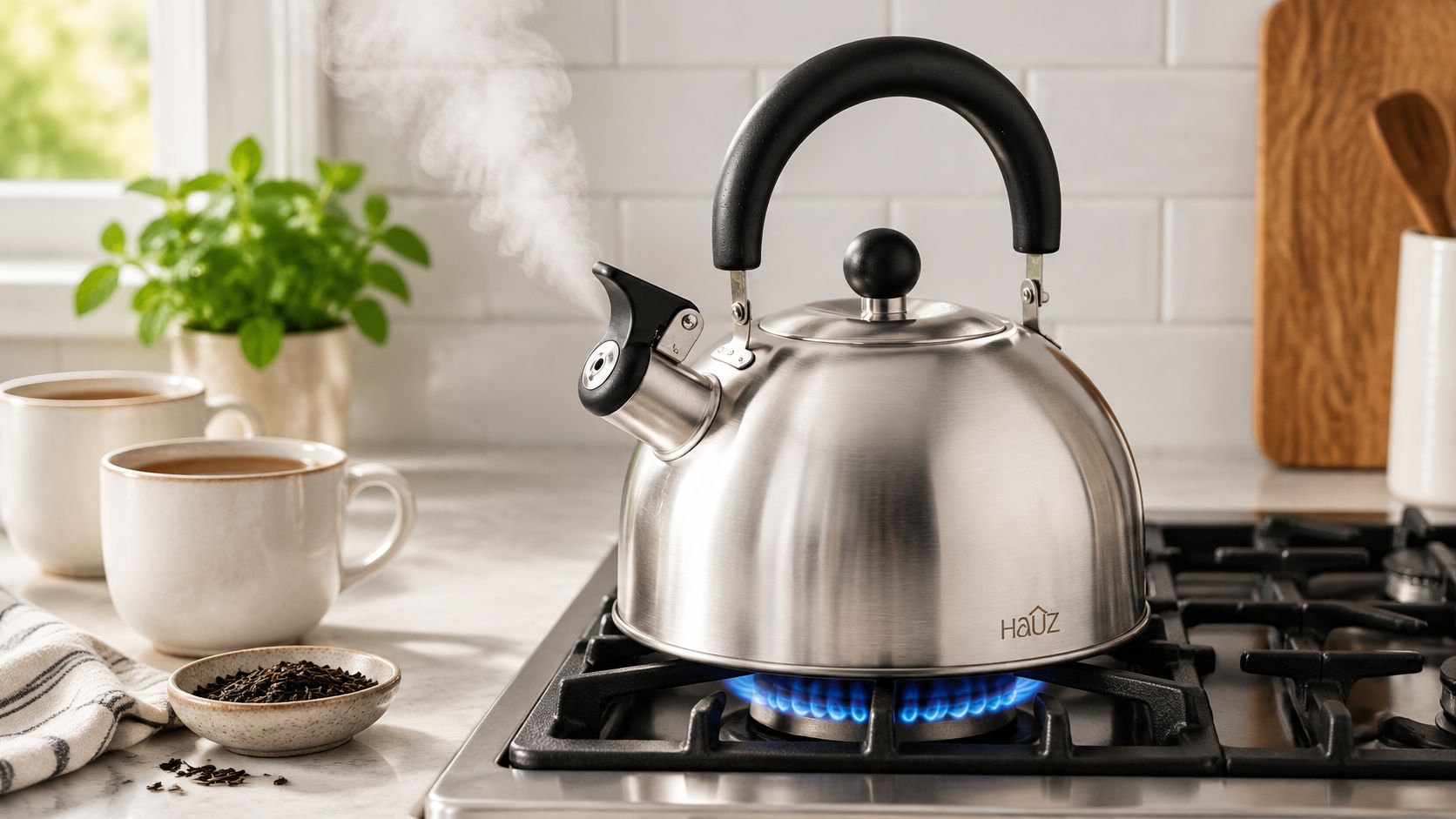
For renters and small businesses, versatility means covering the jobs you perform, not accumulating the most pieces. A suitable covered pan may earn its cupboard space through everyday simmering and reheating. Oven capability matters only if you intend to use it, and only when it's clearly documented.
Choosing a Saucepan for Your Kitchen
Choose by eliminating mismatches before comparing retailers. An attractive finish won't solve a lid that doesn't fit, an unsuitable cooking surface, or a base your stove can't use.
The decision path is short: confirm the lid and base, choose the interior for your ingredients, match the working capacity, and verify compatibility. If a listing leaves any of those unclear, ask for clarification rather than filling in the gaps yourself.
Keep those priorities visible while browsing.
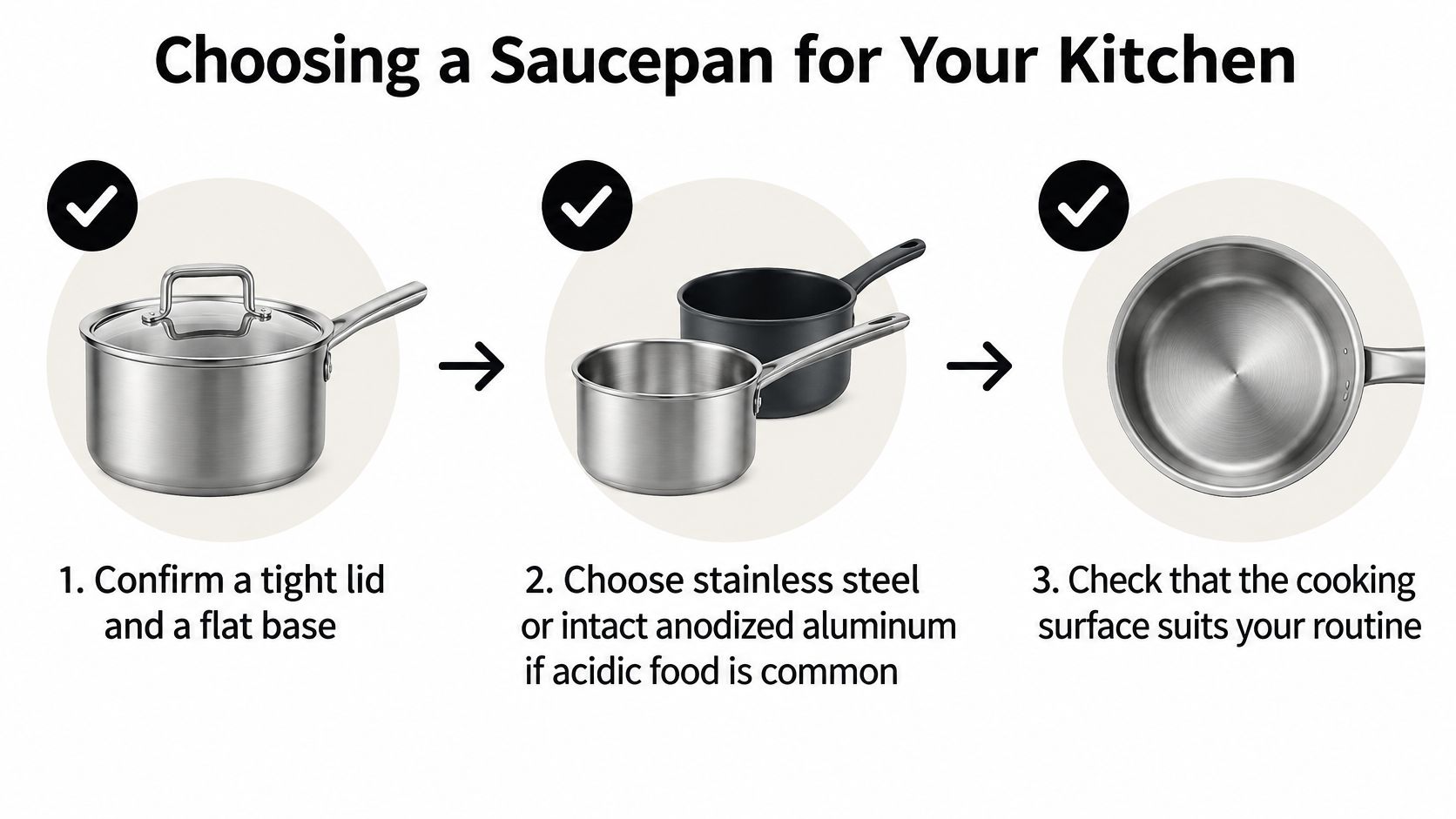
Match the choice to the people using it
For a household cook, start with your most frequent meal. A saucepan that handles everyday soup or side dishes comfortably is more useful than one selected around a rare hosting occasion. Make sure you're buying the matching cover, not assuming it appears elsewhere in the set.
For a renter, handling and storage deserve extra attention. Check whether you can wash the pan comfortably in the available sink and put it away without balancing the lid on unrelated cookware. Don't replace a damaged aluminum pan with another piece showing the same wear.
For a small business, office or rental host, standardise around clearly defined jobs. A sauce-preparation pan and a larger shared-use pan may be easier to manage than an assortment of nearly identical vessels. Keep the product specifications available so replacement decisions don't depend on somebody remembering what was originally bought.
The guide to pot and pan storage can help you check the cupboard arrangement before committing to a purchase.
Use guidance before retailer browsing
GrifGlo is a curated essentials platform that organises home and kitchen products into clear categories, with comparisons, sizing advice and decision-friendly guides rather than an overwhelming catalogue. Its recommendations emphasise everyday usability, fit for purpose and reliability signals, then route shoppers to trusted third-party retailers; some links may earn a commission at no extra cost. It also supports business and bulk purchasing for offices, rental properties and hospitality operations.
That kind of guidance is an option alongside checking manufacturer specifications and inspecting cookware in a store. It doesn't replace the details on the exact product you'll buy.
Before checkout: You should be able to explain why this pan suits your food, your stove and your storage space.
If your explanation depends mainly on appearance or a vague claim of versatility, return to the practical checks. A clear reason to buy is more useful than a long list of features you won't use.
Where to Buy and What to Do Next
Shop where the product description answers practical questions. Look for a stated interior material, clear confirmation that the lid is included, usable dimensions and an explicit compatibility statement. If oven use matters, the description should address the handle and cover as well as the body.
A photograph isn't enough to establish those details. When information is missing, ask the seller or choose a listing that documents the product more clearly. Don't interpret an unspecified accessory as part of the purchase.
Put material claims in context
Canada has a long history of both domestic cookware production and imported supply. A Canadian government cookware market report recorded domestic production of C$44.054 million in 1983 and C$44.658 million in 1984, with stainless steel increasing from roughly 33.0% to 37.3% of domestic output and imports supplying 58.9% and 62.7% of the respective apparent markets.
Those historical figures group cooking utensils together and don't isolate saucepans or lids. They provide context for material choice and sourcing, not a current market estimate or a quality ranking by country of manufacture.
Make the purchase usable from the start
Once you've chosen the pan, keep its care instructions with your kitchen information. Apply the aluminum-care precautions discussed earlier, and inspect the cooking surface during normal washing rather than waiting until damage becomes difficult to overlook.
A practical handover for a shared kitchen should include:
- Cooking limits: Keep stovetop compatibility and any oven restrictions accessible.
- Utensil choice: Put suitable utensils within reach so users don't have to guess.
- Storage location: Give the matching lid a consistent home beside its pan.
- Replacement cues: Treat deep scratches, pitting and significant surface wear as reasons to reassess the cookware.
Use the publisher's cookware guidance to narrow your shortlist, then follow its retailer routing to inspect the current product details. Supplier-fulfilled options from Canada and weekday Pacific-time support are available through the platform, but confirm the fulfilment and support arrangements relevant to your purchase.
GrifGlo offers cookware guides, comparisons and sizing advice to help you turn a vague search into a practical shortlist. Visit GrifGlo with your usual cooking quantity, stovetop type and cupboard space in mind, then check the recommended retailer's specifications for a saucepan with lid that fits your routine.


Leave a comment
This site is protected by hCaptcha and the hCaptcha Privacy Policy and Terms of Service apply.