


You're standing in a cramped kitchen with a dull knife, a chicken breast sliding around on a warped board, and onion juice running onto a rental counter. You don't need a lecture on materials science. You need a board that fits your sink, doesn't wreck your knife, and won't embarrass you when someone watches you cook. That's the decision worth getting right.
Table of Contents
- The Cutting Board Question Most Guides Skip
- Five Decision Criteria That Beat Marketing Claims
- Wood, Plastic, Bamboo, Composite, Glass, Stone and Silicone Compared
- Knife Wear and Hygiene Without the Hype
- Matching the Board to the Job
- Why a Two-Board System Beats the Perfect Board
- Sizing, Thickness and Buying Checks for Small Kitchens
- Care, Cleaning and When to Replace Each Board
The Cutting Board Question Most Guides Skip
Most guides ask you to pick a winner in wood versus plastic before you have even described your kitchen. That's backwards. A board that is perfect for a house with a deep farmhouse sink and a dishwasher running nightly can be miserable in a studio where storage is one narrow cupboard and the counter also holds your kettle, toaster, and dish rack.
Think about last Tuesday, not a special occasion. You probably sliced an onion, trimmed something raw, cut bread or fruit, and then wanted the mess gone quickly. If your board was too big, you balanced it awkwardly over the sink. If it was too light, it scooted. If it held garlic smell from yesterday, you noticed. Those small frictions decide whether you cook more or order in.
Start With Your Routine, Not the Label
Your knife matters more than marketing suggests. A decent chef's knife you keep sharp deserves a surface with some give. Rock-chopping herbs on glass will punish that edge fast, no matter how easy the board is to wipe. A serrated bread knife is far more forgiving. A heavy cleaver needs weight and stability underneath it.
Your cleaning habit matters just as much. Some people wash, towel-dry, and stand a board upright after every use. Plenty of honest home cooks don't. If you know a board will sit wet beside the sink while you eat, choose accordingly. Pretending you'll oil a board monthly when you won't doesn't make the board better. It makes the purchase wrong.
Buy for the cook you are on a tired weeknight, not the cook you imagine becoming on a free Sunday.
Counter space is the third reality check. A huge butcher block photographs well, but in an apartment it can monopolise the only workable surface. A smaller board you can move, wash, and store without a struggle gets used for everything. A giant board that lives permanently on the counter can work too, but only if you have room to leave it there.
There is no single best cutting board material. There's a best match for your knife, your sink, your storage, and the foods you cut most often. Once you accept that, the comparison stops being confusing. Wood, plastic, bamboo, and composite all have jobs they do well. Glass and stone have jobs too, they're just not daily chopping.
Five Decision Criteria That Beat Marketing Claims
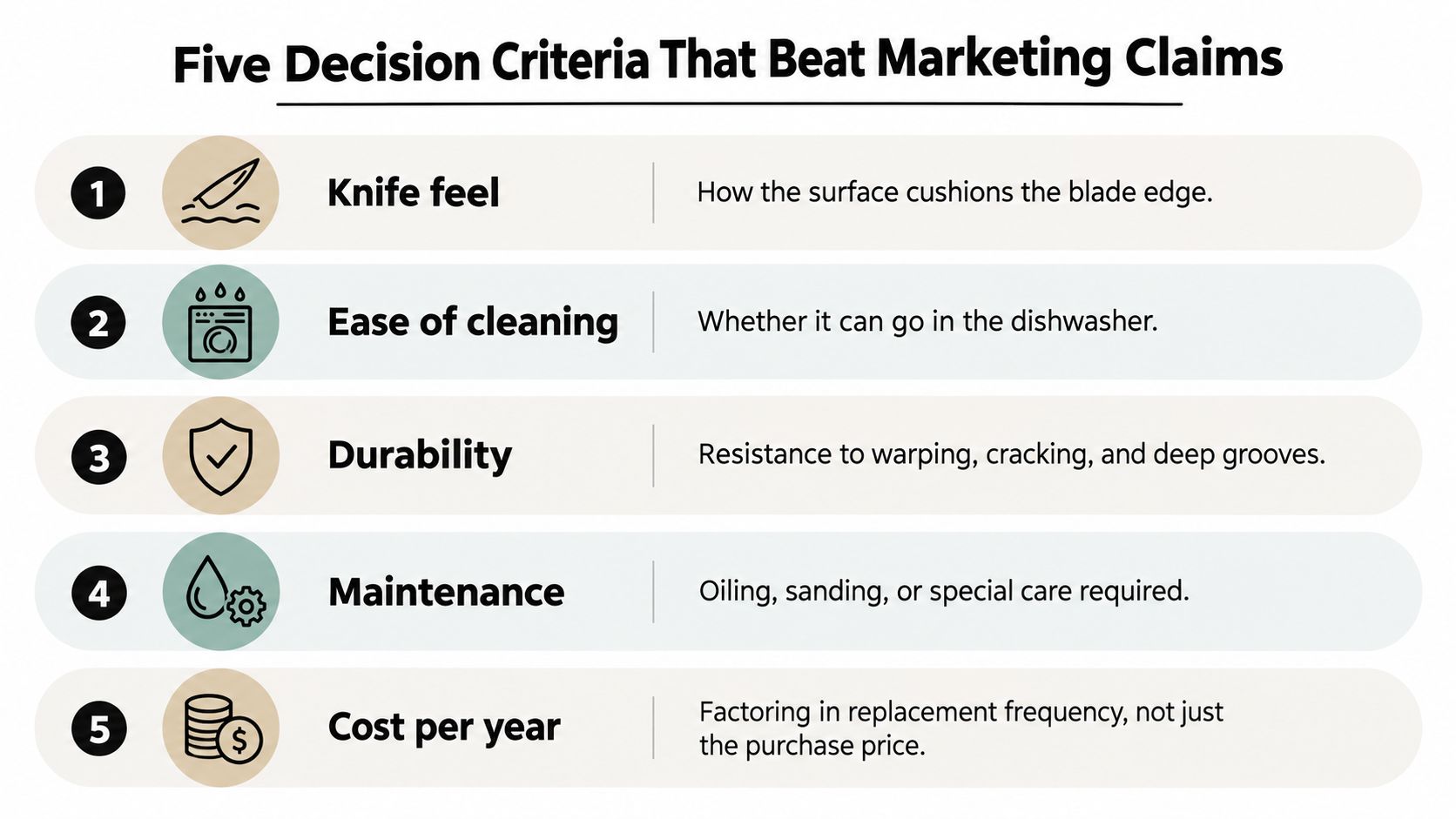
Forget claims about boards being naturally antibacterial or chef-approved. Run every option through five filters. If a board fails two of them for your kitchen, put it back, whatever the packaging promises. A simple decision lens like this is covered in a broader decision-making framework for everyday purchases, and it applies cleanly here.
The Five Filters
- Knife feel: The surface should cushion the edge slightly. Wood and good composite give a muted, controlled landing. Glass and stone give a hard clack and send the shock back into the blade. Plastic sits in between, firm but not punishing.
- Ease of cleaning: Can it go in your dishwasher, and do you have one? Dishwasher-safe plastic and some composites suit cooks who want heat and forgetfulness. Wood and bamboo need hand washing, thorough drying, and upright storage.
- Durability: Look past thickness claims. You want resistance to warping, cracking, and grooves deep enough to trap residue. A rigid board that stays flat beats a flexible mat that curls at the edges after a few hot washes.
- Maintenance: Wood asks for periodic oiling. Bamboo asks for similar care and hates soaking. Plastic asks for honest inspection and replacement. Composite usually asks the least, provided you follow the maker's heat limits.
- Cost per year: A cheap plastic board replaced often isn't necessarily cheap. A pricier hardwood board you resurface and keep isn't necessarily expensive. Divide price by realistic service life in your kitchen, not by the life promised on the box.
The visual below condenses those filters so you can use them in a shop without rereading paragraphs.
Try the filters on a familiar scenario. You rent, you cook chicken twice a week, and you own one good knife. Knife feel pushes you away from glass. Ease of cleaning pushes your raw-meat board toward dishwasher-safe plastic. Maintenance may rule out a high-care hardwood as your only board. You have already narrowed the field before comparing brands.
Weight and storage cut across all five. A board that's awkward to lift wet, or too wide for your cupboard, will annoy you daily. Test that in the shop if you can. Pick it up with one hand, imagine it soapy, and picture where it sleeps tonight.
Wood, Plastic, Bamboo, Composite, Glass, Stone and Silicone Compared
Wood is still the benchmark for knife feel. A dense, close-grained hardwood gives a quiet, forgiving cut and shallow marks tend to look less ragged over time. Not every wood qualifies. California's Health and Safety Code §114132 permits hard maple or an equivalently hard, close-grained wood as a food-contact surface while generally restricting wood and wood wicker, and requires food-contact materials to be safe, durable, nonabsorbent, smooth, and able to withstand repeated warewashing. That is a useful home filter too. Choose closed grain, avoid soft decorative boards for daily prep, and expect hand washing plus oiling.
Plastic, usually HDPE or polypropylene, wins on convenience. It's light, cheap enough to replace, and many boards tolerate the dishwasher. Its weakness shows up later. Knife scars accumulate, stains set in, and a board that started smooth becomes a map of grooves. For raw protein, that trade-off is often acceptable because you gain repeatable hot cleaning and can retire the board without grief.
Bamboo looks like wood and is marketed like a sustainability upgrade, but it behaves differently. It's very hard, light, and often made from glued strips. That hardness is less kind to edges than good hardwood, and glue lines and soaking don't get along. As an affordable board for produce, cheese, and bread, it can work. As a claim that you have bought a superior wood board, it doesn't hold up.
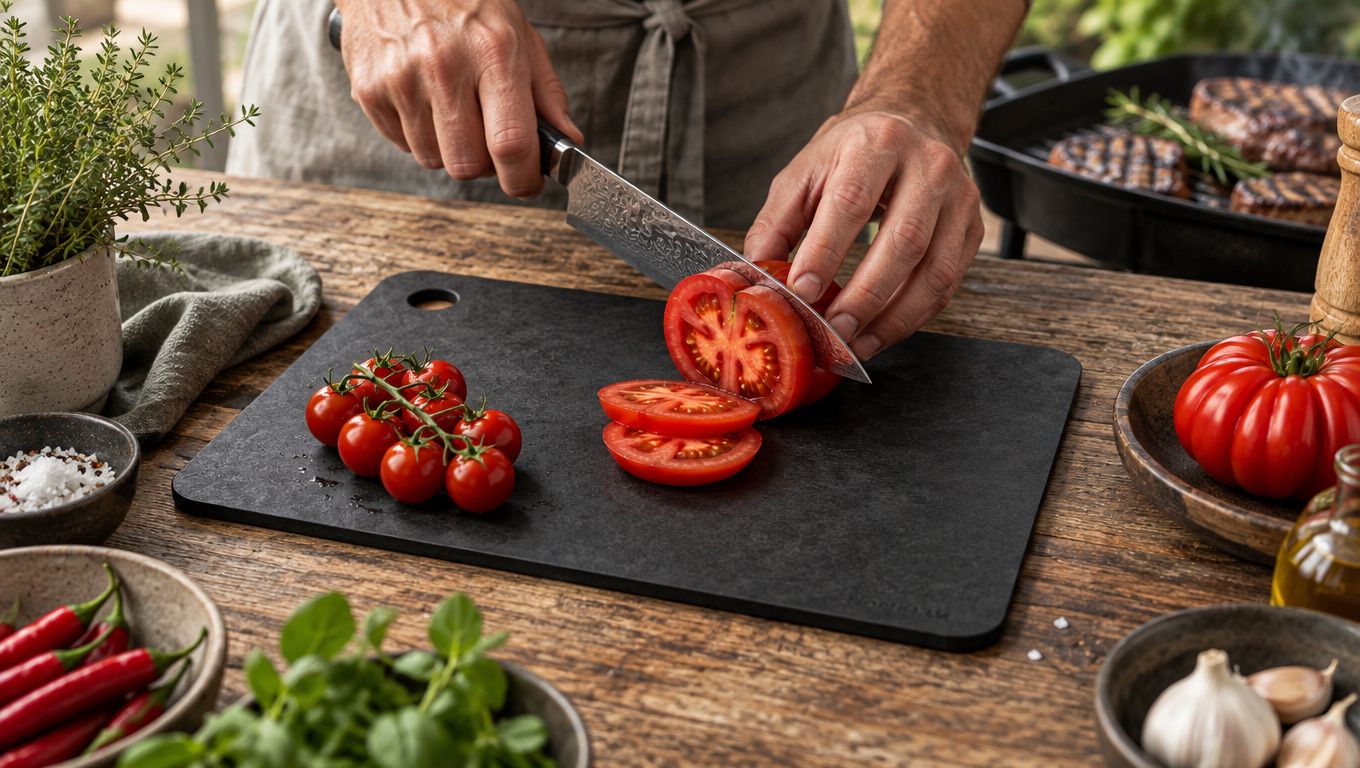
Composite boards, including paper-based and fibre-resin styles, aim for the middle. They often offer a firm but not brutal knife landing, thin storage, and dishwasher tolerance. The Combekk Recycled Paper Cutting Board 20x30 cm is one example in this category, described as crafted entirely from 100% recycled paper and positioned as knife-friendly and dishwasher-safe.
That product image shows the compact format many small kitchens favour.
Glass and stone are easy to wipe and hard to stain, which is why they keep selling. Use them for pastry, serving, or placing hot dishes, not for your main knife work. They don't give under the blade, they're noisy, and food slides. Silicone and flexible mats are useful as secondary surfaces for funneling chopped vegetables into a pan, but most are too thin and grippy, or too floppy, for confident heavy chopping.
Cutting Board Material at a Glance
| Material | Knife feel | Hygiene | Maintenance | Best for | Watch out for |
|---|---|---|---|---|---|
| Wood | Soft, controlled | Good when clean, smooth, dry | Hand wash, oil | Produce, bread, general prep | Soaking, cracking, neglect |
| Plastic | Firm, acceptable | Dishwasher helps, grooves hurt | Inspect, replace | Raw meat, poultry, fish | Deep scoring, warping |
| Bamboo | Hard, less forgiving | Smooth when new | Hand wash, oil | Light prep, serving | Glue lines, splitting |
| Composite | Firm, fairly kind | Often dishwasher-safe | Low, check heat limits | Small kitchens, all-round use | Maker limits vary |
| Glass | Harsh, slippery | Easy to wipe | Minimal | Pastry, serving | Rapid edge damage |
| Stone | Harsh, heavy | Easy to wipe | Minimal | Pastry, serving | Weight, edge damage |
| Silicone | Soft, draggy | Easy to wash | Low | Transfer mats, light tasks | Flex, knife cuts |
Read the table by job, not by loyalty. If you want one surface for careful knife work, wood or composite leads. If you want a sacrificial raw-chicken board you can sanitise hot and replace, plastic leads. If a board's best use is serving, don't promote it to daily prep because it looks clean.
Knife Wear and Hygiene Without the Hype
Two slogans cause most bad purchases. The first says wood cleans itself. The second says plastic is the only hygienic choice. Neither survives a real kitchen. Condition and cleaning beat slogans every time, and a fuller routine for how to sanitize cutting boards properly is worth following once you choose.
This comparison sets out the practical trade-off before the detail.
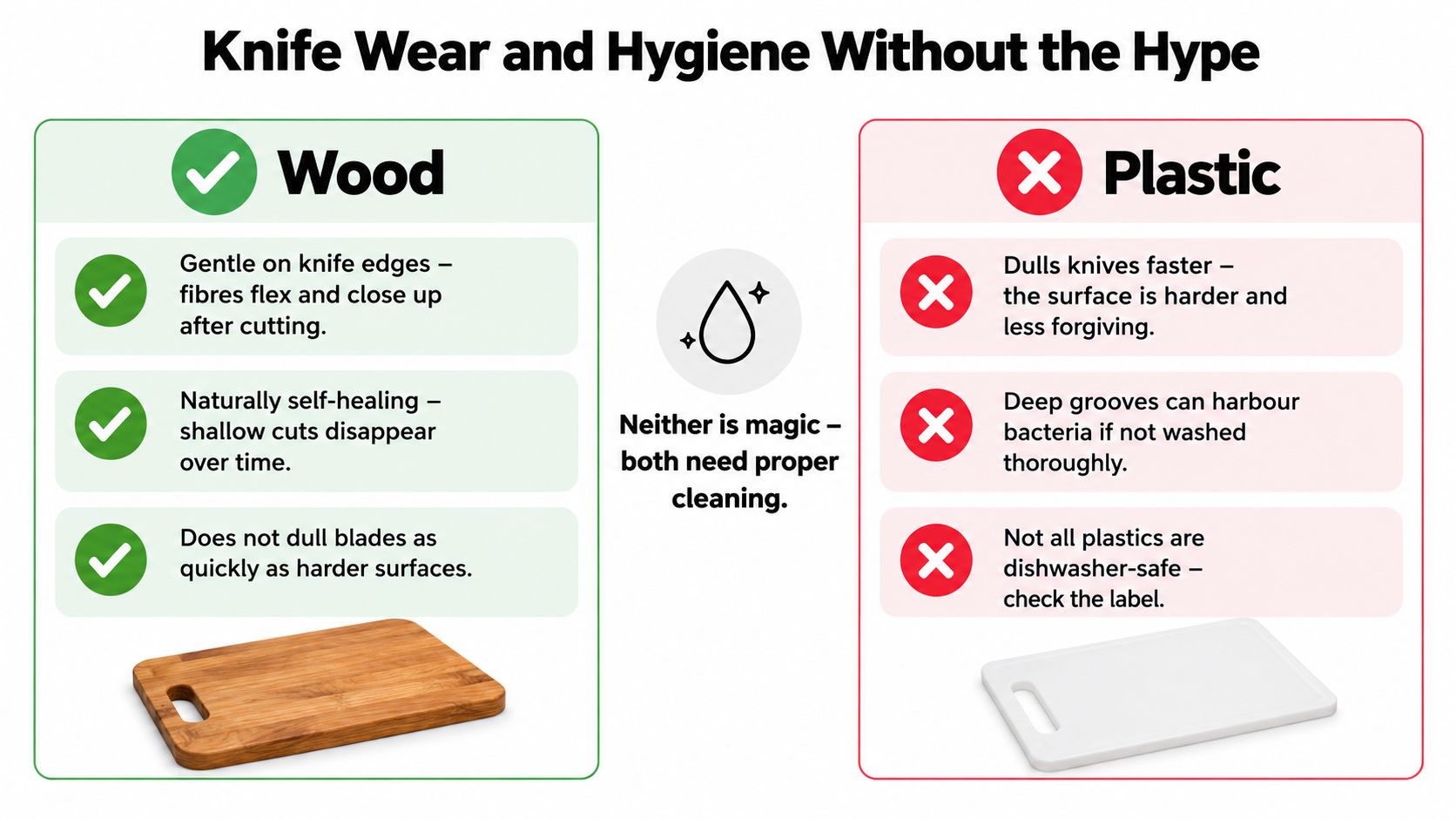
A clean wood surface can draw moisture inward, and bacteria on it may become harder to recover in some settings. That does not give you permission to skip washing. A dry, smooth, well-maintained hardwood board is a sensible surface. A cracked board with raised grain and an old onion smell is not made safe by folklore. Wood earns its reputation when you wash it, dry it upright, and keep the surface sealed.
Plastic has the opposite life cycle. New plastic is smooth and easy to clean, especially in a dishwasher. Old plastic is often the dirtiest-looking board in the cupboard for a reason. Deep knife grooves hold residue and moisture, and a quick wipe doesn't reach what matters. Heat helps, but it doesn't restore a chewed-up surface to smooth.
When Condition Overrules Material
California makes the service-life point bluntly. The California Retail Food Code requirement for scratched or scored boards says cutting blocks and boards must be resurfaced when they can no longer be effectively cleaned and sanitized, or discarded when resurfacing is not possible. Use that as your household rule. If your fingernail catches in grooves across the main cutting area, the debate is over.
A smooth board you clean properly beats a theoretically better material covered in scars.
Knife wear follows hardness and give. Glass and stone feel sanitary because nothing soaks in, but your edge pays for every cut. Bamboo is less extreme, yet still harder on a fine edge than maple-style hardwood. Plastic is moderate. Silicone can grab the blade and show cuts quickly, which is why it works better as a mat than as your main board.
This short video is a useful visual check on how surfaces and technique interact.
Keep one distinction straight. Cleanability is how easily you can remove residue today. Durability is how long the surface stays cleanable. Plastic often wins the first and loses the second if you keep it too long. Wood needs more effort today, but a thick board can be sanded back. Buy with both timelines in mind.
Matching the Board to the Job
Stop asking a board to do every job equally well. Assign jobs. That is how small kitchens stay organised, and it's how you avoid using your nicest surface for the messiest task on autopilot.
Clear Picks by Task
- Raw chicken, meat, and fish: Choose thick, rigid, dishwasher-safe plastic. It should not flex when you press down, should fit your dishwasher or sink, and should be cheap enough that replacing it doesn't sting. Colour-coding helps in shared kitchens, but only if everyone respects it.
- Produce, herbs, and bread: Choose sealed hardwood. Knife feel matters most here, as does a stable, quiet surface during repetitive chopping. Keep this board away from raw protein so a fast tomato slice doesn't turn into a sanitation project.
- One-board renters on a budget: A mid-size bamboo or composite board can be a sensible compromise. Composite is the better pick if you want dishwasher convenience. Bamboo is fine if you mostly cut vegetables and bread and will hand wash it.
- Pastry and serving: Use stone or glass for rolling, cooling, cheese, and presentation. Keep knives light there. A serving board doesn't need to prove it can handle a squash.
Canadian household guidance supports the separation logic. Health Canada's recommendation to use separate boards is to use one cutting board for produce and a separate one for raw meat, poultry, fish, and seafood to reduce cross-contamination risk, wash boards with soap and warm water after every use, and replace or resurface them once grooves become deep.
If you prep a lot of thin vegetables, board stability also affects whether other tools feel worth using. For example, a board that stays put makes it easier to stage ingredients before deciding what a mandoline slicer is used for in your own routine. The point is flow. Ingredients move from board to pan without sliding, dripping, or needing a second wash mid-recipe.
For a solo cook, a practical default is one medium hardwood or composite board for most prep, plus one inexpensive plastic board that lives near the sink for raw protein. For a household cooking daily, go larger on the produce board and keep the protein board separate and obvious. Different colour, different storage spot, no ambiguity.
Avoid false economy. A thin flexible mat for raw chicken sounds clever until it curls, channels juice onto the counter, and makes transfer awkward. A beautiful glass board for everything sounds hygienic until your knife feels dull by Friday. Matching material to job costs less than replacing knives and boards after forcing the wrong match.
Why a Two-Board System Beats the Perfect Board
The perfect board is a fantasy because the jobs conflict. Raw protein wants hot, aggressive cleaning and a surface you won't mourn. Careful produce prep wants knife kindness and stability. Two boards solve that conflict without requiring a big kitchen or a big budget.
This layout shows how little complexity the system needs.
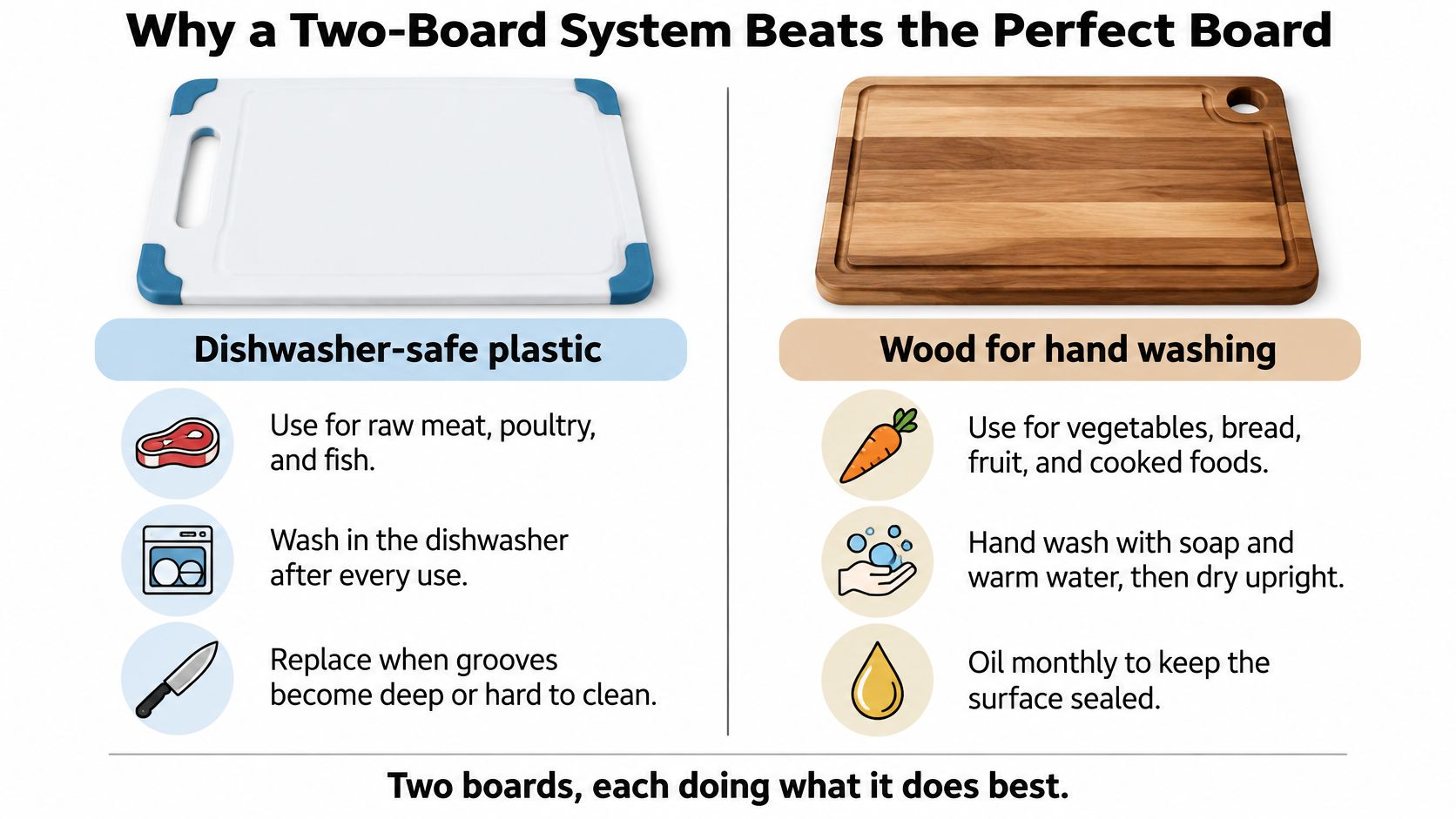
Board one is dishwasher-safe plastic or composite for raw meat, poultry, fish, and seafood. Board two is hardwood, bamboo, or composite for produce, bread, cooked food, and dry prep. Wash board one hot after protein. Hand wash and dry board two upright. Store them in different slots if you can, even if that means one stands beside the stove and the other slides beside baking trays.
Renters, favour thin, rigid boards that fit a narrow gap and won't chip a counter if dropped. Skip heavy stone as an everyday board. Skip oversized boards you cannot wash without soaking the floor. A compact board you can store vertically is better than a premium board that lives in a damp pile.
The system usually breaks through one lazy shortcut. You cut raw chicken, rinse the board quickly, then slice cooked chicken or herbs on it because dinner is late. Don't. That single habit undoes the separation you paid for. Put the protein board straight into the sink or dishwasher, then pull out the produce board.
Lifecycle matters here too. An evidence summary linked from a Canadian food-safety discussion of chopping board hygiene reports that a 2023 study identified plastic chopping boards as a substantial source of microplastics in food, a 2025 systematic review found consistent laboratory evidence of release during use, and a 2025 comparison reported sugar-maple boards reducing detectable E. coli to the detection limit after two hours without cleaning. Those findings don't prove wood is always safer at home. They do support retiring heavily scored plastic rather than treating it as a forever board.
Sizing, Thickness and Buying Checks for Small Kitchens
Material won't save a board that is the wrong size. Measure three places before buying, your main counter run, your sink, and the storage slot. A board that fits only the counter becomes a washing and storage problem. These cutting board dimensions and sizing checks are worth confirming against your own tape measure.
Choose thickness for rigidity, not theatre. The board should not flex when you press the centre, rock on the counter, or slide under a damp towel test. In a shop, set it flat, press each corner, and run a fingernail lightly across the surface. Reject boards with rough patches, raised glue lines, chips, or a finish that already feels uneven.
Size for your longest knife and your commonest ingredient. A board that's fine for garlic and lemons will frustrate you with cabbage, melon, or a whole chicken. A compact option such as a 20 by 30 cm board suits small prep and serving, while the Combekk Recycled Paper Cutting Board 28x38 cm illustrates a mid-size composite format described as made from 100% recycled paper and dishwasher-safe.
Weight deserves honesty. Heavy feels premium until you lift it wet with one hand while holding a pan with the other. Renters should be especially cautious with glass and stone, because a dropped board can damage floors, counters, and feet. If storage is vertical, check that the board won't lean under its own weight and warp over time.
Shop test: If you cannot picture washing, drying, and storing it tonight, do not buy it today.
Online, ignore lifestyle photos with tiny knives and three cherry tomatoes. Look for exact dimensions, material, dishwasher guidance, and whether both sides are usable. A juice groove helps with melon and roasts, but it reduces flat area for onions. Handles help serving, not stability. Buy the boring features that match your cooking.
Care, Cleaning and When to Replace Each Board
Keep care simple enough that you'll repeat it. Wood and bamboo get washed with soap and warm water, towel-dried, stood upright, and oiled when they look dry. The details in this wood cutting board maintenance routine cover oiling and restoring a tired surface.
Plastic and composite go in the dishwasher only if the maker allows it, then get a visual groove check while you unload. Glass and stone need a wipe and a reminder that your best knife shouldn't be doing heavy work there. Silicone gets a soapy wash and storage away from sharp edges that can slice it.
Replace or resurface any board with deep scoring, cracks, warping, persistent odour, or staining you cannot clean. Sand solid wood when appropriate. Discard plastic when grooves dominate the cutting area. Your habits, not a magic material, decide whether the board stays safe.
Ready to set up a practical two-board system without trawling endless listings? Compare compact composite boards and everyday kitchen essentials at GrifGlo, choose the size that fits your sink and storage, and assign each board a clear job from day one.


Leave a comment
This site is protected by hCaptcha and the hCaptcha Privacy Policy and Terms of Service apply.