

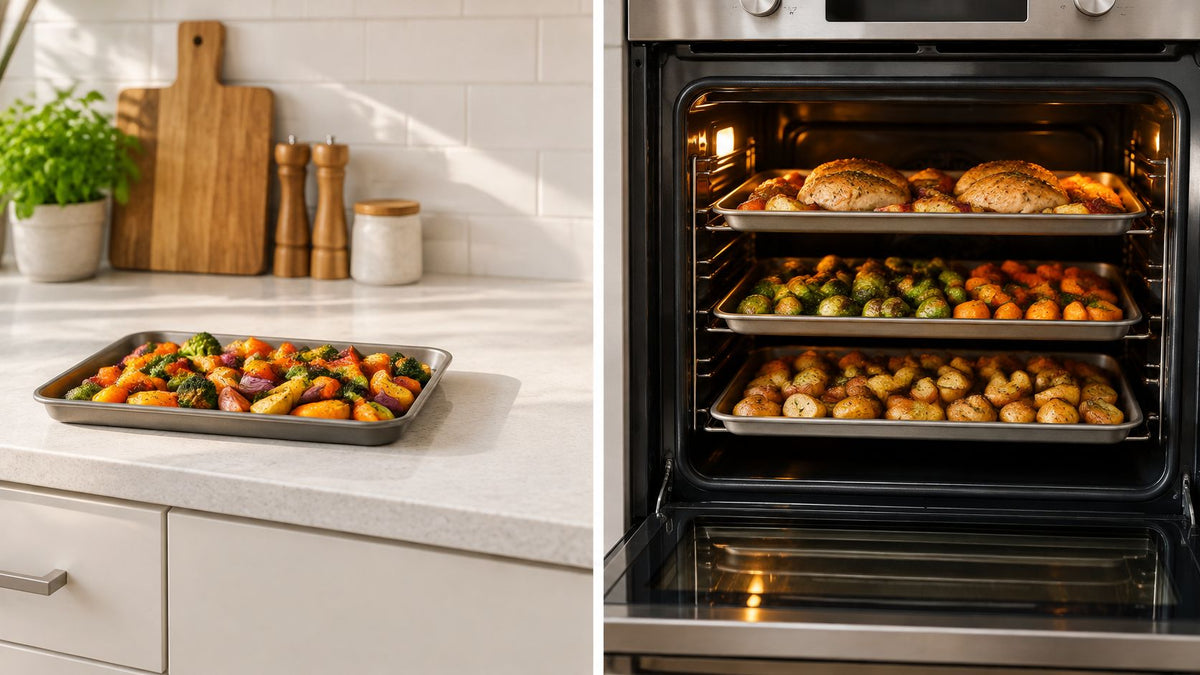
The energy-efficient oven is whichever one finishes your batch in a single run. That is the whole decision in a toaster oven vs regular oven comparison: batch size and the energy break-even point, not the wattage printed on the label.
Run the numbers on a family dinner of roast vegetables for four. The toaster oven handles it as two sequential trays, each with its own preheat, while the regular oven cooks everything at once. The compact appliance runs twice as long and the saving disappears. Shrink that dinner to one portion and the same arithmetic flips: heating a full-size cavity for a single tray wastes more energy than it saves.
Both appliances win somewhere. The toaster oven wins the small, frequent jobs. The regular oven wins the big ones. The break-even point, the batch size at which a second load costs more than heating the larger cavity once, is what separates the two.
Table of Contents
- When a Toaster Oven Beats a Regular Oven
- Specs, Heat and Browning Side by Side
- How Batch Size Decides the Energy Bill
- Which Dishes Fit in Each Oven
- Best Uses for Renters, Families and Small Operations
- Confirm Your Batch Size Before You Buy
When a Toaster Oven Beats a Regular Oven
Three variables decide which appliance wins a given meal: food quantity per session, cooking time including preheat, and how often the session repeats.
Quantity comes first, because one full tray behaves differently from two sequential trays. A toaster oven that fits the whole batch finishes in a single run; one that forces a second load gives back much of its advantage. Cooking time shifts the result in a second way. A quick reheat of a single portion is dominated by preheating, so the smaller cavity wins easily, while a long roast for a crowd spreads that same preheat cost across the whole session and rewards whichever oven holds the batch. Frequency then does the arithmetic: a small saving repeated daily outweighs a larger saving you chase twice a month.
Guidance on mini toaster ovens from Celmin makes the same conditional point: for the same cooking time, a toaster oven draws less energy than a conventional oven in a stove. The condition carries the weight. Savings hold only while the smaller unit finishes the same job in roughly the same time, and a crowded tray that cooks slowly, or a second load, narrows the gap fast.
The useful question is which appliance is sized for this batch.
Local electricity rates convert the energy difference into cents, which is why the cost arithmetic matters as much as the appliance label. Small, frequent cooking favours the toaster oven. Large batches, multiple racks, or full-size cookware make the regular oven the right tool.
Specs, Heat and Browning Side by Side
Chamber volume helps explain why small loads can finish sooner in a toaster oven, while the oven's shape and heating elements affect how food browns. The table separates typical design differences from measurements taken on specific appliances.
Toaster Oven and Regular Oven Specifications at a Glance
| Factor | Toaster oven | Regular oven | What it means |
|---|---|---|---|
| Interior volume | About 0.5 to 1.0 cu ft in typical countertop models | About 4.3 cu ft in the federal modelling reference (Alliance to Save Energy appliance standards history) | Less air and mass to heat |
| Preheat to 350°F | 50 seconds for the fastest tested unit (Natural Resources Canada cooking appliance guidance) | Not given in the cited comparison | The tested toaster oven reached temperature quickly |
| Energy for four slices of toast | 145 Wh for one tested model (Natural Resources Canada cooking appliance guidance) | 306 Wh for a tested full-size oven (Natural Resources Canada cooking appliance guidance) | Results depend on the appliance and load |
| Footprint | Small countertop area | Freestanding or built-in, needs floor or cabinet space | Counter space versus cabinet space |
| Rack positions | Usually one or two | Usually three to five | More rack positions allow more flexibility |
| Purchase price | Varies by capacity and functions in current retailer listings | Varies by range or built-in configuration in current listings | Compare current listings |
The federal technical analysis used a 4.3-cubic-foot cavity as its conventional-oven model. A countertop oven holds a fraction of that volume, so less chamber space needs to reach the set temperature. Chamber volume helps explain the preheat difference, though results vary by model.
Natural Resources Canada's cooking appliance guidance summarises comparative testing in which one toaster oven used 145 Wh for four slices, versus 306 Wh for a full-size oven, and the fastest tested toaster oven reached 350°F in 50 seconds. These are measurements from specific tested appliances, not universal ratings. They illustrate how chamber size can matter for a small load without establishing which oven uses less energy for every meal.
Why Convection Changes the Result
Many countertop models have a fan. Natural Resources Canada explains that convection ovens circulate heated air with a fan, which can cook food more quickly and at a lower temperature than conventional conduction ovens. Moving air strips away the cooler layer around food, so surfaces can set and brown sooner. For shallow items such as chicken thighs, fish fillets, or a tray of potatoes, that faster heat transfer can help; it can also make close monitoring more important.
For a comparison of how basket and oven formats handle moving air, see this guide to air fryers versus convection ovens. In a compact chamber, a fan can intensify browning. Recipe settings written for a large conventional oven may need adjustment.
Where the Shallow Chamber Burns You
Food sits closer to the upper heating element in a shallow chamber, exposing its top to intense radiant heat even when the average air temperature is on target. Chicken thighs can tolerate that intensity, while a loaf or cake rising toward the element may darken before its centre sets. Sugary toppings can scorch under direct heat.
Tall casseroles and delicate bakes show the trade-off most clearly. The surface is near the element while the centre is insulated by the food, and the dish may not fit low enough to avoid that exposure. A regular oven offers more vertical distance and rack positions, which can help with roasts, layer cakes, and foods that need to rise.
Four adjustments can reduce the risk:
- Reduce the temperature: Lower it by about 25°F when adapting a conventional recipe to a convection toaster oven, then judge doneness by the food rather than the clock.
- Lower the rack: Use the lowest position allowed by the manual for tall or delicate items.
- Check at the halfway point: Inspect the top early, since compact chambers can brown food sooner than recipe times suggest.
- Tent with foil: Once the top reaches the desired colour, cover it loosely so the centre can finish without further browning.
Practical rule: A toaster oven's compact chamber suits small loads and shallow foods. A regular oven gives tall dishes and delicate bakes more room.
Neither appliance browns every food better. The toaster oven suits toast, reheated leftovers, one tray of vegetables, or a small portion of protein. The regular oven accommodates multi-rack baking, large roasts, and tall dishes. Choose based on the food's size and shape, as well as how much space it needs above and around it.
How Batch Size Decides the Energy Bill
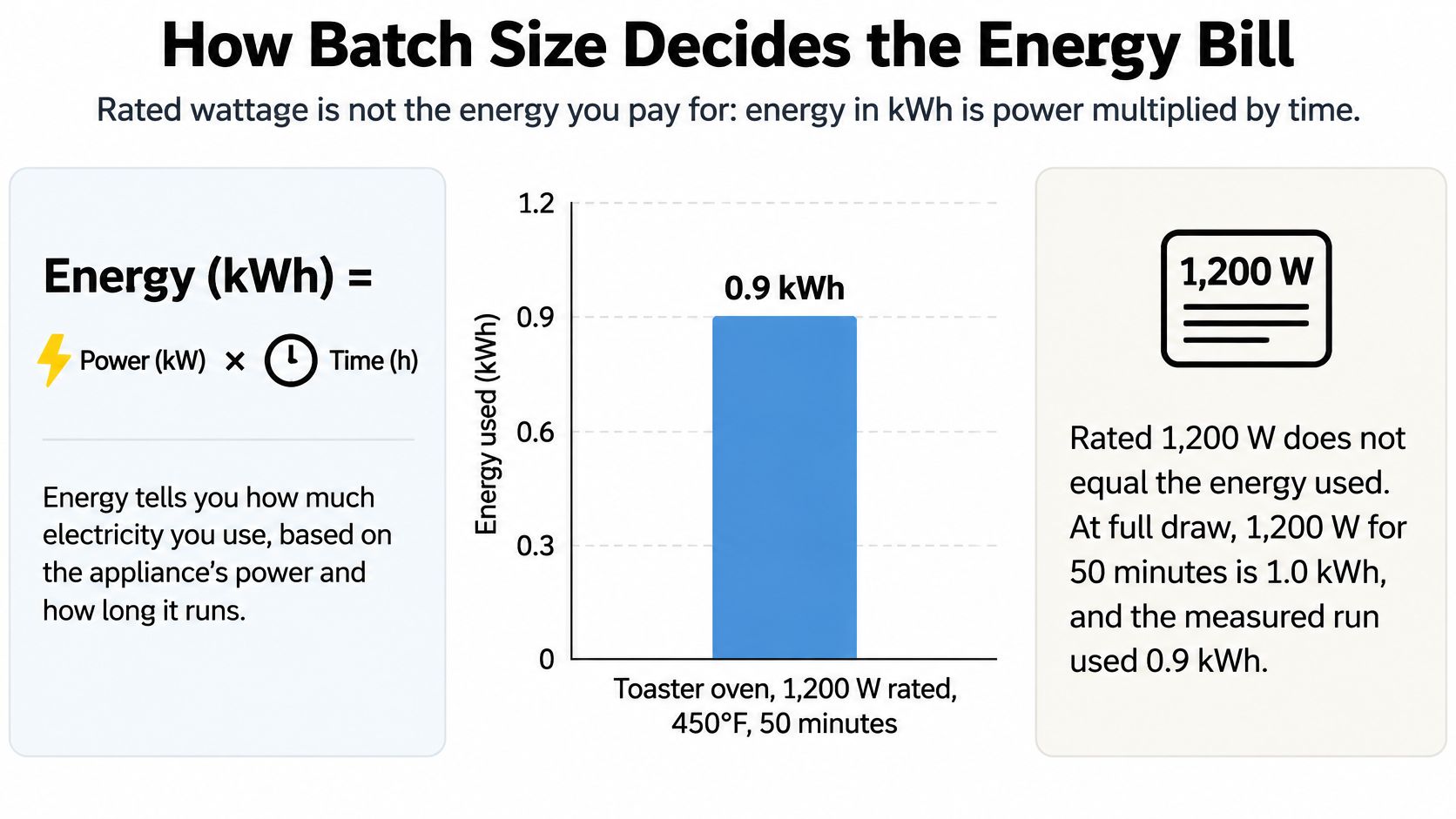
The figure on your bill is energy, and the formula is short: kilowatt hours equal watts times hours divided by 1,000. A 1,200 W toaster oven at full draw for 50 minutes works out to 1,200 times 0.83 divided by 1,000, or about 1.0 kWh. A measured session comes in lower because the elements cycle off once the chamber reaches temperature.
The chart below maps that calculation.
Energy and Cost for One Typical Session
| Appliance and setting | Energy per session |
|---|---|
| Toaster oven, 1,200 W, 50 min at 450°F | About 0.9 kWh |
| Conventional electric oven, 60 min at 350°F | About 2 kWh |
The session figures come from a Canadian report citing BC Hydro measurements, summarised in Natural Resources Canada's EnerGuide appliance guide, which estimates that a toaster oven typically consumes about one-third to one-half as much energy as a full-size oven. Treat the session numbers as operating examples. Thermostat cycling, insulation, convection mode, food load, and preheating time all move the result.
Multiply kilowatt hours by your local rate to get session cost. At an example rate of 15 cents per kWh, the toaster oven session costs about 14 cents and the conventional session about 30 cents. Replace 15 cents with the rate on your own bill and the method still works. If you're reviewing the wider kitchen at the same time, the guide to eco-friendly kitchen appliances applies the same use-based logic beyond ovens.
The video below walks through a side by side cooking comparison, which is useful for seeing how preheat and cooking time combine in practice.
Now the break-even test. Two full toaster oven loads at about 0.9 kWh each consume roughly 1.8 kWh, close to one conventional oven load at about 2 kWh, and they take twice as long. A third load, about 2.7 kWh total, costs more energy than the single full-size session and still finishes later. The countertop model wins only when one small batch covers the meal. The moment a second load becomes routine, you're paying nearly full-size energy for a slower result.
Gas ranges change the arithmetic, not the logic. The 2019 California Residential Appliance Saturation Study indicates that 55% of California households have a gas oven, so gas remains common. If your regular oven burns gas, convert the session using your gas rate rather than your electricity rate. Comparing an electric countertop session against a gas oven session with an electric price produces a confident answer to the wrong question.
Which Dishes Fit in Each Oven
Labelled oven size doesn't tell you whether dinner fits. Interior width, depth, rack height, and door swing decide that, and they vary enough between models that measuring beats guessing every time.
Common Cookware Fit by Oven Type
| Cookware | Toaster oven | Regular oven |
|---|---|---|
| 8 x 8 inch square pan | Fits most models | Fits |
| 9 inch round cake pan | Fits most models | Fits |
| 9 x 13 inch pan | Fits large models only | Fits |
| 12 inch pizza or pie plate | Needs a large model, sometimes trimming | Fits |
| Half sheet pan, 13 x 18 inch | Does not fit standard models | Fits |
| 16 x 12 inch roasting pan | Does not fit | Fits |
| Whole turkey | Does not fit | Fits |
Read the table as a starting point, not a guarantee. Handles add width that pan dimensions often exclude. A casserole dish with wide grips can measure two inches more than its cooking surface suggests, and that difference decides whether the door closes. Height matters just as much. A dish that slides in empty may foul the upper element once food rises or a lid goes on.
The bigger constraint is capacity per cycle. A regular oven holds several pans across its racks at once, so a main dish and two sides finish together. A toaster oven usually handles one pan per cycle, which means total interior volume overstates what you can serve at one time. Households comparing alternatives sometimes look at an over-the-range microwave oven with convection for the same reason. They're really asking how much food one cycle delivers, not how the appliance is labelled.
A few habits prevent most fit problems. Keep cookware from touching the walls or heating elements, because contact creates hot spots and can damage the finish. Remove the rack for a tall dish only if the manual allows it, since some models rely on rack position for safe airflow. Treat trimming as a warning sign. If a pizza or pan only fits after you cut it down or angle it awkwardly, that meal belongs in the regular oven.
Run this measuring routine before you buy. First, measure your largest routine pan including handles. Second, compare that figure against the interior width and depth in the spec sheet, not the exterior dimensions. Third, check usable height from the lowest rack position to the upper element. Fourth, confirm the door opens fully where the unit will sit, with room to slide the pan in straight. Four measurements take five minutes and prevent the most common countertop oven regret.
Best Uses for Renters, Families and Small Operations
Rated wattage does not decide which oven saves energy in a real kitchen. The better fit depends on how much food each household or workplace cooks at once, and whether the smaller appliance can finish that batch in one session.
The comparison graphic summarises the two most common cases before the detailed scenarios.
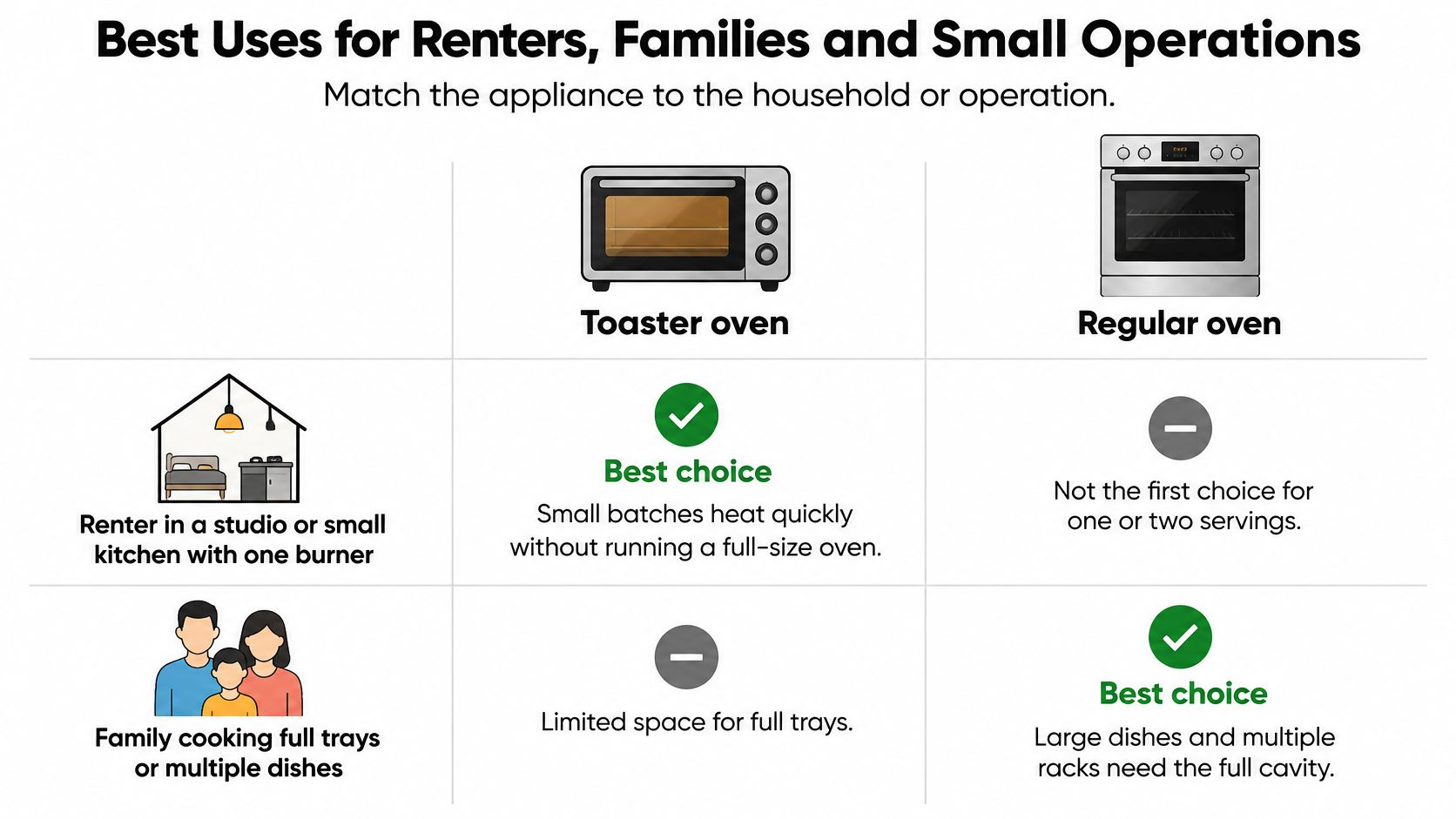
A renter cooks in a studio or small kitchen with one burner or a shared range. For meals for one or two, a toaster oven can heat a smaller cooking space than a full-size oven. It plugs into a standard outlet, avoiding an installation decision. For more layout ideas, browse these kitchen appliances for small spaces.
A family of four cooks batch meals several nights a week. A regular oven can cook full trays and multiple dishes together, making it the stronger main appliance for larger dinners. A countertop oven can still handle reheating slices or crisping a small side while the regular oven is off. If one dinner requires two 0.9 kWh countertop sessions, the total is 1.8 kWh; the comparison with a regular oven depends on how much food each appliance finishes in one session.
A home baker makes bread and layer cakes regularly. Tall loaves and stacked cake layers need room between the food and the heating element, so the regular oven suits those jobs. A toaster oven can handle small batches of cookies or a single tray of scones. Bakers focused on small, flat items can use it for a wider share of their routine.
A short-term rental host equips a guest kitchen. A toaster oven covers breakfast and light meals, with straightforward cleanup between stays. A multifunction countertop model can give guests more cooking options. The NINJA FT205CO Digital Air Fry Pro Countertop 10-in-1 Oven lists 10 functions, including Air Fry, Bake, Pizza, Toast, and Reheat. Clear operating instructions help guests use unfamiliar controls safely.
A small café, office break room, or hospitality team reheats sandwiches and snacks through the day. A countertop unit can handle individual reheating at the point of service. A regular oven suits volume production when many portions need to finish together; using each appliance for the batch it fits can keep the larger cavity off during quieter periods.
If toast is all you make, a dedicated two-slice toaster takes up less space. It cannot roast, bake, or reheat a casserole, so it fits routines limited to toast.
Confirm Your Batch Size Before You Buy
Buying well here means matching the appliance to your largest routine batch, not your biggest annual event. The five steps below turn the comparison into a decision you can defend with your own measurements.
The checklist graphic lays out the sequence so you can work through it in order.
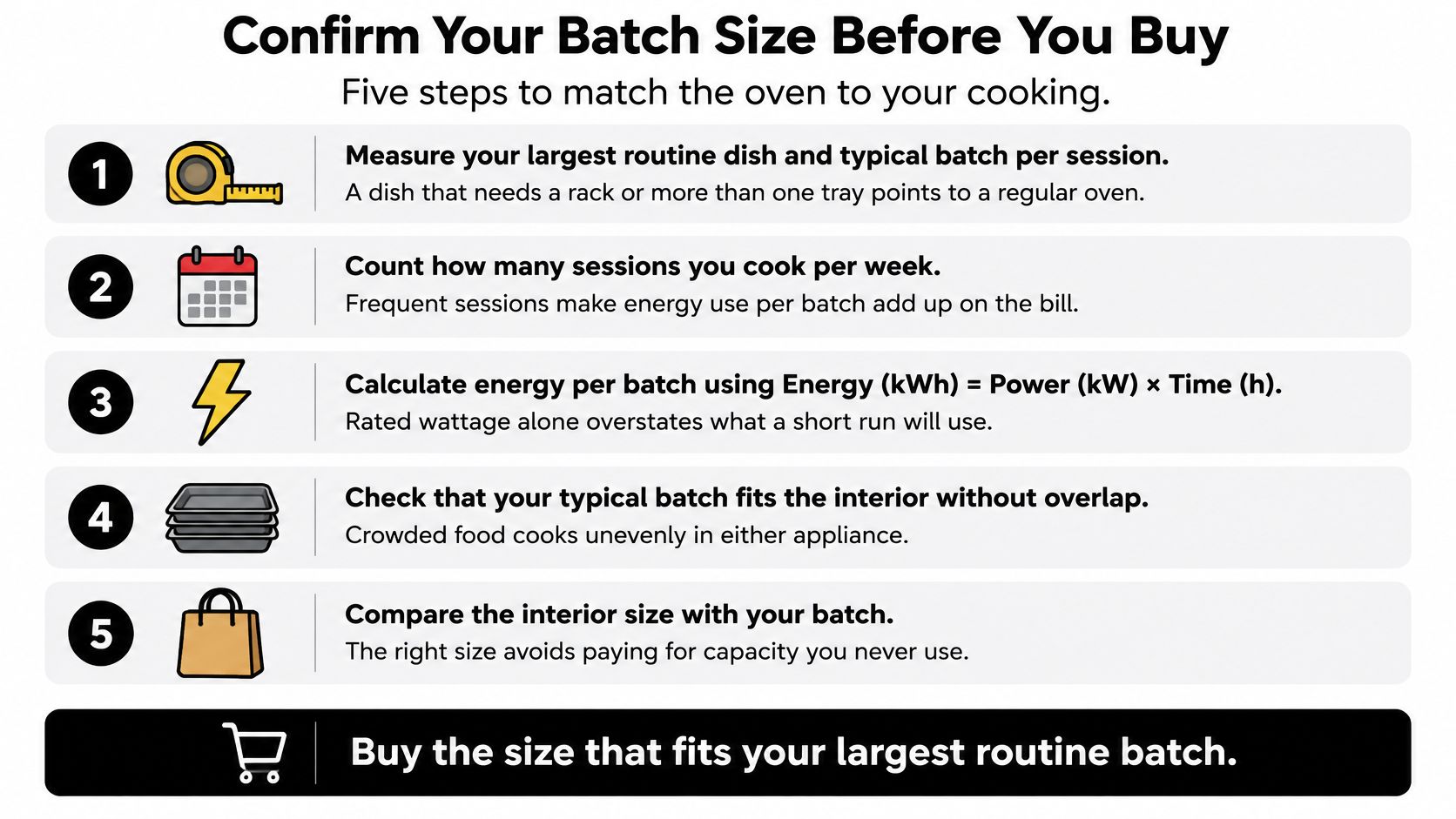
- Measure your largest routine dish and typical batch per session. If that dish needs more than one rack or more than one pan at once, keep or buy a regular oven. This single measurement prevents most mismatched purchases.
- Choose interior size so your largest pan fits with clearance. A two-slice model covers toast and little else. Buyers who roast vegetables or bake small casseroles need a chamber that takes their everyday pan without touching the walls or elements.
- Pick convection if you roast or bake often. The fan speeds up shallow cooking and improves uniformity. Accept the trade-off that you'll reduce temperatures and watch top surfaces earlier than you would in a conventional cavity.
- Check energy claims on the spec sheet with care. Toaster ovens fall outside the federal reporting category for 120-volt portable countertop ovens, so an EnerGuide label may be missing and that's normal. Compare rated wattage and expected runtime using the session method instead. The general kitchen appliance buying guide helps if you're weighing several appliance categories at once.
- Plan placement like an installation, not an accessory. Follow the manual's clearance requirements, keep the unit out of enclosed cabinets and off unstable surfaces, and keep combustibles away from the exterior. Inspect cords and plugs, keep cords away from heat and water, and avoid sharing a circuit with other high-wattage appliances. In a rental, get landlord approval before you rely on the unit daily.
That placement step deserves the emphasis. Ontario's 2025 electrical safety report found 608 cooking-equipment fires in 2024 where electricity was the ignition fuel, up from 572 in 2020. That report doesn't isolate toaster ovens, so it doesn't show countertop models are more dangerous. It shows cooking heat demands respect at any size. Supervision, placement, and wiring condition matter more than whether the appliance sits on a counter or in a cabinet run.
Finish with a one-week test before you commit your routine. Cook a typical week's batches, alternating appliances where you can, and log the time and estimated session cost for each. Your own log, built from your pans, portions, and rates, settles questions that no label can.
If you're sizing a countertop oven for a small kitchen, a rental, or a busy family counter, GrifGlo groups kitchen appliances and practical buying guides by real-life use, so you can compare capacity, functions, and fit without wading through an overwhelming catalogue. Visit GrifGlo to check your pan measurements against current options and choose the oven size that matches the batch you cook.


Leave a comment
This site is protected by hCaptcha and the hCaptcha Privacy Policy and Terms of Service apply.