


The most popular advice about cutting boards starts with memorising colours. That's backwards. A perfectly matched set won't protect dinner if someone slices cooked chicken on the board that just held it raw, or puts a clean board away while it's still dirty in the grooves.
A useful cutting board colour code starts with food separation, then uses colour to make the right choice easier. For Canadian households, that can mean a simple pair of labelled boards rather than a restaurant-style rainbow.
Table of Contents
- Cutting Board Colour Code Chart
- What Colour Can and Cannot Do
- Choose Your Board Count and Set Up
- Wash Rinse and Sanitize Between Foods
- When a Coloured Board Should Be Replaced
- Write Your Legend Before You Buy
Cutting Board Colour Code Chart
Use this chart as a working convention, not a statutory Canadian colour palette. Copy the assignments that fit your kitchen, and make sure everyone preparing food follows the same legend.
Common cutting board colour code
| Colour | Assign to | Hazard if mixed | Required at home? |
|---|---|---|---|
| Red | Raw red meat, including beef, pork and lamb | Raw juices transferred onto ready-to-eat food | No; a distinct raw-protein board works |
| Yellow | Raw poultry, including chicken, turkey and duck | Bacteria from raw poultry transferred to other foods | No; may share the household raw-protein board, with cleaning between incompatible tasks |
| Blue | Raw fish and seafood | Raw seafood juices, residue and odour transferred to other foods | No; may share the household raw-protein board, with appropriate cleaning |
| Green | Washed fruit, vegetables and herbs | Produce contaminated by raw animal foods | A separate produce or ready-to-eat board is the practical starting point |
| White | Bread, cheese, dairy and other ready-to-eat foods | Food that won't be cooked again placed on a contaminated board | Can share the green board if it stays reserved for produce and ready-to-eat food |
| Brown, optional | Cooked meat in some restaurant charts | Cooked food recontaminated by a raw-food surface | No |
| Purple, optional | Dedicated allergen-sensitive preparation in some restaurant charts | Allergen residue transferred through shared equipment | No particular colour is required; use a clearly labelled dedicated board when needed |
Read the food category before the colour
Ready-to-eat means the food won't receive another cooking step before someone eats it. Bread and cheese belong here, but so do sliced roast chicken, cooked steak and a tomato destined for a sandwich. Cooked meat doesn't belong on the raw-meat board because both foods are meat.
Green is best understood as washed produce, not a place to pile soil-covered vegetables beside chopped salad ingredients. Wash produce before moving it into the clean preparation area. Keep dirty packaging and raw-food trays away from that area too.
Brown and purple are optional assignments, not missing pieces that every household must buy. Brown is particularly easy to misread because charts don't always give it the same job. Write the food assignment on your own legend rather than assuming a guest or new employee knows what it means.
Keep a usable set even if its colours differ
A navy board and a cream board can form a workable household system. So can clearly labelled boards made from different materials. Don't force a purchased set into this chart if the result is harder to remember.
When choosing the board that will handle raw ingredients, consider size, stability and cleaning needs alongside identification. Our guide to the best cutting boards for meat helps with that purchasing decision.
Shared equipment becomes a cross-contamination route when someone moves from raw food to ready-to-eat food without proper cleaning and sanitizing, a pathway described in the Long Beach food-safety inspection guide.
Practical rule: The colour helps prevent the wrong grab. It doesn't sanitize the surface.
What Colour Can and Cannot Do
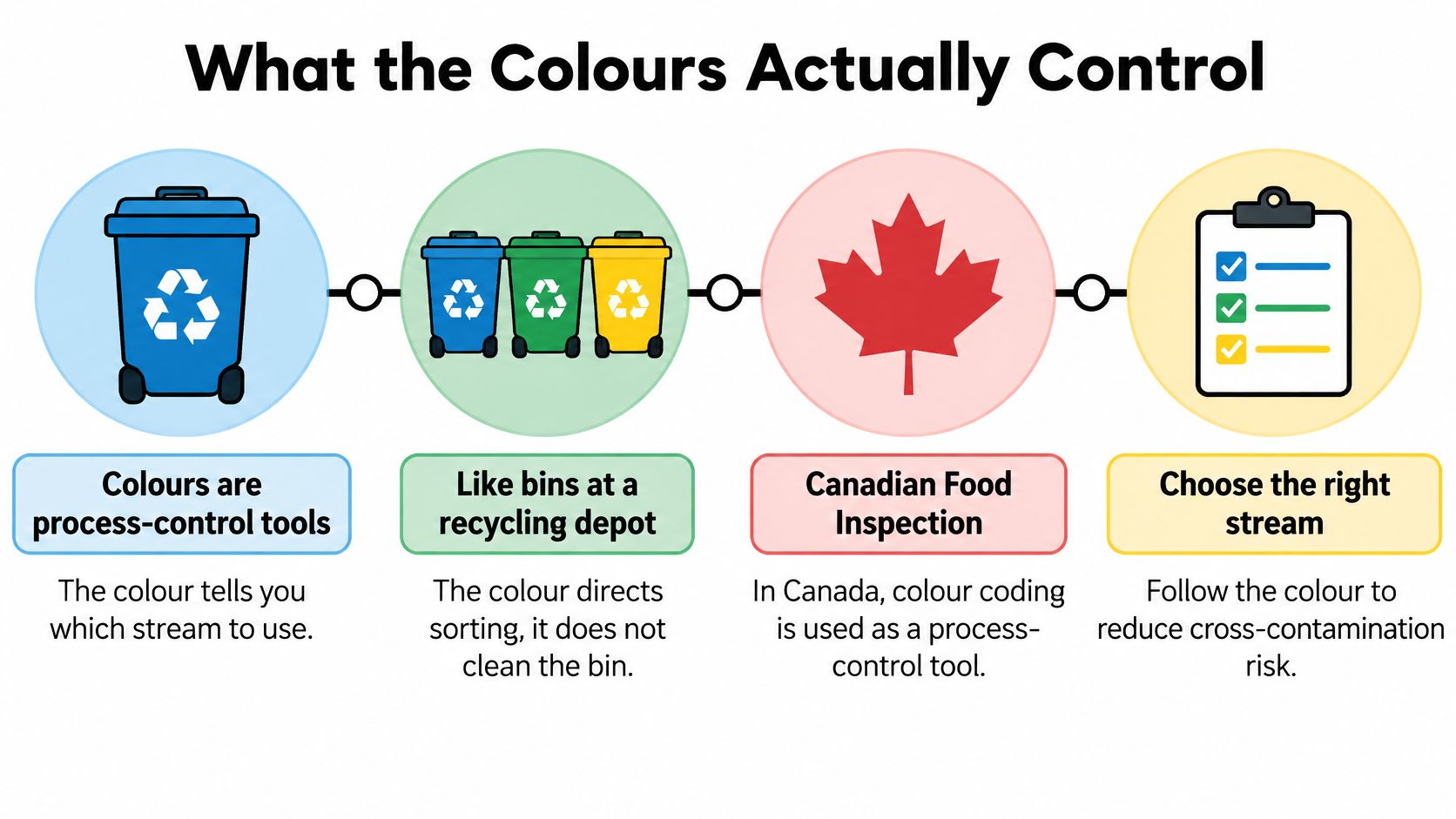
Coloured boards work like bins at a recycling depot. Colour directs each item to the right stream; whether the bin can safely hold the next load depends on cleaning. A marked board gives the same immediate cue: it makes the intended job obvious and makes a wrong grab easier to notice.
That cue has a narrow job. A white board labelled for cooked food can still carry chicken residue if someone used it in a rush, wiped it quickly and returned it to the rack. The marking remains correct, while the surface may be unsafe for the next food.
A tidy, colour-matched rack can therefore hide an unsafe workflow. A cook may choose the right boards and still carry contamination between them with a knife, towel or unwashed hands. Board assignment sets the boundary; utensils, hands and cleaning determine whether that boundary holds.
Where a correct-looking system fails
Portion chicken on its assigned board, then move to a green board to chop cucumber. If the same unwashed knife travels with you, both boards remain correctly colour-coded while the cucumber loses its protection.
The same problem occurs when one dirty cloth wipes both stations or cooked food returns to the tray that held it raw. The transfer route matters more than a tidy rack.
- Shared knives: Start the next task with a clean knife; a different board alone cannot remove residue.
- Shared wiping cloths: Keep a cloth that touched raw-food residue away from clean preparation surfaces.
- Shared landing space: Have a clean plate or board ready for cooked food before it comes off the heat.
- Shared assumptions: Tell helpers which foods belong on each board, because an unfamiliar colour scheme gives no useful warning.
Canadian guidance teaches separation
Health Canada's safe recipe style guide illustrates separate boards with red for raw meat and green for rinsed vegetables, and advises cleaning boards before and after use. The example gives cooks a memorable pairing without turning every colour on a commercial chart into a Canadian legal requirement.
A household often prepares foods in sequence, giving the cook time to clean and reset the surface between a raw task and a ready-to-eat task. A small café may need raw seafood and sandwich assembly happening at once, so the boundary has to remain visible across parallel stations. The same principle scales with pace and layout without making optional colours compulsory.
Keep raw animal foods away from ready-to-eat preparation first. Colour marks the boundary; clean hands, tools and surfaces keep it intact.
Choose Your Board Count and Set Up
Choose your board count from your menu and workload, not from the number of colours in a package. A rental host fitting two boards into a single cupboard faces a different decision from a caterer running simultaneous preparation stations.
The Canadian Food Inspection Agency's cross-contamination guidance recommends colour coding or other designations to identify equipment by use and location, alongside separation of raw-food and ready-to-eat preparation where applicable. A small kitchen can turn that principle into a practical equipment plan without treating every optional board as compulsory.
How many colour-coded boards to keep
The counts below are suggested setups, not legal equipment minimums.
| Kitchen | Boards to keep | Colour approach | What to post |
|---|---|---|---|
| Home cook or renter | A raw-animal-food board and a produce or ready-to-eat board | Clearly different boards with written labels | A legend on the fridge or inside a cupboard door |
| Rental host | The household pair, plus a spare raw-food board | Use consistent assignments across units | A short instruction in the house notes and beside storage |
| Small café or catering kitchen | Dedicated red, yellow, blue, green and white boards when those tasks are on the menu | Full convention, with matching knives where practical | A station procedure card checked before the shift |
| Allergen-sensitive preparation, any kitchen | An additional board reserved for the defined task | Purple if available, otherwise a clearly labelled spare | The exact preparation restriction on the board and procedure card |
Set up around the food you prepare
A café serving only coffee and packaged pastries doesn't need the same raw-protein setup as a caterer. An office kitchen used for reheating lunches shouldn't acquire a restaurant-style system merely because several people share it. Buy for the hazards present, not the kitchen's name.
- List normal preparation tasks. Include raw proteins, washed produce, cooked meat, bread and any allergen-sensitive work. Note which tasks happen at the same time.
- Choose the smallest useful separation. Start by protecting ready-to-eat preparation from raw animal foods. Add dedicated boards where simultaneous tasks would otherwise compete for a surface.
- Assign each board a written job. Use wording such as “raw poultry” or “washed produce and sandwiches.” “Clean board” isn't a food assignment.
- Plan the knives too. Matching handles can help identification, but separate clean knives matter more than matching colours.
- Make labels readable. Put an identifier on a non-food-contact edge or storage slot. If using tape, keep it off the cutting face and replace it when it loosens.
- Train and check. In a business, add the legend to the written kitchen procedure and have staff confirm the setup before service.
- Define the correction. A board used outside its assigned job goes out of service for washing, rinsing and sanitizing before reuse.
Make storage support the decision
Store boards so a cook can see the label without lifting a stack. Provide a drying position as well as a storage position, and keep raw-food equipment from dripping onto clean preparation tools. Where space is tight, a vertical slot beside the sink can serve both purposes, holding each board on edge so the written job stays visible.
Choose a footprint that accommodates the food and fits your sink or dishwasher. The cutting board dimensions guide can help you check those practical constraints before buying.
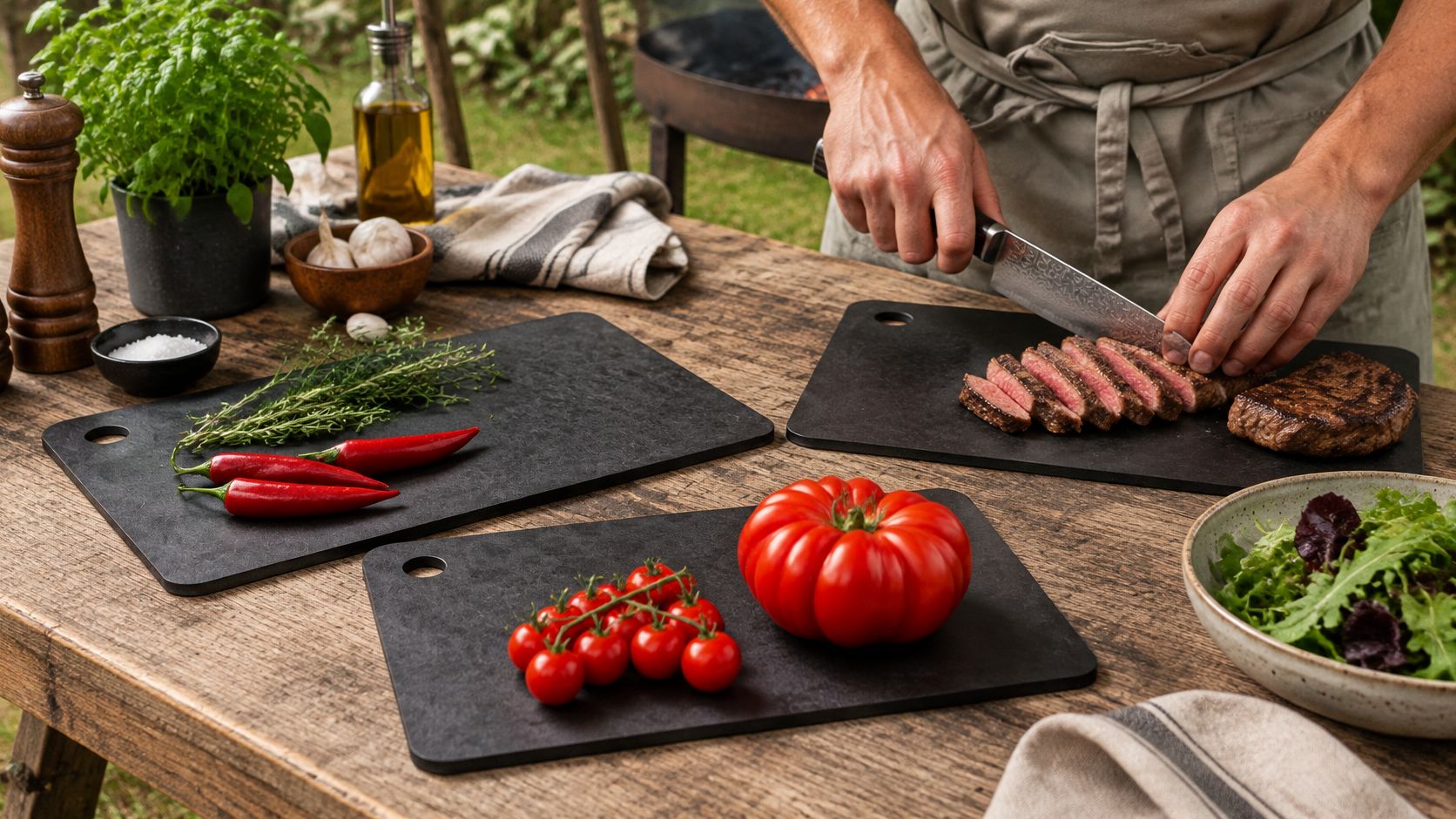
The Combekk Recycled Paper Cutting Board 20x30 cm is listed as made from recycled paper and dishwasher-safe. Those product characteristics don't determine whether you should assign it to raw-food or ready-to-eat preparation; its written job does that work, whatever its footprint.
Test the finished setup with a simple question: could a new cook select the right board without asking? If not, improve the labels before adding more equipment.
Wash Rinse and Sanitize Between Foods
Every board needs a cleaning routine that removes food residue before sanitizing. A splash of water, a wipe with a towel or a spray over visible scraps isn't a substitute for that sequence.
Health Canada recommends sanitizing cutting boards and utensils before and after preparation, not merely during the final kitchen cleanup. Build the routine into the task so a used board can't drift back into circulation.
Follow the full cleaning sequence
- Scrape away scraps. Empty loose food into the bin. Pay attention to residue around handles, juice grooves and the underside.
- Wash with hot water and dish detergent. Scrub the cutting face, edges and back with a suitable cleaning brush. Work along grooves rather than passing over them once.
- Rinse thoroughly. Remove detergent and loosened food before applying sanitizer.
- Sanitize with a suitable product. As one labelled option, Health Canada's food-safety guidance gives 5 mL of bleach in 750 mL of water, used according to product directions. For a commercial food-contact sanitizer, follow its specified dilution, contact time and any rinsing instruction; don't substitute the bleach recipe for another product's directions.
- Air-dry in a clean position. Stand the board in a rack that allows drainage and airflow. Don't rub it dry with a towel that has also wiped the counter.
- Inspect before returning it. Check that the face is visibly clean and serviceable, then return it to its assigned storage position.
Don't mix cleaning chemicals or increase a sanitizer's strength by guesswork. Keep the product instructions available, especially in a shared kitchen where someone else may prepare the solution.
Handle interruptions without shortcuts
Say the produce board is still being cleaned when you need to make a salad. Wait for a clean, sanitized surface rather than borrowing a board that just held raw chicken and giving it a quick wipe.
A household raw-protein board also needs attention between incompatible tasks. Its assignment doesn't mean you can cut poultry, switch straight to seafood and assume the shared category removes the need to clean.
A board is ready for another task because you've completed the cleaning process, not because it looks empty.
A dishwasher is an option only when the board's manufacturer permits it. Position the board so water can reach its surfaces, avoid overcrowding, and inspect it afterwards rather than assuming a completed cycle fixes retained food or physical damage.
For help choosing and using a cleaning method, consult our guide on how to sanitize cutting boards. Keep the method consistent enough that every cook knows when a board is used, being cleaned or ready to return.
When a Coloured Board Should Be Replaced
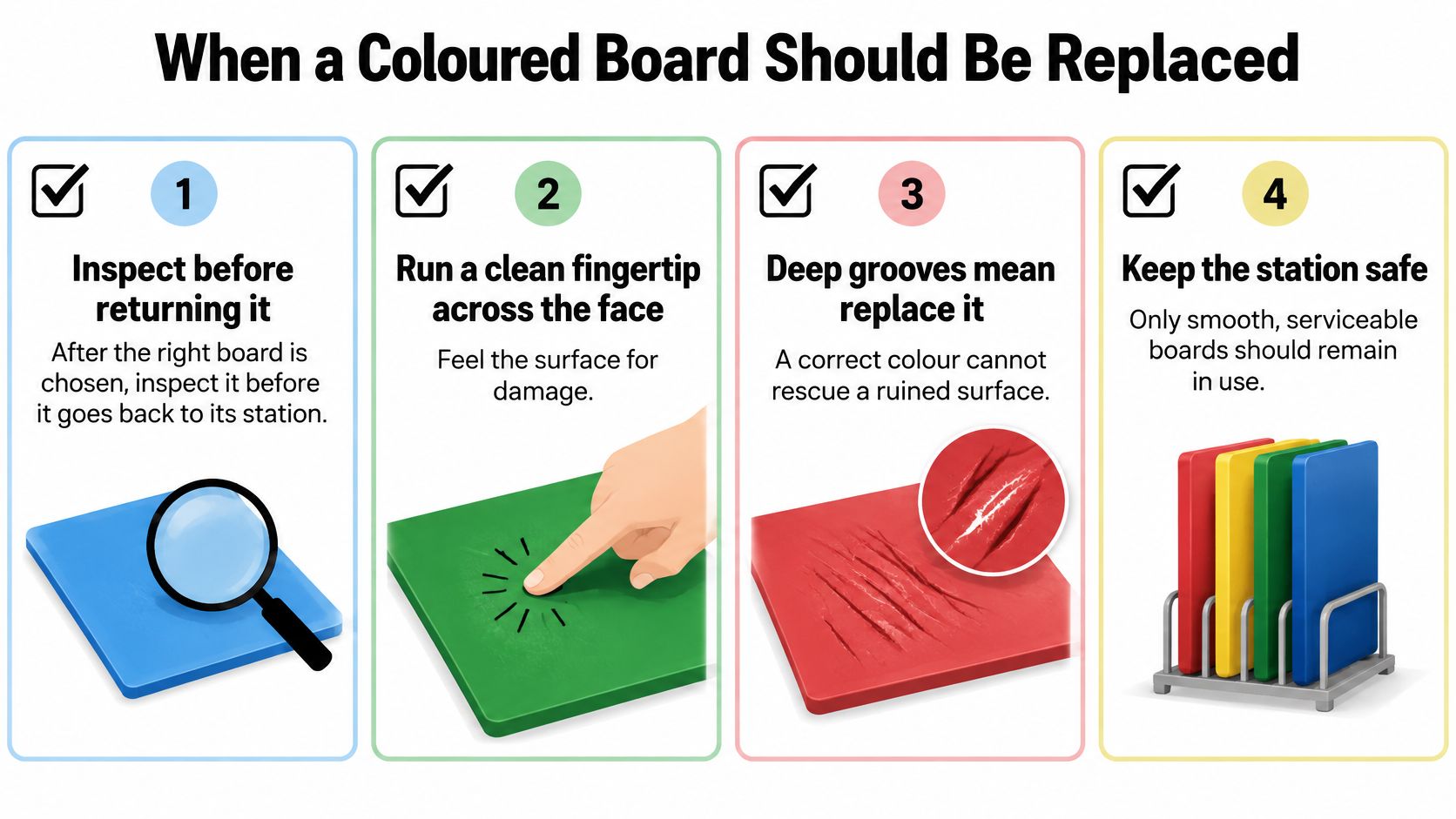
Run a clean fingertip across the washed board before putting it away. Feel for rough patches and grooves, then look closely at any cut that catches a fingernail. That's a useful screening check, not a laboratory test of safety.
A correctly labelled board can still be unfit for food preparation. The deciding question is whether you can reliably clean and sanitize the surface, not whether the colour remains bright.
Use this inspection checklist while the board is clean and dry.
Look beyond cosmetic wear
- Deep scoring: Inspect grooves that retain food despite normal scrubbing.
- Cracks and splitting: Check the edges, handle openings and joints as well as the centre.
- Persistent odour or residue: Investigate a sour or fishy smell after cleaning and drying. Don't cover it with fragrance or oil.
- Warping or rocking: Place the board on a flat surface and check whether it moves during cutting or traps water underneath.
- Staining: Treat persistent staining as a prompt for closer inspection, not automatic proof that bacteria remain.
The California Retail Food Code gives regulated California operations a clear condition-based rule: scratched or scored cutting surfaces must be resurfaced when they can no longer be effectively cleaned and sanitized, or discarded when resurfacing isn't possible. That's a California requirement, not a Canadian replacement law, but it illustrates why surface condition deserves more attention than colour.
Repair only when the material allows it
Some thick wooden boards can be resurfaced, provided the construction, remaining thickness and manufacturer's care instructions allow it. Sanding isn't a universal repair for plastic or recycled-paper composites. An unsuitable repair can leave a rough face or damage the board further.
Our wood cutting board maintenance guide addresses wood-specific care. Oiling a wooden board is maintenance, however, not a way to fill deep cuts or sanitize a dirty surface.
Use the video as a visual companion when assessing board care and condition.
Keep a replacement assigned to the same job so the station remains understandable. Remove an unserviceable board from kitchen storage rather than leaving it nearby as an emergency option.
Retirement rule: A worn raw-food board doesn't become suitable for bread simply because you change its label.
Write Your Legend Before You Buy
Write the food assignments on a card before opening a shopping page. The six-colour chart is a memory aid, so your legend can use red, blue, yellow or any clearly different boards, as long as raw animal foods stay off ready-to-eat surfaces and worn boards leave the set.
For a household, the card might read “raw meat, poultry and seafood” beside one storage slot and “washed produce, bread and cooked food” beside another. For a shared preparation line, write the actual menu categories and mark which tasks happen at the same time, because simultaneous work is what turns one clean board into a bottleneck.
Make the purchase list earn its space
Use your busiest ordinary cooking day as the test. A Canadian home cook who rarely handles raw poultry may need less from a dedicated poultry colour than from a spare board that keeps the cleaning routine practical when the first board is still in the sink.
- Check fit: Confirm that the board suits the counter, sink and drying rack.
- Check identification: Choose readable edge labels and a storage location where they remain visible; if a label fades, mark the edge again before the board goes back into rotation.
- Check maintenance: Make sure the household or team can follow the material's cleaning instructions.
- Check spare capacity: Add a spare when cleaning delays would otherwise encourage someone to borrow the wrong board.
Trial the arrangement during normal cooking
Keep the legend beside the board storage, not buried in a drawer. During your initial trial, notice where people hesitate, where used boards accumulate and whether clean knives are available with the boards.
For rental properties or hospitality teams standardising several kitchens, we have a Wholesale / Bulk section linked from our website footer. Prepare the assignment list before sourcing so each location receives equipment for the same clearly defined jobs.
Buy the boards your written legend calls for, label them before first use, and remove damaged equipment from the working set. If a mark wears off, rewrite it before the next prep session and retire the board when the surface can no longer be cleaned effectively.
GrifGlo offers kitchen products alongside guides, comparisons and sizing advice to help you choose equipment for everyday preparation. Visit GrifGlo with your board legend and storage measurements in hand, then compare options against the jobs your kitchen needs.

Leave a comment
This site is protected by hCaptcha and the hCaptcha Privacy Policy and Terms of Service apply.