

The windows are shut, the HVAC system is recirculating, and the living room still smells faintly of wildfire smoke. Your air purifier is running at full speed, yet the air may not be getting as clean as you expect. The fan can move a lot of air, but the air purifier filter determines what that air leaves behind.
A good buying decision starts with more than a brand name or a sleek housing. You need to understand HEPA filtration, activated carbon, CADR, MERV ratings, CARB certification, room sizing, and replacement costs. California's wildfire-smoke experience offers a useful test because it shows how filtration performs in occupied homes, not just in a product brochure.
Table of Contents
- Why Your Air Purifier Filter Matters More Than the Machine
- The Four Main Filter Types and How They Work Together
- Reading the Numbers Behind Filter Performance
- Matching Filter Types to the Pollutants in Your Home
- Sizing a Filter System to Your Room
- Replacement Schedules and Everyday Maintenance
- Common Filter Myths That Lead to Bad Buys
- Putting It All Together for Your Home
Why Your Air Purifier Filter Matters More Than the Machine
An air purifier is a simple system. A fan pulls room air through one or more filter layers, and the cleaned air returns to the room. The casing, controls, display, and app may differ, but the filter assembly remains the part that captures particles or adsorbs odours and gases.

Two machines with similar prices can therefore deliver different results. One may combine a properly labelled HEPA filter with enough airflow, while another may rely on a vague “HEPA-like” claim or a thin carbon sheet. In a smoky room, the difference comes from how much air reaches the filter and what the filter can capture.
California gives buyers a practical safety screen. The California Air Resources Board's indoor air-cleaning device regulation requires air cleaners sold in or shipped to California to meet ozone-emission and electrical-safety requirements. The ozone limit is no more than 0.05 parts per million, and the rule took effect in 2008 after AB 2276. CARB reports that more than 9,000 air cleaners from over 800 manufacturers have been certified under the programme.
Practical rule: Treat CARB certification as a baseline safety check, then judge the filter and airflow separately.
CARB's public guidance favours mechanical cleaners with HEPA filters for home use. Its materials describe HEPA filters as 99.97% efficient at removing particles smaller than 0.3 microns. That doesn't mean every purifier labelled “HEPA” performs identically in your room, because airflow, seal quality, filter loading, and room size still matter.
You can apply the same careful thinking to other home systems. For example, GrifGlo's home energy monitor guide uses the principle of checking the underlying specification instead of relying on a product's appearance. With a purifier, that means confirming the filter type, smoke CADR, replacement design, and certification before you compare smart features.
The Four Main Filter Types and How They Work Together
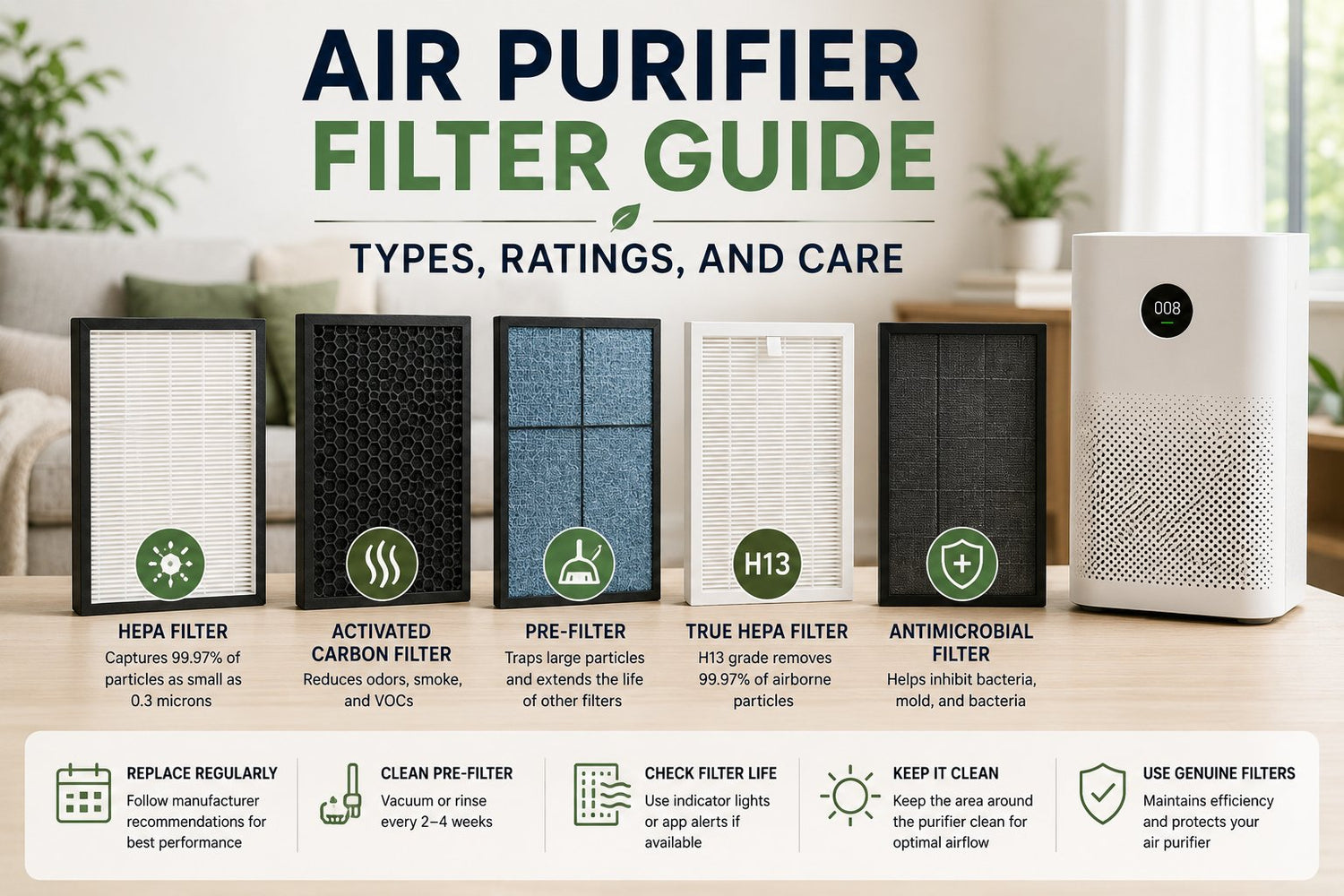
Filter layers work like a choreographed team. The first handles debris, the second catches fine particles that escape, and the carbon stage deals with odours and some gases. In a California home affected by wildfire smoke, each layer supports a different part of the cleanup job, so removing one can leave a practical gap.
The pre-filter catches the obvious debris
The first layer usually sits at the air intake. A washable or replaceable pre-filter catches pet hair, lint, and larger dust before they reach the denser filter behind it. That protects the main filter and helps preserve airflow.
Its value is practical: a pre-filter filled with hair and dust makes the fan work harder to move air through the system. It also gives the finer filter less debris to hold, which can help control replacement costs. The layer will not handle the fine particles that make wildfire smoke difficult, so treat it as the system's first line of protection rather than its smoke solution.
The HEPA layer acts as the fine-particle sieve
A true HEPA filter uses dense media to capture very small particles through several mechanical filtration mechanisms. California's mechanical-systems guidance describes HEPA performance as 99.97% removal of particles at 0.3 microns, as explained in California's mechanical-systems guidance.
“HEPA-like”, “HEPA-type”, and similar labels do not provide the same standardised assurance. They may describe media that captures particles effectively, but the wording alone does not establish the true HEPA benchmark. For wildfire smoke, check the construction and the purifier's CARB certification together. Certification addresses permitted ozone emissions and electrical safety, while the filter determines the particle-capture stage.
Carbon deals with a different problem
Activated carbon is a porous material that can adsorb some odours and gases. It may help with cooking smells, smoke odour, and certain volatile organic compounds. Performance depends on the amount and design of carbon in the filter, so a thin carbon coating offers less material for adsorption than a substantial carbon stage.
The common airflow order is pre-filter first, particle filter second, then carbon either combined with the particle filter or placed separately. Some products combine or reverse these stages. Check the replacement-filter diagram instead of assuming the layout.
| Filter Type | What It Captures | How It Works | Position in System |
|---|---|---|---|
| Pre-filter | Hair, lint, larger dust | Coarse physical screening | First, at the intake |
| True HEPA | Fine particles, including smoke particles and allergens | Dense mechanical filtration | Main particle stage |
| HEPA-type or HEPA-like | Particle matter, with performance dependent on the product | Manufacturer-defined media | Usually the main particle stage |
| Activated carbon | Some odours and gases | Adsorption within porous carbon | Separate layer or combined filter |
The CLOROX 11031 Alexa Smart Medium Room True HEPA Air Purifier is listed with Alexa voice control, true HEPA 3-stage filtration, a real-time air-quality display, and auto mode with smart adjustment. These features can simplify operation, but begin your purchase check with filter construction, smoke CADR, CARB certification, and replacement availability.
Reading the Numbers Behind Filter Performance
A high-efficiency filter still cleans slowly if its fan cannot move enough air. In a California home during wildfire smoke, CADR and the filter rating answer different questions: how much air the purifier cleans, and how effectively the filter captures particles. You need both before judging a machine.
For smoke, Canadian public-health guidance uses a practical sizing rule: choose a smoke CADR of at least two-thirds of the room's floor area in square feet. A 120-square-foot room needs roughly an 80-CADR purifier under that rule, as explained in this Canadian public-health air-cleaner guide. Treat that figure as a starting point, since an open doorway or smoky air leaking from nearby rooms increases the workload.
CADR tells you how much clean air arrives
Manufacturers may publish separate CADR values for smoke, dust, and pollen. Use the smoke value when wildfire exposure is your main concern. A higher pollen or dust figure does not make up for a lower smoke CADR, because each number comes from a different test.
Room shape and airflow also affect results. A purifier rated for a closed bedroom may clean that room effectively while struggling in an open-plan living area with high ceilings. During a smoke event, close windows and doors where practical, then place the unit where air can enter and leave freely.
MERV applies mainly to HVAC filters
MERV, or Minimum Efficiency Reporting Value, is used widely for furnace and central-air filters. California's energy standards require filters rated at least MERV 13 when tested under ASHRAE Standard 52.2, or equivalent performance of at least 50% in the 0.3 to 1.0 micrometre range and 85% in the 1.0 to 3.0 micrometre range. Check that your HVAC system can handle the filter's resistance before upgrading.
Portable purifiers may not carry a MERV rating. For these units, look for a clearly stated HEPA specification, smoke CADR, and CARB certification, which helps confirm suitability for California indoor-air use. MERV 13 describes a central HVAC filter, while a portable purifier is judged through its own filter specification and clean-air delivery. Compare the complete setup, not one label in isolation.
Wildfire smoke contains fine particulate matter, including PM2.5. Pollen and visible dust are generally larger, while pet dander can vary in size and often travels on larger debris. A staged system uses the pre-filter, particle filter, and carbon layer for different jobs.
The HAUZ APM7963 Air Popcorn Maker is unrelated to air filtration, but its hot-air-only operation illustrates why airflow descriptions need context. A purifier's airflow figure matters only when you know whether it describes fan speed, filtered air delivery, or a certified CADR result.

For another specification-led buying example, compare this guide with water-filter selection and testing advice. Identify the test, understand the unit, and match the number to the problem you need to solve.
Matching Filter Types to the Pollutants in Your Home
A smoky California day makes filter roles easier to see. Fine wildfire particles call for an effective particle filter, while cooking, cleaning products, and other household sources may add odours or gases. Pollen, dust, and pet dander need particle capture too, but their size and behaviour can differ.
A staged purifier assigns each layer a separate job. The pre-filter catches larger debris and protects the denser media. A true HEPA stage captures fine particles. Activated carbon addresses odour components effectively, but it does not filter particles. No single layer performs every task equally well.
| Filter Type | Wildfire PM2.5 | Pollen & Allergens | Dust & Dander | Odours & VOCs |
|---|---|---|---|---|
| True HEPA | Strong fit for fine particles | Strong fit | Strong fit, especially with pre-filter support | Limited |
| HEPA-type or HEPA-like | Depends on the product specification | May help | May help | Limited |
| MERV 13 HVAC filter | Useful within a compatible central system | Useful | Useful | Limited |
| Activated carbon | Limited for particles | Not its main role | Not its main role | Main filter stage for this goal |
California wildfire guidance recommends mechanical HEPA filtration because it removes very small particles without adding ozone or other harmful byproducts. CARB's certified air-cleaning device list helps screen portable units for California ozone and safety requirements. Certification does not show whether a purifier has enough capacity for your room, so check its smoke CADR separately.
For wildfire smoke, prioritise a clearly specified particle filter and a CARB-certified device sized for the space. For allergies, the same particle-capture approach addresses pollen and airborne dander. For cooking smells, paint odours, or traffic-related gases, look for activated carbon described as a distinct stage. Carbon amount and construction affect how useful that layer remains as gases pass through.
An air-quality monitor for home can help you observe particle changes during cooking or smoky conditions. It cannot replace filtration or confirm that gases were removed, but it provides a practical check on when indoor particle levels rise. Pair those readings with filter condition and room use, rather than treating one display value as a complete measure of air quality.
Sizing a Filter System to Your Room
A purifier can carry a CARB certification and still be undersized for a smoky bedroom. Measure the room first. Multiply its length by its width to find the floor area, then compare that space with the unit's smoke CADR. A 120-square-foot bedroom, for example, needs roughly 80 smoke CADR under the sizing guidance discussed earlier.
That calculation gives a starting point, not a guarantee. Choose more capacity when doors remain open, the room connects to a kitchen or hallway, or wildfire smoke keeps entering through gaps. A “medium room” label is not a substitute for measured capacity. Always calculate the actual floor area before selecting a purifier.

Three practical room examples
- Small bedroom: Measure the floor area and compare it with the published smoke CADR. A CARB-certified unit with a clearly specified particle filter gives you a better basis for wildfire-smoke use than a room-size label alone.
- Living room: Decide whether the purifier will clean only the living room or also an adjoining kitchen and hallway. Connected spaces increase the air volume, so one portable unit may have difficulty keeping smoke particles down.
- Home office: Noise affects whether you keep the purifier operating. A quieter model that runs consistently may clean more air over the day than a louder model you regularly switch off.
Occupied rooms also need enough clean airflow for the people using them. California guidance discussed earlier recommends at least 5 air changes per hour or 30 CFM of equivalent clean airflow per occupant. Use that measure alongside floor area when several people share one room, especially during wildfire smoke.
Kitchen placement requires source control as well. The air purifier for kitchen guide explains how cooking emissions, placement, and ventilation affect the result. A purifier supplements an effective range hood and sensible cooking practices, rather than replacing them.
Replacement Schedules and Everyday Maintenance
A new filter doesn't stay new. Dust, pet hair, pollen, and wildfire particles accumulate in the media, and the purifier may eventually move less air through the filter. Follow the manufacturer's schedule first, then shorten it when the unit runs heavily or the home faces unusually dirty air.
A workable routine is:
- Pre-filter: Inspect it regularly, vacuum it between changes, and replace it around every 1 to 3 months when that matches the model's design and usage.
- True HEPA filter: Plan around 6 to 12 months, with the shorter end more appropriate for heavy use or smoky conditions.
- Activated carbon: Expect roughly 6 to 12 months, depending on odour exposure and the manufacturer's instructions.
Those intervals are practical planning ranges, not universal guarantees. Filter construction, airflow, room conditions, and operating hours all change how quickly media loads.

Signs the filter needs attention
Reduced airflow, increasing fan noise, a visibly grey or yellow HEPA surface, returning odours, or a room that no longer clears as usual all justify an inspection. A filter indicator can help, but don't rely on a light if the purifier is operating in unusually smoky or dusty conditions.
Once a month, turn the unit off, vacuum the pre-filter if the instructions allow it, wipe dust from the housing seal, and check that the filter sits flush. A damaged gasket or loose fit can allow air to bypass the media.
For a broader maintenance perspective, Castus's replacement timing guide is a useful resource because replacement timing depends on loading and operating conditions, not just the calendar. Use genuine or properly matched replacement filters whenever possible, and confirm that any replacement is compatible with the purifier's seal and airflow design.
Before washing or vacuuming a HEPA or carbon filter, check the manual. Many main filters aren't washable, and moisture can damage the media. The guide to cleaning an air purifier filter can help you distinguish between cleanable pre-filters and disposable main filters.
Common Filter Myths That Lead to Bad Buys
Myth one, a higher price guarantees cleaner air. Price can reflect sensors, controls, design, or brand positioning. It doesn't automatically prove stronger particle removal. A properly specified true HEPA purifier with a smoke CADR matched to the room may make more sense than an expensive model with unclear filtration details.
Myth two, HEPA removes everything. HEPA is a particle filter, not a universal gas scrubber. It can address fine smoke particles and allergens, while activated carbon is the stage intended for some odours and gases.
Myth three, HEPA-like means true HEPA. It doesn't. True HEPA has a defined 99.97% benchmark at 0.3 microns, while HEPA-like wording doesn't establish an equivalent standard. In a smoky room, that missing definition makes the claim harder to evaluate.
Myth four, a running purifier doesn't need a new filter. A fan can keep spinning even when the filter is loaded. As airflow becomes restricted, the system may deliver less clean air, and rising noise can signal that the fan is compensating.
Myth five, MERV is the portable-purifier score. MERV primarily describes HVAC filter performance. A central system may use MERV 13, while a portable unit is better assessed through true HEPA labelling, CADR, seal quality, and CARB certification.
Use this buyer checklist before purchasing:
- Filter claim: Is the main particle filter clearly identified?
- Smoke performance: Is a smoke CADR provided?
- Safety: Does the device appear on CARB's certified list?
- Carbon stage: Is carbon present if odour or VOC control matters?
- Ownership: Can you find the correct replacement filter and its current Canadian price?
Putting It All Together for Your Home
Use five checks before opening the checkout page.
- Name the main problem. Wildfire smoke and allergies point toward strong mechanical particle filtration. Cooking smells and some household gases add a need for activated carbon. Pet hair makes a useful pre-filter more important because it protects the denser media.
- Measure the space. Apply the smoke CADR rule of at least two-thirds of room area in square feet. For a room measured in square metres, convert the area before using a square-foot CADR specification. Don't treat a “medium room” label as a substitute for a measured capacity.
- Verify safety and filter language. Search CARB's certified-device information, look for a clearly stated true HEPA specification, and confirm the smoke CADR. California's framework links particle filtration with ozone performance, so both parts matter.
- Calculate ownership cost. Canadian listings show replacement filters ranging from about CA$29.98 to CA$89.99 at Home Depot and Canadian Tire for common brands, while Best Buy Canada lists HEPA filters around CA$39.99 to CA$69.99. Canadian buying guides estimate annual filter costs of about CA$74 to CA$200, depending on the model and whether it uses one filter or several, as reflected in this Canadian replacement-filter retail information.
- Create a maintenance habit. Add a monthly pre-filter inspection to your calendar and record the date of each main-filter change. If you live in a wildfire-prone area, inspect sooner when airflow or odour control changes.
Local climate and building conditions can alter the practical setup. A resource covering air purifiers in Phoenix AZ may be useful for comparing portable filtration with broader HVAC strategies, especially when outdoor dust and indoor cooling needs overlap.
The best air purifier filter isn't the one with the most impressive marketing language. It's the one with a verified safety profile, a clearly defined particle filter, enough smoke CADR for your room, suitable carbon capacity for your odour concerns, and a replacement cost you'll regularly maintain.
GrifGlo brings together practical air-quality products and decision-friendly guides so you can compare filter types, room fit, and ongoing ownership needs in one place. Visit GrifGlo to evaluate air purifiers and other home essentials with a clearer path from specification to everyday use.


Laisser un commentaire
Ce site est protégé par hCaptcha, et la Politique de confidentialité et les Conditions de service de hCaptcha s’appliquent.