

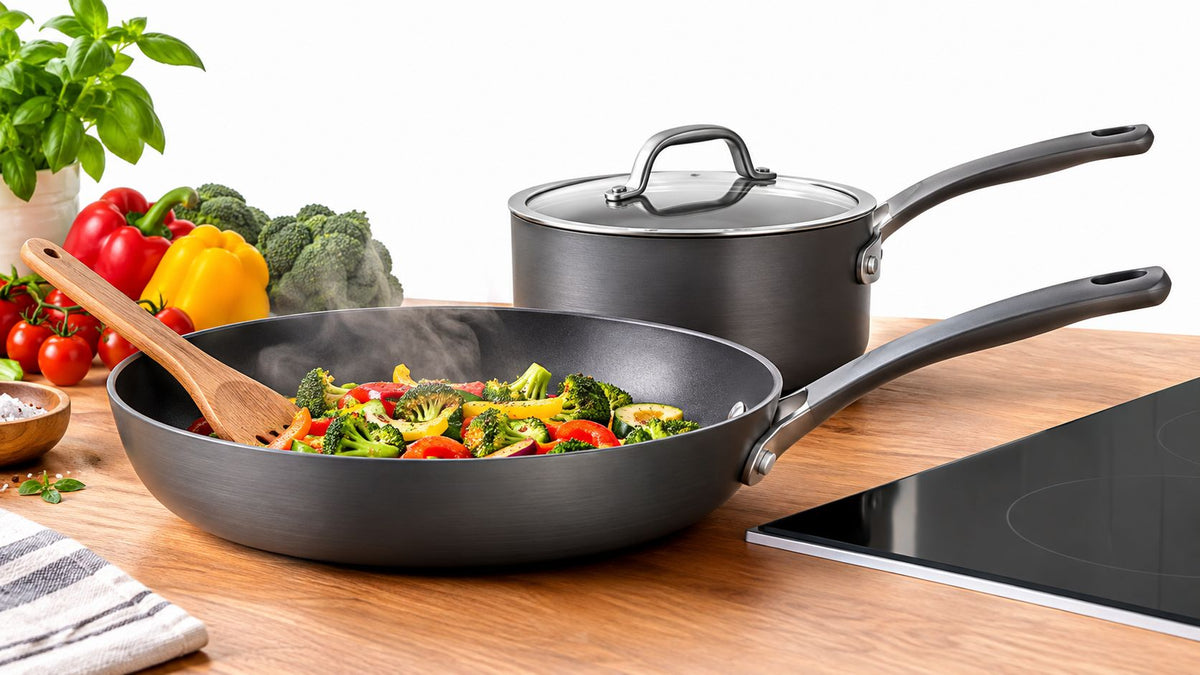
You're halfway through dinner when the skillet turns an omelette into a stuck-on puzzle. The tomato sauce is scorching around the edges while the centre stays quiet, and the pan in your rental kitchen has a handle that already feels loose. These frustrations look small, but cookware material sits behind each one.
Anodized aluminum cookware is designed to keep aluminum's quick heat response while giving its surface greater hardness and less reactivity. That can make it a practical choice for families cooking nightly, renters who need manageable pans, and property managers replacing kitchen equipment between occupants. It isn't perfect for every stove or cooking style, though.
The useful question isn't “What's the best cookware material?” It's “What will work reliably in this kitchen, for these meals, with this cleaning routine?” The guide below covers how anodizing works, what the safety and California disclosure labels mean, how to care for the surface, and how to choose pieces for a home, rental, or small operation. If you're still deciding between pan shapes, this guide to saucepan versus frying pan can help before you compare materials.
Table of Contents
- Why the Pan You Cook With Quietly Shapes Every Meal
- What Anodizing Actually Does to Aluminum
- The Real Pros and Cons of Anodized Aluminum Cookware
- Safety, Food Contact, and the California Disclosure Rule
- Cleaning and Caring for Hard-Anodized Surfaces
- How Anodized Aluminum Compares to Stainless, Cast Iron, and Coated Nonstick
- Choosing the Right Set for Renters, Families, and Small Operations
- A Simple Decision Framework Before You Buy
Why the Pan You Cook With Quietly Shapes Every Meal
A Wednesday evening meal exposes cookware weaknesses quickly. Eggs need an even, controlled surface. A sauce needs steady heat without a scorched ring. A large pan should lift comfortably when you're moving vegetables from the hob to the table. When a pan responds poorly, the cook often blames the recipe, even though the material may be the quieter problem.
Renters usually notice handling and storage first. A pan that's manageable in a compact kitchen is easier to wash, return to a cupboard, and use on a small electric or gas hob. For families, the priority may be consistency. The same skillet should brown a grilled cheese sandwich, cook several portions of chicken, and release vegetables without demanding perfect technique every night.
Property managers have a different calculation. A furnished rental needs pieces that tolerate repeated use by people with different habits. Handles, lids, surface care, stacking, and cooktop compatibility matter as much as the first cooking result. Replacing an entire mismatched collection creates more work than standardising a practical group of pans.
A useful buying rule: choose for the routine you actually have, not the cooking identity you hope to develop.
Anodized aluminum sits between several familiar options. It preserves aluminum's strong heat response, adds a hardened surface, and can be paired with nonstick coatings in some designs. It may suit a cook who wants faster temperature changes than heavy cast iron offers, but more durability than a basic coated pan. It may also suit a property where lightweight handling matters, provided the base matches the hob.
The sections ahead treat the pan as a working tool rather than a status purchase. You'll see where the material performs well, where it creates compromises, and which checks deserve attention before you put a set in a basket.
What Anodizing Actually Does to Aluminum
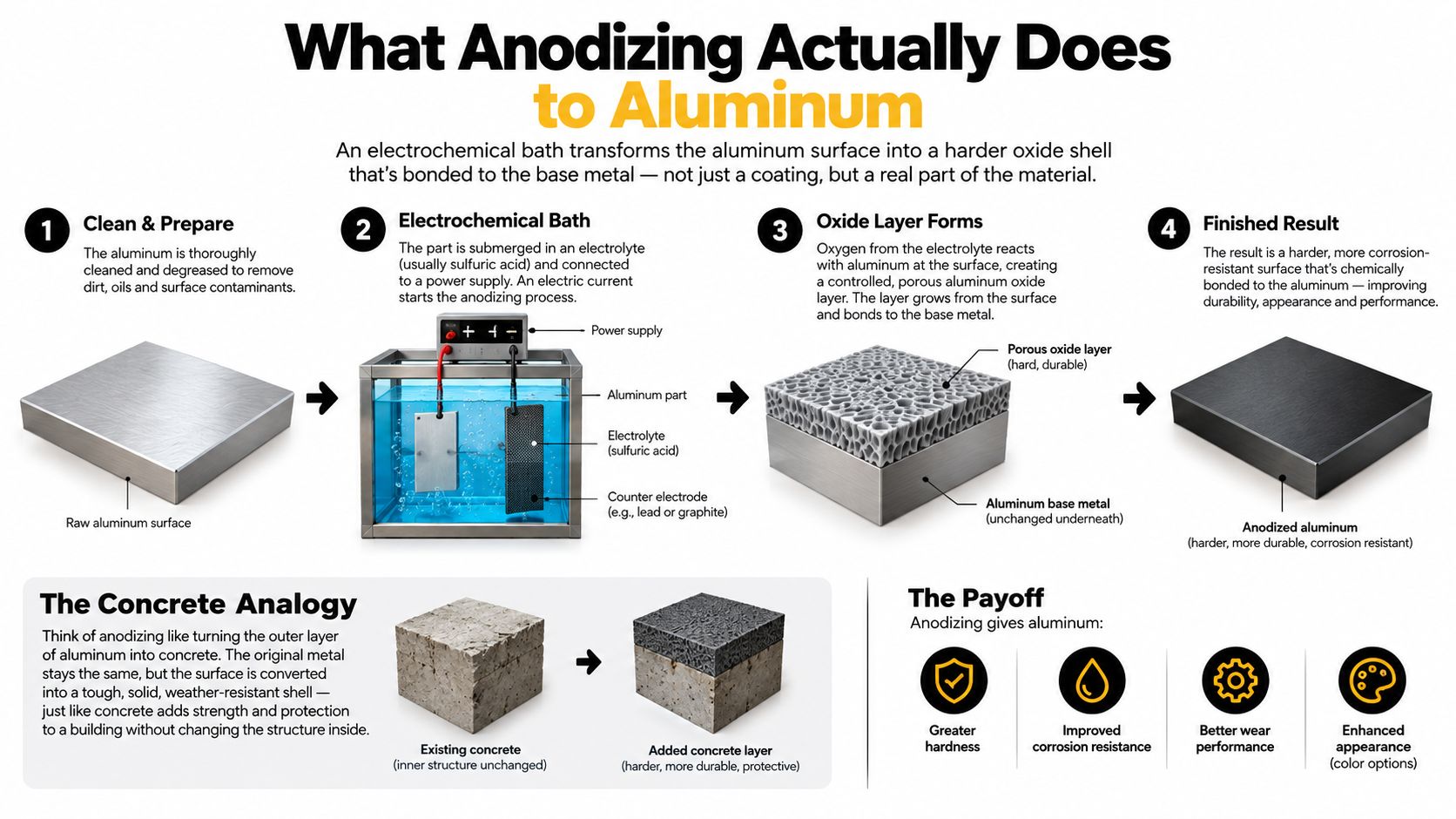
Anodizing is an electrochemical process that changes the outer surface of aluminum. The manufacturer places the metal in an electrolytic bath and uses an electrical current to form a layer of aluminum oxide on the surface. That layer is bonded to the underlying aluminum, rather than sitting on top like paint.
A simple analogy is a loaf of bread with a deliberately hardened rind. The inside remains the same basic material, but the outside becomes more resistant to everyday contact. With cookware, the hardened outer layer helps shield the aluminium beneath it from direct contact with food.
Health Canada describes anodized aluminum cookware as conducting heat as ordinary aluminum does, while its hard oxide surface improves scratch resistance and durability. It also says the surface reduces aluminum transfer into food, particularly with acidic foods such as tomatoes and rhubarb. You can read the agency's guidance on safe cookware use and food contact.
Standard and hard anodizing
Manufacturers commonly distinguish standard anodizing, often called Type II, from hard anodizing, often called Type III. Hard anodizing produces a denser, more wear-resistant oxide layer, which is why it appears so often in cookware descriptions. The exact construction still varies by manufacturer, so the words “hard anodized” should be read alongside the care instructions and base design.
The result usually looks darker and more matte than bright, untreated aluminum. The surface can also feel more substantial because cookware makers often combine the treatment with thicker-gauge metal or reinforced bases. The anodizing itself doesn't mean every pan has the same wall thickness, weight, or oven rating.
McGill's independent Canadian science commentary explains that the oxide layer is unreactive, does not leach aluminum into food, and can be harder than stainless steel while retaining aluminum's heat-conduction advantage. That combination explains the material's appeal in kitchens that need even heating and a surface built for frequent use.
For a related household example, the FOCUS ELECTRONICS 86208 Flex Magnet COB Light Aluminum uses an aluminum housing and offers a flexible magnetic design, a bright COB LED, a compact 11-inch length, and included AAA batteries. It's a lighting product, not cookware, but it illustrates why the word “aluminum” alone doesn't tell you whether a surface has been anodized.
A short visual explanation can make the process easier to remember:
The Real Pros and Cons of Anodized Aluminum Cookware
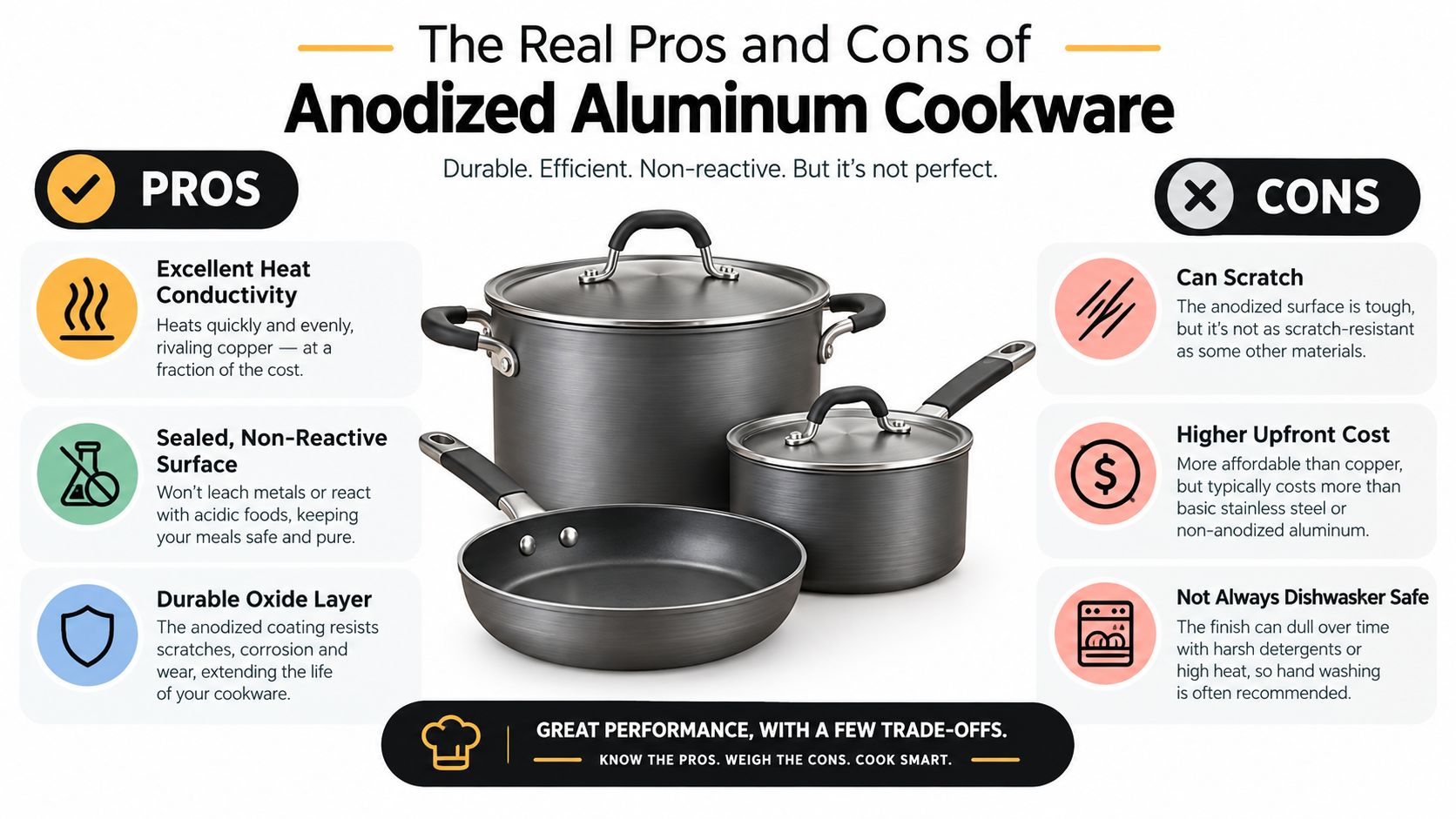
The strongest case for anodized aluminum cookware is its balance. Aluminum reacts quickly to changes in heat, which helps when you lower a burner under a delicate sauce or raise it to brown vegetables. The anodized surface adds a harder, less reactive cooking face, so the pan isn't behaving like bare aluminum when you add tomato, lemon, or vinegar.
Where it earns its place
A weeknight cook may value the quick response more than heat retention. If onions are browning too quickly, a responsive pan gives you a better chance to correct the temperature. Hard-anodized construction also tends to resist everyday wear better than a thin, untreated aluminum pan.
McGill's commentary describes anodized cookware as easier to clean, harder than stainless steel, and better at conducting heat. Those properties can work well for a busy kitchen where one skillet moves from sautéing vegetables to cooking a protein, then goes straight to the sink.
The surface isn't automatically nonstick, however. Some hard-anodized pans have a separate nonstick coating, while others rely on the textured oxide surface plus oil and cooking technique. Read the product description carefully instead of assuming that “hard anodized” means eggs will slide out without fat.
Where the compromises show
Induction is the first compatibility question. Aluminum itself doesn't provide the magnetic response an induction hob needs, so the pan requires a bonded steel or other magnetic base. A pan can be excellent on gas or electric and still fail to heat on induction.
Weight also varies. Hard-anodized pans may feel heavier than standard aluminum, especially when they use thicker construction or a reinforced base. That can improve stability, but a large sauté pan filled with food may be uncomfortable for someone with limited wrist strength.
The dark matte finish has a practical downside. Grease film, oil marks, and pale water streaks can be more visible than they are on polished stainless steel. Deep scratches that expose raw aluminum also aren't a home repair job. You can clean and protect the surface, but you can't recreate the factory anodizing in a kitchen cupboard.
For a specific large-surface example, the All-Clad HA1 Double Burner Grill Pan, 13 × 20-Inch Nonstick is described as spanning two burners, with low walls and an open surface intended for larger portions, grill marks, and fat drainage. Its dimensions also show why buyers should consider storage and lifting before choosing oversized cookware.
| Advantage | Everyday benefit | Limitation |
|---|---|---|
| Quick heat response | Easier temperature changes for sauces and vegetables | Heat can change quickly if the burner is set too high |
| Hardened oxide surface | Better resistance to routine scratches and wear | Deep damage cannot be repaired at home |
| Reduced reactivity | More confidence with acidic ingredients | The surface still needs sensible care |
| Optional nonstick construction | Easier release for eggs and pancakes | The coating, if present, has its own care limits |
| Aluminium base | Manageable handling compared with cast iron | Induction requires a magnetic base |
Safety, Food Contact, and the California Disclosure Rule
Food safety and product disclosure are related, but they answer different questions. The food-contact question is whether the cooking surface is suitable for contact with ingredients. The disclosure question is whether a manufacturer must identify intentionally added chemicals under a particular law.
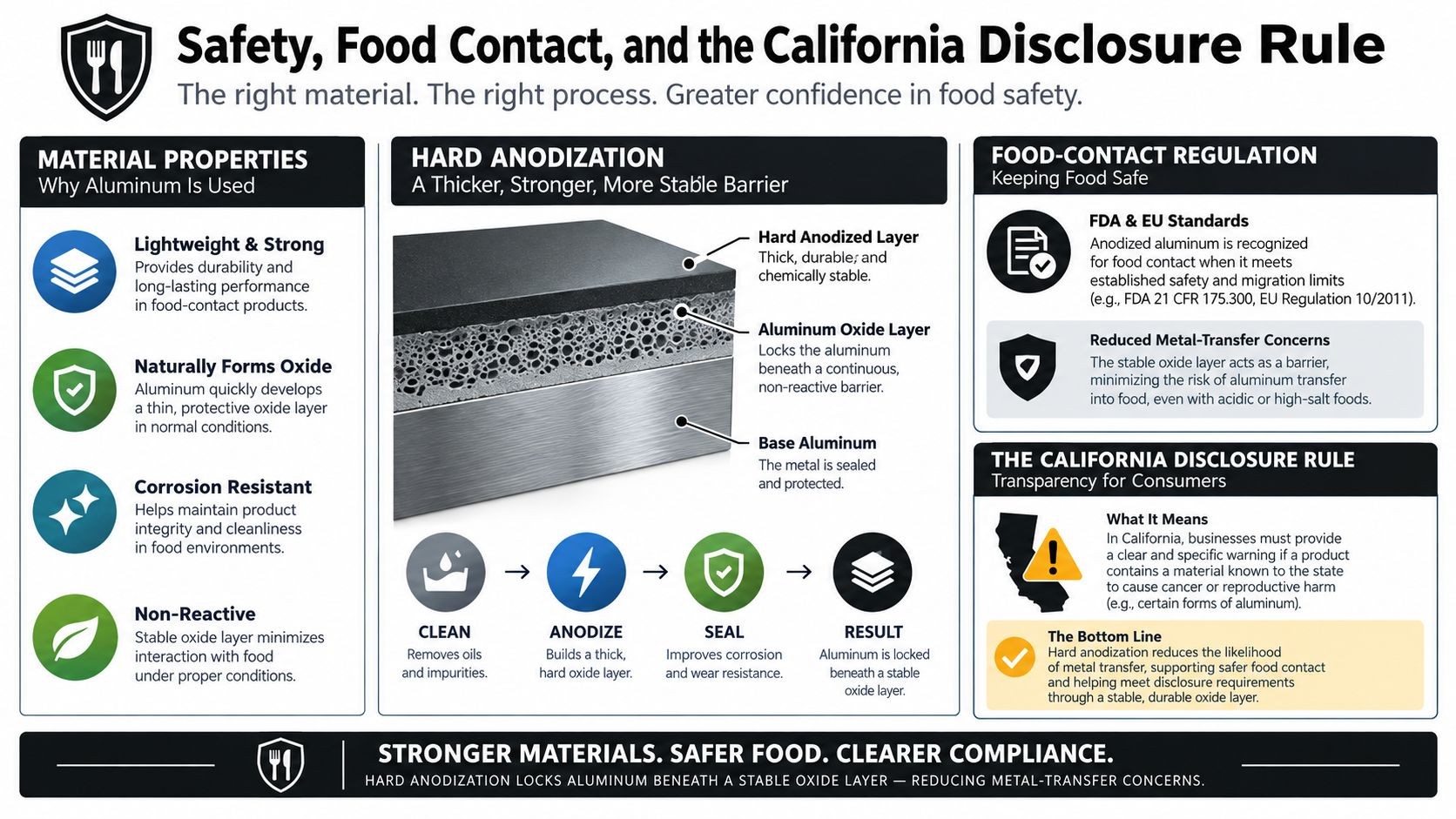
Hard anodization changes the surface that food touches. Health Canada says anodized aluminum retains aluminum's heat conductivity while its hard oxide surface reduces transfer into food, especially acidic foods. That distinction matters when a bare aluminum pan would otherwise be used for a long-simmered tomato sauce or a rhubarb preparation.
McGill's commentary describes the anodized layer as unreactive and says it does not leach aluminum into food. Those points support a measured view: an intact anodized surface is not the same food-contact situation as untreated aluminum. You should still follow the manufacturer's instructions, especially if the pan has a separate nonstick layer or visible damage.
What California buyers should understand
California's AB 1200 cookware disclosure law took effect in stages. For covered cookware sold in the state, manufacturers had to post website disclosures starting January 1, 2023, and add product-label disclosures starting January 1, 2024, when cookware contains intentionally added chemicals on California's designated list in a food-contact surface or handle. The requirements and wording are set out in the California Health and Safety Code.
This is especially relevant to anodized aluminum products because aluminum appears on California's authoritative chemical lists. A pan marketed as hard-anodized or nonstick can therefore require a disclosure review when it contains aluminum in the relevant surface or handle. AB 1200 also restricts certain “free of” claims for listed chemical classes unless no individual chemical from that class was intentionally added.
For a renter or household buyer, a disclosure isn't a simple pass or fail signal. Read the manufacturer's material information, check whether the product has a separate coating, and look for clear statements about the food-contact surface. Claims such as PFOA-free, PTFE-free, or lead-free can be useful, but they're meaningful only when the manufacturer explains what they cover.
If you're also comparing ceramic surfaces, this guide to ceramic cookware safety can help you separate coating questions from the properties of the aluminum body. Reasonable caution means checking the construction and care instructions. It doesn't mean treating every disclosure as proof that the pan is unsafe.
Cleaning and Caring for Hard-Anodized Surfaces
Care starts at the sink. Let the pan cool enough to handle safely, then wash it by hand with mild dish soap and a soft sponge. This removes residue without adding the abrasion that gradually dulls or scratches a hard-anodized surface.
Dishwasher cycles can be hard on cookware finishes, and steel wool or abrasive powders can shorten the useful life of the surface. A pan labelled dishwasher-safe may tolerate that cleaning method, but hand washing is the gentler default when you want to preserve the finish.
What to do when food sticks
Don't attack a cold pan with a metal scraper. Add water while the pan is still warm, let the residue loosen, and lift it with a wooden or silicone utensil. This approach is especially useful after a sugary sauce or browned protein leaves a stubborn film.
For a more detailed cleaning routine, see this guide to cleaning a nonstick frying pan. The same practical habits apply when a hard-anodized pan includes a separate nonstick interior, but always give the manufacturer's instructions priority.
Baking soda paste can help with mild discolouration or a dull patch. Use light pressure, rinse thoroughly, and avoid turning a cosmetic mark into an abrasive cleaning session. Vinegar diluted with water can help with mineral spots, but don't leave acidic cleaners sitting on the pan for long periods.
Storage makes a difference
Stacked pans can scratch one another even when each piece looks smooth. Place a felt protector or folded paper towel between nesting pieces, and store lids so their rims don't grind against the cooking surface.
Hard-anodized cookware doesn't need cast-iron-style seasoning. A thin wipe of cooking oil after washing can help food release, but it isn't a replacement for a worn nonstick coating or protection against deep scratches. Renters cleaning between moves and families washing pans nightly will get better results from consistent gentle care than from occasional heavy restoration.
How Anodized Aluminum Compares to Stainless, Cast Iron, and Coated Nonstick
No material wins every cooking argument. Stainless steel rewards high heat, browning, and deglazing, but food release depends on preheating, oil, and timing. Cast iron holds heat exceptionally well and suits steaks, cornbread, and oven cooking, but its weight and maintenance can be tiring.
Traditional coated nonstick makes eggs and pancakes easy for beginners. It generally offers the slickest release when new, but the coating needs careful utensil and heat choices. Hard-anodized aluminum can offer a middle path, with faster response than cast iron and a tougher surface than a basic nonstick pan, though it may not release delicate food as effortlessly as a fresh coating.
| Material | Heat response | Weight | Maintenance | Best for |
|---|---|---|---|---|
| Anodized aluminum | Fast and responsive | Moderate, depending on construction | Gentle washing and surface protection | Weeknight meals, sautéing, sauces, rental kitchens |
| Stainless steel | Steady, with technique-dependent heating | Moderate | Tolerates robust cleaning and high heat | Browning, searing, deglazing, long service |
| Cast iron | Slow to heat, excellent heat retention | Heavy | Seasoning and careful drying | Steaks, cornbread, baking, oven meals |
| Coated nonstick aluminum | Fast, with easy food release | Light to moderate | Avoid harsh tools and excessive heat | Eggs, pancakes, delicate foods, beginner cooking |
Match the material to the meal
A family cooking quick dinners may use anodized aluminum for vegetables, rice, sauces, and ordinary skillet work. A cook who sears steak regularly may prefer stainless steel or cast iron for the high-heat surface and fond left behind for pan sauce.
Bread bakers often appreciate cast iron's heat retention, while a furnished rental may benefit from anodized aluminum or stainless steel because the pieces are easier to standardise across different users. A property manager should also check whether cleaning instructions are realistic for guests. A pan that requires specialist care may create more turnover complaints than its cooking performance justifies.
The material choice can also be mixed. One household might use a hard-anodized skillet for eggs and vegetables, a stainless sauté pan for browning, and a cast-iron baking vessel for bread. That is often more practical than expecting one set to perform every task equally well.
For a broader look at the decision between stainless and coated surfaces, read this comparison of stainless steel and nonstick cookware. The important point is not to choose by material reputation alone. Choose according to heat, food type, lifting comfort, and the cleaning habits of the person who'll use the pan.
Choosing the Right Set for Renters, Families, and Small Operations
A renter usually needs a compact working kit rather than a ceremonial collection. An 8-inch skillet handles a single egg or a small portion, while a 10-inch skillet covers everyday frying and sautéing. Add a 3-quart saucepan for grains, vegetables, reheating, and sauces. If the kitchen uses induction, confirm that each piece has a magnetic base before buying.
Families need capacity without filling every cupboard. A 10-piece set can make sense when it includes a 12-inch sauté pan, two saucepans, and a stockpot suited to batch cooking. Check whether the lids fit multiple pans, whether handles remain comfortable when the pan is full, and whether the pieces stack without grinding their surfaces together.
Small operations, furnished rentals, and bed-and-breakfast kitchens should prioritise standardisation. Matching pieces simplify inventory checks, make replacement easier, and reduce the chance that a guest receives a pan incompatible with the property's hob. Uniform handles and lid shapes also help staff identify missing items quickly.
Read the specification sheet closely
Cooktop compatibility should appear before colour or finish. Gas and conventional electric hobs are generally straightforward, while induction requires a magnetic base. Halogen and ceramic-glass surfaces need a flat base that sits securely and won't scratch the cooking surface.
Oven limits vary by pan, lid, handle, and coating. Don't rely on a typical range such as 400 to 500°F as a guarantee. Verify the exact temperature rating, broiler guidance, and whether the lid has a lower limit than the pan.
Riveted handles can provide a secure connection, but they also create small areas that need cleaning. Lids should sit neatly without wobbling, and handles should remain comfortable when you tilt a pan to pour. Open-stock purchasing can be more efficient than buying a large set if you already own a useful stockpot or only need to replace one skillet.
Sizing should follow meals, not the number of pieces in a box. A rough household rule is one quart of saucepan capacity per person for daily cooking, while an 8-quart stockpot can cover soups and pasta for four. Treat those as starting points, then adjust for appetite, storage, and the dishes you regularly prepare.
| Buyer type | Recommended pieces | Key features to prioritise | Budget range |
|---|---|---|---|
| Renter | 8-inch skillet, 10-inch skillet, 3-quart saucepan | Induction base if needed, manageable weight, nesting storage | Choose a practical mid-range set or open-stock pieces |
| Family | 10-piece set, 12-inch sauté pan, two saucepans, stockpot | Useful lid coverage, batch-cooking capacity, comfortable handles | Spend on the pieces used most often |
| Small operation | Standardised skillets, saucepans, sauté pans, and stockpots | Stackability, clear care instructions, consistent replacement options | Compare total replacement needs, not just the initial set |
A Simple Decision Framework Before You Buy
Start with the hob. If you cook on induction, confirm the base is magnetic rather than assuming the word “aluminum” tells you enough. Gas and electric users have more flexibility, but a flat, stable base still matters.
Next, count the meals and the people. A single renter may need two skillets and one saucepan, while a family cooking batch meals needs a larger sauté pan and stockpot. Don't pay for duplicate pieces that will spend their lives stacked at the back of a cupboard.
Then assess cleaning realistically. If the pan will go through a busy household routine or rental turnover, look for clear dishwasher guidance and a finish that users can maintain without special products. If you're happy to hand wash, you can give more weight to handling, heat response, and surface feel.
Finally, ask who owns the risk. A homeowner buying for personal use may accept a more specialised pan. A property manager needs replaceable pieces, consistent sizing, and specifications that remain easy for different occupants to understand.
Four questions to keep beside the product page
- What cooktop do I use? Confirm induction compatibility, base flatness, and size.
- How many people do I cook for? Select capacity before counting pieces.
- How will the pan be cleaned? Match the care instructions to real behaviour.
- Is this for one cook or changing occupants? Prioritise personal fit for a home and standardisation for a rental or small operation.
A basic hard-anodized starter set with an induction-compatible base can suit many renters. Home cooks who want a wider range of techniques may pair anodized aluminum with one stainless sauté pan. Small operations should standardise on one clearly specified line and document its care routine for staff or guests.
This is the same practical logic behind a decision-making framework: reduce a broad choice to the constraints that determine success. The right pan is the one that matches the cook, the stove, and the meal, not the one with the longest feature list.
GrifGlo organises cookware guidance, comparisons, and sizing advice for households, renters, property managers, and small hospitality teams. Visit GrifGlo to compare practical kitchen essentials and choose anodized aluminum cookware that fits your routine, storage, and cooktop.


Laisser un commentaire
Ce site est protégé par hCaptcha, et la Politique de confidentialité et les Conditions de service de hCaptcha s’appliquent.