

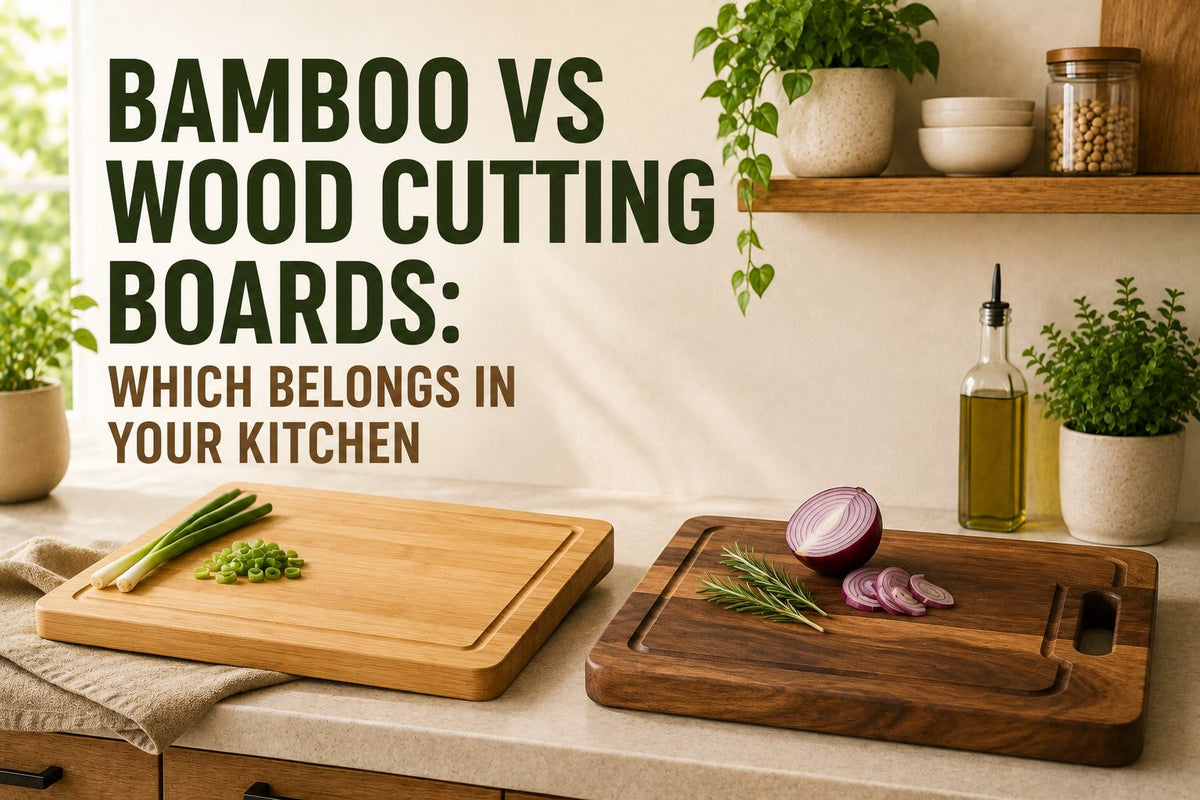
Most advice on bamboo vs wood cutting boards starts with an easy verdict: bamboo is the greener, more hygienic choice. That conclusion is too quick. Bamboo boards are usually compressed composites made from bonded strips, while many wood boards are milled from solid hardwood. That difference affects how each board scars, handles moisture, responds to washing, and reaches the end of its useful life.
For Canadian kitchens, the better question isn't which material wins in a product comparison. It's which board suits the way you cook. A board that looks impressive on day one can become a poor purchase if you soak it, put it through the dishwasher, or ignore deep knife grooves. Compliance also matters, particularly for commercial kitchens, rental properties, and anyone buying boards in bulk.
| Criterion | Bamboo boards | Hardwood boards |
|---|---|---|
| Construction | Usually laminated strips bonded with adhesive | Often solid wood or hardwood blocks |
| Surface feel | Dense and hard, with visible glue lines on many boards | Natural grain, with construction varying by board |
| Knife care | Can be less forgiving to knife edges | Often gentler, depending on species and finish |
| Moisture behaviour | Water-resistant, but vulnerable to adhesive-line damage | Can warp or crack if soaked or dried poorly |
| Repair potential | Limited when delamination or glue failure begins | Often can be resurfaced if damage is still cleanable |
| Maintenance | Hand-wash, dry promptly, oil regularly | Hand-wash, dry promptly, oil as needed |
| Compliance question | Ask about adhesive, finish, and migration testing | Ask about finish and food-contact documentation |
Table of Contents
- Rethinking the Bamboo vs Wood Cutting Boards Debate
- How Bamboo and Wood Boards Are Actually Made
- Comparing Hardness, Knife Care, and Sanitation
- Canadian Food-Contact Compliance and Adhesive Safety
- Matching Board Material to Your Kitchen Routine
- Total Cost of Ownership Over One to Three Years
- Practical Recommendations for Every Kitchen Setup
Rethinking the Bamboo vs Wood Cutting Boards Debate
Bamboo isn't automatically sustainable or sanitary just because the raw material grows quickly. The finished board is a manufactured object, and its performance depends on how the bamboo was split, bonded, pressed, finished, and treated during daily use. A solid hardwood board has a different set of strengths because its working surface can often be renewed rather than discarded when wear accumulates.
That distinction matters more than most shopping guides admit. If you chop vegetables every evening, process proteins, and wash the board aggressively, the material label won't protect you from poor care. Deep grooves, standing water, open seams, and delayed drying create the practical problems that shorten a board's life.
Practical rule: Buy for your washing habits first, your aesthetic preferences second, and the marketing story third.
Canadian homes also create particular pressure on kitchen equipment. A busy family may clean immediately but use the board heavily. A renter may want one uncomplicated board that survives inconsistent care. A short-term rental host needs repeatable cleaning instructions and dependable food-contact documentation. A professional or bulk buyer needs more than a vague “natural” label.
Bamboo can work well for cooks who want a light, dense surface and who will hand-wash it. Canadian safety-oriented retail guidance describes bamboo as harder and more water-resistant than many wood boards, which can reduce knife scarring and limit places where bacteria persist, but it also warns that bamboo needs frequent oiling and shouldn't be left in the dishwasher because heat and repeated moisture can warp or damage it. Canadian guidance on unacceptable cutting-board materials and care supports that balanced view.
Hardwood earns its place when repairability and knife care matter. The board may demand more attention, yet a well-made hardwood surface can offer a longer service path for an owner willing to clean, dry, oil, and eventually resurface it. The verdict is therefore behavioural: the board you maintain consistently will usually outperform the board whose material you merely admire.
How Bamboo and Wood Boards Are Actually Made
Construction explains much of the disagreement around these boards. Bamboo is a grass, not a conventional hardwood, and commercial cutting boards are generally produced by cutting it into strips, drying those strips, arranging them, and bonding them under pressure. The adhesive creates a unified panel, but it also introduces glue lines that don't behave exactly like the surrounding bamboo.
A solid hardwood board starts with timber that is milled, shaped, and finished. Depending on its design, the grain may run across the surface in an edge-grain layout or present end grain in a block construction. The board can still contain joins, but its behaviour comes primarily from the wood fibres rather than from a network of adhesive seams.

Why glue lines change the wearing pattern
Bamboo's dense feel can be appealing under a knife. That hardness helps resist light surface marking, but a hard surface isn't automatically kinder to blades. The knife meets a firm, laminated material, and repeated chopping can make sharpening more important over time.
The adhesive lines also create a different failure pattern. A solid hardwood board may develop shallow cuts that can be sanded away if the damage hasn't compromised cleanability. A bamboo board with separating seams or delamination has a more fundamental problem. Sanding the top may not restore the bond beneath it, and aggressive sanding can remove useful material without fixing the underlying failure.
This is why construction deserves more attention than a simple bamboo-versus-maple label. Two boards that look similar in a shop can have very different repair prospects once moisture reaches their joins.
Moisture moves through both materials
Neither board should be treated as a soaking dish. Wood fibres exchange moisture with the surrounding environment, while bamboo composites can respond differently across the bamboo strips, adhesive, and finish. Repeated wetting, high heat, and slow drying place stress on the whole assembly.
A pizza-serving board illustrates the same design issue from another angle. Grain direction, surface stability, and finish influence how a board handles food, heat, and presentation, which is why choosing a board for its intended task matters. The wooden pizza board guide offers a useful comparison point for that broader distinction.
For shoppers considering a non-wood alternative, the Combekk Recycled Paper Cutting Board 20x30 cm is described in the catalogue as made entirely from recycled paper and as knife-friendly and dishwasher-safe. It belongs in a separate material category, so its care instructions shouldn't be assumed to apply to bamboo or hardwood.
Comparing Hardness, Knife Care, and Sanitation
California's Retail Food Code, effective January 2025, offers a more useful starting point than a simple hardness contest. It generally excludes wood and wood wicker from food-contact surfaces but explicitly permits hard maple or an equivalently hard, close-grained wood for cutting boards and cutting blocks. The same guidance requires scratched or scored surfaces to be resurfaced or discarded when they can no longer be effectively cleaned and sanitised. California Retail Food Code guidance for cutting boards therefore matters to home cooks who want a board that remains serviceable, not merely attractive when new.
That rule also exposes a practical difference between a solid hardwood board and an adhesive-bonded bamboo composite. A bamboo board may resist light marks and feel firm during vegetable preparation, but its long-term condition depends on the bamboo strips, adhesive joins, and finish. Hardwood can show knife marks sooner, yet a structurally sound board may offer more scope for renewal.
What the board feels like during real prep
Bamboo often feels crisp and stable during tomato slicing, cucumber work, and fruit preparation, especially when the surface is kept dry and oiled. Its resistance to light scarring suits cooks who prefer a board that looks tidy. The trade-off can appear at the knife edge. Repetitive chopping may make a finely maintained edge feel less lively sooner, particularly for cooks who sharpen carefully and expect maximum retention. A practical kitchen knife sharpening guide helps set realistic expectations for that maintenance cycle.
Hardwood generally offers a more forgiving cutting surface, but “wood” still covers many species, grain layouts, finishes, and construction methods. A softer or poorly finished board is not automatically a better choice. Its advantage is often repairability, provided damage has not reached a serious crack, persistent warp, or failed join.
Raw-protein preparation changes the priorities. Choose a board large enough to contain juices, clean it promptly, and inspect it under good light before the next use. A bamboo board needs particular attention around glue lines and any lifted or separated strips. A hardwood board needs inspection too, with the added option of resurfacing when its structure remains sound.
Sanitation depends on condition and routine
Neither material becomes self-sanitising through hardness or water resistance. A board that stays wet, especially around its underside and edges, is harder to keep in good condition. Repeated exposure can affect bamboo's composite structure, while hardwood may warp, crack, or deteriorate when drying is delayed.
Surface condition determines whether cleaning remains effective. Fine knife marks are part of normal use, but a scored area that holds residue calls for action rather than more casual wiping. Resurface a structurally sound hardwood board when appropriate. Replace or reassess a bamboo board if damage compromises its bonded layers or leaves areas that cannot be cleaned reliably.
For kitchens handling raw proteins, board material should sit inside a documented cleaning routine. The resource on commercial kitchen bacteria control provides a useful operational perspective, including the need to treat cleaning as a repeatable process rather than a reaction to visible mess. In a home kitchen, that means washing promptly, drying every face and edge, and separating tasks where practical.
The cost is tied to habits. A bamboo board that is washed by hand, dried quickly, and monitored at its joins may serve well, while a neglected hardwood board can become unsanitary or structurally weak. Conversely, a cook who wants to sand and renew a board may get more usable years from hardwood. The better choice depends on whether the household will follow the care routine and whether the board can be repaired when wear becomes visible.
Canadian Food-Contact Compliance and Adhesive Safety
Canadian shoppers rarely receive enough practical information about the difference between an untreated hardwood surface and a compressed bamboo composite. The important question isn't whether a board is marketed as natural. It's whether the complete finished product, including adhesive and coating, is suitable for contact with food under normal use.
Canadian food-contact rules require materials not to transfer harmful substances during normal use. Bamboo binders also receive scrutiny for formaldehyde, which makes adhesive composition a legitimate purchasing question rather than an abstract manufacturing detail. The concern is especially relevant where strips are bonded together and the food-contact surface may be affected by the adhesive system or finish.

What to ask a supplier
A consumer doesn't need to become a materials engineer, but a vague product page shouldn't be the final word for a board used in a commercial or shared kitchen. Ask the seller or importer for documentation that identifies the finished board, not merely a general statement about bamboo or wood.
Look for:
- Food-contact declaration: Ask whether the finished board is intended for food contact under normal use in Canada.
- Migration testing: Request evidence that the complete material and finish have been assessed for substances that could transfer to food.
- Adhesive information: For bamboo, ask what bonding system joins the strips and whether the supplier provides documentation addressing formaldehyde concerns.
- Finish details: Confirm what coating is used and whether it is intended for a cutting surface that will be repeatedly washed and cut.
- Traceability: Commercial and bulk buyers should be able to identify the manufacturer or importer responsible for the product.
A single-piece hardwood board has fewer bonded interfaces to assess, but it still isn't automatically compliant because the finish, treatment, manufacturing conditions, and supplier documentation matter. A bamboo board isn't automatically unsafe because it contains adhesive either. The useful distinction is that composite construction creates additional questions, and responsible sellers should answer them clearly.
Compliance is a purchasing filter
For a home cook, this may mean choosing a board with a clear manufacturer statement rather than relying on phrases such as “antibacterial” or “eco-friendly.” For a rental operator or hospitality buyer, it means standardising one documented product and recording its care requirements so staff don't improvise.
Canadian guidance discussed in the market context also highlights a gap in consumer coverage. Buyers often hear about bamboo's natural feel or knife performance, while receiving little advice about third-party testing and chemical-transfer risk. That gap is why food-contact paperwork should sit beside dimensions, grain, and appearance on your buying checklist.
Maintenance still matters after the purchase. Use this wood cutting board maintenance guide for the practical habits that protect a board's cleanability and structural condition. Documentation can't compensate for a surface that has become scored, cracked, or impossible to clean effectively.
Matching Board Material to Your Kitchen Routine
The right choice depends on what happens after dinner, not just what happens during chopping. A cook who washes by hand and dries immediately can use either material successfully. Someone who leaves boards beside the sink or expects dishwasher convenience should reconsider both bamboo and ordinary hardwood.

Choose by routine, not identity
Daily cook: Choose a well-documented hardwood board if you chop vegetables, slice proteins, and care about preserving knife edges. It asks for hand-washing, quick drying, and occasional oiling, but its repair potential can reward consistent care.
Weekend entertainer: A hardwood serving and prep board suits someone who wants a substantial surface with natural grain and a board that can handle presentation as well as slicing. Keep a separate surface for raw meat if your workflow benefits from that division.
Meal-prepper: Prioritise size, stability, and cleanability before material preference. Bamboo can handle repeated vegetable preparation well when you dry and oil it, while hardwood makes more sense if you're willing to maintain and eventually resurface the board rather than replace it.
Light user: If you mostly slice bread, fruit, or small garnishes, bamboo may provide a simple, dense work surface without the visual fuss of a heavily figured hardwood board. Still, don't treat light use as permission to soak it.
The dishwasher household
Neither bamboo nor conventional hardwood should be selected on the assumption that machine washing is harmless. Canadian guidance specifically warns against leaving bamboo boards in the dishwasher because heat and repeated moisture can warp or damage them. Hardwood can also suffer from prolonged wet heat, even if the damage appears more gradually.
If your household relies on a dishwasher for nearly every kitchen tool, look beyond bamboo and wood. A recycled-paper composite may fit that routine better if its manufacturer explicitly lists dishwasher use. For meat-heavy workflows, this guide to cutting boards for meat can help you think through dedicated surfaces, size, and cleaning rather than choosing by colour alone.
Total Cost of Ownership Over One to Three Years
The cheapest board at checkout isn't necessarily the cheapest board to own. A fair comparison includes the time spent washing and oiling, the risk of cracking or warping, the point at which grooves become difficult to clean, and whether the board can be resurfaced instead of replaced.
Bamboo often looks attractive because its dense surface can resist visible wear during early use. The problem appears when aggressive washing, high heat, or standing moisture reaches the laminated structure. Glue lines can weaken, and once a board begins to split or delaminate, the repair options are limited.
Hardwood asks for more active care, but that care can preserve the board's useful life. If the surface becomes scored while the board remains structurally sound, resurfacing may restore a cleanable work surface. That possibility changes the ownership calculation for cooks who use their boards heavily.
Count prep hours, not just purchase price
For a realistic comparison, keep a simple record:
- Record use: Note how often each board handles vegetables, meat, fruit, or serving.
- Track maintenance: Include hand-washing, drying, oiling, and any professional or home resurfacing.
- Inspect condition: Look for deep grooves, cracks, raised fibres, separated seams, and persistent odours.
- Replace on cleanability: Don't keep a board in service once its condition prevents effective cleaning and sanitising.
A bamboo board may cost less to replace but become poor value if your routine repeatedly damages its joins. A hardwood board may require more attention at the start and still cost less over its usable life if resurfacing keeps it serviceable. That isn't a universal price verdict. It's a reminder that maintenance behaviour usually matters more than the material name.
For a rental unit, simple care instructions may matter more than maximum longevity. For a busy family, a second board can reduce bottlenecks and allow one surface to dry while another is in use. For a bulk kitchen setup, consistent documentation, replacement criteria, and supplier traceability are part of the ownership cost even when they don't appear on the invoice.
Practical Recommendations for Every Kitchen Setup
For a first apartment kitchen, choose a documented bamboo board if you want a light, dense surface and you'll hand-wash it after use. Choose hardwood instead if protecting good knives and keeping the board for longer matter more than reducing maintenance effort.
For a family kitchen with heavy daily use, buy a solid hardwood board with enough working space for vegetables and proteins, then commit to prompt drying and periodic oiling. The ability to assess and potentially resurface the surface is valuable when the board sees constant chopping.
A short-term rental needs simplicity. Select a board with clear food-contact information and written care instructions that guests can follow. If guests are likely to use a dishwasher despite instructions, consider a material explicitly designed and labelled for that routine rather than assuming bamboo or wood will tolerate it.
For a hospitality, office, or bulk kitchen, ask for finished-product compliance documentation, adhesive details where relevant, and a replacement policy based on cleanability. Standardising the material and care process is more useful than buying a mixture of attractive boards with inconsistent instructions.
Shoppers who need another material category can review GrifGlo's cutting-board collection, which organises options for practical comparison. Recycled paper composite boards may also suit kitchens seeking a dishwasher-safe option, provided the product's own instructions support that use. The Combekk Recycled Paper Cutting Board 28x38 cm is listed as made entirely from recycled paper and described as knife-friendly and dishwasher-safe.
If you're choosing between bamboo and hardwood, start with your washing routine, knife priorities, and expected replacement cycle, then verify the board's Canadian food-contact documentation. Visit GrifGlo to compare cutting-board options and practical kitchen essentials organised around real household, rental, and bulk-purchasing needs.

Laisser un commentaire
Ce site est protégé par hCaptcha, et la Politique de confidentialité et les Conditions de service de hCaptcha s’appliquent.