

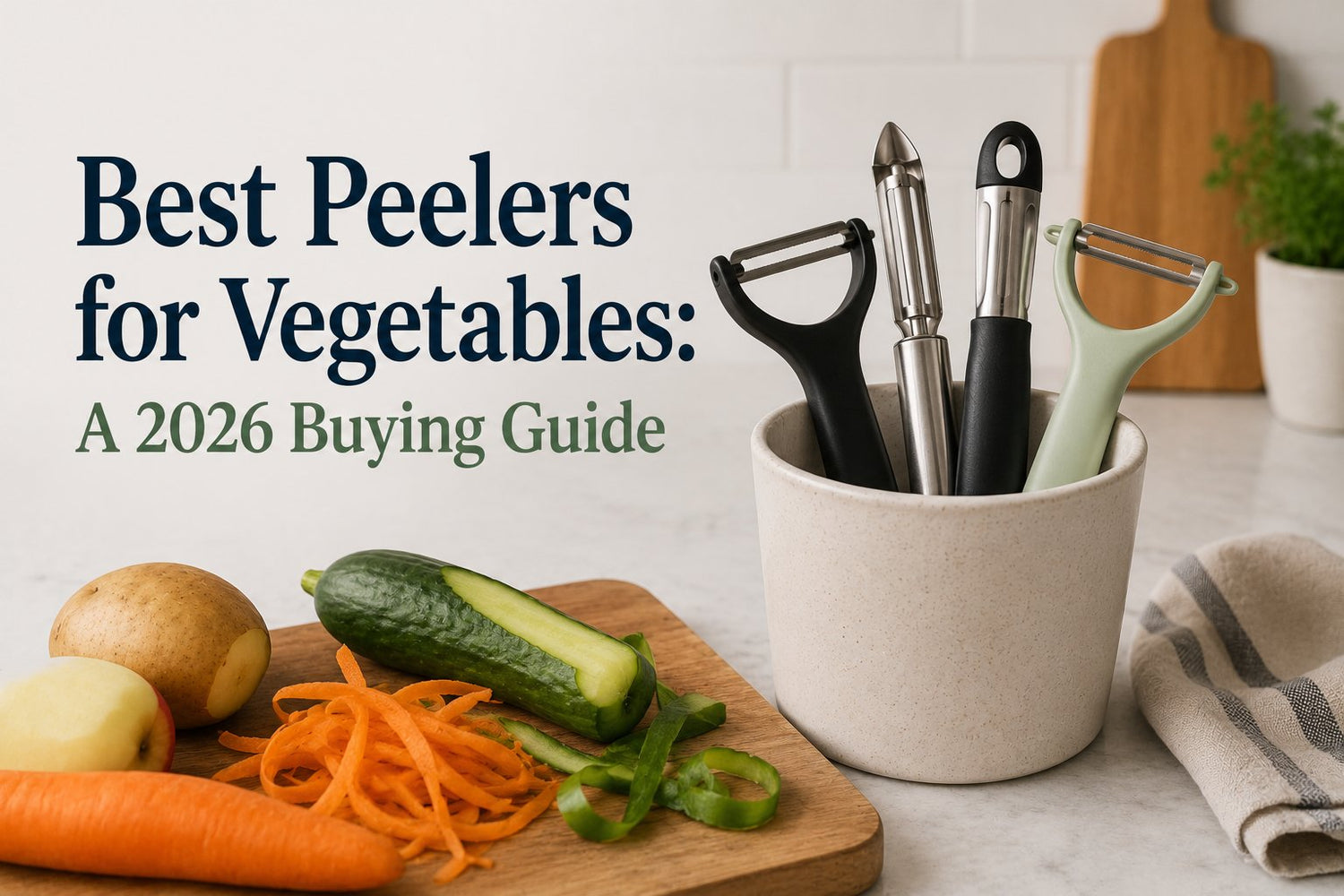
You're probably here because your current peeler is annoying you. It skips over tomato skin, gouges half a potato with each pass, or forces you to grip harder than you should just to get through a few carrots. A bad peeler turns a simple prep job into fiddly, wasteful work.
A good one does the opposite. It moves cleanly, wastes less flesh, and makes repetitive prep feel automatic instead of irritating. That matters whether you're peeling two apples for a snack or working through a pile of potatoes for dinner.
Most roundups try to name one winner and move on. That overlooks the key question. The best peelers for vegetables depend on what you peel most, how you hold the tool, and whether you care more about speed, precision, or comfort. A peeler that flies through potatoes may be mediocre on peaches. One that feels safe on carrots may clog on softer produce.
Table of Contents
- Why Your Vegetable Peeler Matters More Than You Think
- The Four Main Types of Vegetable Peelers Explained
- Key Features to Compare in a Peeler
- Y-Peelers vs Swivel Peelers A Head-to-Head Comparison
- Best Peeler Recommendations for Every Task
- How to Maintain and Keep Your Peeler Sharp
- Your Peeler Decision Checklist and Final Tips
Why Your Vegetable Peeler Matters More Than You Think
You feel a bad peeler halfway through a bag of potatoes. The blade skips, your hand starts squeezing harder, and the pile of peelings looks thicker than it should. By the time you finish, you have lost time, wasted flesh, and made a simple prep job more tiring than it needed to be.
That is why a peeler earns its place in the drawer. It affects speed, waste, grip fatigue, and how safely you can work through a batch of vegetables. If you are building a practical setup, a solid kitchen essentials list should include a peeler that matches the produce you prep.
One peeler does not suit every cook
Common recommendations focus on a broad "best overall" pick. That sounds useful until your kitchen routine looks nothing like the reviewer's.
A cook who peels two carrots for weeknight soup needs something different from a cook who knocks out ten pounds of apples for sauce. Long root vegetables reward control and a clean forward stroke. Round produce rewards speed and a blade angle that keeps moving over curves. Soft-skinned produce can turn a standard straight edge into a frustrating tool in seconds.
That is the trade-off many reviews miss. A peeler can be excellent for potatoes and still feel clumsy on butternut squash. Another can be fast on cucumbers but awkward if your wrist or grip strength is limited.
Practical rule: Choose for your usual prep job first, not the broad claim on the package.
Design changes waste, speed, and comfort
A good peeler takes off a thin, even layer and keeps going without chatter or clogging. That matters more than it sounds. Over a single carrot, the difference is small. Over a pile of carrots, potatoes, or apples, a peeler that cuts too deep wastes produce, and one that drags slows every stroke.
Comfort matters just as much. If the handle shape forces you to pinch hard or bend your wrist into an awkward angle, fatigue shows up fast. In real use, that often matters more than a polished finish or a long feature list.
I judge peelers by one standard. They should disappear in the hand and do one job cleanly, with little thought. The right model is not the one with the loudest marketing. It is the one that fits how you cook, whether that means fast batch prep, careful detail work, or just peeling a few vegetables without fighting the tool.
The Four Main Types of Vegetable Peelers Explained
Before comparing brands, it helps to know the four basic peeler styles. Once you understand the shapes, a lot of buying decisions get easier.
| Peeler type | Shape and grip | Best for | Where it struggles |
|---|---|---|---|
| Swivel peeler | Straight handle, blade in line with the handle | Long vegetables, detail work, familiar knife-like grip | Can feel slower on wide round produce |
| Y-peeler | Horizontal blade across a Y-shaped frame | Potatoes, apples, broad surfaces, fast repetitive peeling | Some cooks never like the grip style |
| Serrated peeler | Usually straight or Y form with toothed edge | Tomatoes, peaches, kiwi, other slippery skins | Rougher on firm vegetables |
| Julienne peeler | Peeler body with comb-like cutting teeth | Thin strips for salads, garnishes, slaws | Not a general-purpose peeler |

Swivel peelers
This is the classic straight peeler many people grew up with. The blade usually pivots a bit as it moves, which helps it follow the contours of the vegetable.
It feels familiar because the hand position is closer to a small knife. That makes swivel peelers comfortable for cooks who like precision and like pointing the tool exactly where they want it to go. They're often strong on carrots, parsnips, and other long produce where controlled strokes matter.
Y-peelers
A Y-peeler places the blade crosswise at the top of the handle. The grip is more like holding a paint roller or a small handle under the blade rather than behind it.
That geometry often makes peeling faster on potatoes, apples, and other rounded produce. The blade spans a wider section, and many cooks find the downward motion more natural during repetitive prep.
A Y-peeler often feels awkward for the first few minutes, then suddenly makes sense when you start peeling larger piles of produce.
Serrated and julienne peelers
Serrated peelers are the answer to produce that laughs at smooth blades. Tomatoes, peaches, and kiwi have skins that can make a standard blade skid. Fine teeth catch that surface instead of sliding off it.
Julienne peelers are specialists. They cut thin strips instead of taking off a plain peel, which makes them useful for salads, vegetable noodles, and garnish prep. They're not a replacement for a standard peeler, just as ITY 4 Piece Ceramic Diamond Pattern Bathroom Set - 70081SET is a distinct household accessory set rather than a kitchen prep tool. Different tools, different jobs.
Key Features to Compare in a Peeler
Once you know the style you prefer, quality differences show up in three places. Blade behaviour, handle feel, and maintenance decide whether a peeler becomes a favourite or drawer clutter.
I couldn't verify any Canada-specific statistical or historical facts about the best peelers for vegetables beyond general recommendation content in the provided results, as noted in this verification note on the limited source set. So the useful approach here is practical evaluation rather than pretending there's a regional data set that settles the question.
Blade material and edge feel
The blade is the whole tool. If it drags, flexes too much, or dulls quickly, nothing else saves it.
In day-to-day use, I look for three things:
- Clean first contact. The blade should bite the skin without skating across it.
- Stable tracking. It shouldn't chatter or wobble when you make a longer stroke.
- Reasonable clearance. If peel strips jam under the blade every few strokes, the design is wrong.
Some peelers feel sharp but harsh. They dig too deep and remove more than they need to. The best ones feel sharp and controlled at the same time.
Handle shape and hand comfort
Handle comfort isn't just about softness. Shape, thickness, weight, and balance matter more. A slick metal handle can feel elegant in the shop and annoying with wet hands. A bulky grip can help one person and tire out another.
For many home cooks, the best test is simple. Hold the peeler in the air and mimic three peeling strokes. If your wrist already wants to twist into an odd angle, keep looking. A peeler should align your hand naturally.
If you're comparing peelers alongside knives, the same comfort logic from choosing a cutlery set in Canada applies. Control beats looks every time.
Maintenance and clogging
Many decent peelers lose points when their blade housing traps peel ribbons. Such a design quickly becomes irritating.
Check these details before buying:
- Open blade area means easier rinsing and less clogging.
- Simple construction usually means fewer hidden bits where food sticks.
- Drying ease matters if you hand-wash tools and don't want moisture lingering around the blade.
The peeler you'll keep using is the one that cleans in seconds and dries without fuss.
A lot of frustration people blame on “dullness” is clogging, poor blade angle, or a handle that encourages bad wrist position.
Y-Peelers vs Swivel Peelers A Head-to-Head Comparison
Most cooks choosing among the best peelers for vegetables are really choosing between a Y-peeler and a swivel peeler. Everything else is niche. This is the decision that affects daily prep.
Here's the quick view first.
| Feature | Y-Peeler | Swivel Peeler |
|---|---|---|
| Grip style | Hand sits under the blade | Hand sits behind the blade |
| Best motion | Fast downward or pull strokes | Controlled back-and-forth peeling |
| Strongest use | Round and broad produce | Long and narrow produce |
| Blade feel | Often more rigid and direct | More adaptive on uneven surfaces |
| Learning curve | Slightly steeper for some cooks | Familiar for most people |

Where Y-peelers usually win
On sheer efficiency, Y-peelers often feel faster. The blade orientation encourages a direct stroke, and the wider top profile can cover more surface on each pass.
Independent expert testing comparing the Kuhn Rikon Original Swiss Peeler with the OXO Good Grips Swivel Peeler found the Kuhn Rikon better overall in a review centred on blade behaviour and hand feel. The same comparison notes a clear design trade-off: a lighter body plus a sharper fixed blade tends to give cleaner passes and less drag on dense vegetables like carrots and potatoes, while swivel designs add articulation but can give up some rigidity and edge stability during repetitive strokes, according to The Produce Nerd's peeler comparison.
That tracks with what many cooks notice at the counter. If you're peeling a big batch of potatoes, a rigid, sharp Y-peeler often feels quicker and less tiring.
Where swivel peelers still make sense
Swivel peelers remain useful for a reason. Their blade movement helps them ride over irregular surfaces. If the vegetable is knobbly, tapered, or awkwardly shaped, that articulation can be forgiving.
They also suit cooks who like a more pencil-like grip. For fine control around curves, stems, or small blemishes, the straight handle can feel more precise.
This quick clip shows the general style under discussion:
Which one should most people buy
If you want one peeler for everyday dense vegetables, I'd lean Y-peeler first. The combination of low drag and stable peeling action is hard to beat when the job is repetitive.
Choose a swivel peeler if these sound like you:
- You value familiar handling because you dislike adjusting to a new grip.
- You peel lots of long vegetables and prefer more tip-forward control.
- You do detail work often around small produce or blemishes.
Choose a Y-peeler if these fit better:
- You peel in volume and want speed with less wasted motion.
- You work mostly with potatoes and apples rather than delicate fruit.
- You prefer a compact tool that stores easily in a crowded drawer.
Neither design is universally superior. But for dense, everyday prep, the fixed-blade Y pattern has a strong practical case.
Best Peeler Recommendations for Every Task
The right recommendation starts with the task, not the catalogue page. If you match the peeler to the work, you'll make a better choice than you would by chasing a generic winner.
Reviewed's 2026 roundup identifies the Kuhn Rikon 3-Set Original Swiss Peeler as the top overall vegetable peeler and the Precision Kitchenware Dual Julienne & Vegetable Peeler as the best specialty option in its tested lineup, as noted in Reviewed's vegetable peeler roundup. That's a useful benchmark because it reinforces something home cooks learn fast. The best performer often isn't the most feature-heavy one.

Best for bulk peeling
If you regularly tackle potatoes, carrots, apples, or sweet potatoes in quantity, go with a light, sharp Y-peeler. In these scenarios, low drag matters most. A peeler that saves a little effort on each stroke feels dramatically better by the time you finish a full batch.
The Kuhn Rikon style is the model to copy here. Lightweight body. Direct blade feel. Clean passes. Those traits beat gadget-heavy designs when the goal is speed and consistency.
Best for delicate skins
Tomatoes, peaches, and kiwi need a different approach. A standard smooth blade often slides before it cuts, which makes you press harder and bruise the surface.
Use a serrated peeler for these jobs. The toothed edge catches the skin with less slipping. It won't be your daily peeler for root vegetables, but it solves a problem the standard blade often can't.
If a smooth peeler keeps skating on soft fruit, stop forcing it. That's usually a sign you need a serrated edge, not more pressure.
Best for long vegetables and detail work
For carrots, parsnips, asparagus, and cucumbers, a swivel peeler still has a place. The straight handle and more pointed control make it easier to peel along length and work neatly around narrow shapes.
This is also the better fit for cooks who peel almost like they're using a paring knife. If you instinctively want to guide the tool with finer hand positioning, swivel designs can feel more natural.
Best for tough squash
No handheld peeler makes hard squash effortless. Some skins are quite demanding. But a sturdy peeler with a stable blade does help.
For butternut squash and similarly firm produce:
- Trim a flat side first so the squash doesn't roll.
- Use shorter strokes instead of trying to remove long strips.
- Prioritise blade stability over extra features.
- Stop if the tool is slipping and switch to partial knife work where safer.
For this kind of prep, comfort matters less than control and bite. A flimsy peeler is frustrating here.
Best for julienne and garnish work
If you make slaws, noodle-style salads, or vegetable garnishes, a julienne peeler is worth owning as a second tool. For such tasks, the Precision Kitchenware Dual Julienne & Vegetable Peeler fits neatly. It's a specialty option rather than a universal replacement, which is exactly the point.
A julienne blade saves time when you want thin, uniform strips without setting up a larger slicer. It's handy for carrots, cucumber ribbons, and similar garnish jobs.
If you're building a broader prep setup and comparing storage solutions for batch cooking, GrifGlo's guide to choosing meal prep containers is relevant because peeler choice and prep volume usually go together. People who peel in quantity often portion and store in quantity too.
Best for left-handed cooks and limited hand strength
Generic rankings often fail people. A peeler can be sharp and still be wrong for your hand.
Look for:
- Symmetrical blade use so the tool doesn't favour one hand awkwardly.
- A handle that stays secure when wet instead of forcing a tight squeeze.
- Low resistance on the stroke because drag tires the hand quickly.
For limited hand strength, a sharp, light peeler usually beats a heavier “ergonomic” one if the heavy model adds effort rather than control. Soft grips help, but only if the blade moves cleanly. Comfort starts at the edge.
How to Maintain and Keep Your Peeler Sharp
A good peeler doesn't need much fuss, but it does need basic care. Most peeling problems start with residue around the blade, moisture left sitting on the metal, or a tool that's been tossed loose into a drawer until the edge gets battered.
Cleaning habits that actually help
Wash the peeler soon after use, especially after sticky produce. Potato starch and fruit residue dry into the blade housing and make the next session feel rougher than it should.
A simple routine works best:
- Rinse immediately so peel fragments don't dry onto the blade.
- Use a brush or sponge carefully to clear trapped bits without dragging fingers across the edge.
- Dry it fully before storing, especially around blade mounts and joints.
If you already maintain your knives, the same mindset from choosing knife sharpening tools applies here. Consistent care beats occasional rescue work.
Sharpen or replace
Some peelers can be touched up lightly, but many are really replace-when-dull tools. That isn't glamorous, but it's the truth. If the blade is thin, enclosed, or awkward to access, aggressive sharpening usually isn't worth the trouble.
A peeler should feel easy. If you have to fight for every strip, the blade has either dulled, clogged, or simply reached the end of its useful life.
A ceramic rod can help on certain exposed edges if you know what you're doing. For many home cooks, though, the better move is replacing a worn peeler before it starts wasting produce and patience. The tool is small. The difference in daily use is not.
Your Peeler Decision Checklist and Final Tips
When you're standing in a shop aisle or comparing models online, don't ask which peeler is “best” in the abstract. Ask which one fits your cooking.

The shortlist that makes the decision easier
- What do you peel most often. Potatoes and apples point many cooks toward a Y-peeler. Carrots and detail work may favour a swivel.
- Do you need a specialist tool. Soft fruit calls for serration. Slaws and garnish work justify a julienne peeler.
- How does your hand naturally move. If the grip feels wrong in the first few test motions, it probably won't improve much.
- Do you want speed or precision. Batch prep and fine control rarely peak in the same design.
- Will you maintain it properly. If you know you won't hand-dry tools, choose a peeler that's simple to clean and less fussy in construction.
Final kitchen tips
A peeler can do more than strip potatoes. It's useful for shaving hard cheese, making chocolate curls, slicing butter thinly, or creating vegetable ribbons for salads.
Drawer storage matters too. If your kitchen tools are always tangled, you'll use the wrong one because it's the one you can reach. A simple system for organizing kitchen drawers makes a bigger difference than people expect.
The best peelers for vegetables are usually the ones that match a narrow set of needs very well. Buy the shape that suits your hand, the blade that suits your produce, and the simplest tool that does the job cleanly.
GrifGlo helps shoppers compare practical home and kitchen essentials with decision-friendly guides, so if you're sorting out prep tools, storage, or everyday kitchen basics, GrifGlo is one place to keep your choices organised without wading through a bloated catalogue.


Laisser un commentaire
Ce site est protégé par hCaptcha, et la Politique de confidentialité et les Conditions de service de hCaptcha s’appliquent.