

You're standing in the kitchen, the door under the sink keeps dropping a little lower, and now it catches the frame every time you shut it. Maybe a pantry door sits crooked after years of use, or an older hinge has gone loose and the screw holes won't hold like they used to. In that moment, the hinge stops being a tiny piece of hardware and becomes the reason the whole cabinet feels annoying to use.
A good hinge choice is less about gadget appeal and more about fit, support, and repairability. The right hinge keeps a door aligned, opens cleanly, and survives everyday use without constant tweaking. If you're trying to sort out the basics before buying anything, start with the cabinet itself, because the cabinet construction usually decides the hinge family long before style does. For storage-heavy spaces, a helpful companion read is under sink storage ideas, since cluttered cabinet layouts often make hinge access and clearance feel worse than they really are.
Table of Contents
- The Hidden Workhorse of Your Kitchen
- Face-Frame vs Frameless The First Decision You Must Make
- A Visual Guide to Common Cabinet Hinges
- Key Measurements That Determine Your Hinge Choice
- How to Select the Right Hinge for Your Project
- Installation Tips and Troubleshooting Common Issues
- Your Path to Perfect Cabinets
The Hidden Workhorse of Your Kitchen
The hinge is the part people notice only after something goes wrong. A door that drifts open, a sash that rubs the frame, or a replacement door that won't sit flush usually points back to hardware, not the wood around it. In California residential and light commercial cabinetry, 110° opening is widely treated as the standard reference point for most base and wall cabinets, so that angle is a practical starting place when you're replacing worn parts or choosing new ones source.
A real repair job often starts with frustration, not with hardware knowledge. A homeowner opens a lower cabinet every day, hears a scrape, and assumes the door has warped. In many cases, the cabinet is fine, but the hinge has lost its grip, the overlay is wrong, or the cabinet construction never matched the hinge style in the first place.
Practical rule: don't shop by appearance alone. Shop by how the door is built, how far it needs to open, and how much adjustment you'll need after installation.
That's why hinge selection matters for more than style. It affects how easily a cabinet door opens in a tight kitchen, how well it lines up after repeated use, and whether a quick repair stays quick. If you're working through a pantry, vanity, or kitchen remodel, the hinge is usually the small detail that decides whether the project feels polished or frustrating.
The rest of the process becomes much easier once you know your cabinet construction, because the cabinet box usually narrows the field before the hinge aisle even does.
Face-Frame vs Frameless The First Decision You Must Make

The first question is simple, even if the terms sound technical. Does your cabinet have a visible front frame, or is the cabinet box open at the front with the door mounting directly to the sides? That single detail usually decides whether you're dealing with face-frame or frameless construction, and it changes which hinge families make sense source.
What face-frame means in plain language
A face-frame cabinet has a solid frame at the front, almost like a picture with a thick mat around it. The door mounts to that frame, so the hinge has to work with both the door and the front border. Because of that, face-frame cabinets often use semi-concealed, surface-mount, or wrap-style hinges rather than only one modern concealed option source.
What frameless means in plain language
A frameless cabinet is closer to a borderless print. The cabinet sides do the structural work at the front, so the door and hinge geometry have to be more precise. In practice, European concealed hinges are the common match here because they mount inside the cabinet and stay hidden when the door is closed source.
The easiest way to check is to open a door and look at the front edge. If you see a wood frame around the opening, you probably have face-frame construction. If the door covers a smooth box edge with no front frame visible, you're likely looking at frameless cabinetry.
That distinction matters even in small projects. For example, a large, flat-surface pan like the All-Clad HA1 Double Burner Grill Pan – 13×20-Inch Nonstick is designed to span two burners, which is a reminder that fit depends on structure and clearance, not just size. Cabinet doors work the same way, if the underlying construction doesn't match the hardware, the door won't behave properly no matter how good the hinge looks on paper.
For planning space inside the cabinet, adjustable pantry shelving can also change how far doors need to swing before hitting storage.
A Visual Guide to Common Cabinet Hinges
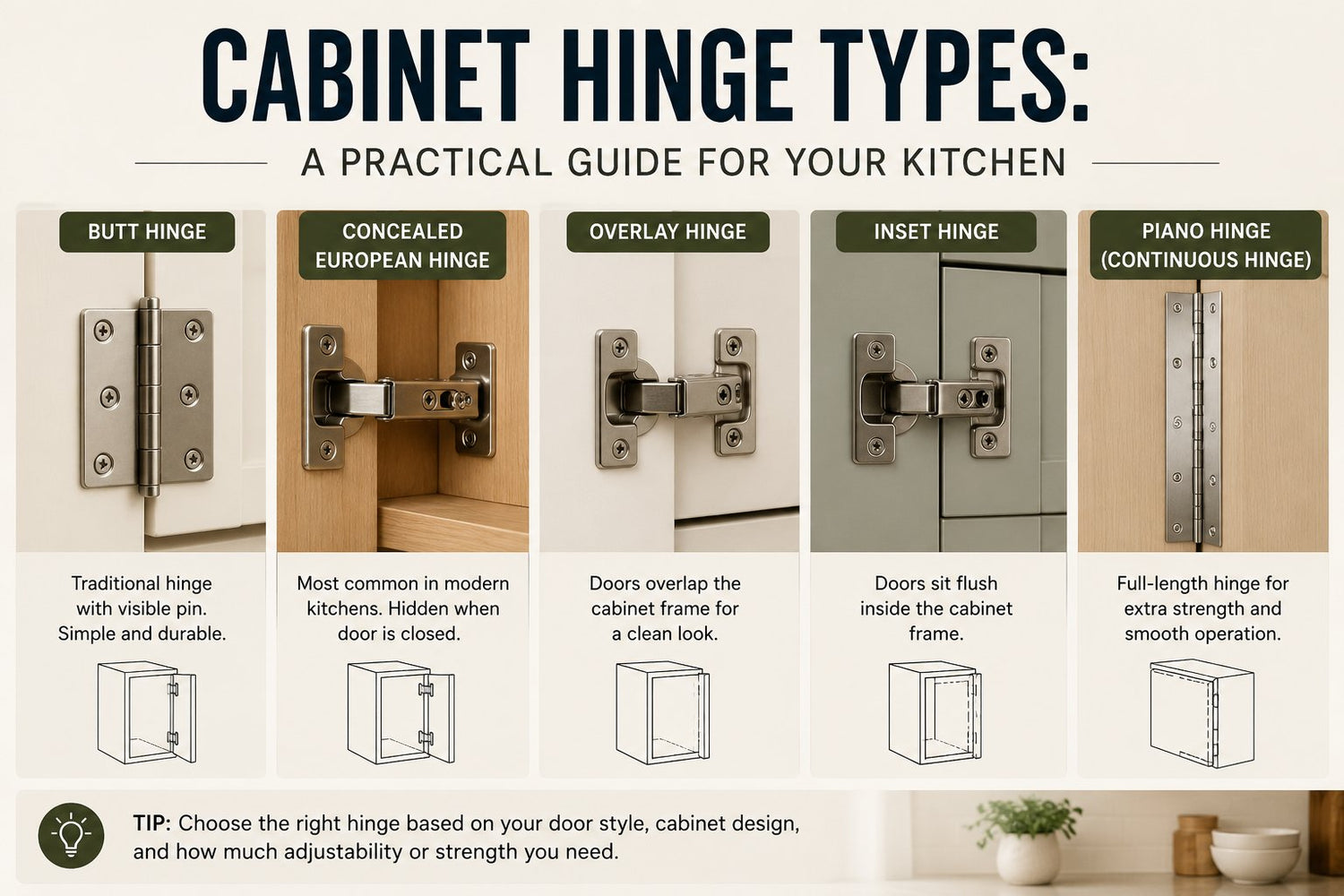
The easiest way to understand cabinet hinge types is to think about what you can see when the door is closed. Some hinges are meant to disappear. Others are meant to be obvious. A few sit somewhere in between, serving older cabinets or repairs where the hardware has to match existing holes and mounting points source.
Concealed and European hinges
These are the modern baseline for many cabinets. They mount inside the cabinet, stay hidden when the door is shut, and work with inset, partial overlay, and full overlay doors source. Their big advantage is adjustment. That extra movement makes it easier to correct a door that sits too high, too low, or slightly off-centre after boring and mounting.
Semi-concealed and wrap-around hinges
These sit between old and new. Part of the hardware is visible, but the hinge still provides a cleaner look than very exposed styles. They're often useful on face-frame cabinets, especially when you're replacing older hardware and want to keep the cabinet geometry close to what's already there source.
Butt and surface-mount hinges
These are the straightforward, exposed options. A butt hinge is one of the older hinge forms, and a surface-mount hinge stays visible on the outside of the door and cabinet. They're common in traditional work, repair jobs, and places where a visible hinge isn't a problem.
| Cabinet Hinge Type Comparison | Visibility (Door Closed) | Adjustability | Best For |
|---|---|---|---|
| Concealed, European | Hidden | High | Frameless cabinets, modern kitchens |
| Semi-concealed, wrap-around | Partly visible | Moderate | Face-frame cabinets, retrofit work |
| Butt hinge | Visible | Lower | Traditional cabinetry, repairs |
| Surface-mount hinge | Visible | Lower | Quick replacement, older cabinets |
| Continuous hinge | Visible | Varies | Taller or heavier doors |
If you're comparing options for general storage, a pantry organiser over the door can be a helpful reminder that door hardware and storage accessories need to work together, not fight for the same swing space.
Key Measurements That Determine Your Hinge Choice
Once you know the cabinet style, the next step is geometry. The hinge has to match the way the door sits against the cabinet, and that means paying attention to overlay, cup size, and opening angle. These terms sound fussy, but they're just ways of describing how the door meets the cabinet and how far it swings.

Overlay and why it matters
Overlay is how much the door covers the cabinet frame or side. A full-overlay hinge is for a door that covers the frame completely, while a half-overlay hinge typically leaves about 12–14 mm of frame overlap source. If you choose the wrong overlay, the door may hit an adjacent door, leave an awkward gap, or fail to close the way you expected.
Cup size and adjustment
European or concealed hinges are commonly specified with a 35 mm cup, and they offer 3-way adjustment after installation source. That matters because even a well-bored door can sit slightly off after mounting. The adjustment screws let you correct side-to-side position, depth, and height without remaking the door.
Opening angle and clearance
In California residential cabinetry, 110° is widely treated as the standard opening angle for most base and wall cabinets source. If you need a door to swing wider for pull-out bins, deep pantry shelves, or awkward corner access, check the opening angle before buying. A hinge that opens too little can make a cabinet feel tighter than it really is.
A quick tape-measure check helps avoid guesswork. Measure the door height, the amount of frame visible at the front, and the available clearance beside the cabinet. Then compare those numbers against the hinge's overlay and opening range before you buy.
For storage planning inside the cabinet, how to organise kitchen cabinets is worth a look because the contents often determine whether a standard opening angle is enough.
How to Select the Right Hinge for Your Project
The right hinge comes from combining construction, measurement, and use case. A kitchen door that gets opened all day needs different hardware from a linen cabinet that's touched once a week. In Canadian installation guidance, retailers recommend roughly one hinge per 30 inches of door height, with doors up to 60 inches using two hinges, and a load rating at least 1.5× the door weight source.
Start with the load, not the look
Heavy doors put more stress on the top hinge, so a light decorative hinge can fail even if it matches the finish. That's why taller or denser doors need more support, not just a nicer shape. Commercial-grade or thicker-gauge hinges are a safer choice when the door will be opened repeatedly.
Match the hinge to the room
A busy kitchen needs dependable adjustment and a clean close. A bathroom vanity may need corrosion-resistant hardware and a door swing that avoids the sink or wall. A rental unit benefits from standardised parts that are easy to source and replace quickly, because downtime matters more than custom flair.
Practical rule: if the cabinet gets used hard, choose the hinge that's easiest to replace later, not the one that only looks impressive on day one.
Pick features that solve a real problem
Soft-close and self-close features are useful when slamming is the issue. Detachable hinges make door removal simpler during painting or cleaning. If the cabinet door is old, mismatched, or already damaged, a repair-friendly option can be the smarter choice than a complete hardware upgrade.
That repair angle matters more than most shopping guides admit. A common problem is a hinge that's hanging loose, where a Canadian hardware guide recommends a knock-in, or dowel, hinge as a replacement choice source. In that situation, preserving the existing door and hole pattern is often more useful than chasing a perfect cosmetic match.
Installation Tips and Troubleshooting Common Issues
The cleanest hinge choice can still fail if the install is sloppy. Keep your drilling consistent, work from the top hinge first, and test-fit on scrap whenever the door material, thickness, or overlay is even slightly different from the last one. Small changes in door geometry can change the reveal enough to make a cabinet feel wrong, even when the hinge itself is fine.

A sagging door usually means the top hinge is carrying too much of the load, the screws have loosened, or the door was undersupported from the start. Uneven gaps often mean the adjustment screws haven't been set evenly, especially on concealed hinges. If the door won't stay closed, check the hinge geometry before blaming the latch or the cabinet box.
Repair first, replace second
Retrofits are where hinge knowledge pays off fastest. If the old hinge is loose, stripped, or discontinued, the goal is often to reuse as much of the existing cabinet as possible. That's why repair-specific guidance matters, because a like-for-like swap can be the least risky option when the door and box are still sound source.
If you're replacing hardware in an older kitchen, it helps to confirm three things before drilling: hole pattern, overlay, and door alignment. A mismatched hinge can force awkward filler pieces, extra boring, or a door that rubs on one side every time it closes.
After the hinge is mounted, fine-tune the position with the adjustment screws instead of grabbing a file or forcing the door. That's where modern concealed hardware earns its keep, because small corrections are built into the hinge rather than added later with guesswork.
For microwave-related cabinet work, how to install over the range microwave is useful if the surrounding cabinet layout affects door clearance or access during installation.
Your Path to Perfect Cabinets
The easiest path is simple. Identify the cabinet type, measure the overlay and clearance, then choose a hinge style that matches the door weight and the way the cabinet is used. When those three pieces line up, the door usually closes cleaner, opens more smoothly, and needs fewer fixes later.
A quick maintenance habit helps keep that result. Check screws for looseness, wipe out dust around the hinge cup or pin, and open each door a few times after cleaning to make sure nothing has drifted out of alignment. Small upkeep beats a full repair every time.
A CTA for GrifGlo to browse practical home and kitchen guides when you're ready to match the right hinge to your cabinet, measure with confidence, and avoid the common retrofit mistakes that turn a simple fix into a weekend problem.

Laisser un commentaire
Ce site est protégé par hCaptcha, et la Politique de confidentialité et les Conditions de service de hCaptcha s’appliquent.