

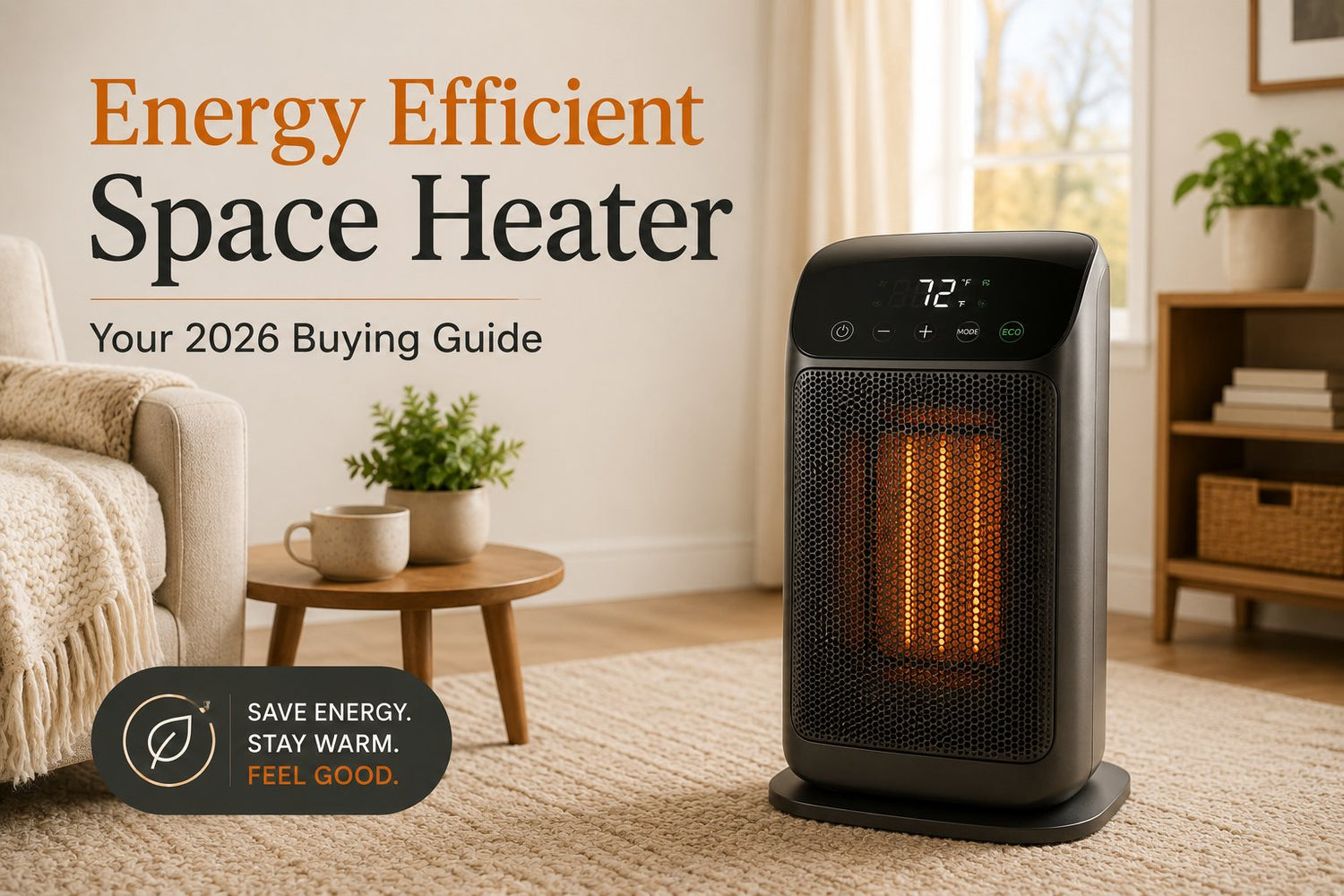
You're probably here because one room in your home feels wrong for the season. The bedroom is chilly before bed. The home office stays cold until noon. The converted garage, basement den, or back corner of the flat never seems to catch up, even when the rest of the house feels fine. Turning up central heating for that one stubborn room can feel wasteful, especially when energy costs are already hard to ignore.
That's where an energy efficient space heater makes sense, but only when you judge efficiency the right way. The key question isn't whether the heater can turn electricity into heat. Most portable electric heaters already do that extremely well. The practical question is whether the heater you choose matches your room, your schedule, and the way you live.
A good buying decision comes down to applied efficiency. Pick the wrong heater type, the wrong wattage, or the wrong controls, and even a decent unit becomes expensive and annoying to use. Pick the right one, and a space heater can make a cold room comfortable without forcing you to heat the entire home.
Table of Contents
- Why Your Central Heating Is Not Always the Answer
- Decoding Energy Efficiency Claims
- Radiant vs Convection Heaters Explained
- Matching Watts to Your Square Footage
- A Step-by-Step Guide to Calculating Operating Costs
- Safety Certifications and Maintenance Best Practices
-
Frequently Asked Questions About Space Heaters
- Can I leave a space heater on all night
- Do space heaters dry out the air
- Is it safe to use a space heater in a bathroom
- Why shouldn't I use an extension cord
- Which heater type feels warmest fastest
- Is a thermostat really worth having
- Should I buy the highest wattage I can find
- Are smart controls useful or just a bonus
- What's the simplest way to choose the right heater
Why Your Central Heating Is Not Always the Answer
A common winter pattern looks like this. You're working at the kitchen table or in a spare room, your hands feel cold, and the thermostat for the whole house is already set high enough that everyone else is comfortable. Raising central heating to fix one cold spot means sending heat into hallways, empty bedrooms, and rooms nobody is using.
That's why zone heating works so well in real homes. Instead of paying to warm the entire house, you heat the space you're sitting in. For many households, that's the difference between practical comfort and unnecessary waste.
This matters even more in homes with uneven insulation, long duct runs, older windows, or rooms over garages. In those spaces, central heating often struggles to deliver even warmth. A portable heater can solve the comfort problem faster than another thermostat adjustment.
Practical rule: If one occupied room is cold while the rest of the home is acceptable, the fix usually isn't “more whole-house heat”. It's targeted heat in the room you're using.
The same logic shows up in other home appliance decisions. You don't buy the biggest system for every problem. You match the tool to the job, whether you're choosing a heater or comparing an air purifier for kitchen use where smoke, odours, and room size all change what works.
A space heater isn't a magic savings device. It's a strategic one. Used in the right room, for the right amount of time, with a door closed and a thermostat doing the control work, it can be a smarter move than pushing central heating harder.
Decoding Energy Efficiency Claims
The phrase energy efficient space heater gets used loosely. Retail pages, product boxes, and adverts often imply that one electric heater somehow creates more heat from the same electricity than another. For standard portable electric heaters, that's usually the wrong way to think about it.
Why most electric heaters sound the same in adverts
In California, the basic benchmark is simple. Electric resistance and infrared space heaters convert electricity to heat at nearly 100% efficiency at the unit level, so savings primarily arise from using them as zone heaters rather than whole-home heating. The same California-focused explanation notes that running a common 1,500-watt space heater for 8 hours per day uses about 84 kWh per week, which can become costly at higher state electricity rates, especially when the heater runs longer than needed (Palmetto on space heater energy efficiency).

That means the phrase “more efficient” often gets misused. If two heaters both draw the same power, the difference usually isn't raw heat creation. The difference is how well they deliver comfort without wasting runtime.
A thermostat is a good example. It doesn't change the basic physics of electric heating. It changes how long the heater runs. A timer does the same. Multiple heat settings help too, because they give you more control over how much warmth you call for in the first place.
What applied efficiency actually looks like
Applied efficiency is about fit.
- Use pattern matters: A heater for ten minutes at a desk needs a different design than a heater used through the evening in a bedroom.
- Controls matter: Thermostats and timers reduce needless runtime.
- Room setup matters: Closed doors, limited drafts, and sensible placement all improve results.
- Heat delivery matters: Spot warmth feels different from full-room warmth, even when wattage is similar.
That's the buying mindset I recommend. Ignore vague claims about miracle elements or secret heating technology. Look for the heater that gives you the kind of warmth you need, in the room you use, with controls that stop it running when it doesn't have to.
As a side note, this “applied efficiency” idea isn't limited to heaters. A product like the KALORIK TO50913SS 4 Slice Digital Toaster Stainless Steel is a good example from another category. Its two separate toasting zones, independently controlled shade selectors with 8 shades, extra-wide slots, and a countdown timer don't alter a toaster's basic function. They improve control, fit, and everyday use. Heating products work the same way. Useful controls often matter more than marketing language.
If you're comparing appliance features elsewhere in the home, the same filter helps when reviewing best kitchen lighting ideas. The headline claim isn't the point. The match between the product and the space is.
Radiant vs Convection Heaters Explained
Once you stop chasing vague efficiency claims, heater type becomes the main decision. The biggest divide is radiant versus convection heating.
The quick way to tell them apart
Radiant heat warms people and objects directly. Think of the feeling of sunlight on your skin through a window. You feel warmer quickly, even if the whole room hasn't changed much yet.
Convection heat warms the air. Think of the room itself getting more evenly comfortable over time. That usually feels better when you'll be in the space for a while.
Utility guidance makes this distinction clearly. Convection units are better for whole-room comfort, while radiant units are better for spot heating and immediate warmth. That matters in California homes because room conditions vary so much, from mild coastal weather to drafty bonus rooms and colder inland spaces (portable heater guidance on radiant and convection use).
Space Heater Technology Comparison
| Heater Type | Heating Method | Best For | Pros | Cons |
|---|---|---|---|---|
| Ceramic fan heater | Convection | Home offices, kitchens, small living areas | Fast warm-up, compact, good for quick comfort | Fan noise, heat can feel less direct |
| Infrared heater | Radiant | Desk areas, workshops, direct seating zones | Immediate warmth, strong spot heating | Less effective for even room temperature |
| Oil-filled radiator | Radiant and convection | Bedrooms, longer evening use, steady background warmth | Even, gentle heat, quiet operation | Slower to warm up |
| Micathermic panel heater | Hybrid | Rooms needing both direct and ambient warmth | Slim profile, balanced heat style | Performance depends heavily on room layout |
How to choose by room and routine
Ceramic heaters are usually the quickest fix for a cold room that needs fast improvement. Many use a fan to move heated air, which helps the room feel warmer sooner. These are often the most practical choice for a small office, breakfast nook, or chilly kitchen where you want comfort without waiting long.
Infrared heaters make more sense when you want warmth on your body, not necessarily in every corner of the room. If you sit in one place at a desk, read in one chair, or work in a drafty garage corner, radiant heat can feel more satisfying than a unit trying to heat all the air around you.
Oil-filled radiators suit people who value steadier comfort over quick blast heating. They're often a good match for bedrooms or living spaces where the heater stays on for longer stretches and you don't want fan noise.
Micathermic heaters sit in the middle. They usually combine some radiant feel with broader room warming. In the right room, they're a sensible compromise.
Radiant heaters solve a comfort problem quickly. Convection heaters solve a room-temperature problem more evenly.
A lot of shoppers over-focus on wattage and under-focus on use case. That's backwards. A desk worker in a cold corner and a family using a small den in the evening may buy the same wattage, but they often need different heater styles.
If you've ever chosen between appliance installation options, the logic is familiar. A product has to suit the space, not just fit a label. That's also true when looking at how to install an over-the-range microwave, where cabinet layout, venting, and clearance matter more than a generic recommendation.
Matching Watts to Your Square Footage
Buying by looks or reviews alone is where many space heater purchases go wrong. Size matters. A heater that's too small won't deliver comfort. A heater that's too large for the room can cycle awkwardly and create uneven warmth.
A simple sizing rule that works
A practical sizing rule is about 10 watts per square foot in a well-insulated room. That implies roughly 1,500 watts for 150 square feet. The same guidance notes that sizing errors hurt efficiency because an undersized heater may never reach the set temperature, while an oversized one can cycle too aggressively (space heater sizing guidance).

Here's how that looks in plain terms:
- Small room: A compact office, nursery, or reading room may need less heater capacity.
- Medium room: A typical bedroom or modest lounge often lands near the common portable-heater range.
- Larger room: Open layouts, long rooms, or spaces with poor insulation may need a different strategy than buying one bigger portable unit.
Room conditions matter. Ceiling height, drafts, old windows, slab floors, and exterior walls all affect how warm the space feels. The square-foot rule is a starting point, not a guarantee.
What goes wrong when sizing is off
An undersized heater tends to run hard for too long. The room never quite settles, so people keep nudging the controls upward. That raises energy use without fixing the fundamental issue.
An oversized heater can be annoying in a different way. The room gets hot near the heater, then cools between cycles. You get temperature swings instead of steady comfort.
Buying cue: Choose a heater for the room you use most often, under the conditions you actually have, not the ideal conditions on the box.
If your room is only occupied for short bursts, a smaller radiant unit may feel better than a larger convection model. If you spend hours there, steady full-room warmth is usually the more comfortable choice.
A Step-by-Step Guide to Calculating Operating Costs
Purchase price is only part of the decision. A cheap heater can become expensive if it runs too often or gets used in the wrong room. The useful habit is learning how to estimate operating cost before you buy.
A standard electric heater converts nearly all input electricity to heat, but your actual cost depends on wattage and runtime. BC Hydro gives a clear example: a 1,400-watt unit used 4 hours per day costs about $19/month in its calculator-style illustration (BC Hydro space heater cost example).
Here's the visual version of the process:

The formula to use on your own bill
Use this formula:
Heater wattage ÷ 1,000 × hours used × your electricity rate = operating cost
Break it into steps.
-
Find the wattage
Check the heater label or specifications. -
Convert watts to kilowatts
Divide by 1,000. -
Estimate runtime
Count the hours you expect to use it, not the maximum possible hours. -
Check your electricity rate
Your utility bill will show it. -
Multiply the figures
That gives you a daily or monthly estimate, depending on the hours you use.
The key point is that control features matter because they reduce runtime. A thermostat that shuts the heater off once the room is comfortable is often more important than a flashy claim on the packaging.
For readers who want a quick walk-through in another format, this video can help:
How to judge whether the cost is worth it
Don't ask only, “How much does this heater cost to run?” Ask, “What is it replacing?” If a portable heater lets you avoid turning up central heating for the whole house, the comparison may still favour the heater even when the per-hour cost looks noticeable.
Use your estimate to test real-life scenarios:
- Desk use: Short bursts in the morning and evening.
- Bedroom use: Pre-heating before bedtime rather than all-night operation.
- Living space use: Evening heating with the door closed.
- Problem room use: Supplemental heating only on colder days.
That's how you turn a heater from an impulse buy into a costed appliance decision.
Safety Certifications and Maintenance Best Practices
Efficiency only matters if the heater is safe enough to use with confidence. On this point, I'd be firm. Safety features are not optional extras on a space heater.
The U.S. Department of Energy cites the Consumer Product Safety Commission estimate that more than 1,700 residential fires every year are associated with space heaters, and it advises plugging electric heaters directly into a wall outlet instead of using extension cords. The same guidance also notes that, when used properly, space heaters can lower total heating costs by up to 10% (Department of Energy small space heater guidance).

The safety features that should not be optional
When I assess a heater, I look for these basics first:
- Certification marks: UL, ETL, or CSA markings show the unit has been tested to recognised standards.
- Tip-over protection: If the heater gets knocked over, it should shut off automatically.
- Overheat protection: The heater should stop running if internal temperatures rise too far.
- Stable base or sturdy design: A narrow, top-heavy unit is harder to trust in active households.
- Cooler-touch exterior: This matters if children or pets share the space.
The extension-cord warning deserves emphasis. Plugging a heater into an extension cord or power strip introduces risk. A wall outlet is the safer choice.
Safety and efficiency work together. A heater that can't be placed and powered properly isn't a good fit for the room.
The maintenance habits that keep heaters safer and more efficient
A neglected heater often performs worse before it fails. Dust blocks vents, restricts airflow, and can raise internal temperatures.
Keep the routine simple:
- Clean vents regularly: Dust build-up reduces airflow.
- Inspect the cord and plug: If you see wear, don't keep using it.
- Keep the area clear: Curtains, bedding, paper, and soft furnishings shouldn't crowd the unit.
- Store it dry and upright: Off-season storage affects how safe the heater is next time you need it.
- Unplug when not in use: Especially in homes with pets, children, or busy walkways.
The same home-care principle applies to other countertop and plug-in appliances. Build a habit of cleaning and checking them before problems grow. That's also a good reminder if you're maintaining cooking gear and reading up on how to clean an air fryer.
Frequently Asked Questions About Space Heaters
Can I leave a space heater on all night
I wouldn't treat that as the default plan. It's usually better to warm the room before sleep and let the thermostat manage limited use rather than running a heater unattended for long periods. If overnight use is part of your routine, choose a model with strong safety features, place it correctly, and follow the manufacturer's instructions closely.
Do space heaters dry out the air
Many people notice the room feels drier, but what often changes most is comfort perception. Warm air can make you more aware of dry skin, throat irritation, or existing low humidity. If that bothers you, reduce runtime, avoid overheating the room, and consider managing humidity separately rather than assuming the heater itself is the only problem.
Is it safe to use a space heater in a bathroom
Only if the heater is specifically designed and rated for that environment. Bathrooms combine water, steam, and electrical equipment, so this is not the place to improvise. If the packaging or manual doesn't clearly support bathroom use, choose a different solution.
Why shouldn't I use an extension cord
Because heaters draw substantial power and the Department of Energy specifically recommends plugging them directly into a wall outlet, not an extension cord, for safer operation. Extension cords and power strips can overheat under heater loads.
Which heater type feels warmest fastest
Radiant heaters usually feel fastest because they warm you directly. Convection heaters often take longer to change how the whole room feels, but they may provide better overall comfort when you stay in the room longer.
Is a thermostat really worth having
Yes. A thermostat helps prevent overheating the room and cuts unnecessary runtime. In practical use, that's one of the most useful efficiency features you can buy.
Should I buy the highest wattage I can find
Not automatically. Match the heater to the room. A bigger number doesn't guarantee better comfort. Poor sizing often leads to awkward cycling, uneven warmth, or a unit that never solves the underlying problem.
Are smart controls useful or just a bonus
They're useful if your routine is predictable. Timers, scheduling, and remote control can help you heat a room when needed instead of leaving the heater running longer than necessary. If you already use connected products around the house, you may also want to compare how they fit into broader smart home devices with Alexa setups.
What's the simplest way to choose the right heater
Start with three questions:
- Where will it be used most often
- Do you want spot warmth or whole-room comfort
- Will you use it briefly or for long stretches
If you answer those, the shortlist gets much smaller. From there, focus on sizing, thermostat control, and safety certification before anything else.
If you're comparing practical home appliances and want straightforward buying guidance without sorting through endless listings, GrifGlo organises decision-friendly categories, comparisons, and fit-for-purpose advice across home, kitchen, organisation, and smart living products.



Laisser un commentaire
Ce site est protégé par hCaptcha, et la Politique de confidentialité et les Conditions de service de hCaptcha s’appliquent.