

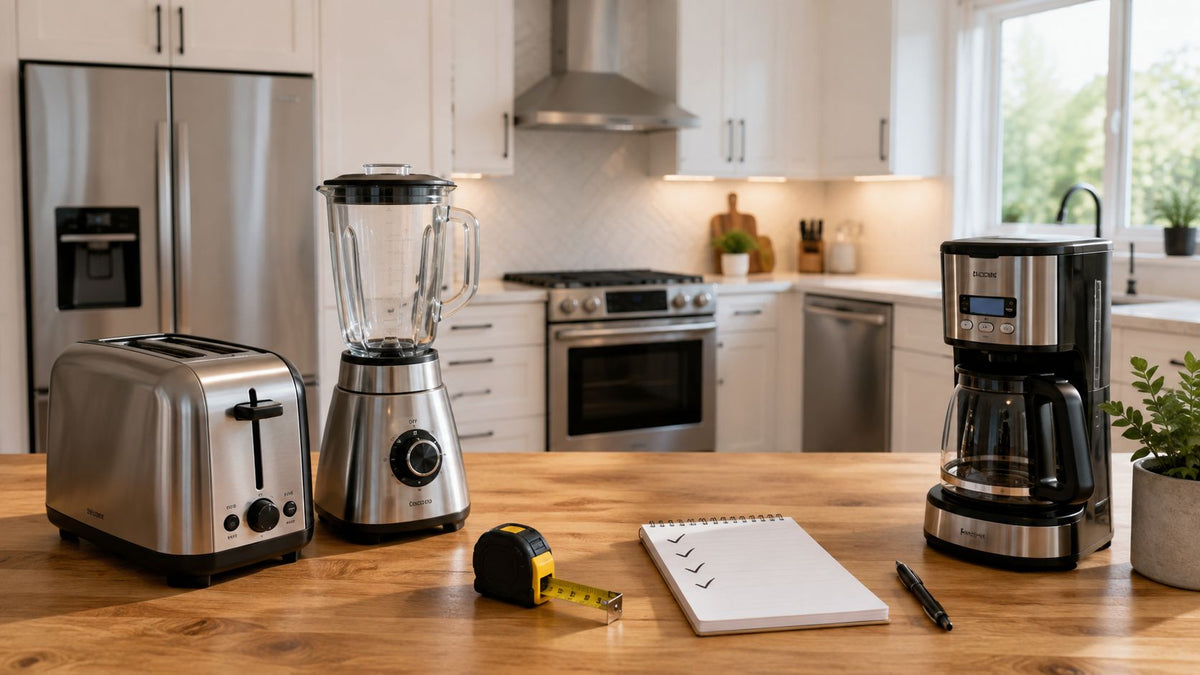
You're standing in a kitchen doorway with a new refrigerator waiting outside, only to discover that the hallway turns too sharply and the condo elevator doors won't open wide enough. The model looked perfect online. The measurements, delivery route, electrical supply, and installation requirements were afterthoughts.
That's how appliance regret usually starts. A useful kitchen appliance buying guide should help you choose equipment that fits your home, cooking habits, household type, and long-term operating costs, not just rank attractive features. Canadian buyers also need to read the EnerGuide label, compare ENERGY STAR certification, and separate the needs of renters, homeowners, and small offices before paying for a premium finish or connected touchscreen.
Table of Contents
- The Kitchen Appliance Buying Decision Starts Before the Store
- Five Decision Criteria That Separate a Smart Buy From a Regret
- Major vs Small Appliances and How to Build the Right Mix
- Canadian Budget Tiers and What Each Level Really Buys You
- Energy and Water Efficiency in the Canadian Market
- Putting the Shortlist Together With a Real Buying Workflow
- Maintenance, Compatibility, and Renter Friendly Habits
- FAQ on Kitchen Appliance Buying
The Kitchen Appliance Buying Decision Starts Before the Store
The refrigerator sat in the building hallway while two people measured the condo doorway again. The kitchen opening was wide enough on paper, but the elevator entrance, hallway turn, and door swing created a different problem. The lesson is simple: measure the delivery path, not just the cabinet opening.
Start with the existing space. Record the width, height, and depth of the appliance opening, then measure every doorway, hallway pinch point, elevator entrance, stairwell, and turn between the delivery truck and the kitchen. Note baseboards, handrails, door closers, and island edges. A refrigerator can fit the final opening and still fail at the first sharp turn.
Separate the urgent purchase from the dream kitchen
Write down whether you're replacing a broken appliance, preparing for a renovation, or furnishing an empty space. A failed refrigerator requires a fast, practical decision. A full refresh gives you time to coordinate finishes, cabinet modifications, ventilation, and utility work.
Renters should begin with the lease. A countertop microwave, portable induction unit, or freestanding dishwasher may be realistic, while a built-in refrigerator or hardwired range may require written landlord approval. Homeowners can consider cabinet changes and new water lines, but those additions belong in the budget before selecting the appliance. Small offices need a different test: prioritise repeated use, cleaning, noise, and serviceability over residential features nobody will manage.
Check utilities and clearances early
Look at the circuit serving the installation area. A 15-amp circuit isn't interchangeable with a 20-amp circuit, and a 120-volt countertop appliance isn't a substitute for equipment requiring 240 volts. Confirm gas access where relevant, water connections for ice makers or dishwashers, and the ventilation arrangement for a range hood or over-the-range microwave.
Don't guess at ventilation clearance. Check the appliance installation manual and the existing cabinet layout before ordering. A hood or microwave needs enough space above the cooking surface, and a recirculating setup has different requirements from a ducted one.
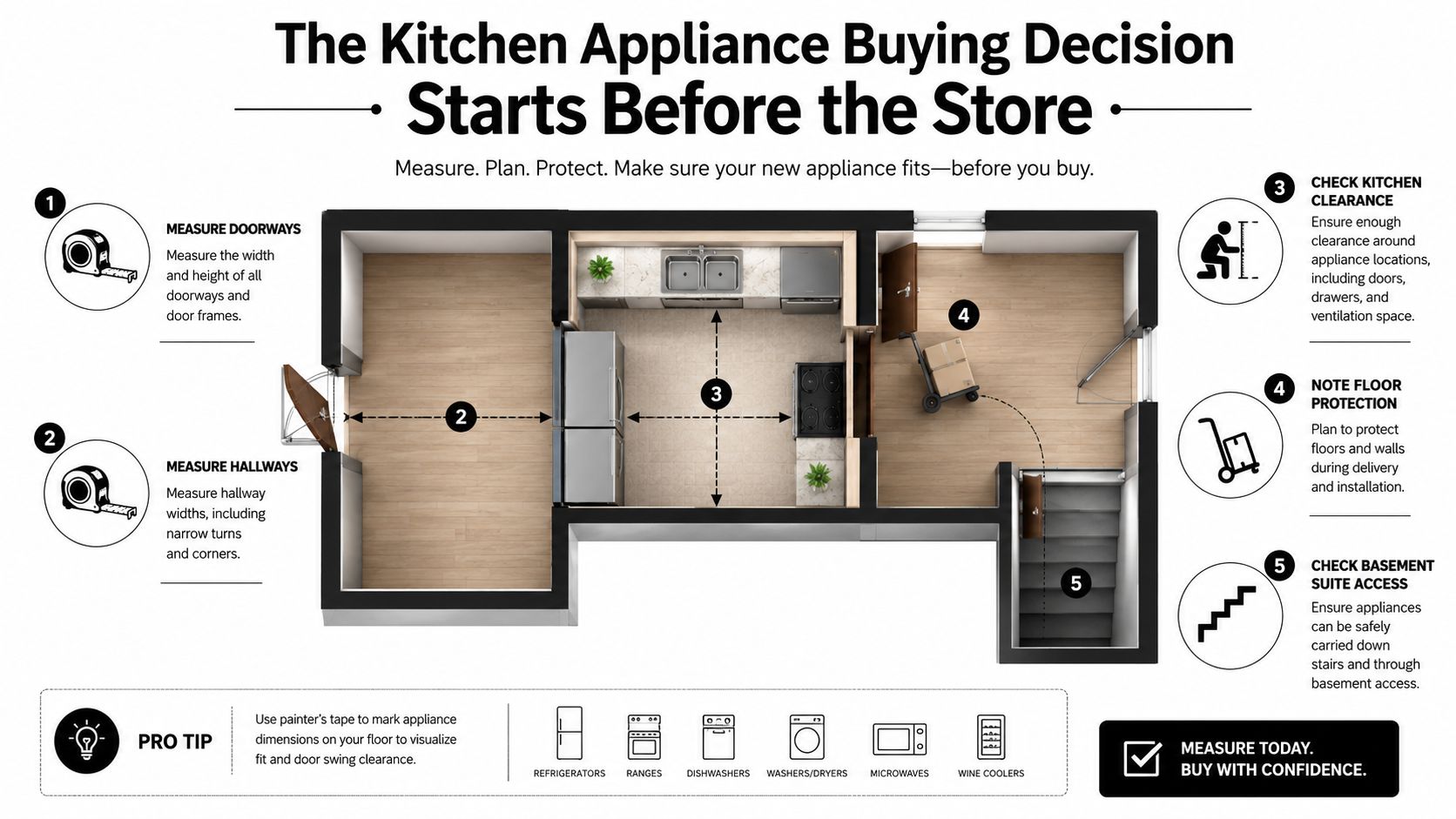
Keep a written checklist with measurements, outlet locations, door-swing clearance, floor protection needs, and removal details. A practical kitchen essentials list can help you separate core equipment from optional countertop additions. Arrive at the store with constraints, not showroom impressions.
Five Decision Criteria That Separate a Smart Buy From a Regret
A shortlist should survive a simple test: can you explain why each model suits your household? Score every candidate against capacity, performance, features, reliability, and total cost of ownership. A glossy display can't answer those questions for you.
Capacity must match the room and routine
Measure usable capacity, not just the headline number. For a refrigerator, compare the internal layout with the food you store. For a range, count burners and consider whether large pans can operate together. For a dishwasher, compare the place-setting rating and rack design with the number of people using it.
A two-person household may value flexible shelving and a compact footprint more than maximum refrigerator volume. A family may benefit from a third dishwasher rack or wider cooking surface, but only if the door can open without blocking the main walkway.
Performance should reflect what you cook
Wattage, BTU output, heating response, and inverter technology matter only when they change your routine. Frequent high-heat cooking justifies stronger ventilation and a cooking surface that handles several pans. A household that reheats leftovers may gain more from even microwave performance and simple controls than from an elaborate cooking programme.
Features create trade-offs
Smart connectivity, air-fry modes, dual ovens, automatic settings, and touchscreens can be useful. They also add electronics, software dependencies, and potential repair complexity. Buy the feature you'll use weekly, not the feature that looks impressive in a demonstration.
For example, the CLOROX 11031 Alexa Smart Medium Room True HEPA Air Purifier snapshot lists Alexa voice control, True HEPA three-stage filtration, a real-time air-quality display, and auto mode with smart adjustment. That makes it a relevant example of how connected convenience should be judged by actual household use, not by connectivity alone.
Reliability starts with service access
Check the manufacturer's warranty, exclusions, and Canadian service network. Ask who supplies replacement parts and whether local technicians work on the brand. A longer warranty isn't useful if service requires long-distance shipping or the covered component is narrowly defined.
Total cost of ownership exposes the bargain
Record the purchase price, delivery, installation, removal, energy use, expected maintenance, and likely service needs. For long-running appliances, annual kWh matters more than a small feature difference. Use the product standardization guide approach to keep your shortlist organised, especially when several people are choosing equipment for one property.
| Criterion | What to measure | Weight (suggested) |
|---|---|---|
| Capacity | Dimensions, internal layout, burner count, or place-setting rating | High |
| Performance | Heating method, output, controls, and cooking results | High |
| Features | Useful modes, connectivity, automation, and simplicity | Medium |
| Reliability | Warranty, service coverage, and parts access in Canada | High |
| Total cost | Purchase, installation, energy, maintenance, and repair | Highest |
Major vs Small Appliances and How to Build the Right Mix
Major appliances shape the kitchen's layout and utilities. Small appliances shape the routine on the counter. Treating them as one category leads to poor spending decisions, especially in condos, rental suites, and small offices.
| Category | Typical cost range (CAD) | Best fit for |
|---|---|---|
| Major appliances | Varies by package and installation scope | Homeowners planning around cabinetry, plumbing, ventilation, and electrical supply |
| Small appliances | Varies by function and construction | Renters, compact kitchens, offices, and households testing a new cooking habit |
The table intentionally avoids invented price bands. Appliance costs change by category, capacity, installation, retailer, and province, so use the all-in amount rather than a generic online range.
Choose single-purpose equipment when the job is repetitive
A simple toaster can beat a larger multifunction oven when all you need is fast toast. A compact air fryer can make more sense than upgrading a built-in range if you cook small portions and have limited counter space. Multifunction equipment earns its footprint when it replaces several devices you'd otherwise store and use.
The NINJA FT205CO Digital Air Fry Pro Countertop 10-in-1 Oven is listed with air fry, broil, air roast, bake, pizza, toast, bagel, reheat, dehydrate, and keep-warm functions, along with digital crisp control technology and increased height capacity. That combination may suit a household seeking several countertop functions, but it still needs a permanent storage and ventilation plan.
Installation determines who should buy what
Renters generally benefit from countertop, freestanding, and portable appliances. Built-ins can damage cabinets, complicate moving, and create disputes over ownership. Homeowners can justify integrated appliances when the cabinetry, water lines, electrical work, and long-term layout support them.
A garbage disposal also deserves a plumbing check rather than an impulse purchase. If installation raises questions about drainage, electrical connections, or local requirements, book Encano Plumbing & Drainage Ltd. for context before cutting into the sink cabinet.
A two-person condo might use a counter-depth refrigerator, compact dishwasher, induction hot plate, toaster, and blender. A family of four may need a full refrigerator, range, dishwasher, hood, and one durable countertop appliance. A basement rental suite should favour freestanding equipment, simple controls, and easy removal. More ideas for constrained layouts appear in this guide to kitchen appliances for small spaces.
Canadian Budget Tiers and What Each Level Really Buys You
Budget tiers work as decision boundaries, not promises about quality. An entry package under $1,500 CAD, a mid-range package from $1,500 to $4,500 CAD, and a premium package above $4,500 CAD reflect different trade-offs. Your actual total also includes the appliance count, delivery, installation, required parts, and local fees.
| Tier | Price Range (CAD) | Features Included | Best Upgrade Spend |
|---|---|---|---|
| Entry | Under $1,500 for a full major-appliance package | Basic controls, standard finishes, core functions | Dimensions, warranty clarity, and acceptable energy use |
| Mid-range | $1,500 to $4,500 | More flexible layouts, stronger cooking features, upgraded convenience | Induction compatibility, convection, refrigerator capacity, or dishwasher performance |
| Premium | Above $4,500 | Higher-end materials, specialised cooking systems, integrated design, advanced controls | A frequently used feature backed by dependable service |
At the entry level, every dollar spent on a poor fit or weak warranty reduces what you can allocate to the rest of the kitchen. Renters should avoid paying for built-in styling they cannot take with them. Homeowners can justify integration only when the cabinetry, connections, and expected ownership period support it. Small offices usually need simple controls, easy cleaning, and predictable replacement costs rather than elaborate cooking modes.
A low-priced refrigerator that fails early, or a dishwasher that cannot handle daily loads, can erase the initial saving. Check the warranty terms and local service access before treating the sticker price as the full deal. For smaller purchases, compare microwave formats and practical features in this guide to microwave ovens in Canada. Microwaves and toasters rarely need premium pricing unless their size or placement solves a specific space constraint.
Mid-range spending earns its place when it changes daily use. Induction compatibility, true convection, a better rack system, quieter operation, or steam functionality can justify the increase for an active cook. Wi-Fi on a refrigerator and a built-in range touchscreen deserve less priority when they do not remove a recurring inconvenience.
Canada's appliance market is moving toward efficiency, smart features, and product innovation. Grand View Research projects Canada's kitchen appliance market to grow from USD 4.92 billion in 2024 to USD 6.96 billion by 2033, but connected features remain only one part of a lifecycle decision.
Set a hard ceiling for the complete purchase. Reserve upgrade money for appliances used daily, and account for warranty support, repair access, and ownership costs before approving the higher tier.
Energy and Water Efficiency in the Canadian Market
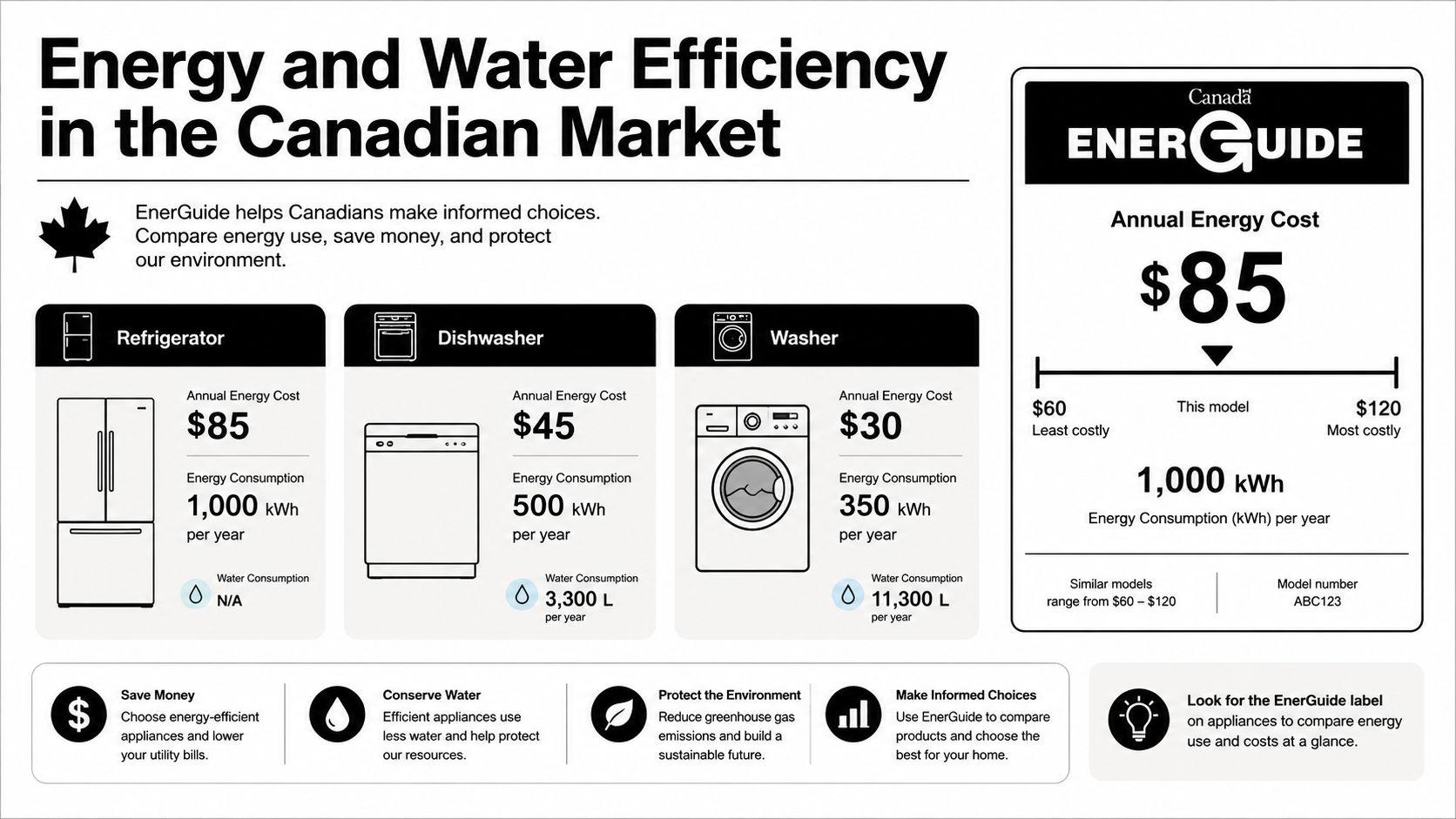
For a Canadian household, efficiency belongs beside price, capacity, and service access. Natural Resources Canada reported that an average set of major household appliances shipped in Canada used roughly 2,299 kWh per year in 2020, almost half the energy used by a comparable set in 2000, according to the NRCan appliance efficiency statistics.
Read EnerGuide before the marketing copy
EnerGuide and ENERGY STAR answer different buying questions. EnerGuide shows estimated annual energy use and places a model on a same-class efficiency scale. ENERGY STAR certifies that a model meets a minimum efficiency threshold relative to similar products. Use both, but compare only appliances with similar capacity and configuration. A large refrigerator should not lose to a smaller model just because its label shows a different consumption figure.
ENERGY STAR certification is common across several appliance categories shipped in Canada. In 2020, 67% of shipped refrigerators, 92% of shipped dishwashers, 73% of shipped clothes washers, and 61% of shipped electric clothes dryers carried the certification. That makes ENERGY STAR a useful screening filter, especially for dishwashers, but it does not replace checking the EnerGuide kWh estimate or the appliance's fit for your home.
Dishwashers make water efficiency visible
NRCan states that ENERGY STAR qualified dishwashers use about 20% to 50% less energy and 35% to 60% less water than standard models. Certified dishwashers use less than 15 litres per cycle, and the Canadian qualification threshold is at least 17% above the minimum regulated standard, as explained in NRCan's EnerGuide appliance guide.
Write down annual kWh, water use, certification status, and expected cycles. Then compare the added purchase cost with your ownership period. Avoid promising savings from a generic electricity rate, because provincial rates and household usage differ. Renters should prioritize efficient models that fit the existing hookup and move easily. Homeowners can justify a higher upfront cost when the appliance will run daily. Small offices should focus on low standby use, capacity, and service access.
For a broader checklist, review these eco-friendly kitchen appliances. Efficiency should support capacity, repair access, and dependable service, not replace them.
Putting the Shortlist Together With a Real Buying Workflow
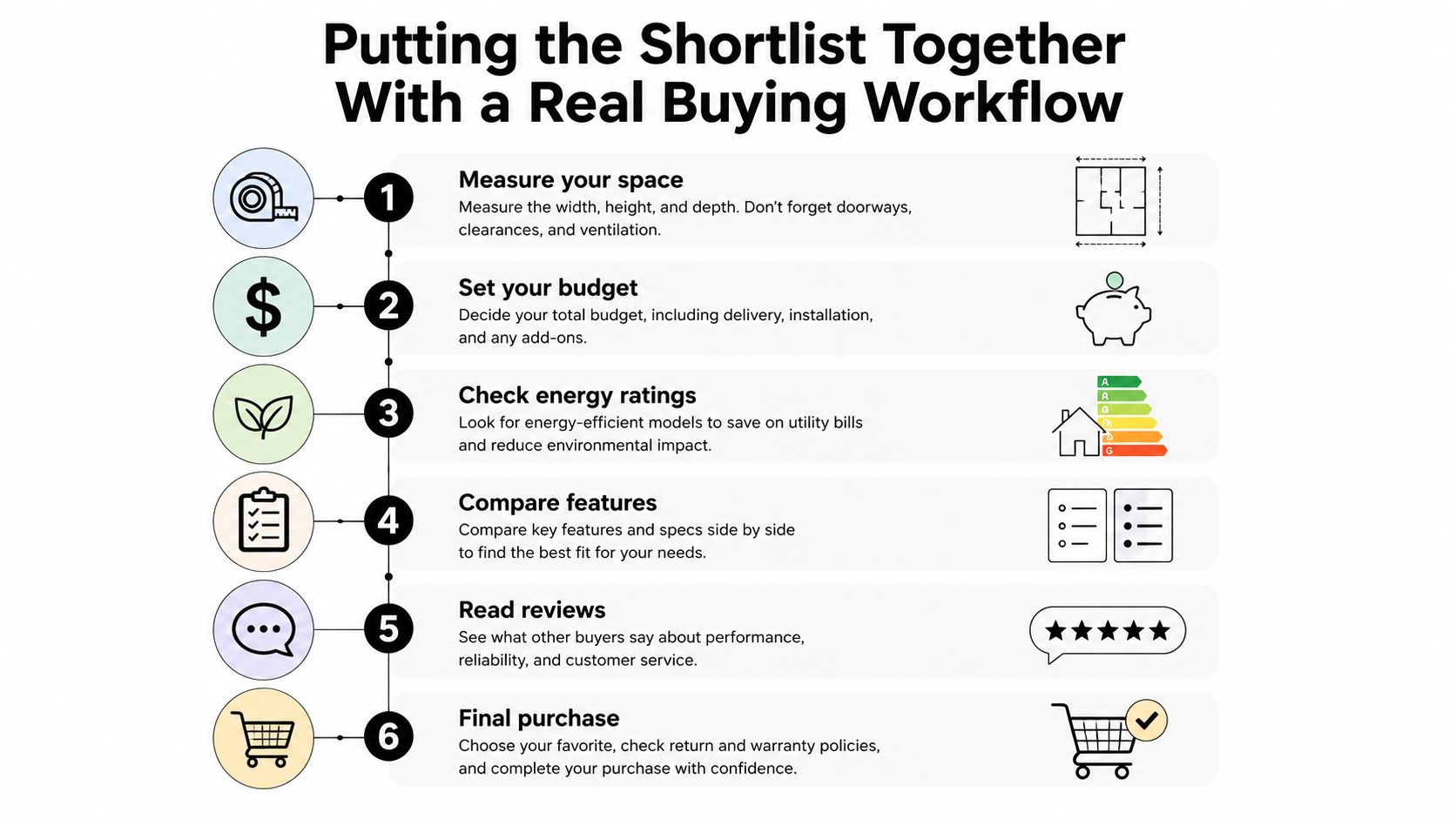
A good shortlist is small enough to inspect and strict enough to reject. Start with measurements, then move through money, energy, features, service, and delivery in that order.
- Measure the route and opening. Record the cabinet cutout, counter depth, doorway widths, hallway turns, elevator access, and door-swing clearance.
- Set the all-in ceiling. Include the appliance, delivery, installation, parts, old-unit removal, and applicable provincial charges.
- Shortlist three models per category. Reject anything that misses the dimensions, utility requirements, or acceptable annual kWh.
- Compare useful features. Decide whether convection, induction, a third dishwasher rack, smart controls, or a specific storage layout changes your routine.
- Check warranty and service. Look closely at compressor coverage for refrigerators and magnetron coverage for microwaves, then confirm Canadian parts and technician access.
- Choose the purchasing sequence. A package can simplify delivery and removal, but bundling only helps when every individual model has already passed the fit and ownership tests.
Save the specification sheets and installation manuals with your measurements. Online listings can omit clearance details, while store displays can hide the depth and utility requirements that matter on delivery day. The final choice should be the model that clears every practical filter, not the one with the longest feature list.
Maintenance, Compatibility, and Renter Friendly Habits
Maintenance is cheaper than avoidable service. The exact routine depends on the manual, but a few habits protect the components that households neglect most often.
Give each appliance a short recurring task
Vacuum refrigerator coils when the manual permits it, wipe the door gasket, and remove debris from seals. Rinse a dishwasher filter, inspect the spray arms, and run the manufacturer-approved cleaner cycle when needed. Degrease range-hood filters and soak removable burner parts according to the manufacturer's instructions.
Kettles and coffee makers need descaling where water leaves mineral deposits. Small countertop ovens need crumb removal, and air fryers need clean baskets and unobstructed vents. Don't use abrasive products or flood electrical controls just because a surface looks greasy.
Compatibility problems appear before breakdowns
Confirm whether the appliance uses 120 volts or 240 volts, whether the range needs gas, and whether the hood or microwave is ducted or ductless. Check water-line requirements for refrigerators and dishwashers. A renter shouldn't hardwire equipment, alter cabinetry, install a gas connection, or run new plumbing without written approval and qualified help.
Renter rule: Photograph existing appliances, walls, flooring, outlets, and cabinet edges before delivery. Keep the photos with the lease and ask who owns the supplied appliance.
If a supplied appliance fails, contact the landlord before booking a technician. If you bought the appliance and the problem involves gas, water, hardwiring, or a building connection, stop and use an appropriately qualified professional. A practical overview of common appliance problems found by home inspectors can help you recognise warning signs, but it isn't a substitute for diagnosis.
Keep the owner's manual accessible. It contains the correct cleaning products, clearance requirements, reset procedure, and service instructions. A small recurring maintenance effort can protect seals, filters, heating elements, airflow, and drainage long after the original warranty ends.
FAQ on Kitchen Appliance Buying
How long should major appliances last in a Canadian home?
There isn't one honest lifespan promise for every model. Service life depends on construction, frequency of use, water quality, ventilation, maintenance, installation, and whether replacement parts remain available. Hard water can leave mineral deposits in dishwashers, kettles, coffee makers, and heating elements, so households with mineral-heavy water should follow the manual's descaling and cleaning guidance closely.
Judge an appliance by its expected use and repair path. A simple model with accessible parts can be a better long-term choice than a feature-heavy model that requires specialised service for a minor electronic failure.
When do EnerGuide and ENERGY STAR change the decision?
They matter most for appliances that run frequently or consume meaningful water and electricity. Start with the annual kWh on the EnerGuide appliance label guidance, compare same-class models, and then check ENERGY STAR status.
They matter less when two suitable models have nearly identical annual use, or when the certified model costs more than your ownership pattern can reasonably recover. Don't ignore the label, but don't let it override a poor fit or weak service access.
Should I buy an extended warranty?
Use a simple break-even test: compare the warranty cost with the likely repair cost, the manufacturer's coverage, the appliance's complexity, and your ability to absorb an unexpected bill. If the plan excludes the parts most likely to fail or requires difficult claim procedures, the coverage may not solve the primary risk.
Self-insuring means setting aside a repair reserve and accepting the uncertainty. That can suit a simple countertop appliance, while a built-in or highly complex appliance may justify closer warranty scrutiny.
Should all appliances match?
Matching suites make the kitchen look organised and simplify finish coordination. They also tie you to one manufacturer's design language and can encourage replacing good equipment just because one unit fails.
Mix brands when reliability, dimensions, energy use, or service access make the independent choice stronger. Match the visible finish and handle style where possible, but prioritise fit for purpose over forced uniformity. Canadian buyers already have varied household equipment and needs. Statistics Canada's Ontario ownership data showed refrigerator ownership at 99.8% of homes in 2001 and 99.6% in 2005, while dishwasher ownership rose from 48.0% to 53.8% over the same period, as reported in Statistics Canada's household appliance data. The practical point is that a refrigerator is a near-universal baseline, while convenience appliances depend more heavily on space, budget, and routine.
GrifGlo organises practical home, kitchen, and smart-living essentials around fit, usability, sizing, and reliability signals, with options that can also support offices, rental properties, and hospitality purchasing. Visit GrifGlo to compare kitchen equipment with a clearer checklist before you place your next order.

Laisser un commentaire
Ce site est protégé par hCaptcha, et la Politique de confidentialité et les Conditions de service de hCaptcha s’appliquent.