

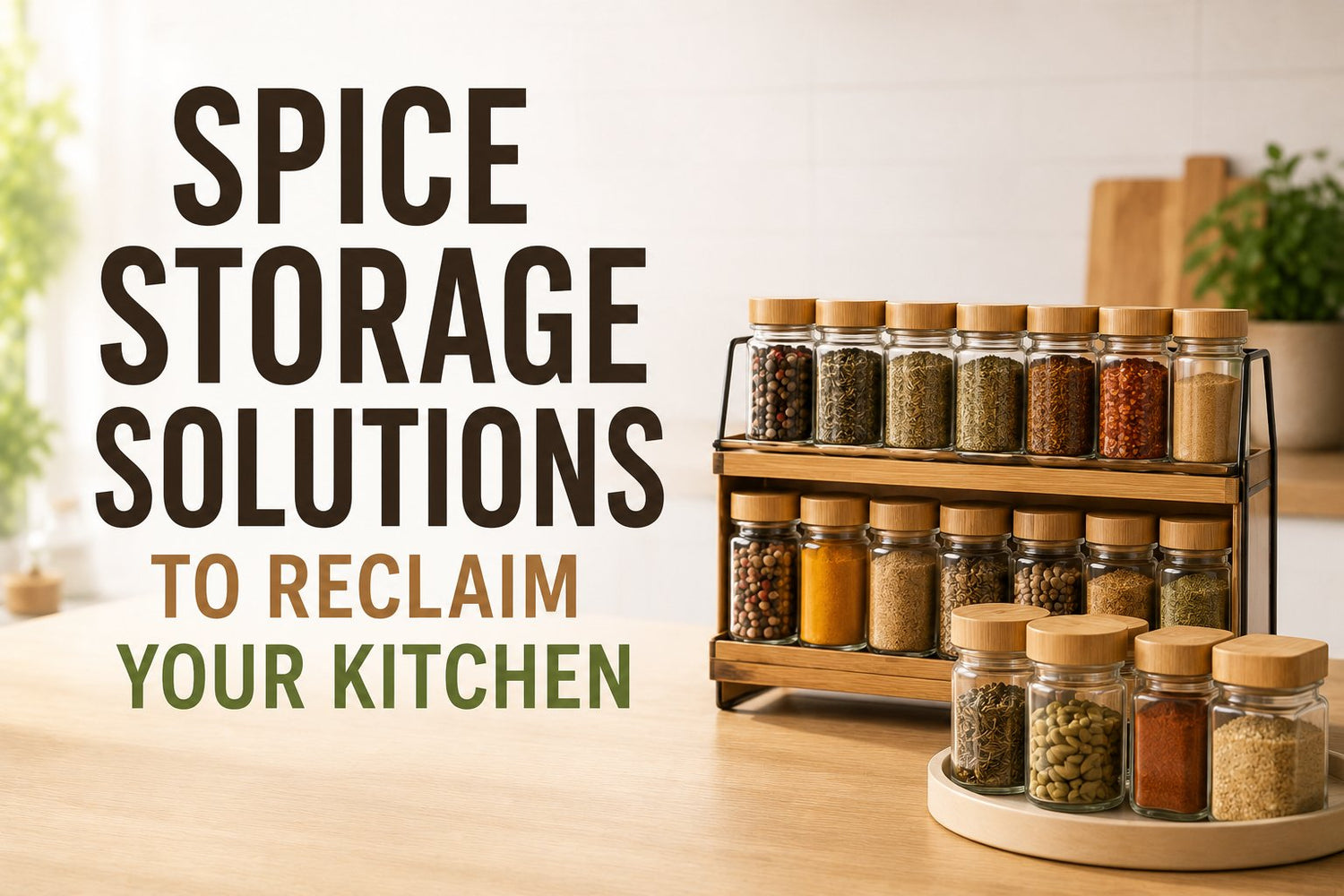
You're halfway through dinner, the pan is hot, and the recipe says smoked paprika. You reach into the cabinet, move three half-empty curry jars, knock over cumin, find two cinnamon bottles you forgot you owned, and still can't see the paprika. That's the moment you realize you need better spice storage solutions.
The problem usually isn't that you own too many spices. It's that your setup hides them, stacks them badly, or puts them in the wrong place for how you cook. Real kitchens get busy. Labels turn sideways. New packets get shoved in front. Renters avoid drilling into walls. Small kitchens don't have a spare drawer waiting to become a perfect spice station.
Good spice organisation works when it matches the space you have, the way you cook, and the amount of upkeep you'll realistically do. If the system looks beautiful but slows you down, it won't last.
Table of Contents
- Why Smart Spice Storage Matters More Than You Think
- Exploring the Universe of Spice Storage Options
- How to Choose the Right System for Your Kitchen
- Planning Your Layout and Sizing It Right
- Labelling and Maintenance for Long-Lasting Order
- Solutions for Renters Businesses and Unique Spaces
- Your Spice Organization Decision Checklist
Why Smart Spice Storage Matters More Than You Think
A spice setup affects how you cook far more than often realized. If you can't see what you own, you cook from memory instead of choice. That usually leads to rushed substitutions, duplicate purchases, and jars that sit so long they lose their punch before you use them.
Well-planned spice storage solutions remove friction. You reach once, not three times. You spot the coriander before buying another jar. You keep the spices you use most where your hand naturally goes while cooking. That sounds small, but it changes the pace of everyday meals.
The wider shift towards kitchen organisation shows this isn't just a niche tidy-home obsession. The spice organiser market in the CA region was valued at $1.2 billion in 2025 and is projected to reach $1.8 billion by 2034, with 5.2% CAGR, reflecting demand for space-efficient kitchen organisation solutions, according to Market Intelo's CA spice organiser market report.
Practical rule: If finding a spice takes longer than using it, your system is costing you time every week.
People often treat spice organisation as a visual project. Clear jars, matching lids, neat labels. That can help, but appearance is only useful when it improves function. A beautiful rack that sits too close to steam or blocks prep space isn't a smart upgrade. A plain drawer insert that lets you read every label at a glance often works better.
If the rest of your pantry feels just as hard to manage, these pantry storage tips for everyday kitchen flow help tie spice storage into a broader system instead of treating it like a separate fix.
Exploring the Universe of Spice Storage Options
Some spice storage solutions are built for speed. Others are built for capacity. Some hide clutter well but make access slower. The right option depends less on trend and more on where your dead space is.

Countertop choices
Countertop storage works best for cooks who use the same small group of seasonings every day. A carousel gives quick access and keeps favourites close to the stove. A tray with a handful of jars is even simpler and easier to clean around.
The trade-off is exposure and space. Counters collect grease, splashes, and visual clutter fast. If your worktop is already crowded, even a compact spice rack can start feeling like an obstacle instead of a convenience.
Good fit:
- Frequent-use blends and basics like salt, pepper, garlic powder, chilli flakes
- Cooks with limited cabinet access
- Households that prefer grab-and-go access
Poor fit:
- Large collections
- Very small counters
- Anyone trying to keep spices away from heat and light
Drawer-based setups
Drawers are one of the most efficient options when the drawer is the right depth. Angled inserts let the labels face up, so scanning is fast and neat. Flat trays are less elegant, but they're flexible and usually easier to adapt around mixed jar heights.
Drawer storage also protects spices from light and keeps the visual noise out of sight. The main drawback is that not every kitchen has a spare drawer near the cooking zone, and some drawers are too shallow for standard jars.
A drawer system works best when every jar lies in one visible layer. Once jars start stacking, you've recreated the cabinet problem in a different place.
If you're comparing container styles before you switch jars, this guide to airtight, stackable, and modular pantry storage containers helps sort out what matters for visibility versus space savings.
Cabinet and pantry systems
Cabinet systems cover the broad middle ground. Tiered shelves raise the back row so you can see more labels. Pull-out racks bring jars to you instead of forcing you to dig into the back of the cupboard. Door-mounted caddies use a narrow surface that many kitchens waste.
These are strong options for medium to large spice collections. They can also feel the most polished. But they vary a lot in effort. A simple tiered riser can be dropped into place in minutes. A pull-out system usually needs more commitment and a more exact fit.
Wall and vertical storage
Vertical storage solves a different problem. It frees up counters and cabinets by moving spices onto walls, fridge sides, or other upright surfaces. Magnetic systems are especially useful in compact kitchens because they turn an unused exterior surface into active storage.
One factual example is the Magnet Shelf Rack for Refrigerator - Kitchen Organizer, a refrigerator side hanging magnet shelf designed for convenient storage. The product snapshot describes a stable tray for seasoning bottles, a middle hook position for paper towel storage, and a bottom wooden rail for towels or kitchen tools.
These setups are handy, but placement matters. If the rack sits in direct sun or next to a hot appliance vent, convenience starts to work against spice quality.
How to Choose the Right System for Your Kitchen
People often shop for organisers before they've diagnosed the problem. That's how you end up with a pretty rack that doesn't fit your cabinet, a drawer insert for a drawer you need for utensils, or matching jars that create more decanting work than you'll keep up with.
In California, 65% of households with pantries use uniform, labeled containers for spice storage, and 54% of homeowners installed pull-out systems or angled shelves in dedicated spice cabinets between 2020 and 2025, enabling 30% more visible spice jars per cabinet compared to traditional shelving, according to California Closets' guide to seasoning storage. That tells you what people are moving towards. Visibility and easier access matter.
Start with location, not the organiser
First decide where spices should live. Not where they could live. Where they'll be used and maintained.
Ask:
- What space is available and not already overloaded?
- Is that space close enough to the cook zone to be practical?
- Will the spices stay protected from heat, splashes, and direct light?
A spare upper cabinet might look like the obvious answer, but if it's above the hob and you hate reaching up while cooking, it's a poor match. A low drawer slightly farther away may still work better because you can see everything at once.
Match capacity to how you cook
A person who keeps ten basics needs a different system from someone who cooks across several cuisines and buys whole spices, blends, and refills.
Here's a straightforward way to approach it:
| Collection size | What usually works | What often fails |
|---|---|---|
| Small and frequently used | Tray, small rack, compact drawer insert | Deep bins where jars disappear |
| Medium mixed collection | Tiered shelf, drawer system, cabinet riser | Single-level shelf with rows hiding rows |
| Large or growing collection | Pull-out, grouped drawers, divided zones | One crowded carousel |
Capacity isn't only about the number of jars. It's about how many need prime access. The paprika, cumin, oregano, cinnamon, and pepper should not compete with holiday blends you use twice a year.
Prioritise visibility and reach
If you have to lift, shuffle, or rotate multiple jars to identify one spice, the system is underperforming. Accessibility beats symmetry.
Look for:
- Face-up or face-forward labels that can be read instantly
- One-move access to your most-used jars
- A single layer where possible, especially in drawers and shallow cabinets
If you're still sorting container shape, this guide to choosing food storage containers is useful because the same fit questions apply to spice jars too.
Choose materials you'll keep using
Glass jars look clean and let you see fill levels. Metal racks feel sturdy. Wood warms up the look of a kitchen. Plastic inserts can be lightweight and easy to wipe out. None is automatically right.
Choose based on what your kitchen demands:
- For messy, high-use cooking pick surfaces that wipe clean quickly.
- For open display choose materials you don't mind seeing every day.
- For renters or frequent movers choose lighter systems that lift out easily.
A system only succeeds if you'll keep returning spices to the same place when dinner is rushed. That's the standard worth using.
Planning Your Layout and Sizing It Right
Buying the wrong size organiser is one of the most common mistakes. The measurements on the product page may be accurate, but kitchen interiors are full of hinges, lips, rails, uneven walls, and drawers that narrow at the base.

Measure the actual usable space
Use a tape measure and record width, depth, and height for the exact spot where the organiser will sit. Then measure it again with the drawer fully closed or the cabinet door shut. That second check catches the problems people miss.
For drawers:
- Measure interior width side to side at the narrowest point.
- Measure usable depth from the inside front to the back obstruction.
- Measure interior height from base to top clearance, not just drawer wall height.
For cabinets:
- Check hinge clearance near the opening.
- Measure shelf depth because back corners can be awkward.
- Test door-mounted ideas carefully if jars might hit interior shelves.
I usually tell people to sketch the space on paper before buying anything. It takes two minutes and prevents the classic return cycle.
A few more layout examples help here: pantry storage racks for narrow shelves and awkward cabinets.
Plan around your jar shape
The organiser and the jars have to work together. Square jars fit neatly and reduce wasted space. Round jars are easy to handle but leave small gaps. Tall jars can block labels behind them. Short, wide jars may fit better in drawers than on door racks.
Use these practical checks before committing:
- Bring one real jar to the measurement step instead of guessing from memory.
- Group by format if your collection is mixed, such as grinders, tins, packets, and refill jars.
- Leave breathing room so you're not forcing jars in and out.
A quick visual can help when you're mapping a cabinet or drawer before ordering:
Sizing habit: Plan for the collection you have now, plus a little growth, but don't oversize so much that the organiser wastes your best space.
Labelling and Maintenance for Long-Lasting Order
A clean setup falls apart fast if labels are hard to read or no one knows where refills belong. The finishing work matters just as much as the organiser itself.
Pick a label style that suits the storage style
Label placement should match your viewing angle. That sounds obvious, but it's where many systems go wrong. People copy a label style they like online instead of choosing one that fits the storage method.
Use this match-up:
- Top labels work best in drawers where jars lie flat or at an angle.
- Front labels suit racks, shelves, and door caddies where jars face outward.
- Side labels can help with tall narrow racks, but only if the jars always face the same direction.
Handwritten labels can feel warm and flexible. Pre-printed labels look consistent. A label maker is fast and tidy. The best choice is the one you'll update without annoyance when you add a new blend or rename a refill jar.
Keep the font simple and high contrast. Decorative script looks nice until you're trying to tell thyme from tarragon while stirring a pan.

Build a simple spice reset routine
Maintenance doesn't need to be a full pantry overhaul. It needs to be short enough that you'll do it.
A workable routine looks like this:
- Pull everything out and wipe the shelf, drawer, or rack.
- Check duplicates and combine where sensible.
- Remove stale, empty, or mystery containers you keep ignoring.
- Return the highest-use spices to prime positions near the front or top.
If you buy refill packets, decant them straight away or store them in one clearly marked backup zone. Loose refill bags tucked behind jars create the same chaos all over again.
For households that cook often, I also like a “working row” approach. Keep the everyday spices in one obvious line or cluster. Put less-used baking spices, whole spices, or seasonal blends in a separate zone. That one distinction does more for long-term order than buying another organiser.
Solutions for Renters Businesses and Unique Spaces
Most spice advice assumes you can install pull-outs, mount racks, or modify cabinet interiors. That's fine for some homes, but it leaves out renters, temporary kitchens, staff kitchens, guest units, and anyone who needs a setup they can move without patching holes later.
A 2025 CA Housing Survey found only 12% of available rental-endorsed products include adjustable, non-adhesive, and damage-free spice organisers, highlighting a gap for portable, lease-safe systems, as noted in this discussion referencing renter spice storage constraints in CA.
Lease-safe options that actually help
The key for renters is using surfaces and formats that don't require permanent attachment.
Good non-permanent options include:
- Freestanding countertop trays for a tight set of daily spices
- In-drawer inserts that lift straight out when you move
- Small shelf risers inside cabinets with no fixing required
- Magnetic side storage on suitable appliances
- Portable bins or handled caddies for overflow or packet refills

One example is the refrigerator-based format shown above. The first-party catalog describes the magnetic shelf as a side hanging organiser with a stable tray for seasoning bottles, a middle hook position for paper towels, and a bottom wooden rail for towels or kitchen tools. That kind of setup can work well when cabinet space is poor and wall mounting isn't allowed.
Over-door storage can also help if the door closes cleanly and the shelves don't force jars to rattle. These over-the-door pantry organiser ideas are especially useful in apartments with shallow cupboards.
What works in guest kitchens and small businesses
Small businesses have a different problem. They need order that multiple people can follow. A café prep area, B&B breakfast kitchen, or shared office kitchenette benefits from systems that are obvious at a glance and easy to wipe down.
In these settings, I'd prioritise:
- Clear category zones such as baking, savoury, beverages, and backups
- Consistent container formats so staff can restock quickly
- Labels large enough to read instantly
- A refill process that doesn't rely on one person's memory
Guest kitchens also benefit from restraint. Too many obscure spices create clutter and confusion. A shorter, well-labelled core set is usually more practical than a large mixed collection nobody uses properly.
Your Spice Organization Decision Checklist
Before you buy anything, run through this list and write the answers down. That alone will improve your odds of choosing the right setup.
- Assess your space: Measure the exact drawer, cabinet, fridge side, shelf, or counter zone you want to use. Check clearances, hinges, and door closure.
- Count your real collection: Separate everyday spices from occasional spices and refill stock. Don't size the prime storage area for backup inventory.
- Define your cooking style: Decide whether you need fast access for a small core set, organised storage for a medium collection, or a system that handles variety and growth.
- Choose your visibility angle: Pick top labels for drawers and front labels for racks or shelves.
- Match the organiser to the space: Use drawers for hidden visibility, cabinets for moderate capacity, counters for convenience, and vertical surfaces for small-space relief.
- Check maintenance tolerance: If you won't decant often, choose a system that handles mixed original containers reasonably well.
- Protect the spices: Keep them away from direct heat, strong light, and steam where possible.
- Leave room for routine: Make sure you can remove jars, wipe the area, and return everything without the setup becoming fiddly.
A good system doesn't need to look perfect. It needs to help you cook without rummaging, rebuying, or losing track of what you already have.
If you're comparing practical kitchen organisers and want decision-friendly guidance instead of endless browsing, GrifGlo is a useful place to narrow options by use case, fit, and everyday function.

Laisser un commentaire
Ce site est protégé par hCaptcha, et la Politique de confidentialité et les Conditions de service de hCaptcha s’appliquent.