

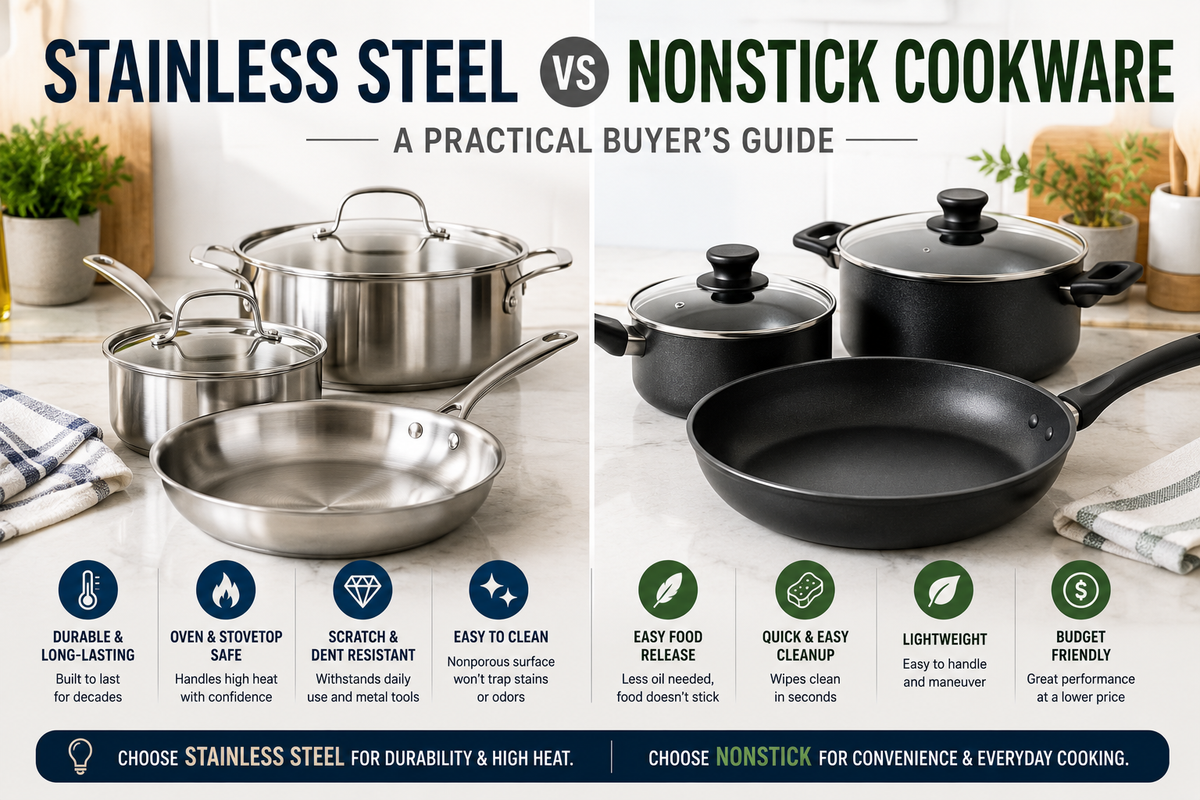
You're standing over dinner with two pans doing two very different jobs. In one, a salmon fillet is developing a crisp, golden skin. In the other, a fried egg is sliding free with barely a nudge. Both pans are useful, but they're useful for different reasons. The stainless steel vs nonstick cookware decision isn't about picking a fashionable brand. It's about knowing which surface behaves properly for the food, heat, and household in front of you.
| Criterion | Stainless steel | Nonstick |
|---|---|---|
| Best strength | Browning, searing, deglazing, oven finishing | Easy release for eggs, fish, pancakes, and gentle cooking |
| Heat tolerance | Better suited to aggressive heat and oven work | Health Canada advises not using nonstick above 260 °C (500 °F) or preheating it empty (Health Canada cookware guidance) |
| Food release | Requires temperature and oil control | Naturally slippery with little fat |
| Cleanup | Can need soaking or scrubbing | Usually quick and gentle |
| Durability | Long-term workhorse | Specialist surface that eventually wears |
| Best default | Main everyday skillet | Complementary breakfast and delicate-food pan |
The sections ahead focus on heat behaviour, durability, upkeep, safety, cost, cooking task, and household stage. This is a working cook's playbook, not a spec-sheet contest. By the end, you'll know which pan to grab for every burner in your kitchen.
Table of Contents
- The Pan on the Stove Right Now
- What Stainless Steel and Nonstick Actually Are
- Head-to-Head Performance, Durability, and Safety
- Matching the Pan to the Dish and the Cook
- Why the Smart Kitchen Uses Both
- How to Choose and Buy With Confidence
- Final Verdict and Long-Term Care
The Pan on the Stove Right Now
It's Tuesday night. You've got salmon in one pan and eggs in another, because dinner and breakfast-for-dinner have collided in the usual household rush. The stainless steel pan is building the browned bits that will become a quick lemon sauce, while the nonstick pan lets the egg glide across the surface without tearing its edges.
That split second tells you more than a long list of features. Stainless steel rewards technique and handles demanding heat. Nonstick removes friction from delicate food. Neither surface is universally superior, and trying to make one do the other's job is how cooks end up with stuck eggs, pale meat, damaged coatings, and unnecessary scrubbing.
A stainless skillet is the pan you reach for when the food needs colour. Dry a steak or chicken thigh, heat the pan, add fat, and let contact with the bare metal create a proper crust. Once you add wine, stock, or water, the browned residue loosens and becomes the base of a sauce. That process is difficult to reproduce in a conventional slick nonstick pan.
The nonstick skillet earns its place when release matters more than fond. Eggs, flaky fish, pancakes, crepes, grilled cheese, and reheated leftovers are less stressful when the cooking surface doesn't grab every protein and starch. It's also forgiving when you're tired, cooking for children, or trying to get breakfast onto plates before everyone leaves.
Practical rule: Grab stainless steel for colour and sauce. Grab nonstick for clean release and low-effort cooking.
Pan shape matters, too. A saucepan is designed for liquids and contained cooking, while a frying pan gives you broad surface area for browning. This saucepan versus frying pan guide is useful if the confusion starts with shape rather than material.
The right choice changes with the dish, your technique, and your household stage. A first-apartment cook may value easy eggs above all else. Someone learning pan sauces needs stainless steel sooner. A family kitchen usually gets the most practical coverage from both.
What Stainless Steel and Nonstick Actually Are
Start with the cooking surface, not the marketing name.
Stainless steel cookware is bare metal. It's an iron-based alloy, commonly identified by grades such as 18/10 or 18/0, and quality pans often use several bonded layers. Stainless steel provides the durable food-contact surface, while an aluminium or copper core spreads heat through the base and, in fully clad construction, up the sides.
That layered construction matters because a single thin sheet can create uneven hot spots. A clad pan behaves more consistently from the centre toward the edges, giving you better control when you're searing meat or reducing a sauce. The metal surface isn't naturally slippery, so food can stick if the pan is cold, the ingredient is wet, or you try to move the food before it has released.
The payoff is browning. Proteins and vegetables make direct contact with the hot surface, allowing colour and browned residue to form. That residue, often called fond, becomes useful once you deglaze the pan with liquid.

The coating changes the job
Nonstick cookware has a base plus a release layer. The body is commonly aluminium, hard-anodized aluminium, or steel. The cooking surface may use a fluoropolymer such as PTFE, or a ceramic sol-gel coating. That coating creates the low-friction behaviour that makes an egg slide and reduces the amount of fat needed for cooking.
The same feature that makes nonstick convenient limits how you use it. A coating isn't the place for aggressive scraping, metal utensils, empty preheating, or punishing burner settings. Once the surface becomes worn, food release declines and the pan stops delivering the reason you bought it.
Ceramic and PTFE pans belong in the broad nonstick category, but they aren't identical products. Read the label to identify the coating system, then follow the maker's heat and utensil guidance rather than assuming every dark, smooth pan behaves the same way.
You can apply the same surface logic to other household materials. If you're comparing easy-clean surfaces elsewhere in the home, a guide to non porous shower tile options offers useful context about why porosity and surface treatment affect maintenance.
For a kitchen drawer, stainless steel tools fit the same practical category of durable, washable metal. The HAUTE CUISINE Stainless Steel Garlic Press - 80710-HC is described with a durable stainless steel build, comfort grip handles, an easy garlic-crushing design, and quick, simple cleanup.
If you're trying to replace a coated pan with another surface, review these non-stick cookware alternatives before buying. The important question is whether you need a bare metal workhorse or a coated release specialist.
Head-to-Head Performance, Durability, and Safety
Stainless steel wins the long game. Nonstick wins the first five minutes of breakfast. That's the blunt version.
| Criterion | Stainless Steel | Nonstick |
|---|---|---|
| Heat performance | Strong choice for searing, browning, deglazing, and oven finishing | Best at gentle to moderate cooking; Health Canada advises keeping it at or below 260 °C (500 °F) and never preheating it empty (Health Canada guidance) |
| Durability | Bare metal tolerates vigorous use and thorough cleaning | Coating can scratch, wear, or lose release performance |
| Maintenance | Needs preheating, dry ingredients, oil, and occasional scrubbing | Needs gentler utensils, gentler cleaning, and controlled heat |
| Safety conversation | No PFAS-based nonstick coating is typically involved | Coating chemistry and disclosure deserve label-level attention |
| Cost over time | Higher upfront commitment can make sense for a durable generalist | Lower-effort specialist, but it's a replaceable tool rather than a permanent pan |
| Cooking feel | Food may stick before it releases naturally | Food usually lifts with little resistance |
| Best role | Main skillet, sauté pan, sauce pan, oven-finishing pan | Eggs, fish, pancakes, crepes, and sticky reheats |
Heat and durability
Stainless steel is the correct choice for the aggressive jobs. Sear a steak, brown chicken thighs, stir-fry over a hot burner, or build a pan sauce, and the bare surface gives you room to work. You can also scrub more confidently when something goes wrong.
Nonstick is not a searing pan. Health Canada specifically advises against empty preheating and use above 260 °C (500 °F) because overheating can degrade the coating and release fumes (Health Canada safe-use advice). That limit isn't an inconvenience to work around. It's a sign that the pan has a narrower job description.
What the safety labels now mean
California's AB 1200 made cookware chemistry more visible. Beginning January 1, 2023, manufacturers had to post an online list of intentionally added chemicals on California's designated list, and beginning January 1, 2024, those chemicals also had to appear on the product label (California AB 1200 bill text). California's Attorney General describes the law as including cookware labelling requirements and PFAS restrictions.
That matters because traditional stainless steel generally doesn't rely on a fluorinated nonstick coating, while many nonstick products use fluorinated surface systems. The label is therefore part of the buying decision, especially if you're choosing between a bare stainless pan and a coated release pan.
Health Canada also explains that PFOA was used in some nonstick coatings, while PFOA and PFOS-related substances are now prohibited or tightly restricted in Canada (Health Canada PFOA summary). For modern shoppers, the practical distinction is coating care, heat control, and transparency rather than a simplistic claim that every nonstick pan is the same.
For additional buying context, this guide to the best non-stick cookware can help you compare specialist pans without pretending they replace stainless steel.
Matching the Pan to the Dish and the Cook
The best pan depends on what you're cooking and how much attention you can give it. A stainless skillet asks you to preheat, dry ingredients, control oil, and wait for release. Nonstick lets you focus on the food rather than negotiating with the surface.
| Dish or Task | Best Material | Why |
|---|---|---|
| Steak or chicken thighs | Stainless steel | High heat and fond create better browning |
| Pan sauce with wine or stock | Stainless steel | Browned residue deglazes into the sauce |
| Over-easy eggs | Nonstick | The coating releases delicate proteins cleanly |
| Flaky fish fillets | Nonstick | Less tearing during turning and removal |
| Pancakes and crepes | Nonstick | Smooth release supports easy flipping |
| Stir-frying | Stainless steel | Handles assertive heat and tossing |
| Grilled cheese | Nonstick | Helps prevent sticking during slower cooking |
| Reheating sticky leftovers | Nonstick | Reduces welded-on starch and cheese |
| Omelette cooked gently | Nonstick | Low-and-slow cooking benefits from release |
| Oven-finished sear | Stainless steel | Better suited to browning before finishing |
The dish makes the decision
Reach for stainless steel when the meal depends on Maillard browning, fond, or deglazing. A steak needs a surface that can take heat and let you build a crust. A chicken thigh needs enough contact to render and brown the skin. A pan sauce needs the browned residue that a slick surface doesn't develop in the same way.
Nonstick handles food that's fragile, sticky, or annoying. Eggs are the obvious example, but flaky fish, crepes, pancakes, grilled cheese, and reheated rice or pasta also benefit. If the meal is likely to burn while you answer a child's question or unload the dishwasher, nonstick gives you a more forgiving margin.
The surface should match the failure you most want to avoid. Stainless steel prevents pale food. Nonstick prevents torn food and a sink full of scrubbing.
Household stage matters just as much
A renter with one induction plate and a kettle can get through daily cooking with one well-balanced nonstick skillet, especially if breakfast and reheating dominate. That setup becomes limiting as soon as the cook wants to brown butter, sear meat, or make a sauce from pan drippings.
A first-apartment cook learning those techniques should add a fully clad stainless skillet early. It teaches heat management and opens up dishes that nonstick makes difficult. A family feeding picky eaters should keep both materials available, because the same kitchen may need crisp chicken, soft eggs, pancakes, and reheated macaroni in one day.
An aspiring home chef who cooks weeknight meals and entertains on weekends should lean stainless steel for the main work. Keep nonstick for breakfast and delicate food rather than asking it to carry the whole kitchen.
For larger braises and slow oven cooking, understanding what a Dutch oven is used for helps prevent another common mismatch. A frying pan can't replace every piece of cookware, regardless of its surface.
Why the Smart Kitchen Uses Both
A kitchen built around only stainless steel becomes frustrating at breakfast. A kitchen built around only nonstick hits its ceiling when someone wants properly browned chicken, a serious sear, or a pan sauce. The sensible answer is a small hybrid set, not a cupboard full of duplicates.
Stainless steel is the generalist. It sears, sautés, deglazes, simmers, and moves from stovetop to oven when the construction allows it. It also tolerates the accidental hard scrape, the stubborn fond, and the family member who forgets that metal utensils are not ideal for coated surfaces.
Nonstick is the specialist. It handles eggs, fish, pancakes, crepes, grilled cheese, low-fat cooking, and sticky reheats with less effort. It shouldn't be treated as disposable junk, but it should be treated as a replaceable tool with a narrower range.

A stainless-first starter kit
For a household that wants broad capability, start with:
- An 8-inch tri-ply skillet: Useful for one or two portions and smaller sauté jobs.
- A 12-inch tri-ply skillet: The main surface for searing, vegetables, cutlets, and family-sized cooking.
- A 3-quart saucepan: The practical vessel for grains, sauces, vegetables, and modest batches.
- A 12-inch straight-sided sauté pan: Better containment for shallow braises, reductions, and larger sautéed meals.
- One 10-inch nonstick skillet: Reserved for breakfast, fish, pancakes, and other release-sensitive foods.
That's enough range for most weeknight cooking without buying every pan shape offered in a bundle. The stainless pieces do the heavy work, while the nonstick pan protects you from the tasks that punish bare metal.
When nonstick-first makes sense
Students, renters, and small households may reasonably begin with nonstick. It's light, easy to clean, and immediately useful for simple meals. The problem appears when the cook tries to brown chicken, create fond, or use higher heat. At that point, stainless steel isn't a luxury. It fills a genuine performance gap.
Treat nonstick as the specialist and stainless steel as the generalist. Health Canada's overheating guidance reinforces that distinction, and California's disclosure rules make coating chemistry something shoppers can now inspect rather than ignore (California AB 1200).
The hybrid approach also controls replacement decisions. When a nonstick pan loses its release performance, replace that one specialist instead of replacing an entire cookware collection.
How to Choose and Buy With Confidence
Construction comes first. A fully clad tri-ply stainless pan generally gives you more even heat across the cooking surface than a pan with a thin metal body and a separate disk only on the bottom. If you cook on induction, confirm compatibility before buying rather than assuming every stainless pan will work.
For nonstick, avoid thin stamped bodies that feel flimsy or sit unevenly on the burner. A thicker forged or hard-anodized aluminium body is usually a more convincing starting point because the pan feels steadier and is less likely to behave erratically on a hot hob.
Use your hands before you read the box
Pick up the pan by the handle only. A stainless skillet should feel substantial without making you fight it. A nonstick skillet should feel balanced enough for one-handed flipping, especially if you'll use it for crepes, omelettes, or fish.
Inspect the handle connection. Riveted stainless handles feel secure, but they can become hot and still require a mitt. Phenolic stay-cool handles may be comfortable on the hob, but check the oven instructions carefully. A handle that isn't oven-rated shouldn't go into the oven just because the pan body looks sturdy.
Look at the cooking surface under bright light. The coating should appear uniform, without visible chips, bubbles, or rough patches. For stainless steel, check that the base sits flat and the rim is finished cleanly.
Shopping habit: Read the care instructions before you buy. They reveal the pan's real limitations more clearly than the front of the packaging.
Check the chemistry claims
For nonstick cookware, identify whether the surface is PTFE or ceramic, and read claims such as PFOA-free or PFAS-free carefully. California's AB 1200 framework began online chemical disclosure on January 1, 2023, followed by product-label disclosure on January 1, 2024 (California Legislature). For California shoppers, the online disclosure and physical label belong in the comparison, especially when a product makes a broad chemistry claim.
California's policy direction continued in 2025, when lawmakers approved a broader PFAS phaseout proposal that would have required covered cookware to comply by 2030, subject to the proposal's category rules and future implementation (Powers Health summary). That proposal isn't the same as a current universal restriction, but it shows why a stainless steel pan can be the lower-regret long-term choice for shoppers who want less dependence on coating chemistry.
For searing-specific selection, Mise's guide to searing pans is a useful companion because it keeps the decision centred on heat and surface area rather than on a decorative set.
Watch the buying guidance here before ordering:
If you use gas burners, compare the pan's base, balance, and heat response with this guide to the best cookware for gas stoves. Skip the oversized bundle unless every piece has a job. Fewer, better-matched pans are easier to store, clean, and replace intelligently.
Final Verdict and Long-Term Care
My recommendation is straightforward. Buy stainless steel as your main cookware, then add one good nonstick skillet for the jobs stainless steel handles poorly. That combination gives you durable high-heat performance without forcing you to fight every egg and fish fillet.
| Situation | Recommended Setup | Care Priority |
|---|---|---|
| Renter with two burners | One 10-inch nonstick skillet and one 10-inch stainless fry pan | Keep the nonstick below its heat limit and learn stainless preheating |
| Busy family | Stainless saucepan, larger stainless skillet, and one nonstick breakfast pan | Protect the coated pan from metal tools and rushed high heat |
| Aspiring home chef | Fully clad stainless collection with one nonstick pan | Use stainless for fond and sauces, nonstick only for delicate cooking |
| Small household | One versatile stainless skillet plus one smaller nonstick skillet | Match pan size to portion size and avoid unnecessary duplication |
| Breakfast-heavy cook | Stainless main pan with a dedicated nonstick specialist | Wash the nonstick gently and replace it when release declines |
A renter with two burners shouldn't buy a full set. Start with the two skillets that cover the widest range. A busy family should add a stainless saucepan for sauces, grains, and vegetables, plus a larger skillet for volume cooking. An aspiring home chef should put most of the budget and storage space into fully clad stainless, then keep nonstick for eggs and crepes.
Keep stainless steel working properly
Preheat stainless gradually, dry ingredients before they hit the pan, add oil once the surface is ready, and give food time to release before forcing it. If something sticks, deglaze while the pan is warm rather than attacking it immediately with a sharp utensil.
Rainbow discolouration is a cosmetic nuisance, not a reason to discard the pan. A stainless-safe cleaner such as Bar Keepers Friend can restore the finish when ordinary washing doesn't.
Preserve the nonstick surface
Use low to medium heat for routine cooking, don't preheat the pan empty, and choose silicone or wood utensils. Wash with a soft sponge and avoid treating the coating like bare metal. Once the surface is scratched, patchy, or no longer releases food properly, replace the pan rather than trying to rescue it with harsher cleaning.
California's disclosure timeline shows that the cookware safety conversation is still developing. The 2023 online disclosure milestone, 2024 label milestone, and the 2025 phaseout proposal with a projected 2030 cookware compliance point make stainless steel the lower-regret durable workhorse for many buyers, while nonstick remains valuable as a controlled, replaceable specialist (California AB 1200, 2025 California PFAS proposal summary).
Visit GrifGlo to compare practical kitchen essentials and cookware guidance organised around real cooking tasks, household needs, and fit for purpose. Use that approach to build a stainless-first setup with one properly chosen nonstick pan, instead of buying a crowded set that doesn't match the way you cook.

Laisser un commentaire
Ce site est protégé par hCaptcha, et la Politique de confidentialité et les Conditions de service de hCaptcha s’appliquent.