

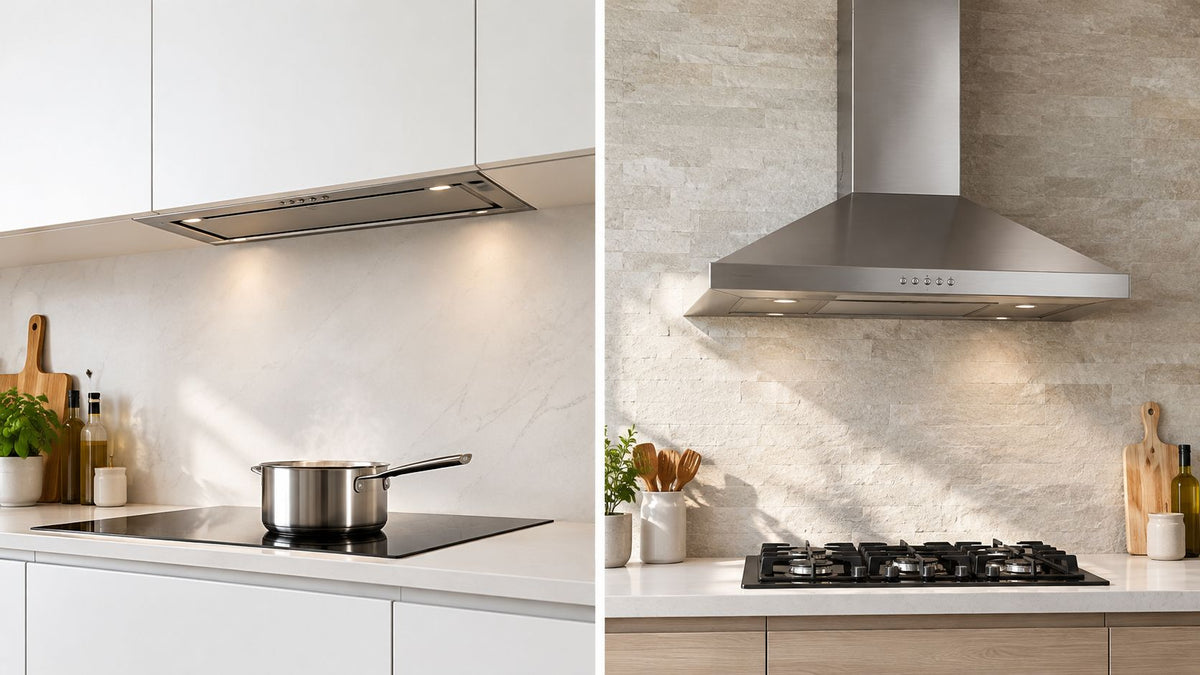
Under-cabinet hoods are used by 59% of surveyed Canadian households, compared with 7% for wall-mount models, but that doesn't make them the better performer by default. The decisive factors are outdoor ducting, canopy coverage, burner position, and whether you run the hood during and after cooking.
The popular advice says to choose based on style: keep the cabinets and install an under-cabinet hood, or remove them and make a wall-mount hood the centrepiece. That advice is incomplete. I install these systems regularly, and the key question is simpler: which hood will capture your cooking plume before it spreads through the kitchen?
A wall-mount hood can provide a broad capture area, but a poorly ducted model mounted too high can disappoint. An under-cabinet hood can look modest, yet perform well when it sits close to the burners, covers the active cooking zone, and vents outdoors through a short, smooth duct.
| Decision factor | Under-cabinet hood | Wall-mount hood |
|---|---|---|
| Best fit | Existing cabinetry and compact kitchens | Open wall space and broader cooktop coverage |
| Main strength | Compact installation with less renovation | Larger capture envelope and stronger visual clearance |
| Main risk | Limited projection or canopy coverage | Poor duct routing, excessive height, or unnecessary structural work |
| Ventilation priority | Outdoor ducting and close burner coverage | Outdoor ducting, canopy depth, and correct mounting height |
| My default recommendation | Choose it when the cabinet layout already works | Choose it for wide cooktops, open walls, or demanding cooking |
Table of Contents
- The Appearance Trap in Hood Selection
- Installation and Ducting Differences
- Airflow Performance and Noise Reality
- Code Compliance and Safety Requirements
- Real Kitchen Scenarios and Usage Patterns
- Cost, Maintenance, and Long-Term Value
- Making Your Final Decision
The Appearance Trap in Hood Selection
The most common mistake in an under cabinet range hood vs wall mount decision is treating the hood as a finish selection. Homeowners compare stainless steel, black glass, chimney shapes, and cabinet lines, then assume the more impressive-looking unit will manage smoke and grease better. The hood's silhouette tells you very little about its installed capture performance.
A Canadian study of 4,500 complete household survey responses found that 59% of respondents had an under-cabinet hood, while only 7% had a wall-mounted hood, meaning under-cabinet models appeared in roughly 8.4 times as many households in that surveyed housing stock (Canadian range hood and ventilation data). That establishes popularity, not superiority. Under-cabinet hoods are common because Canadian kitchens often place the cooktop beneath upper cabinets, not because the format automatically removes more pollutants.
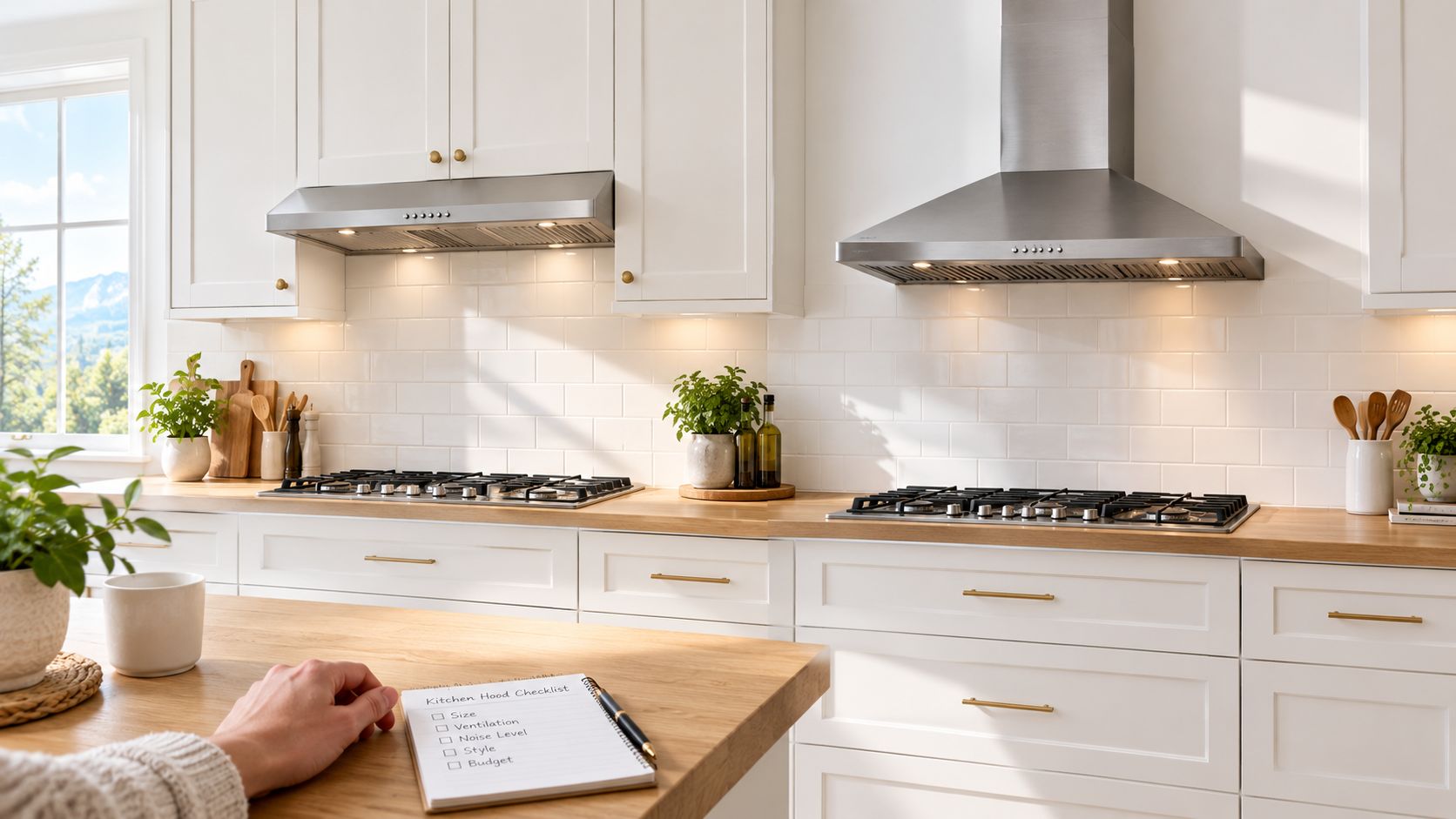
Think in capture geometry
Capture geometry means the relationship between the canopy, the burners, the mounting height, and the direction of the rising cooking plume. A wall-mount hood may have more open space around it, but if its canopy doesn't extend over the front burners, smoke can escape before the fan pulls it in. An under-cabinet model may sit closer to the cooking surface and collect the plume effectively, provided its depth and width suit the range.
Outdoor ducting matters just as much. A recirculating hood can filter grease and some odours, but it returns heat, humidity, and fine particles to the room. A correctly sized hood that exhausts outdoors is usually the more sensible choice for Canadian homes, regardless of how it mounts.
Your cooking habits decide the winner
The second test is usage. If you cook on the front burners, use a griddle, sear meat, or prepare foods that create heavy steam, canopy coverage becomes more important than a decorative chimney. If you rarely cook and mainly need light odour control, a compact under-cabinet installation may be the practical answer.
My opinion is direct: choose the mounting style only after you map the cooking zone and duct route. If the wall-mount option gives you broad coverage and a clean exterior duct, take it. If it forces a long, restrictive duct run or leaves the front burners exposed, keep the cabinets and buy the better-positioned under-cabinet hood.
Installation and Ducting Differences
Installation is where the two formats separate quickly. An under-cabinet hood uses the existing cabinet structure, so the installer can often replace an old unit without rebuilding the wall. A wall-mount hood removes the cabinet above the cooktop and needs a clear, properly supported wall surface, plus a chimney route that may continue through the ceiling or roof.
Neither style should be judged by the product box alone. The manual controls the permitted mounting height, duct size, clearances, electrical requirements, and whether the motor can operate in a recirculating configuration.
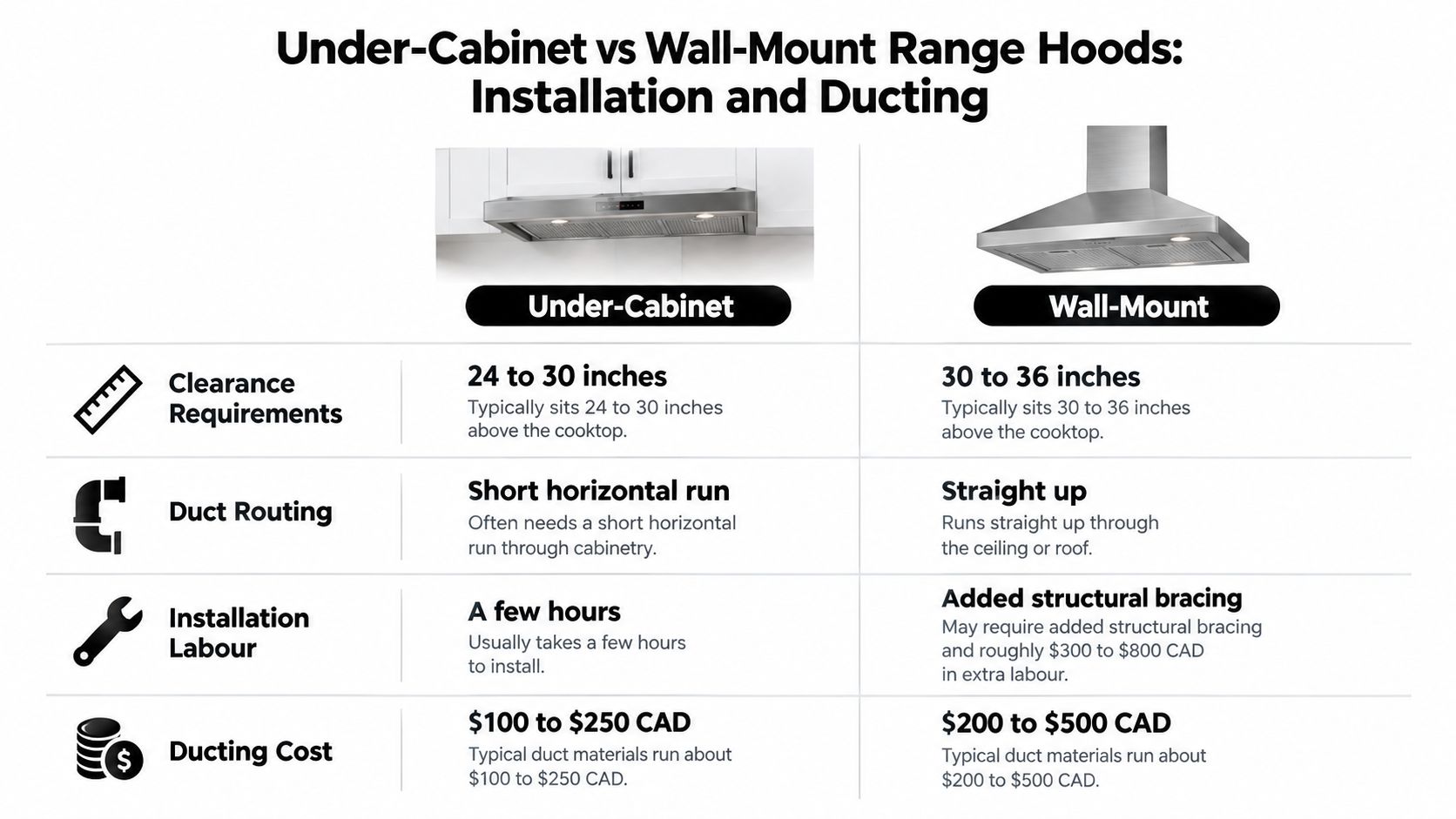
| Criterion | Under-Cabinet Hood | Wall-Mount Hood |
|---|---|---|
| Cabinet relationship | Fits beneath an existing wall cabinet | Replaces the cabinet above the cooktop |
| Wall requirements | Cabinet provides mounting support | Requires clear wall space and secure fixing |
| Duct route | Often exits through the rear wall or rises through cabinetry | Often rises through the chimney to the ceiling or roof |
| Capture shape | Usually compact and close to the cooktop | Often broader, deeper, and more visually open |
| Renovation impact | Usually limited to the hood and duct opening | May involve cabinet removal, wall repair, and chimney finishing |
| Best installation condition | Existing cabinet layout with a nearby exterior wall | Open wall, wider cooktop, and a workable vertical duct route |
Duct resistance is the hidden constraint
A short, straight metal duct delivers more usable airflow than a long route with repeated bends. Every change in direction, undersized section, and restrictive transition increases resistance. Flexible ducting is especially poor for a permanent cooking exhaust installation because its ridges and shape reduce airflow and collect grease.
Before ordering, measure the route from the hood outlet to the exterior termination. Confirm the hood's required duct diameter, maximum equivalent duct length, damper arrangement, and whether the exterior wall or roof route is accessible. The range hood installation guide can help you organize those checks before the installer arrives.
A wall-mount hood isn't automatically harder, but it usually creates more visible construction. An under-cabinet hood isn't automatically easier if the cabinet blocks the duct or the existing opening is the wrong shape.
Installer's rule: A smaller hood with a clean, compliant duct route can outperform a larger hood connected to a restrictive one.
If you're planning other kitchen equipment at the same time, keep the work sequence organised. For example, the GE Kitchen Composter is a compact kitchen device with a 3L capacity, so it belongs on the appliance and waste-planning list rather than in the hood ducting plan.
Airflow Performance and Noise Reality
Airflow on the specification sheet is only a starting point. Your installed hood must move air through the duct, bends, damper, and exterior termination, so compare certified performance under resistance whenever the manufacturer provides it, rather than choosing the largest free-air number. Capture geometry and duct quality matter more than whether the hood sits under a cabinet or on the wall.
A peer-reviewed Canadian study of 132 households recorded a geometric-mean particle decay rate of 2.5 per hour when a vented hood operated, compared with 2.0 per hour for an unvented or recirculating hood. The difference wasn't statistically significant, so a vented model should not be treated as an automatic solution to every indoor-air problem (Canadian household ventilation study).
Placement decides how much of the plume reaches the hood. A deep wall-mount canopy with a short, well-built duct can capture effectively, while a shallow hood mounted too high can let smoke and grease escape. An under-cabinet model performs well when it stays close to the cooking surface and covers the burners producing the most heat and grease. For a concrete reference on sizing and sound levels at working speed, see this 36-inch vent hood overview.
Runtime beats chasing a larger motor
Run-on time deserves more attention than many shoppers give it. The same research found that operating the hood for at least 15 minutes after cooking provided particulate reduction comparable to increasing airflow by 100 CFM during cooking. Start the fan before food reaches the pan, keep it running during cooking, and use the timer after switching off the burners.
Noise determines whether that routine lasts. A hood that sounds harsh at its normal setting gets switched off too early. Check the certified sound rating, listen at the speed you expect to use, and favour a smooth duct route because turbulence makes any motor seem louder.
A personal fan moves air around the cook, but it does not capture pollutants at the source. It cannot replace a range hood or outdoor ducting.
Code Compliance and Safety Requirements
A range hood is part of the home's ventilation system, so mounting style alone does not determine safety. Canadian requirements and enforcement vary by province and municipality. Confirm the applicable rules with the installer before cutting through a wall, cabinet, or roof.
Health Canada notes that exhaust systems above approximately 90 to 180 litres per second, or roughly 190 to 380 CFM, may require additional venting or makeup-air provisions (Health Canada guidance on indoor ventilation). A powerful hood can depressurise the home and draw combustion gases backward through a fireplace, natural-draft water heater, or other combustion appliance.
Use this installation sequence
- Confirm the appliance and hood relationship. Follow the range manufacturer's clearance requirements and the hood manual. A wall-mount canopy's open appearance does not remove height limits.
- Verify the duct plan. As covered in the ducting section, use a smooth metal duct with minimal bends and terminate outdoors. Never discharge cooking exhaust into an attic, crawlspace, wall cavity, or another interior area.
- Check makeup air. If the hood falls within Health Canada's higher exhaust range, ask the installer or building authority whether makeup air or an interlock is required.
- Install grease filtration and keep exhaust systems separate. Canadian code-related guidance specifies that kitchen exhaust intakes within 3 metres horizontally of a cooktop should have a grease filter. Residential cooking exhaust ducts generally need to remain independent of other exhaust ducts (Canadian ventilation requirements).
- Test the finished system. Run every fan speed, inspect the damper, check for vibration, and confirm that air exits outdoors without leaks.
Large wall-mount hoods often serve large cooktops, so makeup-air questions arise more often. Under-cabinet models are not exempt. Safety follows the installed airflow, capture position, and duct arrangement, not the mounting label.
For a cooktop away from the wall, review the requirements for range hoods for islands before adapting a wall-mount design.
Real Kitchen Scenarios and Usage Patterns
Hood selection should follow cooking habits and capture geometry, not the mounting label. A careful simmering cook has different needs from a household that regularly sears, fries, or uses the front burners in an open-plan kitchen.
Canadian research found that only 27% of cooking activities in the studied homes used added ventilation. A range hood was used in 10%, a window was opened in 15%, and both methods were used in 2% of activities. Ventilation use reached 36% in summer but fell to 19% in winter. These figures show why a hood that is easy to reach and simple to operate matters in daily use. (Canadian household cooking ventilation findings)
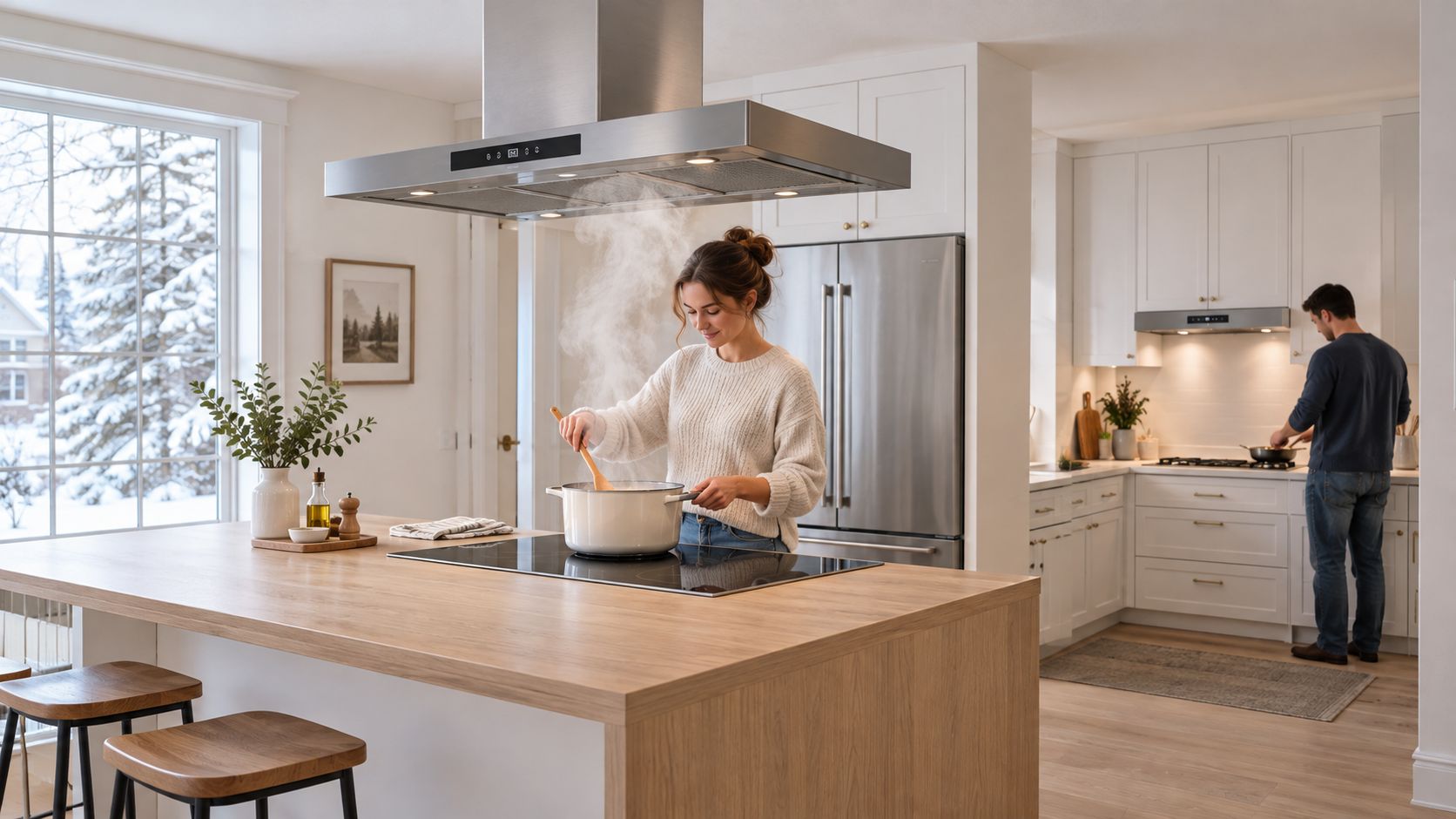
The compact rental kitchen
A renter or condo owner with an existing cabinet run usually benefits from an under-cabinet hood. It preserves the layout, limits construction, and may connect to an existing exterior duct. If the building permits recirculation only, choose a model with accessible grease filters and use it consistently. Recirculation can filter grease and odours, but it will not exhaust heat and humidity outdoors.
A wall-mount hood makes sense only when the building can support its duct route and clearances. A larger canopy cannot compensate for a restricted shaft or poor exhaust path.
The open-concept family kitchen
An open-plan kitchen needs dependable capture because cooking pollutants can travel into living and dining areas. I favour a wall-mount hood when its canopy reaches over the active burners and the duct route is short, direct, and correctly sized. An under-cabinet model is the better choice when it provides broader coverage or a cleaner duct connection.
Burner position creates the common mismatch. 58% of surveyed respondents preferred front burners, but only 20% had a hood that fully covered those burners. Measure the canopy projection against the front cooking zone. A centred hood can still miss the plume rising from a front burner.
The serious home cook
Frequent high-heat cooking calls for broad capture, practical ducting, and a motor that remains tolerable at working speed. A wall-mount hood often suits a wide cooktop when the wall can accept a deep canopy. An under-cabinet hood remains the stronger option when cabinetry keeps the unit close to the burners and provides the better duct route.
Stand at the cooktop, identify the burners used most, and trace the plume path upward. If the hood does not cover that path, change the design before choosing the finish. A correctly placed, well-ducted hood outperforms a larger hood installed for appearance alone.
Cost, Maintenance, and Long-Term Value
The cheapest hood to buy isn't always the cheapest hood to own. A wall-mount installation can require more surrounding work, while an under-cabinet unit can create awkward access if the cabinet, duct transition, or filter opening is cramped. The right value calculation includes cleaning effort, replacement parts, duct accessibility, and how likely you are to use the fan.
| Factor | Under-Cabinet Hood | Wall-Mount Hood |
|---|---|---|
| Exterior cleaning | Usually easy to reach from the front | Can require more attention around the chimney and canopy |
| Filter access | Often compact and close to cabinet edges | Frequently more open, depending on the canopy design |
| Grease exposure | Close mounting can place surfaces near splatter | Larger surfaces may collect grease across a broader area |
| Duct inspection | May be partly hidden inside cabinetry | Often follows a visible chimney route before entering the wall or ceiling |
| Repair access | Cabinet layout can restrict access | Open wall space can simplify access, but chimney sections may need removal |
| Best ownership fit | Owners who want a straightforward replacement | Owners who accept more installation detail for broader coverage |
Maintenance is part of performance
Wash metal grease filters according to the manufacturer's instructions and wipe the canopy before residue hardens. Inspect the exterior damper for obstruction and listen for new vibration, rattling, or airflow changes. Those signs often point to a loose connection, grease accumulation, or a duct restriction.
A wall-mount hood may be easier to reach around the filter area, but its larger visible surfaces need regular wiping. An under-cabinet hood may be simpler overall, though tight cabinetry can make filter removal and duct inspection less convenient.
Use this range hood cleaning guide to establish a routine, then ask a qualified technician to inspect the duct and damper when airflow noticeably drops. The hood that delivers reliable capture for years is usually the one you can clean without dismantling half the kitchen.
For most moderate-use kitchens, I recommend paying for better duct planning before paying for decorative upgrades. A plain hood with clean airflow and accessible filters is better value than an expensive centrepiece that gets neglected.
Making Your Final Decision
Choose an under-cabinet hood when the existing cabinet layout is sound, the cooktop is compact, and the duct can reach the exterior without an awkward route. It's the sensible choice for many Canadian replacements, especially when preserving storage and limiting renovation work matter more than making the hood a visual feature.
Choose a wall-mount hood when you have a clear wall, need broader canopy coverage, cook frequently at high heat, or want the hood positioned as a deliberate part of the kitchen design. Don't select it solely for the impression of higher power. Confirm that the duct route, mounting height, and canopy projection support the performance you want.
Use this final checklist
- Coverage: Does the canopy extend over the burners you use most, especially the front burners?
- Ducting: Can the installer use smooth metal ductwork with minimal bends and an exterior termination?
- Air replacement: Could the exhaust rating require makeup-air planning in your home?
- Noise: Is the working speed quiet enough that you'll run it during cooking and afterward?
- Access: Can you remove the filters, clean the canopy, and inspect the damper without dismantling cabinetry?
- Layout: Will the hood preserve useful storage, or does a wall-mount design create a better capture envelope?
A renter should usually prioritise a compliant, usable replacement that fits the existing opening. A homeowner renovating permanently should prioritise burner coverage and duct geometry before finishes. A serious cook should choose the format that captures the actual plume, even if that means abandoning the more fashionable option.
For broader home purchasing decisions, GrifGlo's decision-making framework offers a structured way to compare fit, installation constraints, and everyday use. The answer to the under cabinet range hood vs wall mount question is clear once you stop asking which style looks better and ask which installation will be used correctly.
GrifGlo helps households compare practical kitchen appliances, organisation products, and home essentials using clear fit-for-purpose guidance. Visit GrifGlo to evaluate range hood considerations alongside the tools and systems that make your kitchen easier to use every day.


Laisser un commentaire
Ce site est protégé par hCaptcha, et la Politique de confidentialité et les Conditions de service de hCaptcha s’appliquent.