

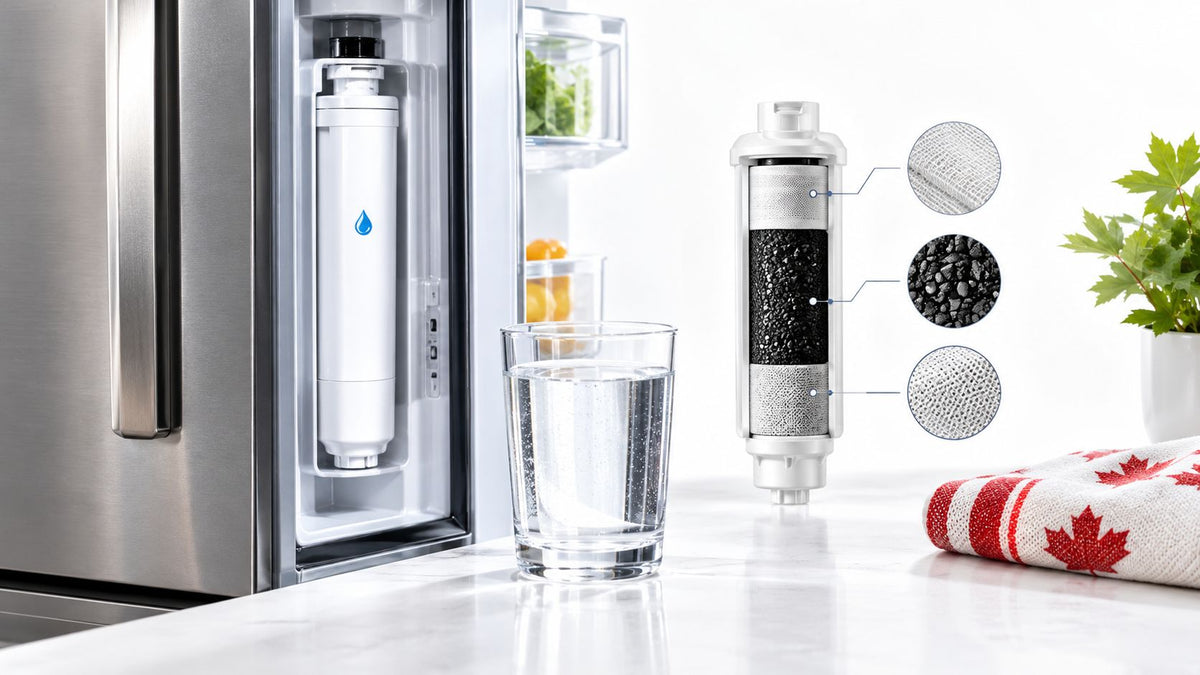
You're standing in the kitchen with a glass under the refrigerator dispenser when the water suddenly tastes faintly of chlorine. The filter light has been glowing for days, but the replacement cartridge in your online basket only says “fits your fridge.” Does it actually remove the substance you care about, and will it install without leaking?
A refrigerator water filter is a small component, but choosing one involves more than matching a shape. You need to understand what the cartridge can reduce, which format your appliance uses, how its capacity matches your household, and when replacement is due. Canadian households already show strong interest in point-of-use treatment: in 2019, 43% used some type of filter or purifier, while jug filters alone were used by 25%, according to Statistics Canada's household water-treatment overview.
This guide is a practical buying conversation, not a brand ranking. It will help you connect everyday concerns such as taste, odour, visible particles, and specific contaminants with the cartridge's certified claims, then install and maintain the filter with confidence. For a broader look at household filtration choices, you can also compare the guidance in GrifGlo's water-filter guide.
Table of Contents
- Why the Filter in Your Fridge Matters More Than You Think
- How a Refrigerator Water Filter Cleans Water
- The Three Filter Formats and How to Match One to Your Fridge
- Certifications That Reveal What Gets Removed
- Lifespan, Replacement Signs, and Why Filters Slow Down
- Replacing the Cartridge Without Cracking an O-Ring
- What Flow Rate, Capacity, and Price Mean for Buyers
- Putting It All Together Before You Buy
Why the Filter in Your Fridge Matters More Than You Think
Municipal water treatment does important work before water reaches your home. Yet a treated supply can still have a taste or smell you dislike, and household plumbing can affect what comes out of the tap. A refrigerator water filter gives you a convenient treatment point for the water you drink and the ice you use every day.
A treated supply can still taste different
You might notice a swimming-pool smell after maintenance at the water plant, a metallic note from plumbing, or tiny particles after work on a local line. Those observations don't automatically mean your water is unsafe. They do explain why people choose additional treatment for taste, odour, appearance, and peace of mind.
Canadian household behaviour supports that distinction. Nearly all potable water produced by Canadian public utilities underwent filtration and disinfection, yet many households still selected an additional filter or purifier, as described by Statistics Canada. The choice often concerns how water feels and tastes at the point of use, rather than a belief that municipal treatment does nothing.
Practical rule: Treat “filtered” as an incomplete statement. Ask which contaminant, at what rated capacity, and under which certification.
The filter is useful, but it isn't a universal purifier
A cartridge may reduce chlorine taste and odour, trap sediment, or carry a certified claim for a particular health-related contaminant. It won't automatically remove every substance just because it fits inside a refrigerator.
That matters if your concern is lead, arsenic, PFOA/PFOS, or another named contaminant. Your local water information should guide the search, and the exact cartridge documentation should confirm the reduction claim. A refrigerator filter should supplement responsible water-system information, not replace it.
The most useful way to shop is therefore to begin with your routine. Do you fill a glass several times a day, rely heavily on ice, or use the dispenser only occasionally? The answer affects capacity and replacement timing. Your fridge model then narrows the physical options, while certification narrows the credible treatment options.
How a Refrigerator Water Filter Cleans Water
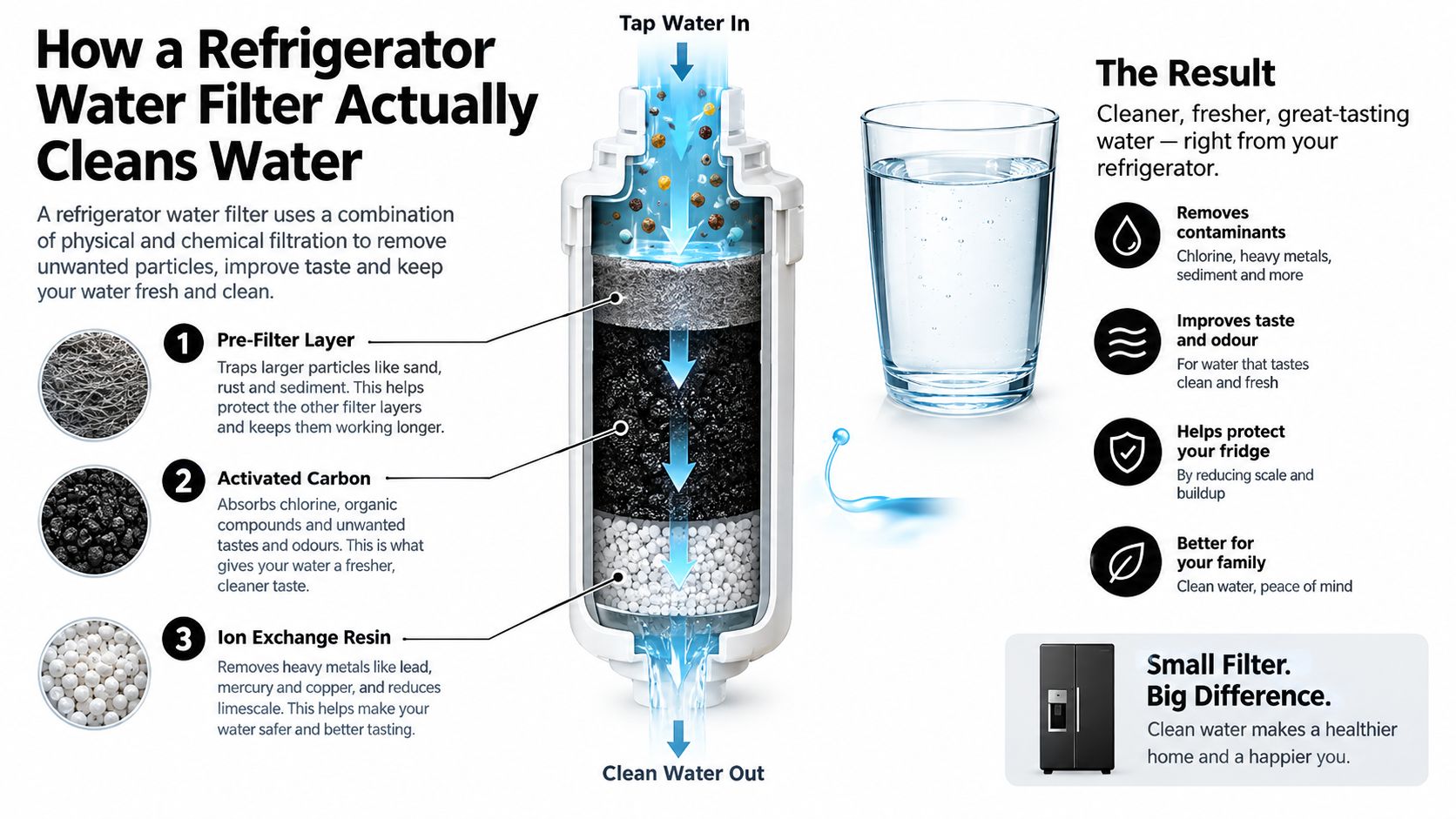
A refrigerator cartridge treats water in stages rather than through one magic screen. Water enters through an upstream layer that catches larger particles, then passes through activated carbon and, in some designs, additional media for specific reduction claims.
First stop is the sediment layer
The outer or upstream layer often serves as a sediment pre-filter. It works like a coarse kitchen sieve, catching visible grit before water reaches finer media. This layer can hold particles such as rust and sediment, but it does not show that the cartridge removes dissolved contaminants.
The pre-filter also protects the stages after it. As larger particles fill the available pathways, water encounters more resistance, flows more slowly, and may cause the cartridge to reach its useful limit sooner.
Activated carbon does more than strain
Activated carbon is often the main working material inside a refrigerator cartridge. Its porous structure creates a large internal surface, where certain compounds attach as water passes through. This process, called adsorption, means a substance sticks to a surface. Absorption is different because it involves soaking throughout a material's volume.
Depending on its design and tested performance, carbon may support claims involving chlorine, taste, and odour. Those claims do not cover every dissolved contaminant. The label or performance documentation should name the specific substance reduced.
Some cartridges add ion-exchange resin or another specialised medium. These materials may support targeted claims for substances such as lead or mercury, yet an extra layer alone does not prove effectiveness. Check for independent certification and the exact contaminant name.
Air-cleaning products use related but different combinations of media. The DYSON HEPA Air Carbon Purifier Filter - 965432-01 is described as using 360° HEPA filtration and activated carbon for odours and gases, but an air-purifier filter cannot replace a refrigerator cartridge. GrifGlo's air-purifier filter guide provides a broader explanation of layered filtration.
The Three Filter Formats and How to Match One to Your Fridge
Before choosing a certified filter, confirm the physical format your refrigerator accepts. A cartridge can meet a contaminant standard and still be unsuitable if it cannot lock into the housing or connect safely to the water line.
Identify the physical arrangement first
Refrigerator systems generally use one of three arrangements:
- Internal in-line cartridges sit behind a lower grille or in a compartment near the base. Tubing connects them to the water supply, and the cartridge may remain hidden during normal use.
- Twist-and-lock cartridges fit inside the refrigerator compartment or near the dispenser. You insert the cartridge, then rotate it until the housing holds it in place.
- External in-line filters attach to the supply line outside the fridge, often behind the appliance or beneath a nearby cabinet. This format can serve a refrigerator without a dedicated internal housing.
Check the model number before ordering. A photograph of the old cartridge can help, but the owner's manual, filter-status menu, and manufacturer's parts list provide stronger confirmation of the intended format. If a replacement must fit within a tight kitchen, GrifGlo's kitchen-appliance dimensions guide can help you assess the surrounding clearance. It will not identify the cartridge model.
| Format | Typical Location | Example Models | Cost per Litre |
|---|---|---|---|
| Internal in-line | Behind the grille or inside the cabinet | Fridges with a separate water-line housing | Depends on cartridge capacity and replacement price |
| Twist-and-lock | Inside the refrigerator compartment | Fridges with a dedicated internal filter socket | Depends on cartridge capacity and replacement price |
| External in-line | On the supply line behind or beneath the fridge | Older or filter-ready plumbing arrangements | Depends on cartridge capacity, fittings, and replacement price |
The table leaves cost per litre open because cartridge prices, rated capacity, water conditions, and household usage vary. Calculate your figure from the package information by dividing the replacement price by its rated capacity.
A mismatched cartridge may produce slow flow, leaking connections, or an error message. If the replacement resists, stop rather than forcing it into the housing. A kettle such as the HAUZ AKL1695 Whistling Stovetop Stainless Steel Kettle 2L can heat water for tea or coffee, but it does not replace a connected refrigerator filtration system.
Certifications That Reveal What Gets Removed
A certification is useful only when it matches the contaminant you want to reduce. A broad phrase such as “pure water” says little about performance. Read the standard together with the named contaminant, test result, and rated capacity.
Match the standard to the contaminant
NSF/ANSI 42 generally covers aesthetic concerns such as chlorine, taste, and odour. NSF/ANSI 53 covers health-related contaminant claims, which may include lead, mercury, or certain microorganisms when the specific claim appears in the product documentation. NSF/ANSI 401 addresses certain emerging contaminants, including categories such as pharmaceuticals and pesticides. A cartridge certified under NSF/ANSI 53 with P473 may include a specific claim for PFOA/PFOS reduction.
The number alone does not prove that a filter removes every contaminant in its category. Check the performance sheet for the exact contaminant, test conditions, rated capacity, and replacement requirement.
Apply the claim to your household
Suppose a Canadian household wants to reduce chlorine taste and lead. Statistics Canada household-filtration information can provide context about why households filter their water. Certification records answer the more specific buying question: what does this cartridge claim to reduce?
A cartridge with a verified NSF/ANSI 42 chlorine-reduction claim may address the taste concern. It addresses lead only when the documentation also lists a tested lead-reduction claim, commonly under the relevant health-effects standard. “Carbon filter” describes the material, not proof of either result.
California's Residential Water Treatment Device Registration Program offers a useful way to check claims. Consumers can search by device type, refrigerator-filter category, model, and targeted contaminants such as lead, arsenic, and PFOA/PFOS. Its guidance states that health-related claims should be independently tested and certified by an accredited organisation, with performance tied to the cartridge's rated gallon capacity.
Use GrifGlo's product standardisation guide to compare labels consistently. Record the contaminant, standard, capacity, and replacement condition. Missing details make a claim harder to evaluate.
Lifespan, Replacement Signs, and Why Filters Slow Down
A filter doesn't have one universal expiry signal. Your refrigerator may count time, estimate water volume, or use a simple reminder that depends on the installation date. Learn which system your appliance uses before treating the indicator as a measurement of actual cartridge performance.
Capacity and calendar reminders answer different questions
A gallon or litre counter tracks estimated water use and is more responsive to a busy household. A time-based reminder is simpler, but it may not reflect how much water has passed through the media. Neither method replaces the cartridge's own rated capacity and replacement instructions.
Watch for practical signs:
- Slower dispensing: Sediment or exhausted media can restrict the pathway.
- Weaker ice production: A restricted water supply can affect how quickly the ice maker fills.
- Returning taste or odour: Chlorine or a musty note may signal that carbon media has reached its useful limit.
- An illuminated indicator: The fridge is asking for maintenance, even if the water still looks clear.
Water can look normal after a cartridge has reached its rated capacity. That appearance isn't a performance test. California's water-treatment guidance warns that using a cartridge beyond its rated capacity can stop the claimed contaminant reduction, so follow the manufacturer's interval and capacity rather than waiting for a dramatic visual change.
A saturated cartridge can also slow the stream because trapped particles occupy the available pathways. Replacement is routine maintenance, not an accusation that the water system has failed. Mark the installation date on the cartridge or set a phone reminder, then use the fridge prompt and changes in flow or taste together.
Replacing the Cartridge Without Cracking an O-Ring
Most cartridge changes are manageable at home if you avoid force and keep water pressure under control. Read the refrigerator manual first, because the release mechanism differs between models.
- Prepare the area. Place a towel beneath the housing or dispenser compartment. If the manual instructs you to shut off the supply, do that first. Otherwise, dispense a small amount of water to reduce pressure in the line.
- Remove the old cartridge. Twist, pull, or press the release button according to the housing design. Keep the old filter upright if it contains water.
- Inspect the socket. Look for a displaced seal, debris, or a damaged O-ring. Wipe the mating area clean with a soft cloth. Don't use tools to pry a cartridge out unless the manual specifically permits it.
- Install the replacement. Align the tabs or arrows, push the cartridge into position, and rotate it until it stops. Stop when it locks. Overtightening can distort the O-ring, which may create a slow leak later.
- Flush the new filter. Run water into a container for the volume specified by the manufacturer. New carbon cartridges can release loose carbon fines at first, so don't drink the initial cloudy or grey water.
- Check the connection. Dispense water again and inspect the housing and nearby tubing for leaks. A small drip deserves attention before you return the appliance to normal use.
- Reset the indicator. Use the button sequence in the manual. If the light remains on, the cartridge may be installed correctly but the reminder still needs a manual reset.
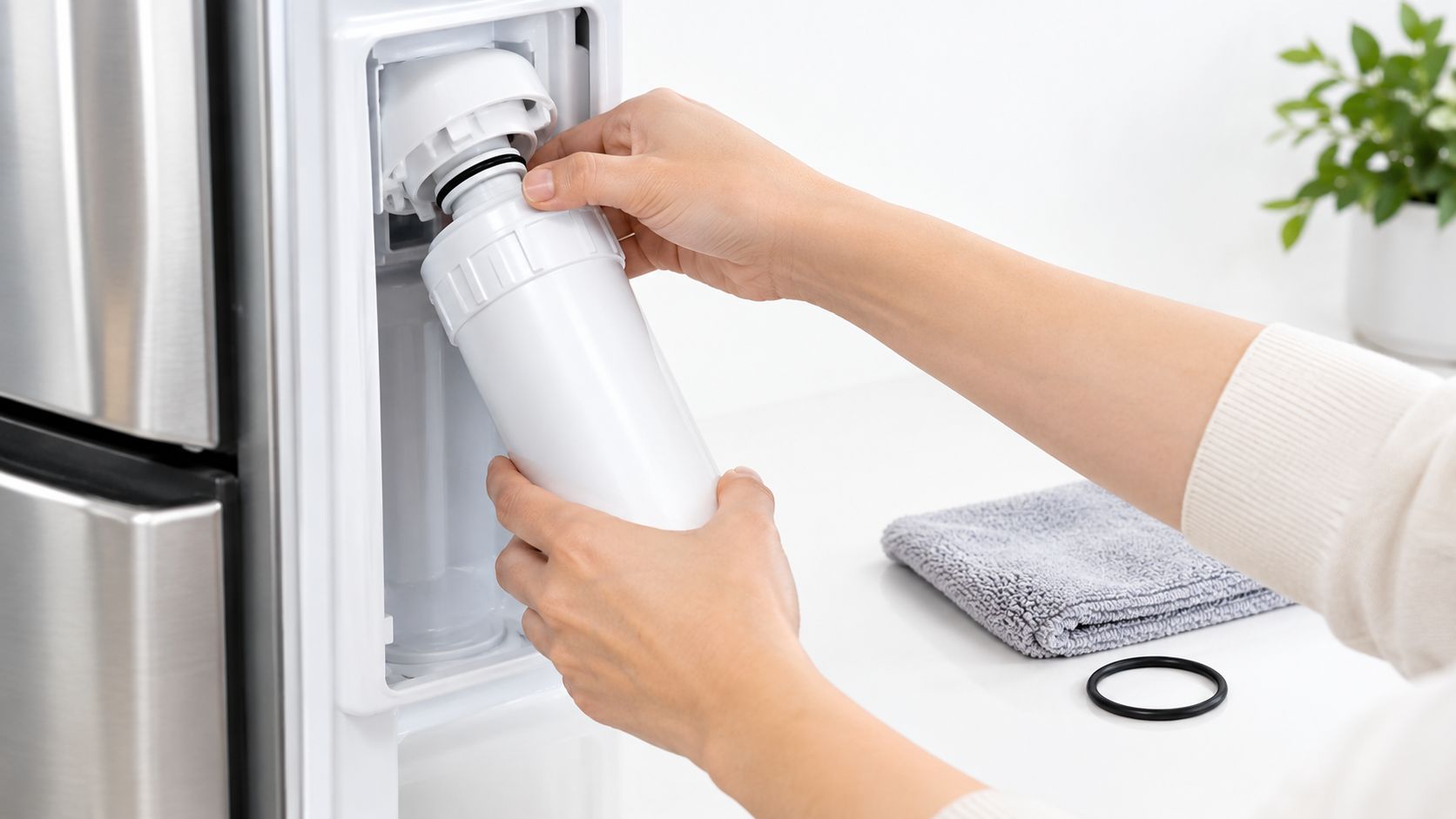
If the indicator stays lit after installation, don't immediately assume the filter is defective. Many fridges treat the light as a timer and require a separate reset sequence. Persistent leakage, a cracked housing, or a cartridge that won't lock calls for the manufacturer's service instructions or a qualified technician.
What Flow Rate, Capacity, and Price Mean for Buyers
A busy family may empty the dispenser several times a day, while a lightly used fridge may sit untouched for hours. Those routines determine how quickly water moves through a cartridge and how often its rated capacity matters.
A household that fills bottles, dispenses drinking water, and uses the ice maker frequently will send more water through the filter than a couple who uses the dispenser occasionally. A small office with a shared refrigerator may also consume water steadily throughout the workday. In that setting, the rated capacity and a replacement record matter more than the price printed on the package.
Flow rate describes how readily water passes through the cartridge. A restricted stream makes filling a glass frustrating, yet a faster stream does not automatically mean better filtration. Filter media need sufficient contact time with the water to meet their tested performance. Compare the manufacturer's flow specification with the refrigerator's requirements, rather than choosing the highest figure.
Rated capacity is the volume of water the cartridge is designed to treat under stated test conditions. It is a testing reference, not a guarantee that every household will get identical results. Sediment, disinfectant chemistry, and the targeted contaminant can cause the media to reach its limit sooner.
Canadian conditions can change the practical choice
Regional water sources and household habits influence what buyers seek from a filter. In 2007, 56% of census-metropolitan-area households with a municipal water supply reported treating their water, and jug filters were used by 35% of those municipal-water households, according to the agency's household water-treatment analysis. The analysis identifies taste, odour, and appearance among the main reasons for treatment, along with concerns about chemicals, health risks, and metals or minerals.
Those figures do not establish that a particular refrigerator cartridge will address a local concern. They do show why Canadian buyers should check their own water information and match a certified contaminant claim to that need. A filter certified for taste improvement, for example, should not be treated as proof of removal for a different substance.
To compare ongoing cost, divide the cartridge price by its rated capacity in litres. Then account for household use and local water conditions. A cheaper cartridge may cost more over time if its capacity is lower or if it lacks the certified claim your water concern requires.
Putting It All Together Before You Buy
Keep the decision in this order. It prevents an attractive marketing label from distracting you from basic compatibility.
- Does it fit the refrigerator? Confirm the model number, housing style, connector, and manufacturer instructions. Never rely on appearance alone.
- Does it address your concern? Name the substance or property you want to improve, such as chlorine taste, odour, sediment, lead, or PFOA/PFOS. Then match it to the exact certified claim.
- Does the capacity suit your household? Compare the rated capacity with your dispensing, ice-making, and workplace or rental use. A busy fridge may reach capacity sooner than a lightly used one.
- What is the cost per litre? Use the cartridge price and rated capacity, then consider how often you can realistically replace it and whether the filter's performance claim depends on a particular interval.
- Can you maintain it properly? Record the installation date, flush the new cartridge, inspect for leaks, and reset the reminder. If the appliance serves a rental property, office, or hospitality space, keep a replacement log based on the manufacturer's interval and rated capacity.
This sequence follows the same practical logic used in GrifGlo's decision-making framework: establish the actual need, verify fit and evidence, then compare ongoing use rather than shopping on one headline feature.
Call a technician when the housing is visibly damaged, a new cartridge continues to leak after correct installation, or the indicator refuses to reset despite following the appliance instructions. Those problems involve the refrigerator system, not just the replaceable media.
GrifGlo offers decision-friendly guides and comparisons for practical home, kitchen, and appliance purchases, including fit, sizing, and everyday maintenance considerations. Use the guidance here to shortlist a compatible refrigerator water filter, then visit GrifGlo to make the rest of your home buying decisions with the same clear process.

Laisser un commentaire
Ce site est protégé par hCaptcha, et la Politique de confidentialité et les Conditions de service de hCaptcha s’appliquent.