

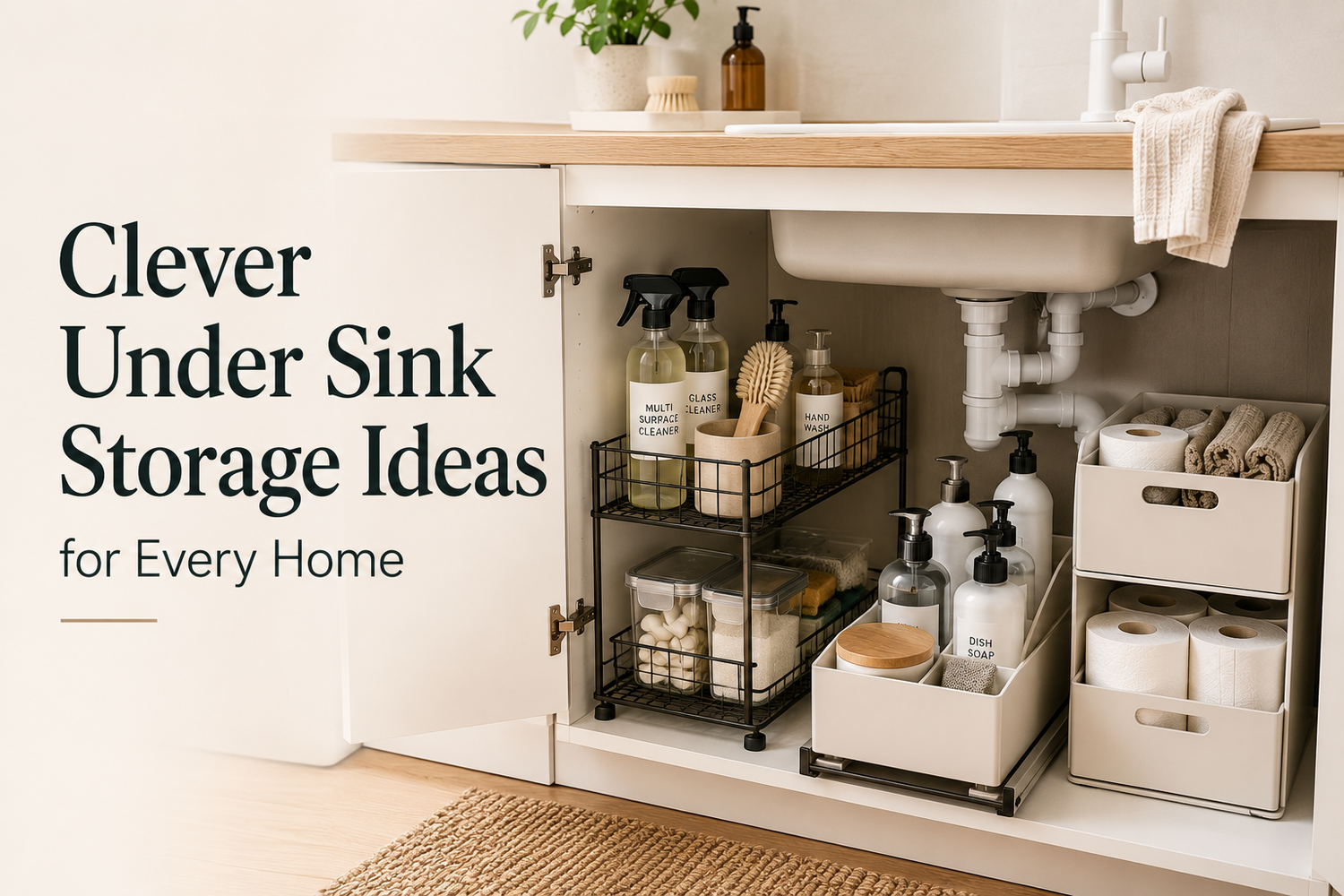
Open the cabinet under your kitchen or bathroom sink and you'll usually find the same mess: half-used cleaners, backup soap, damp cloths, a sponge that should've been thrown out last week, and a maze of pipes cutting the space into awkward little pockets. It's one of the most frustrating storage spots in the home because it looks useful from the outside, then fights you once you try to organise it.
That frustration gets sharper in smaller homes and rentals. In California, temporary and space-efficient organisers are especially practical because the state has a large renter population, with roughly 45% of occupied housing units renter-occupied according to California Department of Finance profiles based on Census/ACS data, which means many households need solutions they can install and remove cleanly at move-out time (renter-focused under-sink storage guidance). Add compact kitchens, tight bathrooms, plumbing obstructions, and lease restrictions, and a basic bin-and-basket approach stops working fast.
Good under sink storage ideas solve the main constraint first. Sometimes that's the pipe layout. Sometimes it's a bad back, a tight budget, or the need to keep chemicals away from children and pets. This guide is built around those problems so you can choose a setup that fits your cabinet, your routine, and your tolerance for installation. You don't need a perfect Pinterest cabinet. You need one that opens easily, keeps the cabinet floor visible, and lets you grab what you need without knocking over three other things.
Table of Contents
- 1. Constraint: Awkward Plumbing - Use Modular & Stackable Bins
- 2. Constraint: Renter-Friendly - Deploy Tension Rods & Hanging Baskets
- 3. Constraint: Accessibility - Install a Pull-Out Drawer or Lazy Susan
- 4. Constraint: Tight Budget - Repurpose Household Items for Smart Storage
- 5. Constraint: Child & Pet Safety - Use Latching Bins & Door-Mounted Caddies
- 6. Constraint: Maximizing Space - Deploy an Expandable Under-Sink Shelf
- Under-Sink Storage: 6-Point Comparison
- Your Action Plan for an Organised Under-Sink Space
1. Constraint: Awkward Plumbing - Use Modular & Stackable Bins
Most under-sink failures start with one wrong assumption: that the cabinet should hold one neat organiser. It usually shouldn't. The P-trap, shutoff valves, disposal, and water lines break the space into uneven pockets, so a single shelf or one large bin often wastes more room than it saves.
A modular setup works better because it bends around the cabinet's obstacles instead of pretending they aren't there. In practice, that means using several bins in different widths and heights, then placing them where the space is open.
Measure the dead zones first
Start with a full reset. Empty the cabinet, wipe the base, and check for moisture stains before any organiser goes back in. Under-sink areas are also maintenance zones, not just storage zones, and that matters in homes where leak prevention is a priority. The U.S. Environmental Protection Agency notes that a single household leak can waste more than 10,000 gallons of water per year, which is one reason easy-access under-sink layouts matter so much in California homes dealing with drought awareness and older plumbing (under-sink organisation and leak visibility).
Then measure three things: the full cabinet width, the height under the lowest pipe, and the narrow side spaces beside plumbing. Those side pockets are where slim bins earn their place.
Practical rule: Put the largest bin in the clearest open area first, then fill around the plumbing with smaller containers. Don't buy a “set” until you know the awkward measurements.
A good everyday layout often looks like this:
- Tall side bin: Hold backup dish soap, dishwasher tabs, or refill pouches upright.
- Low front bin: Keep daily-use cloths, sponges, and scrub brushes where you can grab them fast.
- Small rear bin: Store rarely used items like drain strainers, gloves, or extra garbage bags.
- Stackable drawer bin: Use only in sections with true vertical clearance, not under the trap.
What works and what doesn't
Clear bins help because you can see what's inside without pulling out every container. Stackable pieces are useful only if the upper bin still leaves pipe access and doesn't force you to unstack half the cabinet to reach one item. That's where many tidy-looking setups fail in real use.
If you want more guidance on comparing storage formats, GrifGlo's article on airtight vs stackable vs modular pantry storage containers is useful for thinking through how modular systems trade visual uniformity for flexibility.
One caution: modular organising can get expensive if you keep buying bins to solve a layout that really needs fewer products under the sink. I often see cabinets clogged with duplicates, not poor storage. Keep daily-use cleaners below. Move overflow elsewhere.
For a kitchen with limited cabinet space, that may also mean relocating bulky cookware accessories and oversized pieces to another zone. Something like the All-Clad HA1 Double Burner Grill Pan – 13×20-Inch Nonstick belongs in a cookware storage area, not shoved under the sink, since its 13 x 20 inch double-burner format is designed for a generous cooking surface rather than compact cabinet storage.
2. Constraint: Renter-Friendly - Deploy Tension Rods & Hanging Baskets
If you rent, drilling inside a cabinet usually isn't worth the risk. Even when a landlord wouldn't object, moisture-prone cabinet interiors can show adhesive damage, chipped laminate, or filled holes later. The smartest renter-safe under sink storage ideas are the ones you can remove in minutes and clean up without a trace.
A tension rod is one of the few cheap fixes that solves a real problem. It lifts spray bottles off the floor of the cabinet and frees the base for heavier items or a shallow tray.
Where a tension rod earns its keep
Install the rod high enough that hanging bottles don't drag on the cabinet floor, but low enough that the triggers hook securely. In a kitchen sink cabinet, I'd usually place the rod front to back if the side walls are sturdy and uninterrupted. In some bathroom vanities, side to side works better.
Spray cleaners are ideal here because the trigger does the work for you. The bottle hangs naturally, stays visible, and doesn't tip over. You can also add a couple of lightweight S-hooks for a small basket that holds gloves, a dish brush, or a spare stopper.
Don't turn the tension rod into a full shelving system. It's best for hanging and separating light items, not carrying bulk weight.
California homes often benefit from removable systems like this because portable storage is practical in a state with a large renter population and compact housing mix. The U.S. Census Bureau's American Community Survey shows California's homeownership rate at about 55% in recent years, which means roughly 45% of households rent and often rely on temporary, space-efficient organisers rather than built-ins (California under-sink storage context).
The common failure point
People overload the rod. That's where the whole setup starts slipping, bowing, or dropping into the cabinet.
Keep the rod for these items only:
- Trigger bottles: Glass cleaner, bathroom spray, all-purpose cleaner.
- Light basket contents: Sponges, small brushes, gloves, dishwasher tablets in a pouch.
- Cloths on hooks: Microfibre cloths or rubber gloves that need to dry.
Skip these:
- Heavy refills: Large detergent bottles and bulk liquid containers belong on the cabinet floor.
- Sharp tools: Loose blades or pointed cleaning tools shouldn't hang where they can snag or fall.
- Leaky products: Anything with a poor cap seal will drip onto the rod and cabinet walls.
If you're comparing vertical storage formats for compact spaces, GrifGlo's guide to pantry storage racks is helpful for thinking through where open hanging storage beats shelving, and where it doesn't.
This setup isn't elegant, but it's practical. For many renters, that's the right target.
3. Constraint: Accessibility - Install a Pull-Out Drawer or Lazy Susan
The hardest part of an under-sink cabinet isn't storing things. It's reaching them. If you're kneeling, leaning, or blindly sweeping your arm into the back of the cabinet, the space is working against you. Accessibility fixes that.
Two tools do most of the heavy lifting here: pull-out drawers and Lazy Susans. Both reduce digging. They just solve the problem differently.
Choose based on how you reach
A pull-out drawer is better for rectangular items, backups, and categories you want contained. Pull once, and the whole section comes forward. That's especially useful for someone with limited mobility, sore knees, or a cabinet that's deeper than it is wide.
A Lazy Susan works best for bottles you use often and want to see at a glance. Turntables are simple, no-install options that make sense under a bathroom sink with lotions, hair products, or daily cleaners.
Use this rule of thumb:
- Pick a pull-out drawer: When the cabinet is deep and you need contained zones.
- Pick a Lazy Susan: When you store mostly bottles and want quick visibility.
- Skip both: When plumbing cuts the cabinet into tiny uneven sections. In that case, bins are usually better.
The wider organisation market reflects how common these modular and movable systems have become. The U.S. home organisation products market was estimated at USD 14.2 billion, which points to a large installed base for pull-out caddies, modular organisers, and other space-saving systems (U.S. home organization products market study).
Installation trade-offs to know upfront
Pull-out drawers sound perfect until they hit the hinges, scrape a pipe, or stop short of full extension. Measure the inside width, the door opening, and the exact footprint of the plumbing before you buy. The cabinet opening can be narrower than the interior box because of hinges and framing.
Accessibility isn't only about reach. It's also about visibility. If you can't see the cabinet floor, you won't notice drips, grime, or expired products until they become a bigger problem.
Lazy Susans have their own downside. Round trays waste corners, and square bottles can crowd each other when the tray spins. They're best when the convenience of rotation matters more than squeezing every bit of storage from the cabinet.
For anyone already trying to improve access in other cramped areas of the kitchen, GrifGlo's guide to kitchen drawer organizers offers the same principle in another format: bring items forward instead of stacking them into a blind pile.
4. Constraint: Tight Budget - Repurpose Household Items for Smart Storage
Some of the best under sink storage ideas cost almost nothing. If your cabinet is chaotic, the first win usually comes from grouping items, not buying specialty products. You can do a lot with containers you already have.
A shoebox can separate backup sponges from garbage bags. A sturdy delivery box can hold dishwasher tablets. A magazine file can store foil, wrap, or narrow cleaning bottles upright. These aren't glamorous fixes, but they stop small things from spreading across the entire cabinet floor.
Use what already fits
The key is matching the container to the mess. Don't repurpose items randomly. Choose containers that solve one specific failure, like bottles toppling, cloths getting damp, or tiny products disappearing into the back corner.
A few low-cost examples that work well:
- Magazine file: Store cutting boards, foil boxes, or rolled cloths vertically.
- Tissue box: Feed plastic bags through the opening so they stop spilling everywhere.
- Lidded shoe box: Corral refills or products you don't need every day.
- Small tray or food container: Keep scrubbers and sink stoppers together near the front.
This approach also makes sense if you're organising a first apartment, a student kitchen, or a guest bathroom where function matters more than matching bins. In those spaces, “good enough and contained” beats “perfect but unfinished” every time.
When cheap fixes stop being useful
Repurposed storage breaks down when the materials can't handle moisture. Thin cardboard softens, open boxes catch drips, and deep containers become mini junk drawers if they aren't labelled or used consistently.
I'd avoid anything absorbent directly on the cabinet floor unless you're inside a waterproof tray. That one detail makes budget systems last longer and keeps spills from turning into cabinet odour.
A cheap organiser that survives damp conditions is more useful than a pretty one that warps after one leak.
For broader ideas on creating zones in cramped kitchen spaces, GrifGlo's article on how to organize kitchen drawers is a helpful reminder that containment matters more than matching materials.
Budget organising is at its best when it's honest. If a repurposed bin works, keep it. If it annoys you every day, replace that one piece instead of starting over.
5. Constraint: Child & Pet Safety - Use Latching Bins & Door-Mounted Caddies
Under-sink cabinets often hold the most dangerous products in the room. Bleach, dishwasher detergents, drain cleaners, toilet chemicals, and concentrated sprays all end up there because the space feels out of sight. If you have a crawling child, a curious toddler, or a pet that noses open doors, that assumption isn't safe enough.
The fix is separation first, then storage. Hazardous products should live in a dedicated latching bin on the cabinet floor, while harmless daily-use items move up and away into a door-mounted caddy or separate container.
Separate safe from unsafe
A good safety setup makes your routine easier, not just more secure. Sponges, cloths, hand soap refills, and brushes are safer to access on the door or near the front. Harsh cleaners stay grouped in one harder-to-reach location so they aren't mixed in with everyday items.
This is the structure I recommend most often:
- Latching floor bin: Store chemical cleaners and pods together so they're contained and harder to grab individually.
- Door-mounted caddy: Hold non-toxic tools like cloths, dry brushes, and empty spray bottles.
- Cabinet lock: Add a proper child-safety lock to the cabinet itself, because a latch on the inner bin isn't enough on its own.
- Visible floor space: Leave part of the cabinet base exposed so you can still spot leaks or residue quickly.
Bathroom sinks and utility sinks benefit from the same system. The exact products change, but the logic doesn't.
Mistakes that weaken the setup
The biggest mistake is overloading the cabinet door. A caddy filled with heavy bottles can strain hinges, interfere with closing, or slam when the door opens. Door storage should stay light.
The second mistake is storing toxic and non-toxic items together in one “organised” basket. That may look tidy, but it undermines the whole point of sorting by risk. A child grabbing for a sponge shouldn't be reaching past chemicals to get it.
If you use pods or concentrated cleaners, keep them in their original packaging unless your latching bin is acting as an outer container. Transferring them into unmarked jars or casual bins creates confusion and makes accidents more likely.
A safe under-sink cabinet should still be convenient for adults. If the setup is too fiddly, people stop using it properly. That's when the cleaning spray ends up loose in the front corner again.
6. Constraint: Maximizing Space - Deploy an Expandable Under-Sink Shelf
When someone wants one product to fix the whole cabinet, an expandable under-sink shelf is usually the closest thing to a reasonable answer. It isn't magic, but it does create a second level where there was only a cluttered floor before.
These shelves work because they're built in pieces. The frame expands, and the shelf panels adjust around the plumbing so you can leave gaps where the pipes run. That flexibility matters much more than a fixed shelf that fits only in theory.
Why adjustable shelves matter more than fixed ones
Under-sink cabinets vary wildly inside. Even two similar vanities can have different trap locations, disposal shapes, valve positions, and cutouts. That's why adjustable-height, pipe-aware systems are usually the smarter choice than rigid inserts. When organising around plumbing obstructions, measuring around the pipes and using the vertical space on either side is the most practical way to gain usable capacity, especially in compact homes that need every inch to work harder.
Assembly usually takes a little patience. The shelf frame goes in first, then you add the panels only where they won't block the plumbing. Once installed, use the upper level for lighter, drier items and the lower level for heavier products or a leak tray.
“Measure around the pipes” sounds obvious, but most buying mistakes happen because people measure the cabinet walls and ignore the valves, trap, and hinge swing.
The shelf is only half the system
An expandable shelf gives you surfaces. It doesn't give you order. If you pile loose products on both levels, you've just created a two-storey mess.
Pair the shelf with a few simple habits:
- Use shallow bins on the top tier: They stop small items from sliding between shelf panels.
- Keep heavy refills below: The lower level is usually more stable for bulky containers.
- Leave a pipe inspection lane: Don't pack the centre so tightly that you can't check for moisture.
- Line the base if needed: A non-slip liner or tray helps with cleanup and keeps containers from drifting.
For a more zoned approach to grouping cabinet contents, GrifGlo's guide on how to organize your pantry with bins and zones translates well to under-sink storage too. The principle is the same: group by use, not just by size.
Expandable shelves are strong candidates when the cabinet is wide enough to benefit from an upper tier and the plumbing leaves side access. In very narrow cabinets, they can feel bulky. In those cases, separate bins or a pull-out often work better.
Under-Sink Storage: 6-Point Comparison
| Solution | Implementation Complexity 🔄 | Resource Requirements ⚡ | Expected Outcomes ⭐📊 | Ideal Use Cases 💡 | Key Advantages ⭐ |
|---|---|---|---|---|---|
| Modular & Stackable Bins | Low–Moderate, measure & arrange | Moderate, multiple bins to buy | High, customizable fit & visibility | Irregular plumbing; varied item sizes | Flexible layout; easy to reconfigure |
| Tension Rods & Hanging Baskets | Very Low, no tools required | Low, 1–2 rods + lightweight baskets | Moderate, frees floor and organizes vertically | Renters; spray bottles & light items | Damage-free, removable, inexpensive |
| Pull-Out Drawer or Lazy Susan | Moderate–High, install for pull-outs; lazy susan plug‑and‑play | Moderate–High, hardware or quality unit | Very High, excellent access & visibility | Accessibility needs; frequent use items | Dramatically improves reach and retrieval |
| Repurpose Household Items | Very Low, gather on-hand items | Minimal, reuse what you have | Low–Moderate, basic grouping, low durability | Tight budget; temporary or sustainable solutions | Cost-effective, sustainable, immediate |
| Latching Bins & Door-Mounted Caddies | Low–Moderate, mount caddy, buy latching bins | Moderate, safety bins + caddy + optional lock | High, secures hazardous items, separates zones | Homes with children or pets | Enhances safety and organization |
| Expandable Under-Sink Shelf | Moderate, assembly and fit adjustments | Moderate, single adjustable unit | High, creates a second level, more usable area | Small kitchens; maximize under-sink storage | Doubles surface area; purpose-built and adjustable |
Your Action Plan for an Organised Under-Sink Space
You open the cabinet to grab dish soap, and a spray bottle catches on the pipe, a loose sponge tips over, and the cleaner you need is buried at the back. That is usually the moment people start shopping. It is rarely the right first step.
Start by naming the constraint that is making the cabinet hard to use. Awkward plumbing needs storage that can work around bends and shutoff valves. Rental rules call for removable fixes. Limited reach calls for items that come out to you, not systems that force you to crouch and dig. A tight budget changes the standard too. In that case, the goal is a setup that works better this week, not a cabinet makeover.
The wrong organiser creates a second problem. A neat-looking shelf can block pipe access. Door storage can bang into tall bottles. Cheap cardboard bins save money up front, then warp in a damp cabinet. The right answer is the one that fits your cabinet, your routine, and the amount of effort you are willing to maintain.
A simple reset usually gets the best results:
Empty the cabinet completely. Wipe the base so you can spot old drips, sticky residue, or water damage. Toss dried-out products, duplicates, and anything you have not used in months. Then sort what is left into clear groups such as daily cleaning, backups, dishwasher items, and pet-safe or child-safe supplies.
After that, choose one storage method based on the biggest friction point, not all of them at once. If access is the problem, add a pull-out tray or turntable. If shape is the problem, use smaller modular bins instead of one large organiser. If the cabinet just needs better capacity, an adjustable shelf may be enough. I usually tell clients to test one fix for a week before adding anything else. It shows very quickly whether the actual issue is reach, visibility, or simple overcrowding.
Keep the floor area partly visible. That small choice makes leak checks much easier.
Placement matters too. Put everyday items at the front and backups behind or above them. Store heavy refills low and stable. Keep only sink-related supplies here, because under-sink cabinets turn into overflow zones fast, and that is when clutter returns.
In small homes, rentals, and older kitchens, reconfigurable storage tends to last longer than rigid systems built for one exact layout. Pipes get repaired. People move. Product sizes change. Bins, caddies, rods, and adjustable shelves are easier to adapt than a fixed setup that only works if nothing changes.
If you want help comparing storage formats before buying, GrifGlo publishes decision-focused guides across kitchen, home, and organisation categories that can help narrow the options.


Laisser un commentaire
Ce site est protégé par hCaptcha, et la Politique de confidentialité et les Conditions de service de hCaptcha s’appliquent.