

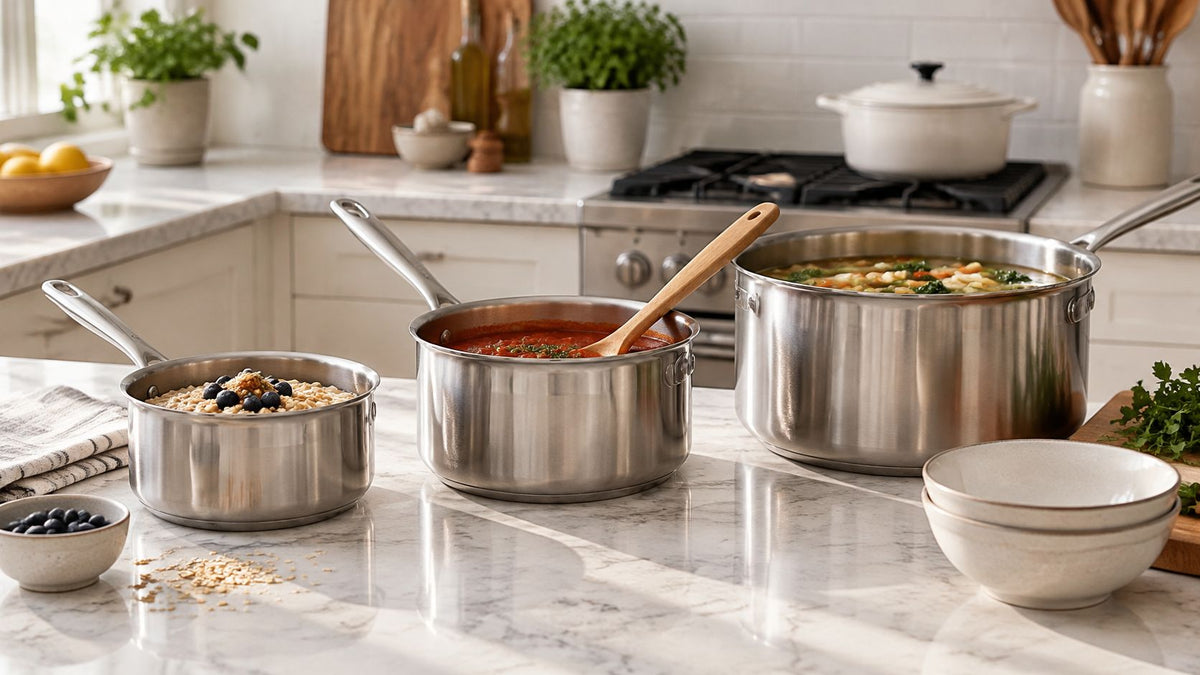
A 2 to 3 L saucepan is a useful starting point for many everyday kitchens. Choose 1 to 1.5 L for small quantities, and consider 4 L or more when your recipes genuinely need a larger batch. These are shopping guidelines, not fixed capacities for a particular household size.
The key question is the total food and liquid in the recipe, plus enough room for stirring, expansion and bubbling. A pan labelled 2 L should not be expected to simmer 2 L of sauce safely at its rim.
Saucepan Sizes by Task
| Stated capacity | Useful starting point | What to check |
|---|---|---|
| 1 to 1.5 L | A small sauce, reheating one portion or a little porridge | The quantity should cover the base adequately without crowding |
| 2 L | Everyday small batches of grains, vegetables or sauce | Water, food expansion and foam must fit |
| 3 L | Larger sauces, soup and several portions | Allow enough headroom to stir comfortably |
| 4 to 5 L | Planned leftovers or larger family batches | Weight, cupboard height and whether a two-handled pot is easier |
People eat different portions and recipes use different amounts of cooking water. A large pasta boil may need a stockpot even when a small saucepan holds the finished portions. Check the recipe’s vessel guidance rather than converting household size directly into litres.
Allow Working Room Above the Food
Use rated capacity as a size reference, then leave headroom for the actual cooking method. Oats, rice, pasta and other starchy foods can foam or expand; thick sauces need room to stir. A gentle reduction and a vigorous boil do not need the same margin.
As a planning example, 2 L of sauce in a 3 L pan leaves 1 L above the initial batch. That describes volume only; watch the food and follow the recipe to determine whether the pan is appropriate. It is not a universal maximum fill rule.
If you repeatedly cook a known batch, measure its starting ingredients and liquid in a jug. Compare that amount with the pan’s stated capacity and the room the recipe needs. This is more useful than counting theoretical half-cup servings.
Check whether a listing gives litres or quarts. A U.S. quart is approximately 0.95 L; an imperial quart is approximately 1.14 L. Confirm the unit used rather than treating all “quart” labels as identical.
Check Diameter, Depth and Handles
Two pans with the same volume can have different shapes. A wider pan exposes more liquid surface for reduction; a narrower, deeper pan may suit a smaller burner and take less shelf width. Neither shape is automatically more efficient for every task.
- Measure the base: the flat heating area can be smaller than the rim diameter.
- Try the handle: consider balance when the pan contains hot food, not just when it is empty.
- Check the lid: confirm whether one is included and whether the handle is comfortable.
- Measure storage: include the handle, lid and cupboard opening.
- Review oven limits: wood, plastic and other handle materials can restrict use.
For a large batch, a two-handled pot may be easier to lift than a heavy saucepan with one long handle. Our cookware measurement guide explains why the rim and base measurements serve different purposes.
Match the Pan to an Induction Cooktop
Choose a pan identified as induction-compatible and check its base with a magnet. A magnetic response is a screening test; the exact cooktop’s minimum pan size, zone layout and detection requirements still govern compatibility.
Use the appliance manual’s permitted base diameters rather than relying on a generic ring-size table. A pan smaller than the detection requirement may not activate. A very large base over a small coil may heat unevenly, depending on the pan’s construction and heat distribution.
Induction heats compatible metal through a magnetic field. It does not guarantee uniform heating to the edge of every pan. Keep the base flat and clean, and follow both the pan and cooktop instructions. See our induction-cookware guide for the material checks.
Buy for Your Regular Recipe
Start with the size that handles your usual meal comfortably. Add a larger pot when recurring batches justify its weight and storage, rather than replacing a manageable everyday pan with the largest one available.
For batch cooking, plan containers and fridge space before filling a bigger vessel. Our freezer-container guide can help match portions to storage.
Browse GrifGlo Cookware with your required volume, base diameter and storage measurements written down. Confirm dimensions, included lid, cooktop compatibility and handle limits on the exact listing before ordering.

Laisser un commentaire
Ce site est protégé par hCaptcha, et la Politique de confidentialité et les Conditions de service de hCaptcha s’appliquent.