

You're probably encountering a common dilemma. You've measured the room, opened three tabs, and now you're staring at a string of model numbers and BTU ratings wondering whether to play it safe with a bigger unit.
That's where people get stuck. A window AC that's too small runs constantly and still leaves the room warm. One that's too large can make the room cold fast, then leave it feeling damp and uncomfortable. Good window air conditioner sizing isn't about buying the biggest box that fits your budget. It's about matching cooling capacity to the room, the sunlight, the way the space is used, and the window it has to fit.
In California especially, that matters. A shaded coastal bedroom and a sunny inland apartment may have similar square footage, but they won't behave the same once afternoon heat hits.
Table of Contents
- Why an Overpowered AC Is as Bad as an Underpowered One
- Calculate Your Base BTU Needs in Two Simple Steps
- Fine-Tuning Your Calculation for Real-World Conditions
- A Quick Sizing Chart for Fast Estimates
- Final Checks Before You Buy
- Common Sizing Questions Answered
Why an Overpowered AC Is as Bad as an Underpowered One
The most frustrating AC purchases usually go wrong in one of two ways. The first is obvious. You install the unit, turn it on, and it never quite catches up. The room stays stuffy, the machine keeps running, and you start wondering whether the problem is the insulation, the weather, or the unit itself.
The second mistake is less obvious, which is why it catches so many people. The room gets cool quickly, but it never feels settled. The air feels chilly without feeling comfortable. Bedding feels slightly damp. The unit keeps switching on and off, and the comfort never evens out.

That second problem is why bigger isn't automatically better. Consumer Reports notes that an oversized unit can leave a room feeling damp and clammy because it cools the air so quickly it shuts off before it has a chance to dehumidify. That matters in coastal areas, but it also matters inland because comfort isn't only about dropping the temperature.
Practical rule: Right-sizing is the goal. You want enough capacity to handle the room's load, but not so much that the unit short-cycles and leaves the air uncomfortable.
I've seen people treat BTU like they'd treat horsepower in a car. More sounds safer. In practice, the better comparison is choosing the right tool for one room. Window units are built for room-by-room cooling, not brute-forcing every comfort problem with extra capacity.
That's also why advice for cooling should be room-specific. If you're comparing seasonal comfort appliances for different parts of the home, a guide like this look at energy-efficient space heater choices can be useful for the opposite end of the temperature range. The same principle applies. Matching the appliance to the space matters more than buying oversized.
Calculate Your Base BTU Needs in Two Simple Steps
Before you adjust for sun, people, or kitchen heat, you need a clean starting point. This part is simple, and it keeps you from guessing.

Measure the room you actually want to cool
Measure the length and width of the room in feet. Then multiply those two numbers to get the square footage.
If the room is an open area but the AC will really serve only one zone, measure the zone you expect the unit to handle. That sounds obvious, but people often overestimate when calculating this way. They measure a full open-plan area, then expect a single window unit to solve everything evenly.
A window AC works best when you size it for the space it can realistically influence, not for the whole floor plan you wish it could cover.
If the room has unusual shape changes, alcoves, or a partial divider, be realistic. Cooling doesn't move around corners and through closed doors the way buyers often hope it will.
Later, if you're also dealing with cooking odours or air quality in a busy kitchen, a separate guide like this one on choosing an air purifier for kitchen use helps with the non-temperature side of comfort.
Convert square footage into a base BTU number
The U.S. Department of Energy recommends using about 20 BTU per square foot of living space. That gives you a baseline before any other adjustments.
A quick example:
- Measure the room: say it's 500 square feet
- Apply the baseline: 500 x 20 = 10,000 BTU
The same rule means a 700-square-foot room starts around 14,000 BTU before adjustments. Those numbers are a starting line, not the finish.
Here's the video version if you prefer seeing the process laid out visually:
One practical mistake I see all the time is letting unrelated appliance shopping influence AC thinking. Someone buys a compact appliance like the Hamilton Beach 35065C 3 Liter Digital Air Fryer, sees that it has a 3L compact capacity, 8 preset cooking functions, digital time & temperature control, and a nonstick easy-clean basket, then carries that same “small appliance” mindset into cooling. But a window AC isn't something you size by convenience or countertop logic. It has to match the heat load of the room.
Fine-Tuning Your Calculation for Real-World Conditions
The base number gets you close. The room's actual conditions determine whether that number will feel right once you live with the unit.

Standard adjustment rules commonly used in sizing guidance call for adding 10% for a very sunny room, subtracting 10% for a heavily shaded room, adding 4,000 BTU for a kitchen, and adding 600 BTU for each regular occupant above two. Those adjustments are where good window air conditioner sizing becomes much more accurate.
Sun exposure changes the job
A room with strong afternoon sun behaves very differently from a room under trees or deep shade. In California, west-facing windows often create the biggest surprise because the room may feel manageable in the morning and punishing later in the day.
Use these adjustments:
- Very sunny room: add 10% to your base BTU calculation.
- Heavily shaded room: subtract 10%.
A practical example helps. If your base number is 10,000 BTU and the room gets hard afternoon sun, bump it to 11,000 BTU. If that same room is heavily shaded instead, reduce it to 9,000 BTU.
That doesn't mean every bright room needs the largest unit available. It means sun exposure should push you within the correct range, not trick you into oversizing the room by a wide margin.
Kitchens and people add heat fast
Kitchens are a category of their own. Ovens, cooktops, and regular activity make them harder to cool, so the standard adjustment is direct: add 4,000 BTU for a kitchen.
Occupancy matters too. Bodies give off heat, and a room that regularly holds more than two people needs extra capacity. The common rule is add 600 BTU for each regular occupant above two.
That means the same living room may need one answer for a single person working and another answer for a family space used every evening.
- Kitchen example: a room with a base of 10,000 BTU becomes 14,000 BTU if it's a kitchen.
- Occupancy example: if four people regularly use the room, add 600 BTU for each of the two occupants above two, for a total of 1,200 BTU added to the base.
For homes that rely on layered cooling, people often pair a correctly sized AC with air movement in occupied areas. If that's part of your setup, portable fans with misters can help with local comfort, especially in patios, garages, and dry heat zones where direct airflow matters.
Why humidity and cycling matter
This is the trade-off most sizing guides rush past. A unit that's too large may satisfy the thermostat quickly, then shut off before it has done enough moisture removal for the room to feel comfortable.
That's why two rooms with the same square footage may deserve different decisions inside the same BTU range. A shaded bedroom near the coast often benefits from restraint. A sunny inland room with high solar gain often needs the upper end of the range after adjustments.
If you remember only one thing, remember this. Comfort comes from matching capacity to the room's real load, not from buying the most powerful unit you can fit in the window.
A Quick Sizing Chart for Fast Estimates
Sometimes you just need a quick sense check before you compare models. Retail sizing charts are useful for that, as long as you treat them as a starting point rather than the final answer.
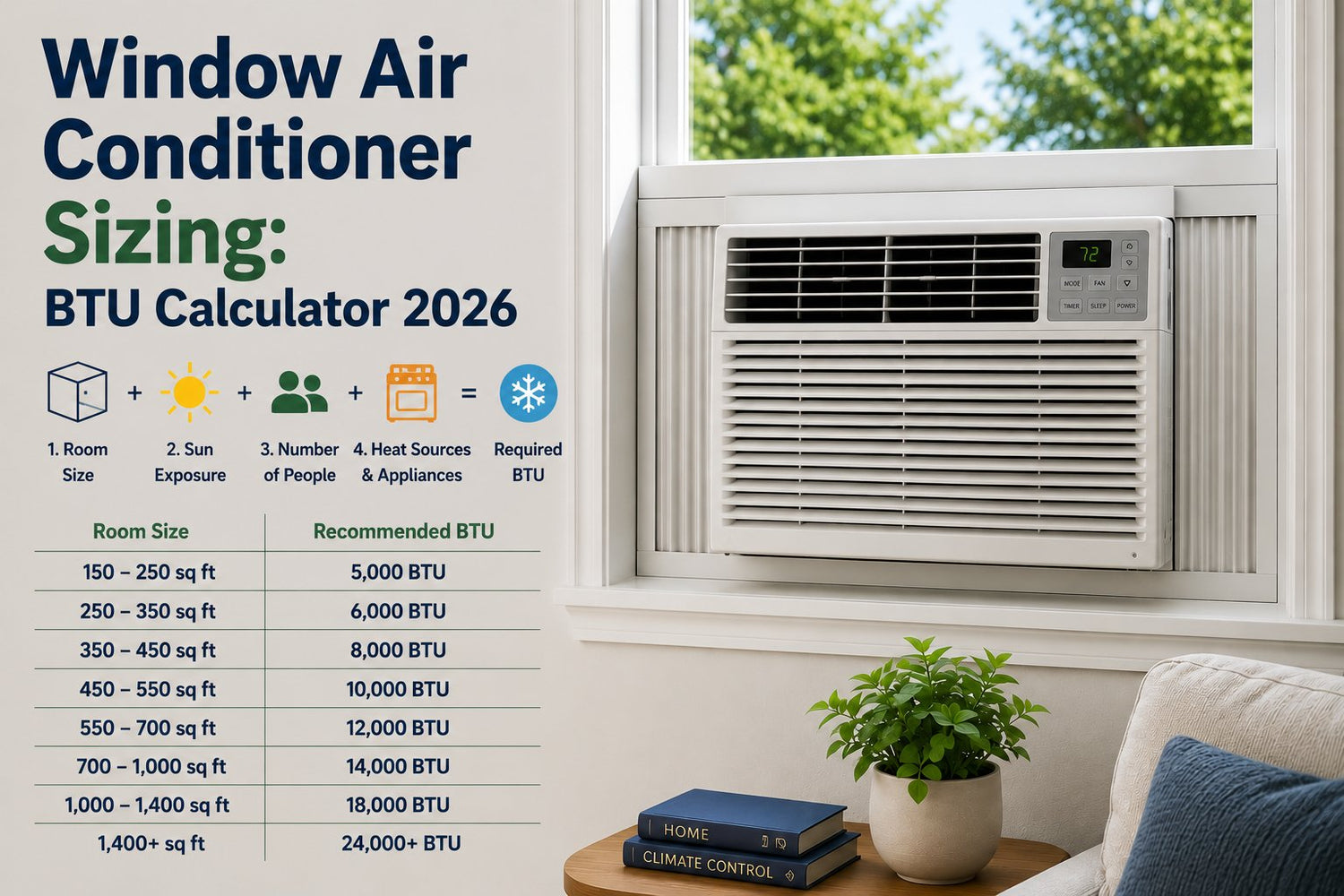
Common retail guidance places 150 to 350 square feet at 5,000 to 8,000 BTU, 350 to 550 square feet at 8,000 to 12,000 BTU, 550 to 1,050 square feet at 12,000 to 18,500 BTU, and 1,050 to 1,600 square feet at 18,500 to 25,000 BTU. The same guidance also recommends installing the unit in a shaded, north-facing window when possible to improve efficiency.
Window AC sizing quick reference chart
| Room Area (Square Feet) | Recommended BTU Capacity |
|---|---|
| 150 to 350 | 5,000 to 8,000 BTU |
| 350 to 550 | 8,000 to 12,000 BTU |
| 550 to 1,050 | 12,000 to 18,500 BTU |
| 1,050 to 1,600 | 18,500 to 25,000 BTU |
Use this chart for a fast estimate, then pressure-test it against the room's conditions. A shaded sleeping room may land comfortably at the lower end. A kitchen, a sunny west-facing room, or a frequently occupied family room may need the higher end.
Don't let the chart make the decision for you. Let it narrow the field.
That same common-sense approach applies to other large household purchases too. People often shop by dimensions first, then discover fit and function details later. If you've ever compared appliance footprints, a guide like this one on choosing a 36-inch fridge follows a similar logic.
Final Checks Before You Buy
Getting the BTU number right is only half the job. A unit with perfect capacity is still the wrong purchase if it won't fit the opening or your setup can't support it.

Make sure the unit fits the opening
This is the most avoidable mistake in the whole buying process. Buyers focus on BTU and forget that window geometry can disqualify the unit before it ever cools a room.
TCL's sizing guidance notes that many 5,000 to 12,000 BTU window units need an opening width of roughly 23 to 36 inches and a minimum opening height of about 14.5 to 16 inches. Larger units may need wider and taller openings.
Measure the actual opening, not the trim, not the glass, and not what you think the window should fit. Check for anything that interferes with installation, including unusual frames, security bars, or shallow sills.
Check power before you order
Retail guidance also stresses checking for a nearby outlet and making sure the circuit can handle the load before purchase. That matters a lot in older apartments, rentals, and houses where electrical flexibility is limited.
I tell people to treat this as critical. If the plug, outlet location, or circuit situation is wrong, the transaction isn't done. It's delayed, or worse, it becomes a return.
A lot of homeowners already use connected devices to manage routines room by room, so this is also a good time to think about whether the room's setup is practical overall. If you're organising the space around connected controls and everyday automation, smart home devices that work with Alexa can help you think through placement and use patterns around the window area.
Look beyond BTU on the spec sheet
After fit and power, I'd check three things:
- Noise level: Bedrooms and home offices punish loud equipment quickly. Read the spec sheet and think about where you'll sit or sleep.
- Energy efficiency: Compare efficiency ratings across similar models so you're not only buying capacity.
- Installation details: Side panels, support requirements, and tilt instructions all affect how well the unit performs after it's mounted.
A return caused by bad measurements is annoying. A unit that fits badly, rattles, or can't be powered properly is worse because you only discover it after the box is open.
Common Sizing Questions Answered
Is bigger better
No. Oversizing is one of the most common comfort mistakes with window units. A too-large unit can cool the room too fast, shut off too soon, and leave the space feeling clammy rather than balanced. Right-sizing beats maximum sizing.
Can one window AC cool multiple rooms
Usually not well. A window unit is intended for an individual space, and room-by-room sizing works because airflow and temperature control drop off once you ask one unit to push cooling around corners, through doorways, or across a larger layout. If you try to solve that by oversizing, you often trade one problem for another.
What do EER and CEER mean
They're efficiency ratings you'll see on product listings and labels. In simple terms, they help you compare how efficiently one unit delivers cooling against another. A higher efficiency rating is generally the better sign when you're comparing similar models with similar capacity.
If you want a practical place to compare fit-for-purpose home products and buying guides without digging through endless listings, GrifGlo organises everyday essentials across home, kitchen, organisation, and smart living with decision-focused guidance. That's useful when you're trying to make a fast shortlist and avoid buying the wrong appliance for the space.
If you're narrowing down a room AC and want fewer dead ends, GrifGlo is a practical place to compare home essentials and decision-friendly guides built around real-life fit, sizing, and everyday use. For renters, homeowners, and property managers alike, it's designed to make buying clearer before you commit.



Laisser un commentaire
Ce site est protégé par hCaptcha, et la Politique de confidentialité et les Conditions de service de hCaptcha s’appliquent.