

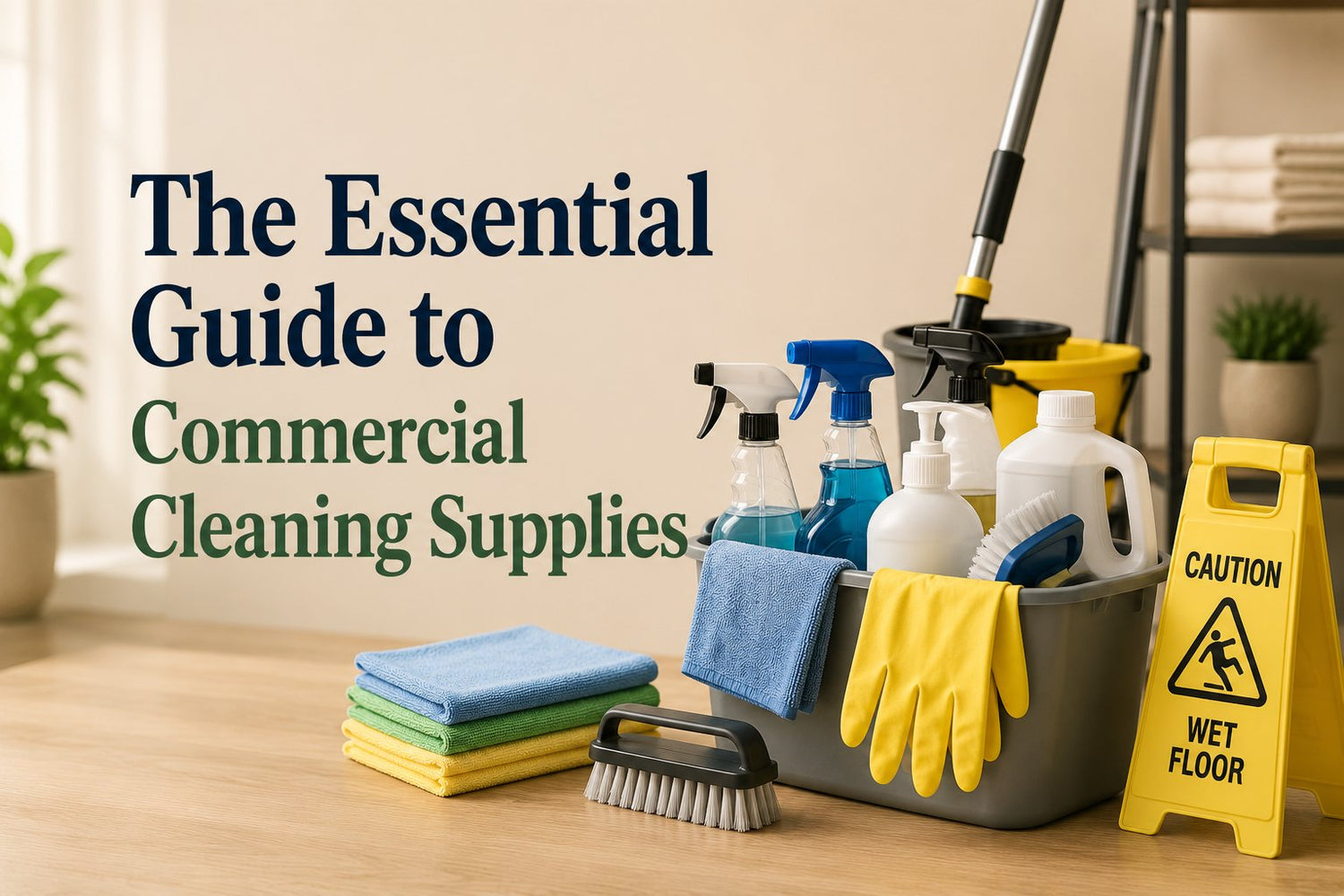
You're probably dealing with this right now. The cleaner says you're out of restroom paper again, someone ordered a harsh chemical that leaves residue on desks, and the supply cupboard is packed with half-used bottles nobody trusts enough to finish. On paper, buying commercial cleaning supplies looks simple. In practice, it becomes a messy mix of safety, budget, storage, training, and last-minute substitutions.
Most offices and rental properties don't have a cleaning problem. They have a procurement system problem. Products get bought one at a time, by different people, for immediate pain relief instead of long-term control. That's how you end up with duplicate chemicals, missing PPE, and invoices that keep creeping up without a clear reason.
A better approach is to treat commercial cleaning supplies as an operating system. The right product list matters, but the bigger win comes from repeatable purchasing rules, clear par levels, proper storage, and product choices that match the surfaces and risks in your building.
Table of Contents
- From Chaos to Control Your Strategic Procurement Guide
- Decoding Commercial Cleaning Supplies
- How to Choose the Right Cleaning Products
- Safety First Your Guide to OSHA Compliance and PPE
- Procurement Checklists for Offices and Rentals
- Smart Budgeting and Inventory Management
- Putting Your Commercial Cleaning Strategy into Action
From Chaos to Control Your Strategic Procurement Guide
The first time a new office manager takes over cleaning supply ordering, the same pattern shows up. They open three supplier catalogues, search “all-purpose cleaner”, and get hit with dozens of near-identical names. Some say neutral. Some say disinfecting. Some are concentrated. Some are “professional formula” without saying what that changes in real use. Then the anxiety starts. Buy too little and operations stall. Buy the wrong thing and you risk damaged floors, staff complaints, or a compliance headache.
I've seen buildings where one cupboard held glass cleaner, degreaser, disinfectant, dish soap, floor finish, hand soap refills, random spray bottles, and no clear labels on half of it. Nobody knew what had been approved, what had been diluted properly, or what should be reordered. People were working around the system because there wasn't a system.
That's the shift that matters. Procurement isn't clerical work. It's operational control. If you set it up properly, you reduce waste, protect surfaces, support staff, and make budgeting calmer month after month.
Practical rule: If a product can't be identified, stored correctly, and reordered consistently, it doesn't belong in your programme.
Think of this guide as a working method rather than a shopping list. You're building standards for what gets bought, how it gets used, where it's stored, and when it gets replaced. That applies whether you manage a small office, a medical-adjacent workspace, or a portfolio of rental units. The same discipline that helps someone choose a machine in a product comparison, such as this Cricut Maker 4 review for 2026, also helps with facilities purchasing. Clear criteria beat catalogue overload every time.
Decoding Commercial Cleaning Supplies
Commercial cleaning supplies aren't just bigger bottles of household products. They're built for repeated use, larger spaces, broader surface mix, and tighter expectations around consistency. That's why buyers who treat them like consumer goods usually overspend or create avoidable problems.
The category itself has also matured. The Grand View Research commercial cleaning products market report says the commercial cleaning products market was valued at $121.29 billion in 2023 and is projected to reach $202.32 billion by 2030. For a procurement manager, that matters because it signals a more structured buying environment shaped by compliance, institutional demand, and recurring replenishment.

Commercial grade is a toolbox, not a single product type
A useful way to think about commercial cleaning supplies is as a toolbox. You don't buy one tool and expect it to do every job well. You choose a set of products that each solve a specific cleaning task with the least waste and the lowest practical risk.
Domestic-grade products are usually made for occasional use, simpler surface mixes, and lower-volume storage. Commercial-grade products are selected around use case. Daily touchpoint cleaning, washroom descaling, grease removal, floor maintenance, and glass care often need different chemistry and different application methods.
That's also why “all-purpose” is one of the most misunderstood terms in facilities purchasing. It usually means broad utility, not universal suitability.
The main categories that belong in most programmes
Most buildings should sort their purchasing into clear functional groups:
- General-purpose cleaners: These handle day-to-day soil on desks, counters, doors, and non-specialty surfaces. They're your base layer product, not your answer to every stain or sanitation requirement.
- Disinfectants and sanitisers: These are for situations where reducing microbial load is part of the cleaning standard. They need tighter control because contact time, surface compatibility, and staff handling matter.
- Degreasers: Kitchens, break rooms, service areas, and bins generate oily residue that a mild cleaner won't remove well. Using a weak product here just leads to repeated labour.
- Floor-care products: Hard floors need separate attention. A neutral cleaner, stripper, finish, or restorative product each has a different role. Mixing them up gets expensive fast.
- Glass cleaners: These are meant to clean reflective surfaces without haze or residue. A general cleaner often leaves streaks because it wasn't formulated for that finish.
- Restroom cleaners: Washrooms have a different soil profile. Soap scum, mineral deposits, odours, and fixture contact points call for products designed for those conditions.
- Green or lower-risk options: In California especially, buyers often need to look beyond simple category labels and compare ingredient disclosure and substitution options more carefully.
A strong cleaning programme doesn't ask one bottle to do six jobs. It assigns the right chemistry to the right surface and task.
Equipment sometimes sits beside these categories rather than inside them. For example, a portable airflow device like the F23 Handheld Rurbo Mini Personal Fan isn't a cleaning chemical, but in practical operations a small fan may support comfort in hot service spaces or during low-level drying and air movement tasks. The important point is to keep accessories separate from approved chemical categories so buyers don't blur the list.
How to Choose the Right Cleaning Products
Selecting cleaning products is mostly a decision about trade-offs. Lower unit cost can mean more training. Faster application can mean more packaging waste. A stronger chemical can solve one issue while creating surface damage somewhere else. Good buyers don't chase the broadest claim on the label. They match product form, chemistry, and handling requirements to the building.

Concentrate or ready to use
Concentrates usually make sense when you have predictable volume, trained staff, and a controlled dilution process. They reduce storage bulk and can simplify recurring ordering because you're buying a standard base product rather than many small bottles. The catch is obvious. If staff over-dilute, you get weak performance. If they under-dilute, you waste product and increase residue or hazard.
Ready-to-use products fit sites with light volume, limited training time, or many temporary users. They're simple, fast, and easier to control at the point of use. They also take up more shelf space and can make buyers think they're solving a process problem when they're really avoiding one.
A simple comparison helps:
| Decision point | Concentrate | Ready to use |
|---|---|---|
| Staff training | Higher need | Lower need |
| Shelf space | Lower bulk storage | Higher bulk storage |
| Mixing errors | Possible if process is weak | Minimal at point of use |
| Standardisation | Strong if dispensing is controlled | Strong if limited product range |
| Best fit | Steady demand sites | Smaller teams or simpler sites |
If your team struggles with dilution discipline, don't force concentrates everywhere. Fix the process first.
Match chemistry to the surface
Surface compatibility is where many supply programmes fail. Countertops, sealed floors, washroom fixtures, electronics, glass, and food-adjacent areas don't all respond the same way to the same chemistry. A product that cuts grease well may be too aggressive for a finished floor. A disinfectant that performs well in a washroom may leave films on office furniture if used as the default spray.
The CDC guidance on cleaning supplies and equipment recommends neutral detergents with a pH between 6 and 8 for most environmental cleaning and advises using narrow-necked bottles rather than open buckets for portable solution containers to reduce contamination from double-dipping cloths. In practice, that means neutral chemistry should be your default starting point for many routine cleaning tasks, and your dispensing method matters as much as the formula.
A few working rules help:
- Use neutral cleaners for routine surfaces: These are usually the safest baseline where heavy soil or specialised disinfection isn't required.
- Reserve strong products for defined jobs: Degreasers, descalers, and specialty bathroom chemicals should be tied to clear use cases.
- Protect sensitive finishes: Electronics, screens, coated furniture, and polished surfaces need approved methods, not improvisation.
- Control your containers: Label portable bottles, keep them clean and dry, and avoid open pails for carrying reusable solution.
If you want a simple example of why residue and container hygiene matter, this practical guide on how to clean food storage containers shows the same principle at a smaller scale. The wrong cleaner or poor rinse discipline leaves behind odour, film, or contamination risk.
Read the label like a buyer, not just a user
A user asks, “Will this clean the mark?” A buyer asks five better questions.
- What surface is it approved for?
- What dilution or application method does it require?
- What PPE or ventilation does it call for?
- Does it leave residue or require rinsing?
- Can this be standardised across multiple areas?
That's where many catalogues mislead people. Marketing language is broad. Operational language is specific.
In mixed-use spaces with hard flooring, machines can also affect product choice. A unit like the Eureka Wet & Dry Vacuum Mop – NEW400 Cordless All-in-One is described as a hard floor vacuum mop cleaner that vacuums and mops simultaneously, with self-propulsion intended to make movement easier. If you use equipment like that, choose floor chemistry and maintenance routines that fit the machine's intended use rather than adding random cleaners to the tank.
Safety First Your Guide to OSHA Compliance and PPE
A product that cleans well but introduces handling risk, unclear labelling, or avoidable exposure isn't a good procurement choice. Safety has to be built into the purchasing process before the first bottle reaches the shelf. That means every approved chemical needs documentation, handling rules, and a use environment that staff can follow.

What your SDS process needs to do
Every chemical in your programme should have an accessible Safety Data Sheet. Not buried in a purchasing email. Not available only from one supervisor's laptop. Accessible where the product is stored and used, in a format staff can find quickly.
Your SDS process should answer basic operational questions:
- What are the hazards: Skin, eye, inhalation, or reactivity concerns need to be obvious to the user.
- What first aid applies: Staff should know what to do immediately if there's exposure.
- What handling rules matter: Some products can't be mixed, some need ventilation, and some require tighter spill control.
- What PPE is required: Gloves may be enough for one product, while another may require eye protection or respiratory measures in certain tasks.
A weak SDS process creates two problems at once. Staff aren't protected properly, and managers can't defend their programme if there's an incident review.
Keep the approved product list shorter than you think you need. Fewer chemicals usually means better training, fewer mistakes, and cleaner compliance.
California buyers have an added layer to consider. In regions like California, the Safer Consumer Products programme places cleaners, degreasers, and disinfectants under greater scrutiny, which means buyers need to understand ingredient disclosure laws and evaluate safer alternatives without losing performance or compliance, as noted in this overview of California-focused commercial cleaning supply considerations.
Here's a useful training aid for teams that need a visual refresher on chemical safety and PPE:
PPE, ventilation, and secondary containers
PPE selection should follow the product and task, not habit. Gloves are common, but not all gloves are suitable for all chemicals. Eye protection matters when there's splash risk. Respiratory protection may matter in enclosed spaces, but only when the task and product call for it and your workplace procedures support proper use.
Ventilation is often ignored because the work feels routine. That's a mistake. A washroom deep clean in a small enclosed room creates a different exposure profile than wiping desks in an open office. If airflow is poor, product choice may need to change.
Secondary containers are another point where buyers get sloppy. If you decant a product into a spray bottle, that bottle needs to be clean, correctly labelled, and part of an actual process. Unlabelled or half-labelled bottles are one of the fastest ways to lose control of a chemical programme.
A few rules prevent most problems:
- Standardise PPE by task family: Restroom deep cleaning, kitchen degreasing, and general office wiping shouldn't all rely on the same assumptions.
- Check ventilation before approving the product: Don't approve strong chemistry for spaces where staff can't use it safely.
- Label every secondary container properly: If a bottle is in circulation, it needs clear identification.
- Train to actual use: Demonstrations at the cupboard are better than policy documents no one reads.
One caution on substitutions. Household protective items can look useful but still be inappropriate. For example, HOME AESTHETICS HA-4122 Neoprene Oven Mitts 2pc are described as heat resistant up to 500°F with a non-slip grip design, but that doesn't make them a substitute for chemical-resistant gloves in a cleaning programme. Match PPE to hazard type, not just to general protection language.
Procurement Checklists for Offices and Rentals
Good procurement starts with a master list that matches the site type. Offices and rental properties share some needs, but the turnover pattern, guest expectations, and laundry volume in managed units change the supply mix. If you use one generic list for both, you'll either overstock the office or underprepare the rental.
The point of a checklist isn't to predict every exception. It's to stop emergency ordering and bring repeat purchases under control. If you need a broader companion list for general workplace essentials, this office supplies list can sit beside your cleaning procurement sheet.
Sample procurement checklist for a standard office
Sample Procurement Checklist for a Standard Office (50 Employees)
| Category | Item | Suggested Par Level | Notes |
|---|---|---|---|
| General cleaning | Neutral all-purpose cleaner | 2 cases or equivalent site standard | Use for desks, counters, doors, and common touchpoints where suitable |
| Disinfection | Approved disinfectant | 1 to 2 cases | Reserve for defined high-touch or policy-required uses |
| Glass care | Glass cleaner | 1 case | Keep separate from general cleaner to avoid streaking complaints |
| Floor care | Neutral floor cleaner | 1 to 2 cases | Match to floor type and machine/manual method |
| Restrooms | Toilet bowl cleaner | 1 case | Separate from sink and mirror products |
| Restrooms | Restroom surface cleaner | 1 case | Use on partitions, counters, and external fixture surfaces where suitable |
| Paper goods | Toilet tissue | Site-specific monthly par | Track by dispenser type |
| Paper goods | Hand towels | Site-specific monthly par | Align with traffic and refill frequency |
| Hand hygiene | Hand soap refills | 1 month buffer | Standardise dispenser compatibility |
| Waste | Bin liners | 2 to 4 weeks of expected use | Stock by bin size, not by guesswork |
| Tools | Microfibre cloths | 3 colour sets minimum | Separate by area to reduce cross-use |
| Tools | Mop heads and handles | Working set plus backup | Replace on wear, not only on failure |
| Safety | Gloves and eye protection | Task-based par | Store near use area, not in a remote cupboard |
| Containers | Labelled spray bottles | One set per approved product | Don't reuse without cleaning and relabelling |
Sample procurement checklist for a short term rental or managed unit
Rental and turnover work adds speed pressure. You need products that reset a unit quickly, stay consistent across properties, and don't leave strong odours or finish damage that guests notice.
| Category | Item | Suggested Par Level | Notes |
|---|---|---|---|
| General cleaning | Neutral multi-surface cleaner | Per unit starter set plus central backup | Avoid overcomplicating kits for turnover teams |
| Kitchen | Degreaser | Central stock with controlled issue | Use only where grease load justifies it |
| Bathroom | Fixture-safe bathroom cleaner | Per unit starter set | Prevents ad hoc substitutions |
| Glass | Glass and mirror cleaner | Per unit starter set | Important for guest-facing finish quality |
| Floors | Floor cleaner by floor type | Central stock by property group | Split wood-look, tile, and specialty surface needs |
| Laundry | Laundry detergent | Central stock or locked owner supply | Standardise scent and performance expectations |
| Waste | Bin liners | Per unit minimum set plus overflow | Pre-stage in each property |
| Amenities | Hand soap and paper backups | Per unit restock minimum | Tie to housekeeping checklist |
| Tools | Disposable and reusable cloth mix | Team-issued kits | Separate kitchen and bathroom use |
| PPE | Gloves and eye protection | Team-issued kits plus central backup | Don't rely on unit-by-unit storage |
| Turnover support | Odour-neutral reset items | Controlled issue | Keep guest scent complaints in mind |
One practical note for office kitchenettes or furnished rentals. If a property includes countertop cooking gear such as the HAUZ AOM8021 Non-Stick Omelet & Frittata Maker, cleaning instructions should be part of the asset record. Non-stick surfaces need gentle cleaning tools and approved products, or housekeeping teams will shorten the life of the appliance.
Smart Budgeting and Inventory Management
Supply costs drift when no one owns the system. A cupboard can look full and still be badly managed. You may have six months of one item, none of another, expired labels on bottles, and emergency purchases happening because no one tracks issue rates. That's not a stock problem. It's a control problem.
The wider operating context shows why this matters. The IBISWorld janitorial services industry profile estimates the U.S. janitorial services industry at $112.0 billion in 2026 and notes that only 8% of facility managers fully outsource cleaning and maintenance. In other words, most organisations are buying and managing supplies directly. Procurement discipline has real financial weight because the work is often being supported in-house.

Why inventory control matters more than people think
Bulk buying can save money, but only when three conditions are true. You have stable usage, suitable storage, and enough process discipline to rotate stock properly. If any of those are missing, a low unit cost can turn into waste, clutter, and product degradation.
A simple budget should separate supplies into operational buckets such as chemicals, paper goods, liners, tools, PPE, and periodic floor-care items. That gives you a cleaner view of what's volatile and what's predictable. Paper tends to move with occupancy. Specialty chemicals move with task frequency. Tools and dispensers should be tracked more like controlled assets.
Buy in bulk only when you can store it, rotate it, and use it before standards drift or the product degrades in practice.
For teams that buy across kitchen, office, and property operations, a category-based sourcing model often works better than random one-off orders. That's one reason some buyers use platforms such as GrifGlo's wholesale kitchen supplies guidance alongside facility purchasing processes. The practical value is in clearer categories and easier comparison, not in adding more vendors to juggle.
A simple system that works
You don't need software to start. A spreadsheet and disciplined habits can carry a small site a long way. What matters is consistency.
Use this framework:
- Assign one owner: One person should maintain the approved list, par levels, and reorder timing.
- Create a storage map: Every item needs a designated shelf or bin. Mixed storage creates hidden shortages.
- Use FIFO: First in, first out prevents old stock from sitting untouched while new deliveries get opened first.
- Track issue, not just delivery: Recording what arrives is useful. Recording what leaves stock is better.
- Set reorder triggers: Don't wait until the last roll, last bottle, or last liner bundle.
- Review substitutions: If staff keep requesting off-list products, either the standard is wrong or the team needs retraining.
A practical stock sheet might include item name, approved use area, storage location, unit of issue, current on-hand, reorder point, and supplier notes. Keep it lean enough that someone will maintain it.
The biggest savings usually come from ordinary discipline. Fewer duplicate products. Fewer emergency trips. Fewer damaged surfaces. Fewer “mystery bottles” taking space in the cupboard.
Putting Your Commercial Cleaning Strategy into Action
A strong commercial cleaning supplies programme doesn't depend on one organised person remembering everything. It runs on standards. The chemicals are selected for the building, the tools are easy to identify, the labels are clear, and reordering happens before staff start improvising.
That's what separates reactive purchasing from managed procurement. The outcome isn't just a tidy cupboard. It's a safer workplace, steadier costs, and fewer interruptions to cleaning quality.
A practical three step start
Start with an audit. Open every storage area, remove anything unlabelled or no longer approved, and compare what's on the shelf to what staff use. You're looking for duplication, poor container control, and products that don't match the surfaces in the building.
Then build a master list. Use the office or rental checklist as your baseline, trim unnecessary overlaps, and assign a standard product to each routine job. Keep the list short enough that training stays realistic.
Finish by setting a reorder routine. Weekly visual checks work for small sites. Larger sites may need a standing stock review with issue tracking. If storage is part of the problem, practical organisation ideas such as these under sink storage ideas can help you create cleaner zones for chemicals, tools, and refill items.
What good looks like after the reset
You'll know the system is working when staff stop asking which bottle to use for common tasks. You'll know it's working when the same products show up in the same places, in the same container types, with the same labels. You'll know it's working when ordering feels routine instead of urgent.
That's the goal. Not more products. Better control.
A well-managed supply programme supports the image of the business too. Clean washrooms stay stocked. Floors get cleaned with the right chemistry. Guest units turn over consistently. Office kitchens don't accumulate sticky residue because no one bought the proper degreaser. These are small details, but they shape how people experience the building.
Treat procurement like part of operations, because that's exactly what it is.
If you want a simpler way to compare practical household, kitchen, organisation, and business-use essentials without wading through messy catalogues, GrifGlo provides decision-friendly guides and category-based shopping support that can help offices, rental hosts, and small teams build more consistent purchasing routines.

Leave a comment
This site is protected by hCaptcha and the hCaptcha Privacy Policy and Terms of Service apply.