

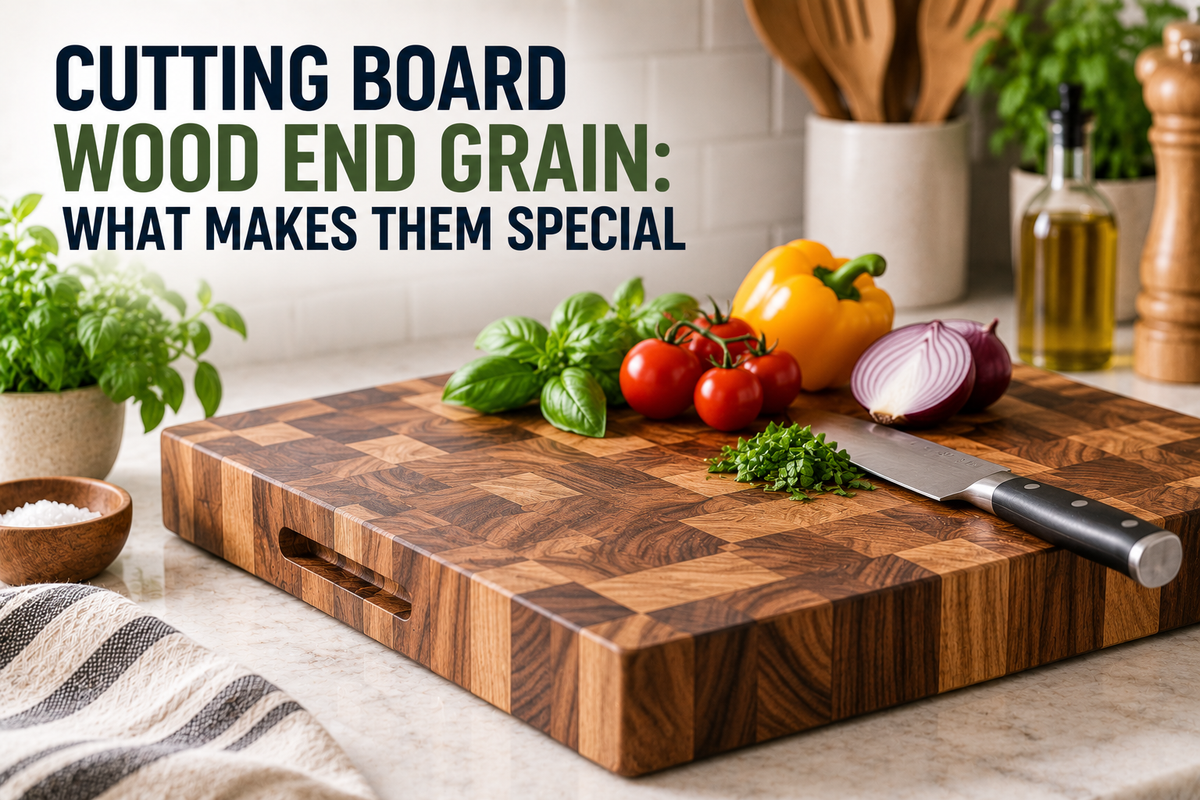
It's Thursday evening, dinner is already running late, and your onions keep sliding toward the counter as you chop. The board is covered with shallow scars, moisture gathers in old knife marks, and every wipe leaves you wondering whether the surface is clean. The board has become part of the work, not just the place where the work happens.
That's why cutting board wood end grain deserves more attention than a colour or pattern choice. The direction of the wood fibres affects how the blade meets the surface, how marks appear, how much the board moves, and how much care it needs. End grain isn't magic, and it isn't automatically the right purchase for every kitchen. Its reputation is partly justified by the physics of wood, but the premium only makes sense when its durability and feel match the way you cook.
Table of Contents
- Why the Grain Direction on a Cutting Board Matters
- What End Grain Means in a Wood Board
- End Grain Compared to Edge and Face Grain
- Common Wood Species Used in End Grain Boards
- How End Grain Boards Are Built and Finished
- Caring for an End Grain Board So It Lasts
- Choosing the Right Size and Use Case
- Is an End Grain Board Worth It for You
Why the Grain Direction on a Cutting Board Matters
A cutting board looks simple until repeated knife work exposes its construction. Every chop drives force into the surface. Every rinse introduces moisture. Every time you sharpen a knife, you're trying to maintain a thin, precise edge that meets the board thousands of times during ordinary cooking. A board's grain direction influences how it responds to that routine.
If the surface shows deep, obvious scoring, food juices can collect in those grooves and make cleaning more frustrating. A board that flexes or slides adds another nuisance. You may press harder, adjust your knife angle, or pause to move the board back into place. Even knife maintenance becomes connected to the work surface, which makes a practical knife-sharpening routine only one part of keeping prep comfortable.
Wood boards generally use one of three construction orientations:
- Face grain uses the broad face of a plank as the cutting surface.
- Edge grain joins long strips with their narrower edges facing upward.
- End grain assembles short blocks so the cut ends of the fibres face the knife.
The wood species can stay the same while the board's behaviour changes. Walnut, maple, or larch doesn't become end grain because of its name. It becomes end grain because a maker changes the direction in which those fibres meet the blade.
Practical rule: Choose the construction first, then compare wood species, dimensions, finish, and appearance within that construction.
A Canadian example shows how this design moved beyond a specialist woodworking idea. Larch Wood Enterprises began in 2003 in a 1,400-square-foot building in East Margaree, Cape Breton, and shifted from flooring into end-grain cutting boards after chef feedback by 2004. The company reported making about 10,000 boards in 2016, with sales reaching Canadian and international buyers, as documented by Saltscapes' account of the company's history. The point isn't that every home cook needs a premium board. It's that orientation can become a meaningful product decision rather than a decorative detail.
What End Grain Means in a Wood Board
A bundle of drinking straws offers a useful model. Hold the bundle upright and press a knife onto the open ends. The blade can move between individual straws rather than slicing across their long sides. Wood fibres are more complex than plastic straws, but the comparison shows why grain direction changes knife contact.
An end-grain board uses small blocks positioned with their fibres standing vertically relative to the cutting surface. The top exposes the end of each wood piece, often creating a checkerboard, brick, or mosaic pattern. As the knife enters, it meets those exposed fibre ends, while the surrounding wood can flex slightly around the cut.
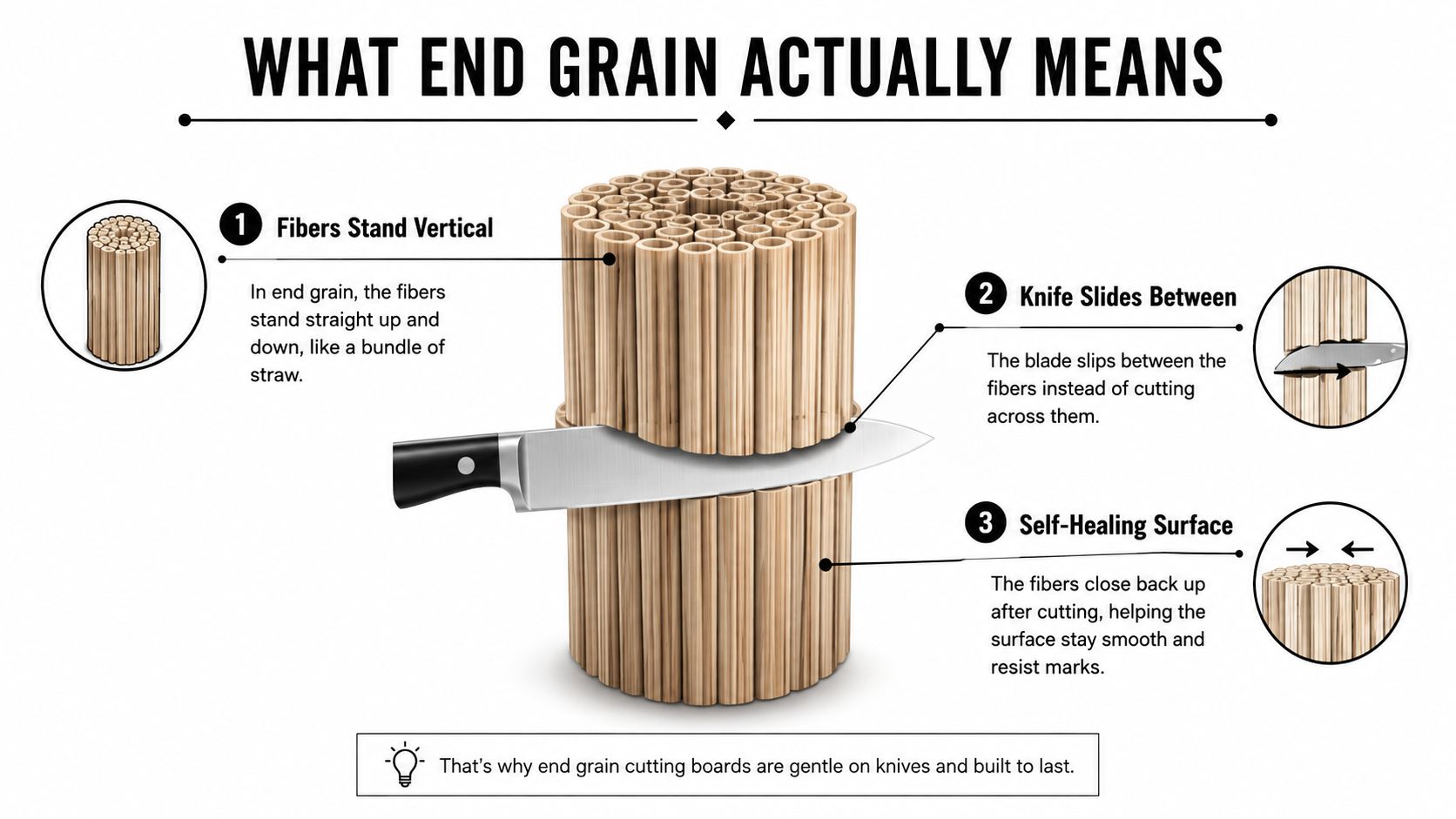
The three grain views
Face grain is the broad, flat face of a plank. It may display wide, flowing lines and an elegant appearance, while its surface fibres receive repeated direct cuts. Edge grain joins long strips side by side, with the grain running parallel to the top. Long, continuous stripes often reveal this construction.
End grain is easiest to recognise through its compact blocks. The surface may resemble a chessboard, small bricks, or a patchwork of growth rings. Combining light and dark woods can make the pattern striking. The pattern follows from the construction method; it is not, by itself, proof of superior craftsmanship. Check the joints, flatness, edge treatment, and finish too.
The same species can appear in all three forms. Maple remains maple whether it is used in a face-grain plank or an end-grain board, yet the knife meets its fibres differently. Canadian-market guidance describes end grain as more knife-friendly, more resistant to visible cut marks, and less prone to splintering or cracking than face-grain construction, as outlined by Crate and Barrel Canada's end-grain board information.
That physical advantage explains part of end grain's reputation. It can support a durable, forgiving work surface, but the construction requires more material, labour, and often greater weight. For a home cook who mainly slices fruit, bread, or cheese, those trade-offs may outweigh the benefit. End grain becomes easier to justify when frequent chopping and long service matter more than budget or easy lifting.
A recycled-paper board, such as the Combekk Recycled Paper Cutting Board 20x30 cm, belongs to a separate material category. Its material description should not be confused with end-grain wood construction, even when both are discussed as knife-friendly prep surfaces.
End Grain Compared to Edge and Face Grain
The most useful comparison isn't “which board is best?” It's “which compromises can you live with?” End grain usually offers the most substantial feel and the gentlest interaction with a sharp blade, but it asks more from your budget, counter space, lifting strength, and maintenance routine.
Edge grain is the middle-ground construction. Its long strips produce a durable work surface that's generally easier to move and maintain than a thick end-grain slab. Knife marks can become more visible because the blade crosses the length of the fibres, but that appearance doesn't automatically make the board unusable.
Face grain is often the simplest and lightest option. It can still provide a pleasant wood surface for slicing bread, fruit, or cheese, but repeated heavy chopping tends to reveal scoring sooner. Treat it as a lighter-duty choice rather than a failed version of end grain.
| Attribute | End Grain | Edge Grain | Face Grain |
|---|---|---|---|
| Knife contact | The blade enters between exposed fibre ends, which can feel forgiving | The blade meets fibres running across the surface | The broad plank face receives direct scoring |
| Visible marks | Small cuts tend to blend into the block pattern | Marks can become easier to see over time | Scoring usually stands out sooner |
| Stability | Thick, heavy construction generally sits firmly | Moderate weight suits everyday movement | Usually lighter and easier to handle |
| Maintenance | Needs consistent cleaning, drying, and conditioning | Usually simpler to maintain | Requires careful moisture control |
| Budget position | Premium tier because construction is labour-intensive | Workhorse value | Lower-cost entry point |
| Best fit | Frequent chopping, carving, and cooks who value longevity | Daily prep and serving | Light prep and presentation |
Canadian category reporting places end-grain hardwood at an estimated 8–12% of cutting-board unit volume, while end-grain and edge-grain wood together account for 55–65% of category revenue because average prices exceed CAD $80, according to IndexBox's Canada cutting-board market analysis. The same report places heirloom and artisan prestige boards below 5% of unit volume but at 12–15% of market value. Those figures describe a premium niche, not a universal standard for household buying.
End grain is a durability purchase. Edge grain is often a value purchase. Face grain can be a sensible light-duty purchase.
Be cautious with exact lifespan promises. Board life depends on wood quality, glue joints, thickness, moisture exposure, and care. A well-maintained end-grain board can remain useful for a long time, but it won't compensate for soaking, dishwasher cycles, or poor drying.
Common Wood Species Used in End Grain Boards
Wood species changes the board's colour, hardness, grain character, and feel. It doesn't replace the importance of construction. A beautifully coloured species in a poorly made board can still warp, split, or develop troublesome joints.
Walnut is popular for its deep brown colour and balanced feel under a knife. It suits cooks who want a darker board that can disguise some food staining while still looking like furniture on the counter. Hard maple has a pale cream appearance that makes the end-grain pattern easy to read. Its firmer surface works well for cooks who want a classic butcher-block look.
Cherry brings a warmer red-brown tone that deepens visually as the board ages. It can suit someone who accepts visible patina as part of the board's character rather than expecting it to stay showroom-perfect. Teak is valued for its natural oils and moisture resistance, although any wooden cutting board still needs proper drying and care.
Exotic species can create striking mosaics, but colour transfer matters. Padauk and purpleheart may bleed pigment into light foods, especially when the surface is new or wet. A maker should explain whether a species is intended for direct food preparation and how the finish was applied.
| Species | Janka hardness | Colour | Daily kitchen suitability |
|---|---|---|---|
| Walnut | Around 1010 | Chocolate brown to deep brown | Gentle feel and understated appearance |
| Hard maple | Around 1450 | Pale cream to light tan | Classic prep surface with strong visual contrast |
| Cherry | Around 950 | Warm reddish brown | Comfortable for regular prep and develops patina |
| Teak | Around 1070 | Golden to medium brown | Useful where moisture resistance is valued, with routine care still required |
| Padauk | Not specified in the verified data | Vivid orange to red | Decorative, but potential pigment transfer needs consideration |
| Purpleheart | Not specified in the verified data | Purple to wine tones | Striking accent wood, best assessed for food-contact suitability |
The hardness figures in the table come from the supplied product guidance, but they shouldn't be treated as a complete buying formula. Very hard isn't always better for a knife edge, and very soft isn't always comfortable for demanding chopping. For another material comparison, read GrifGlo's guide to bamboo versus wood cutting boards.
In Canadian-made boards, eastern Canadian larch is also a notable option. One Canadian product line describes boards handcrafted in Margaree, Cape Breton from sustainably managed local woodlots, with listed thicknesses of 1.5 to 1.75 inches and a roughly 6.5-pound weight for a 17.75 by 11-inch board, as shown in the Canadian larch board listing. Those dimensions illustrate the substantial construction some makers use, rather than defining every end-grain board.
How End Grain Boards Are Built and Finished
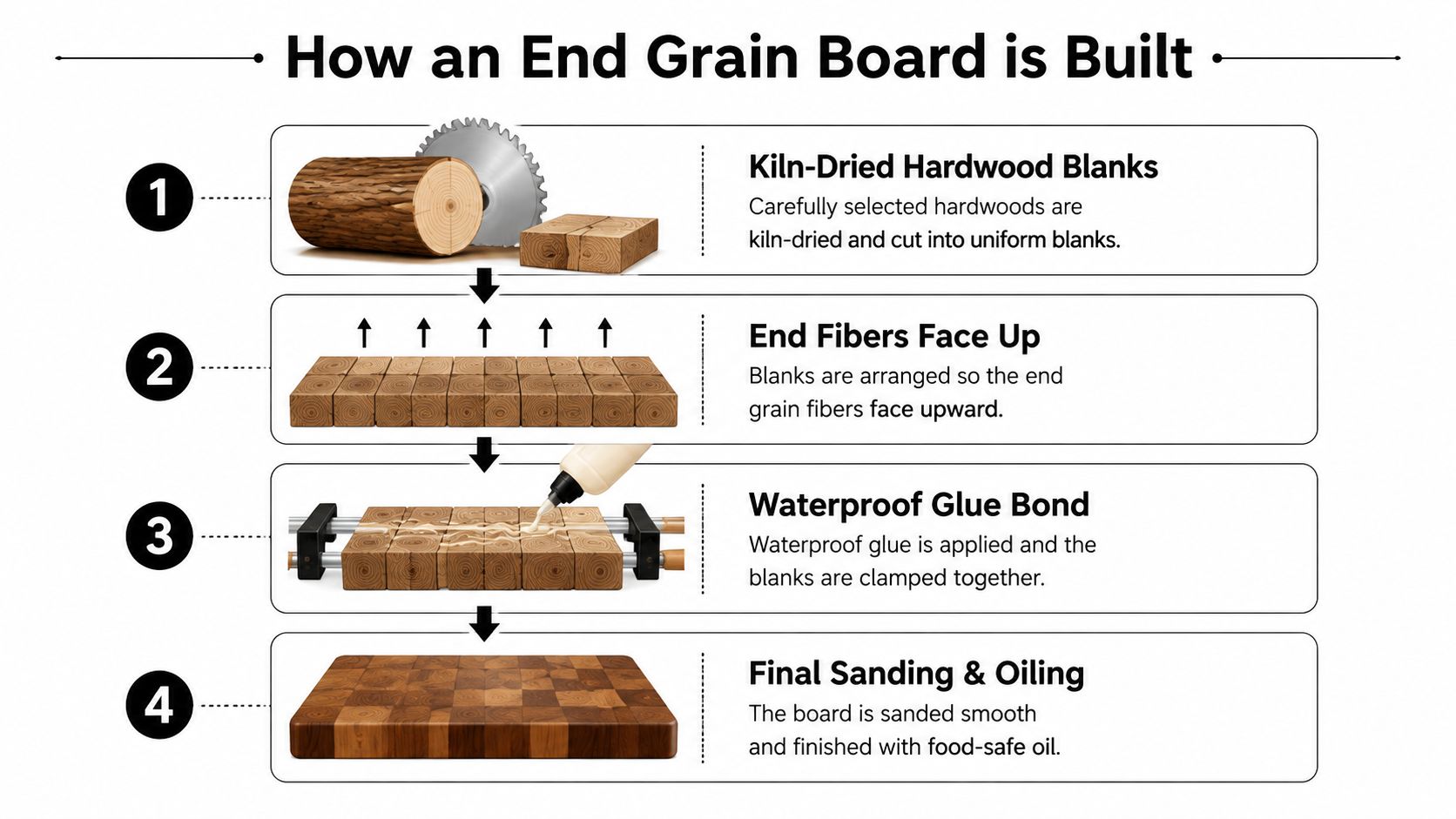
A quality end-grain board begins long before the final oil reaches the surface. The maker starts with properly dried hardwood, cuts it into short blanks, and arranges those pieces so their fibre ends face upward. The board's checkerboard appearance comes from that assembly process.
From blanks to a stable panel
The process usually follows a sequence like this:
- Kiln-dried blanks are cut into manageable pieces. Properly dried wood helps reduce later movement, although wood remains responsive to humidity.
- The blocks are arranged with end fibres facing the future cutting surface. The maker plans the pattern and checks the joints.
- Waterproof, food-safe adhesive is applied, then the pieces are clamped under even pressure. Uneven pressure can leave gaps or create a panel that needs excessive flattening.
- The panel is planed and sanded until the cutting face is level. Edges are softened to make handling more comfortable.
- Food-grade mineral oil penetrates the exposed fibres. A beeswax-based conditioner may follow to give the surface additional resistance to moisture.
The glue lines deserve attention because end grain uses many joined pieces. Look for tight, even seams, a flat work surface, rounded or eased edges, and a finish that doesn't feel sticky or excessively rough. A board that looks impressive from above can still be poorly prepared underneath.
For a practical construction benchmark, one Canadian end-grain product lists a thickness of 1.5 to 1.75 inches and a weight around 6.5 pounds for its stated dimensions, as noted in the Canadian larch listing above. Don't use that figure as a universal requirement. Use it to understand why substantial boards feel stable but can be difficult to lift.
This video offers a visual look at woodworking processes involved in an end-grain board:
A thick board isn't automatically a quality board. Construction accuracy, drying, adhesive coverage, sanding, and finish all matter. The best purchase is the one whose physical demands you'll meet.
Caring for an End Grain Board So It Lasts
End grain exposes more fibre ends, so moisture can enter and leave through the surface more readily. That makes routine care important. You don't need an elaborate ritual, but you do need consistent habits.
After preparing food, rinse the board with warm water and scrub it lightly with a brush and mild dish soap. Don't leave it submerged while you wash dishes. Stand it upright or place it on a rack so air can circulate around both faces, then let it dry completely before storing it flat.
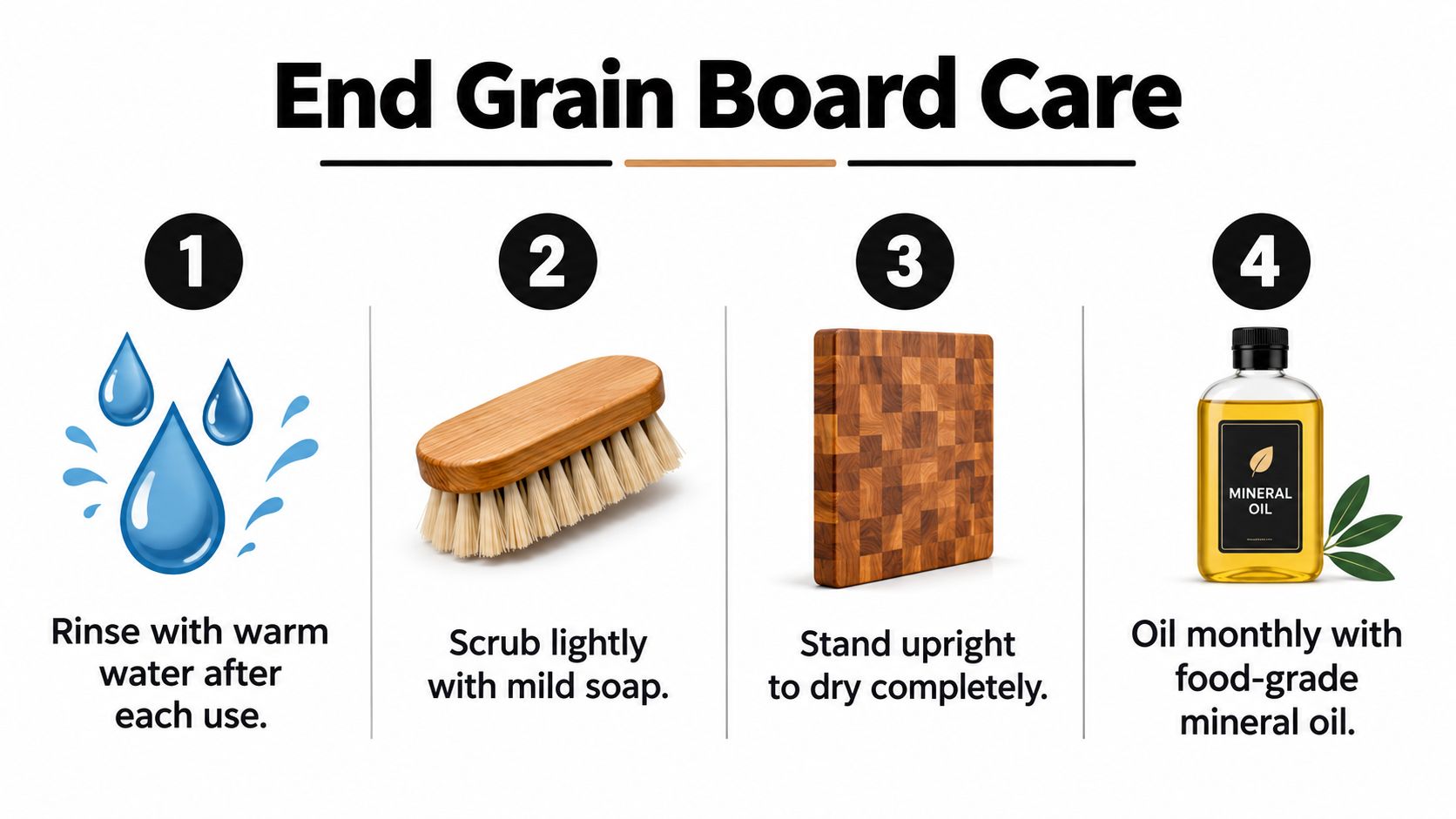
A simple conditioning routine
When the wood looks dry, apply food-grade mineral oil generously across the top, sides, and underside. Let it soak in, then buff away the excess with a clean cloth. A beeswax conditioner can add a more resistant surface layer after regular oiling.
Light scratches don't always call for professional restoration. Once the board is clean and dry, shallow marks can be smoothed with fine sandpaper, then the area can be re-oiled. Sand carefully and evenly so you don't create a dip that collects liquid.
Avoid these common shortcuts:
- No dishwasher: Heat, water, and rapid drying can stress the wood and glue joints.
- No soaking: Standing water encourages swelling and movement.
- No wet storage: A board left against a damp counter can dry unevenly.
- No harsh bleach routine: Bleach may dull fibres and stress glue lines.
- No trapped moisture: Don't stack a damp board under another object.
For a more complete maintenance reference, use GrifGlo's guide to wood cutting board maintenance. The key principle is balance. End grain benefits from conditioning, but oil doesn't make a neglected board waterproof or dishwasher-safe.
Care habit: Wash promptly, dry vertically, and oil when the surface begins to look thirsty. Consistency matters more than dramatic repairs.
Sanitising requires judgment and clean technique. A dilute white vinegar or hydrogen peroxide spray can be used as part of a careful routine, followed by appropriate drying. Keep separate boards, or clearly designate different surfaces, for raw meat and ready-to-eat produce when your kitchen workflow calls for that separation.
Choosing the Right Size and Use Case
The largest board isn't necessarily the most useful one. A good size leaves enough room for the food you're preparing while remaining easy to lift, wash, dry, and store. Measure the counter first, then consider where the board will live between meals.
A compact board suits quick breakfasts, small kitchens, and cooks who usually slice one ingredient at a time. A larger surface helps with family meals, bread, vegetables, and batch preparation, but its weight can turn cleaning into a chore. Thick end grain is deliberately substantial, so anyone with limited grip strength should test the lifting motion before buying.
| Kitchen type | Typical size | Best for | Trade-off |
|---|---|---|---|
| Apartment or compact kitchen | Around 8 by 12 inches | Breakfast prep, herbs, fruit, and limited counter space | Less room for several ingredients |
| Family kitchen | Around 12 by 18 inches or larger | Vegetables, bread, meal preparation, and carving | Needs more storage and drying space |
| Rental or short-term rental | Medium size | General-purpose prep and easier standardisation | May not suit heavy batch cooking |
| Hospitality or frequent batch cooking | Larger butcher-block style | Repeated chopping and substantial prep | Harder to move, wash, and store |
Leave clearance around the board so your hands don't strike a wall, appliance, or utensil holder. A damp towel underneath can improve stability, while non-slip feet may suit a board that stays in one position. If staff or guests need to move and sanitise boards quickly, a thinner edge-grain model may be more practical than a heavy end-grain slab.
Raw meat and produce deserve separate workflow decisions. For specialised preparation, including delicate slicing tasks, these tips for sushi cutting boards can help you think about surface stability, cleanliness, and task-specific sizing without treating one board as suitable for every job.
For meat-focused household workflows, GrifGlo's guide to the best cutting boards for meat provides another way to evaluate board material and use. The right size is ultimately the board you can use correctly every time, not the one that looks most impressive in a product photograph.
Is an End Grain Board Worth It for You
End grain makes the strongest case when you chop frequently, care about knife feel, and want a stable board that can serve as a long-term kitchen tool. The vertical fibre orientation lets the blade enter between fibres rather than cutting directly across them, which helps explain why the surface can show fewer prominent marks and feel gentler under repeated prep. That advantage is rooted in construction, not just branding.
The premium still has limits. End grain is heavier, absorbs moisture readily, needs hand washing and drying, and usually costs more because the maker must cut, arrange, glue, clamp, flatten, and finish many pieces. It also doesn't offer automatic sanitation advantages. A board that receives poor care can fail regardless of how attractive its mosaic looks.
Use this decision test
Choose end grain if you prepare vegetables, herbs, bread, or meat often; want a substantial surface; and will hand-wash, dry, and condition it. It can make sense as a primary family board or as a carefully selected board in a premium rental kitchen where longevity and presentation matter.
Choose edge grain if you want the most balanced everyday option. It's lighter, easier to move, and generally less demanding while still providing a durable wood surface for ordinary chopping and serving. For occasional cooks, that lower-maintenance experience may deliver more practical value than an end-grain upgrade.
Choose face grain for lighter prep or presentation when visible scoring won't bother you. It can work well for bread, cheese, charcuterie, and occasional ingredients, but it's less suited to relentless heavy chopping.
A useful comparison is wood versus plastic. GrifGlo's guide to cutting board wood versus plastic can help you weigh maintenance, handling, and kitchen habits rather than assuming one material wins in every household. The most important question is whether you'll use and care for the board as its construction requires.
GrifGlo is a curated essentials platform that organises kitchen products and decision-friendly guides, including cutting boards, sizing advice, and options for household or hospitality purchasing. Visit GrifGlo to compare practical kitchen essentials by use case, space, and maintenance needs before choosing your next board.

Leave a comment
This site is protected by hCaptcha and the hCaptcha Privacy Policy and Terms of Service apply.