

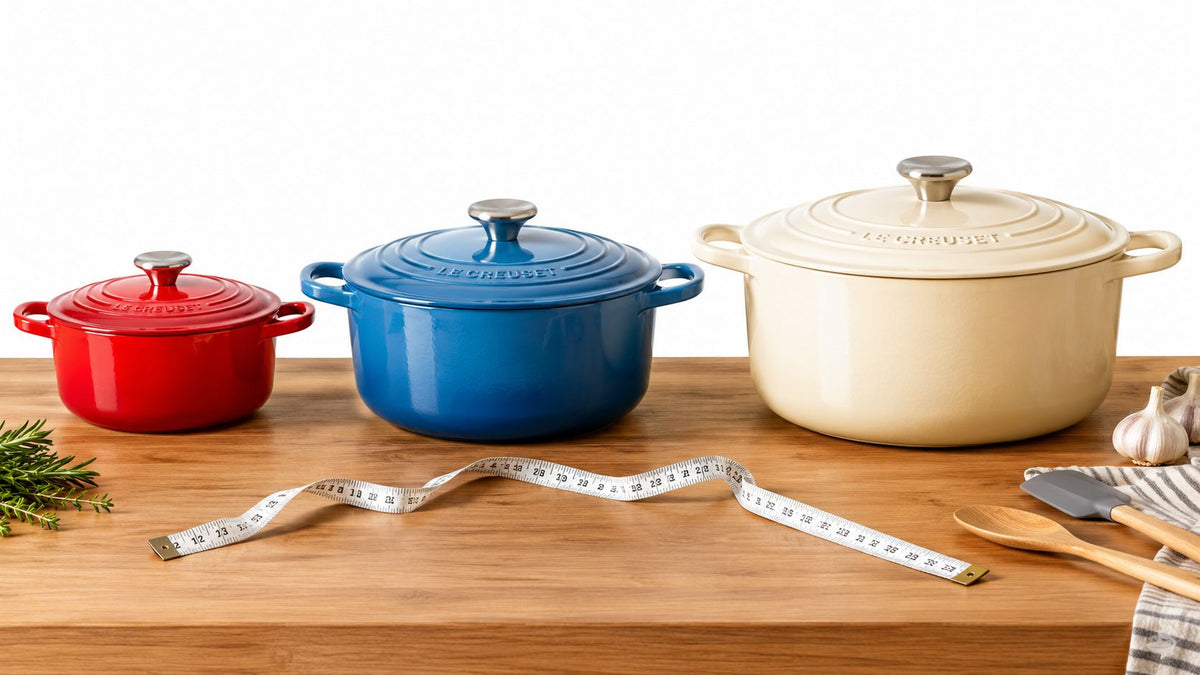
A 5–6 quart Dutch oven is the most practical choice for a typical household of 4–6 people and covers most everyday recipes. Choose 4 quarts only for consistently small portions and tight storage, while larger households, frequent hosts, and cooks who make substantial batches may need 7 quarts or more.
You're probably looking at a row of enameled pots, comparing quart labels that seem precise but don't tell you whether the pan will fit your cabinet, sit comfortably over your burner, or hold tomorrow's leftovers. The largest pot can look like the safest choice until you're lifting it from a low shelf or trying to clear space in a compact California kitchen.
Capacity matters, but the right Dutch oven is the one that fits both your cooking habits and your home. The practical decision sits where serving size, recipe type, storage, and handling meet.
Table of Contents
- Why Choosing a Dutch Oven Size Feels Harder Than the Label Suggests
- Understanding Standard Sizing Rules and Quart Conversions
- Matching Pot Size to Your Household and Cooking Style
- Accounting for Kitchen Constraints and Storage Space
- Building Your Decision Framework for the Perfect Fit
- Making the Final Choice with Confidence
Why Choosing a Dutch Oven Size Feels Harder Than the Label Suggests
A Dutch oven's label shows capacity, not the space required to use it. A bubbling stew needs clearance around the rim, the lid must clear upper cabinets, and a heavy pot should move from hob to oven without straining your grip.
That makes “what size Dutch oven do I need” a practical kitchen question, not a quart-count exercise. Someone cooking for two in a compact apartment may prefer a manageable 4-quart pot. A family of four making soup, bread, and planned leftovers can find that size restrictive. Frequent hosts face another trade-off: extra capacity helps for occasional large meals, but a large vessel can dominate everyday cooking and storage.
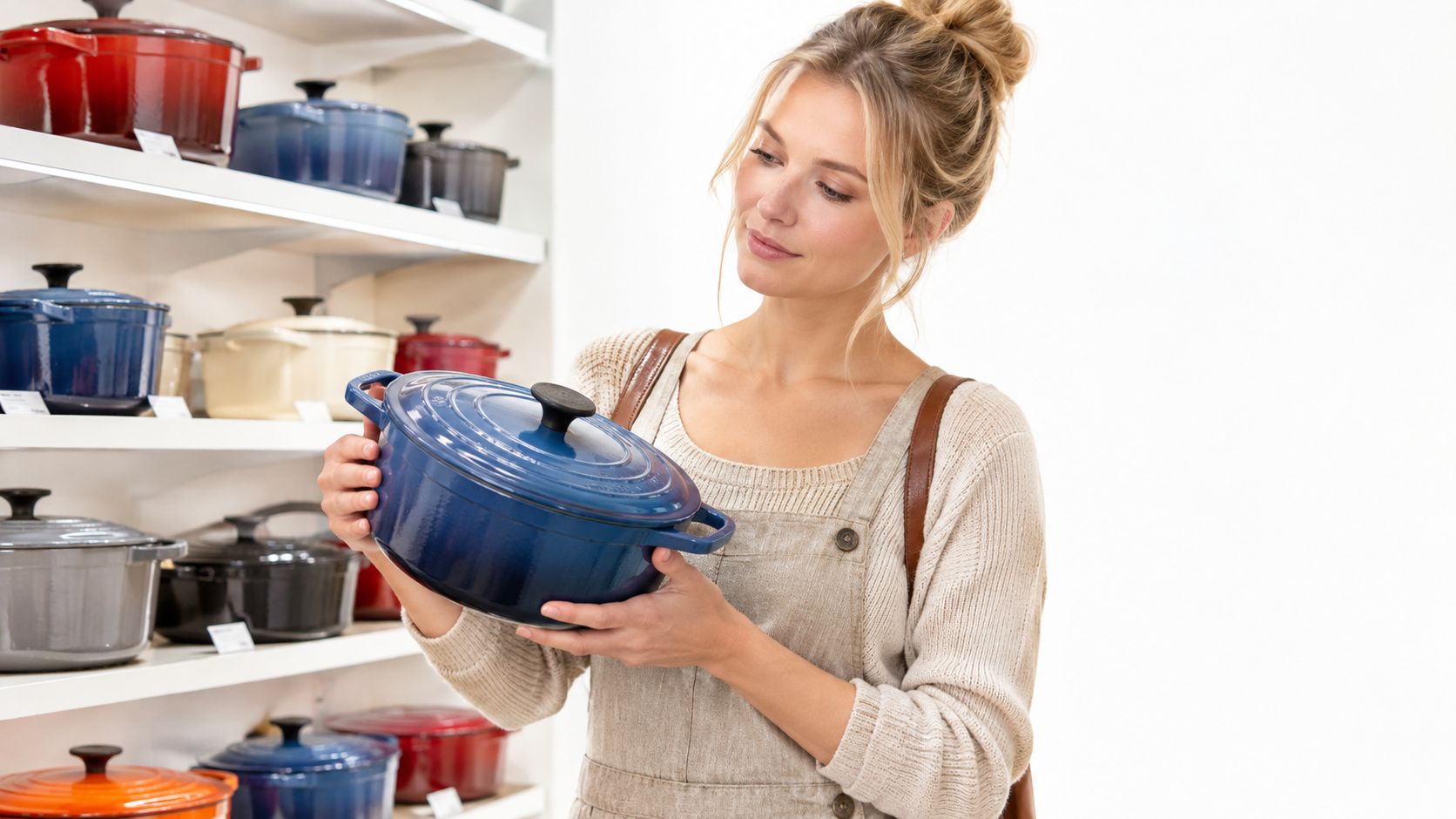
The familiar sizing recommendation provides useful headroom without forcing most cooks into an awkwardly bulky pot. It breaks down when shoppers treat quart capacity as the only measurement that matters. In California apartments, cabinet openings, narrow counters, compact burners, and refrigerator space can determine whether the pot becomes a daily tool or remains an expensive item in storage.
Practical rule: Buy for the meals you cook repeatedly, then check whether the pot fits the kitchen you have, including cabinet clearance and burner space.
Separate the choice into capacity and usability. A simple decision-making framework can organize the comparison, but measurements in your kitchen should settle it. Before buying, measure where the Dutch oven will live, consider how its handles affect nearby space, and account for the room needed to lift the lid safely.
For many cooks, 5–6 quarts remains the most balanced starting point. It accommodates soups, stews, braises, baking, and leftovers while avoiding the bulk of a pot designed mainly for entertaining. The right size is the one you can store, lift, heat, and use often.
Understanding Standard Sizing Rules and Quart Conversions
A Dutch oven's quart rating gives you a starting point, not a complete buying decision. The usual rule is approximately one quart per person, then rounding up when you need flexibility. For four diners, 4 quarts is a minimum, while 5–6 quarts offers more usable room for a versatile everyday pot. This approach is reflected in Lodge's Dutch oven sizing guidance.
Le Creuset's serving guidance helps translate capacity into practical use. Its round Dutch oven guide places 4.5 quarts at 4–5 servings, 5.5 quarts at 5–6 servings, and 7.25 quarts at 7–8 servings. The 9-quart model is listed for 9+ servings, making it better suited to large households and entertaining. Moving from 4.5 to 5.5 quarts adds about 20% more capacity while staying within a familiar family-meal range, according to that sizing reference.
| Capacity | Servings | Best for |
|---|---|---|
| 4 quarts | Around four people at minimum | Small meals, limited storage, modest portions |
| 4.5 quarts | 4–5 servings | Smaller family meals and everyday braises |
| 5.5 quarts | 5–6 servings | General family cooking and one-pot meals |
| 7.25 quarts | 7–8 servings | Larger batches and regular entertaining |
| 9 quarts | 9+ servings | Large households, gatherings, and substantial meals |
Use the table as a planning guide rather than a guarantee. Recipes need usable headspace, and the requirement changes with the dish. A thick stew needs room for stirring, while bread dough needs space to expand. Filling a pot to its rim makes lifting, mixing, and simmering awkward even when the ingredients technically fit.
Capacity is not the same as footprint
Quart ratings do not show how a pot will occupy your stovetop or storage. Shape, diameter, and height matter just as much. A wide round vessel can improve browning, while a taller one may use less counter width but create clearance problems beneath cabinets or an extractor.
The same issue appears with countertop appliances. The NINJA FT205CO Digital Air Fry Pro Countertop 10-in-1 Oven - Factory serviced with Home Essentials warranty is described as offering increased height capacity and reduced countertop space compared with the original Ninja Foodi Digital Air Fry Oven. The practical point is that capacity and physical arrangement are separate buying questions. Check the product's external dimensions, then compare them with your cabinets, burners, and storage location using this guide to kitchen appliance dimensions.
For many homes, 5–6 quarts remains a sensible middle ground. It handles ordinary family cooking without the storage and lifting burden of a much larger model. Choose a larger pot only when your regular recipes justify its footprint.
Matching Pot Size to Your Household and Cooking Style
Household headcount gives you a starting point, but cooking style determines whether that starting point holds up. Two people who cook small portions may be perfectly served by a compact Dutch oven. Two people who make large batches of chilli, bake bread, or freeze meals may find the same pot restrictive.
Expert shopping guidance places 5 quarts within a range that can cover two to six people, while 4 quarts is more appropriate when cooking strictly for two and storage is tight. It also identifies 5.5–7 quarts as a practical single-Dutch-oven sweet spot, because that range balances versatility with manageable handling. These comparisons come from NBC Select's Dutch oven sizing guidance.
Undersizing creates daily friction
A pot that's too small doesn't only reduce the number of servings you can make. It changes how the recipe behaves. Ingredients crowd the base, browning becomes less effective, liquids can surge during simmering, and you lose the space needed to stir without spilling.
Undersizing is especially noticeable with:
- Braises: Meat and vegetables need room around them so you can brown and turn them without forcing pieces together.
- Bread: Dough rises and expands, so a cramped interior can make handling and baking awkward.
- Chilli and stews: Larger batches need headspace for bubbling and stirring.
- Meal preparation: Leftovers are easier when the full batch can cook in one vessel rather than in separate rounds.
If you cook these foods often, sizing up is usually more useful than chasing the smallest pot that technically holds the ingredients.
Oversizing has a cost
A large Dutch oven solves capacity problems, but it introduces its own compromises. A pot that dwarfs a small meal can be harder to lift, more difficult to store, and less pleasant to use for ordinary weeknight cooking. It can also encourage you to cook more food than you need just because the vessel is available.
A practical comparison looks like this:
- For two people with small portions: Choose 4 quarts when cabinets are tight and you rarely cook ahead.
- For two people who want one versatile pot: Choose 5–6 quarts if bread, stews, or leftovers are part of the routine.
- For a family of four: Start at 5–6 quarts rather than assuming the minimum will be comfortable.
- For large stews or regular guests: Consider 6–7 quarts, then confirm that the additional size is manageable.
- For crowds or whole roasts: Look at 8 quarts and above only when those meals are a recurring need.
The right question isn't whether a pot can hold the largest meal you'll ever cook. It's whether the pot supports the meals you make often without becoming a burden between uses. Your kitchen essentials list should reflect that same principle, prioritising tools that earn their storage space.
Accounting for Kitchen Constraints and Storage Space
A 5.5-quart Dutch oven can be ideal on paper and still be wrong for your kitchen. California apartments often combine limited cabinetry with compact stovetops, narrow counters, and refrigerators that leave little room for a large covered pot of leftovers. Existing sizing advice often focuses on servings per person, while practical storage guidance receives less attention. Le Creuset's storage and cookware guidance also recognises that smaller Dutch ovens are easier to manoeuvre and store.
Use this physical check before ordering.
Measure the home for the pot
- Check the cabinet opening. Measure the opening, not just the internal shelf. Include the lid, handles, and the angle required to slide the Dutch oven into place.
- Inspect the shelf depth. A pot can fit through the front and still leave the door unable to close. Account for handles that extend beyond the body.
- Test the stovetop position. Place a similarly sized pan over the burner and check whether the handles interfere with nearby controls, walls, or another cooking zone.
- Plan refrigerator storage. If you often refrigerate leftovers in the cooking vessel, check that the pot and lid can sit securely without blocking shelves or containers.
- Consider lifting and washing. A Dutch oven that requires two hands every time may be used less often, particularly when it's stored low or cleaned in a small sink.
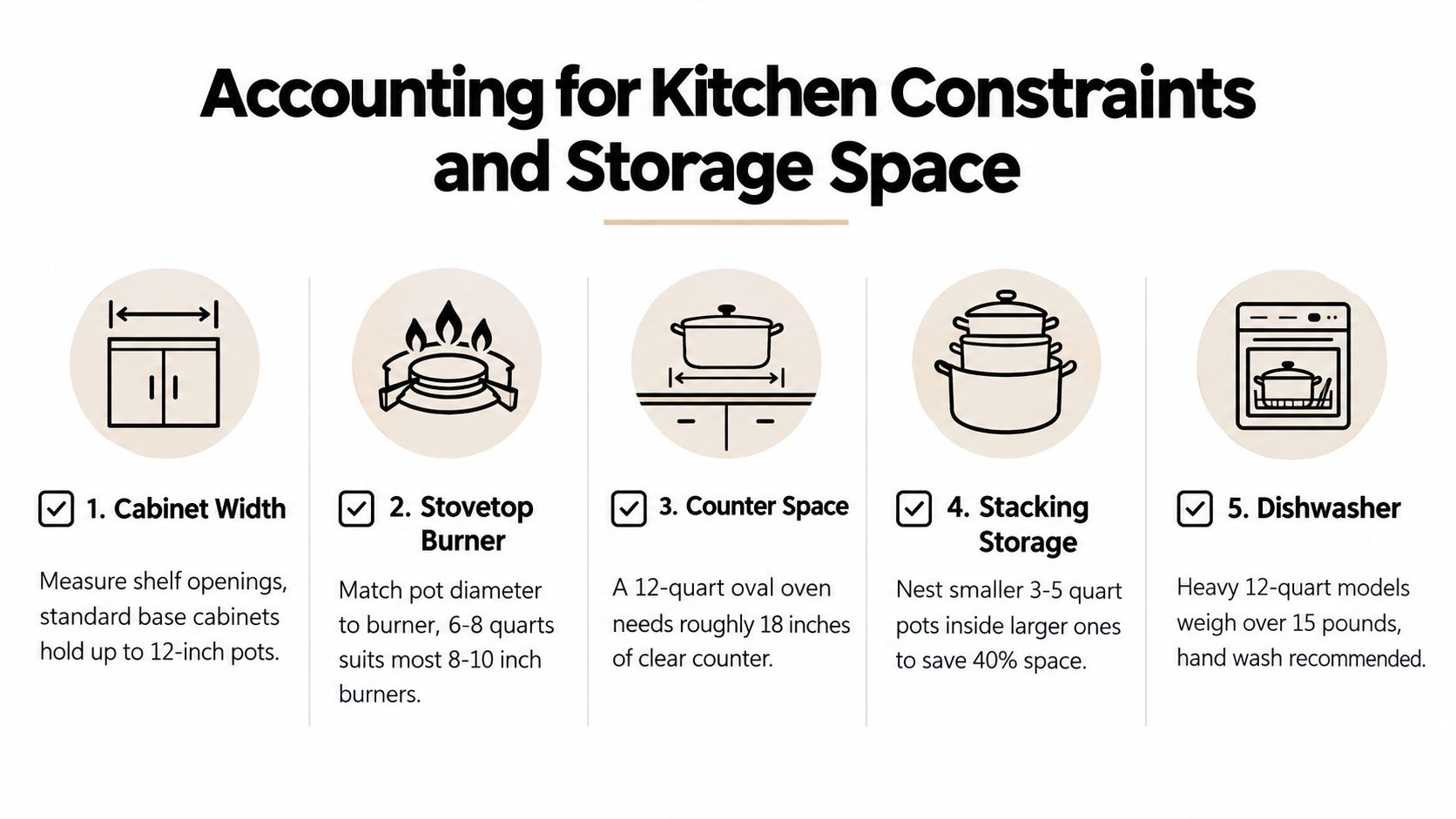
Check the working zone, not only the cupboard
The pot needs clearance while you cook. On a compact hob, a wide Dutch oven may crowd adjacent burners or make it difficult to reach controls. On a narrow counter, you also need somewhere safe to place the hot lid and a stable surface for lifting the pot from the oven.
A smaller home doesn't automatically require a small Dutch oven. It requires a measured choice. If 5–6 quarts fits the cabinet, burner, sink, and refrigerator workflow, it remains the most flexible option. If it doesn't, a smaller model that you can access easily may serve you better than a nominally ideal pot that stays buried.
For more practical ideas, use this guide to organise pots and pans before buying another large piece. Storage is part of the product decision, not an afterthought.
Building Your Decision Framework for the Perfect Fit
The most dependable choice comes from applying three filters in order: how much you cook, what you cook, and where the pot will live. Start with the meals you make on ordinary days, not the largest gathering you might host in the future.
A family of four that cooks soups, braises, bread, and leftovers should begin with the 5–6 quart benchmark. A smaller household with tight storage can move downward when portions remain modest. A cook who regularly makes large stews or entertains should move upward, provided the kitchen can accommodate the extra footprint.
Use this decision matrix
| Your routine | First size to consider | Adjustment |
|---|---|---|
| Two people, small batches, very limited storage | 4 quarts | Stay smaller if large recipes are uncommon |
| Two people, broad recipe range | 5–6 quarts | Choose flexibility over minimum capacity |
| Four people, everyday family meals | 5–6 quarts | Leave room for practical headspace and leftovers |
| Four to six people, frequent batch cooking | 5.5–7 quarts | Size up when stews, chilli, or bread are regular |
| Larger household or frequent entertaining | 7.25 quarts | Confirm cabinet, hob, oven, and lifting clearance |
| Crowds and substantial roasts | 9 quarts | Buy this size only when its capacity will be used regularly |
Le Creuset's guide places 5.5 quarts at 5–6 servings, 7.25 quarts at 7–8 servings, and 9 quarts at 9+ servings, making those categories useful when translating recipe yields into vessel size. The Le Creuset Dutch oven selection guide is a helpful reference for those serving bands.
Make storage a veto point
Capacity should guide the shortlist, but physical fit can eliminate an option. If a 7.25-quart pot blocks a burner, won't fit the shelf, or is uncomfortable to lift, it isn't the right single Dutch oven for that home.
For a deeper look at uses before you commit, review what a Dutch oven is used for. Then write down the recipes you expect to make and compare their batch size with the space available. GrifGlo's curated essentials platform also groups kitchen products and provides decision-friendly guides, comparisons, and sizing advice, which can help when you're evaluating cookware alongside the rest of your kitchen setup.
The best size is the largest pot you can use comfortably and store easily, not the largest pot you can find.
Making the Final Choice with Confidence
The answer is clear for most kitchens: choose 5–6 quarts when you want one Dutch oven for family meals, soups, stews, braises, baking, and leftovers. That range gives a typical household useful capacity without forcing every meal into an oversized vessel.
Choose 4 quarts when your portions are consistently small, your storage is tight, and you don't often cook ahead. Choose 7 quarts or more when larger batches, guests, or substantial roasts are part of your normal routine, not just a rare holiday plan.
The pot should also pass the daily-use test. You should be able to retrieve it without moving half the kitchen, place it securely on your hob, lift it with confidence, and clean it without turning the sink into an obstacle course. A Dutch oven that's easy to reach will usually contribute more to your cooking than a larger one that only comes out for special occasions.
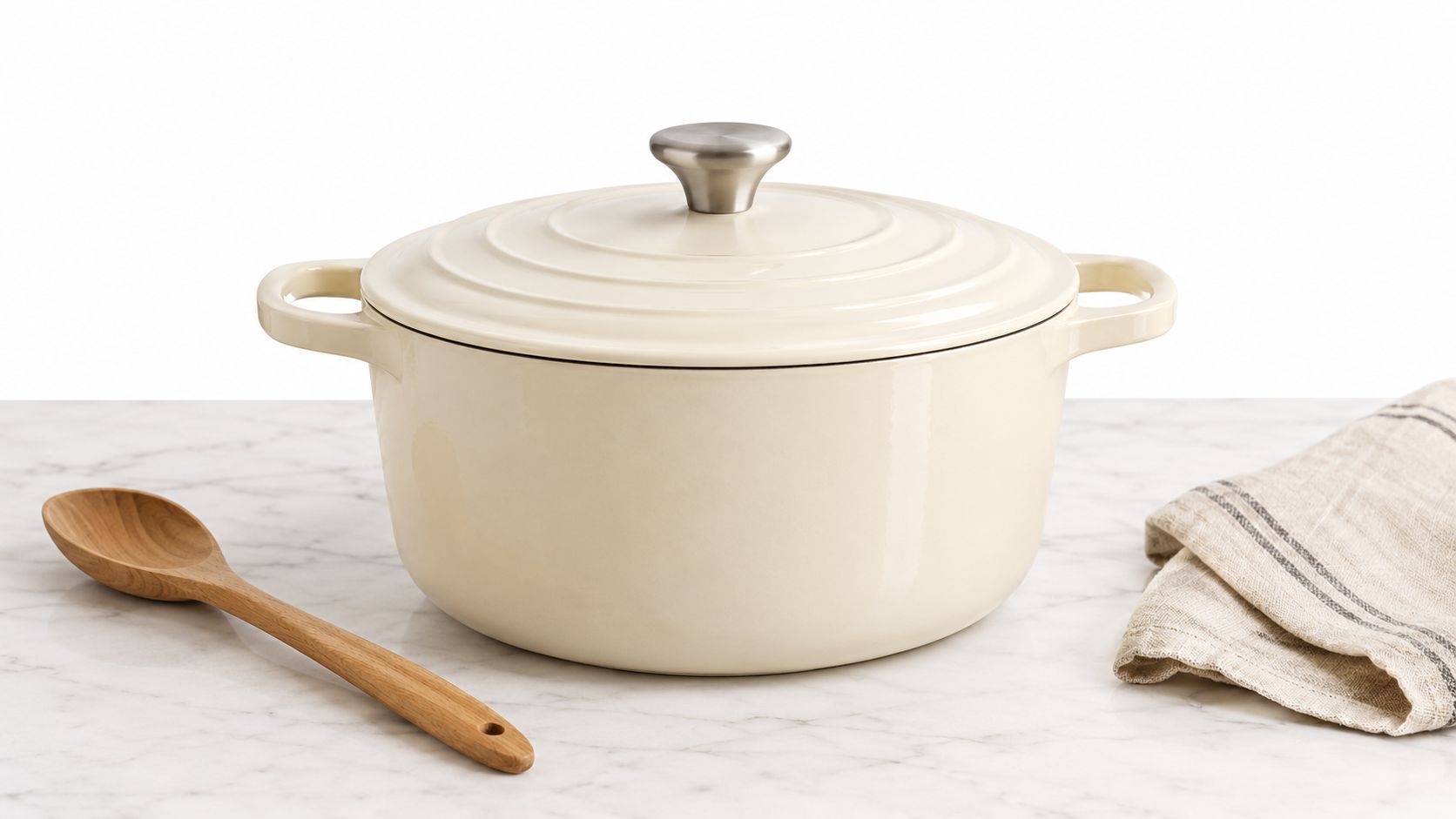
Before you buy, measure the cabinet, check the hob position, account for the lid and handles, and decide whether you'll store leftovers in the pot. Then match that physical reality to your cooking pattern. If both point toward 5–6 quarts, you've found the practical middle ground. If they point smaller or larger, trust the evidence from your own kitchen.
Explore GrifGlo for curated kitchen essentials, cookware comparisons, and practical sizing guidance designed around real home constraints. Use those tools to compare the Dutch oven capacity, storage fit, and everyday usability before you place your order.


Leave a comment
This site is protected by hCaptcha and the hCaptcha Privacy Policy and Terms of Service apply.