

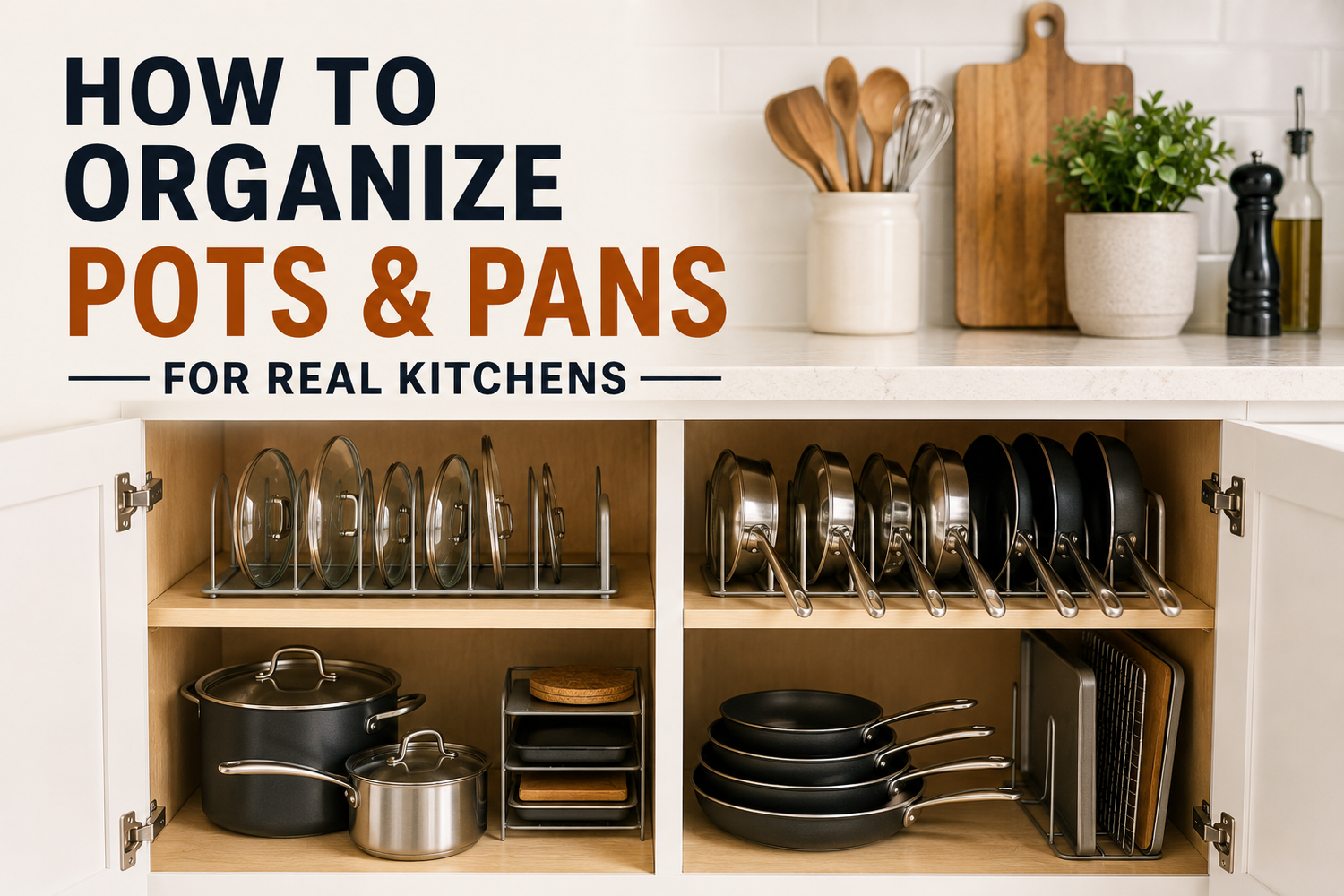
You open the cabinet to grab a lid, and three pans slide sideways with that familiar metal-on-metal scrape. Dinner's already moving, your spoon is in one hand, and the cookware stack suddenly feels like a bad design choice instead of storage. That's the core problem behind how to organize pots and pans, because the goal isn't a prettier cabinet, it's getting the right piece out fast without shuffling everything else.
In California, that matters even more. The state's smaller average home size and high renter share make fixed, bulky storage less practical, so the systems that work best are usually reversible, space-efficient, and easy to move. The best setup is the one that lowers retrieval effort every time you cook, whether you're in a tight apartment, a family kitchen, or a small hospitality space that has to stay functional under pressure.
Table of Contents
- Why Most Pot and Pan Setups Fail at the Stove
- Inventory and Declutter Before You Store Anything
- Choosing the Right Storage Method for Your Space
- Lid Organization That Actually Stays Put
- Zoning the Kitchen Around One Arm's Reach
- Real Layouts for Tight, Family, and Rental Kitchens
- Troubleshooting and What Good Enough Looks Like
Why Most Pot and Pan Setups Fail at the Stove
The classic failure looks harmless at first. The pans are nested neatly, the lids are somewhere nearby, and the cabinet door closes without a fight. Then the burner is on, the sauce is reducing, and you need the one lid buried under three others. At that point, organisation stops being a visual issue and becomes a retrieval-effort problem.
Practical rule: if you have to move one pan to reach another, the system is already too dense.
California kitchens make that problem sharper because space is tight and renters cannot always install permanent hardware. The state's housing context, including a median home size of about 1,860 square feet in 2023 from the U.S. Census Bureau, compared with the national median of roughly 2,233 square feet in the same Census housing data, makes cabinet efficiency a practical issue, especially for pots and pans, not just a nice-to-have detail. California also had about 45% renter households in state housing reporting, so the most useful systems are usually reversible ones, like nested pans by size, separate lid storage, and adjustable dividers or vertical racks rather than fixed cabinetry, as outlined in the California-specific storage guidance from Home & Gardens.
The stove-side logic is simple. Store what you use most often where your hand naturally reaches, and make everything else earn its place by frequency, not sentiment. A cabinet that fits every pan you own can still be a bad layout if the daily skillet sits behind a stockpot you only use twice a season.
Gas stove cookware guidance fits into the same thinking, because a good pan system only works when the cookware you use is easy to grab and return. For home cooks, that means the cabinet has to support the cooking pattern, not interrupt it. For small hospitality kitchens, it means staff can reset quickly between tasks without digging through excess volume.
Inventory and Declutter Before You Store Anything
Empty the cabinet first. Don't rearrange around the clutter, because clutter is what makes every storage method look worse than it is. Put every pot, pan, lid, and insert on the counter, then group them by type so you can see what's really there, not what you remember owning.
Keep, donate, retire
Use three decisions and stay strict about them.
- Duplicates: keep them only if each one gets used regularly. If one pan handles the same job as another and sits unused, it's taking up prime storage for no reason.
- Damaged pieces: retire warped or failing cookware unless it does something unique that nothing else can replace.
- Specialty items: keep the tagine, wok, or odd-shaped pan only if you can name the last time you used it and the reason it still deserves cabinet space.
That filter matters because the rest of the layout should assume a realistic set of cookware, not an overstuffed collection. The kitchen essentials guidance is useful here because it pushes you to think in terms of what a kitchen needs, not what a store bundle tries to sell as complete.
A cabinet full of unused cookware doesn't just waste space. It slows the cook who has to reach past it every night.
A practical target for many homes is a manageable core set, not an oversized stack of backups. Once the collection is pared down, every storage choice becomes clearer. The skillet that cooks most weekday meals earns the easiest slot. The soup pot can live one step further away. The rarely used roaster can leave the main zone entirely.
That same logic helps in small commercial kitchens too. When staff share storage, duplicates multiply fast, and dead stock hides behind active cookware. A quick inventory gives each piece a job or a reason to leave, which makes the remaining system easier to maintain.
Choosing the Right Storage Method for Your Space
A good storage method removes extra steps between the stove and the cabinet. That matters in a full-size family kitchen, a rental with no drill rights, or a small hospitality setup where every second at the line counts. Drawers, cabinets, hanging systems, and freestanding units can all work, but each one solves a different retrieval problem. Pick based on what saves hand movement, not on what looks neat in a photo.
A sharp knife belongs in the same conversation. Organized cookware still slows a cook down if the cutting tools are dull, because the time loss happens at prep and retrieval, not just inside the cabinet.
The trade-offs that matter
| Storage Method | Retrieval Effort | Footprint | Best For |
|---|---|---|---|
| Drawers with dividers | Low, because pieces stay visible and separated | Uses existing drawer space well | Families, daily cooks, deeper base cabinets |
| Cabinets with risers or pull-outs | Medium to low, depending on access | Good vertical use, but depth can be wasted | Most homes, especially where cabinet volume matters |
| Hanging racks | Very low for active pans | Frees cabinet space, but uses wall or ceiling area | Non-renters, compact kitchens with mounting options |
| Freestanding racks | Low to medium, with open access | Takes floor area | Small hospitality operations, bulk cookware, rentals with no drill rights |
The best choice is usually the one that shortens the hand-to-pan path. A cabinet can work well for almost anyone, but deep shelves turn inefficient fast if you have to move one item to reach another. Vertical storage usually beats flat stacking when cabinet volume is limited and access is the primary bottleneck.
For a cabinet-first setup, kitchen cabinet organisation guidance fits the same practical rule. Use the space so items are reachable, not just stored. If you are using a product like the Ordora Pots & Pans Organizer, 4D-21H, 21-Inch, measure the cabinet first. The product details call out 21 inches high, a reinforced counterweight frame, and 4 strong prongs, so the fit has to match the cabinet opening before it can do any good.
Practical rule: if you cook daily in one tight zone, prioritize access over capacity. If you rotate pans seasonally, adjustable cabinet storage usually makes more sense.
GrifGlo groups practical kitchen and organisation products in one place, which helps when you want to compare storage tools without sorting through endless listings. That matters for a home kitchen, a rental unit, or a small operation that needs straightforward purchasing and no guesswork.
Storage methods compared
The question is how much effort each method adds every time you cook. Drawers are strong where deep cabinets are weak, because they bring cookware toward you instead of making you reach into the back. Hanging systems work well in open kitchens, but they suit rentals poorly if you cannot attach hardware to the wall or ceiling.
Cabinets work best with vertical accessories, not with cookware stacked flat until the whole shelf becomes a pile. Freestanding units have a place in small commercial kitchens because they keep access consistent, but they do take floor area that some spaces do not have. The weakest setup is the one that looks roomy while forcing you to move three things to reach the fourth.
Lid Organization That Actually Stays Put
Lids break pot systems more often than pots do. They slide, tilt, and steal more space than they should, especially when they're mixed into the same stack as the cookware. If the lids don't have a separate home, the whole cabinet turns into a puzzle every time you cook.
Keep lids separate from the pan stack
Door-mounted hooks work well when you can't afford to waste shelf depth. Vertical lid racks inside the cabinet are better when you want lids to stand in a single visible row. The upside-down method also works, where a smaller lid nests on top of a larger pot to create a flatter stacking surface, but it only helps if the stack stays shallow and stable.
For renters, no-drill solutions matter. Adhesive over-the-door hooks and tension-rod style racks let you create a lid zone without touching the wall. For families, one narrow cabinet or a counter-side divider can keep lids predictable, which matters when more than one person cooks and nobody remembers the backup hiding place.
Handle interference is the hidden problem. Alternate handle direction when you nest pans so they don't lock together and waste height. If the stack starts to feel like a single object instead of several separate pieces, it's too tight. Use separators between pieces when needed, especially with non-stick cookware, so the rims don't rub and the stack doesn't turn into a scraping session.
Drawer organiser ideas can help if your lids live beside utensils or small tools, but the bigger point is consistency. Pick one lid system and stick with it. Multiple lid homes create uncertainty, and uncertainty slows cooking more than a little extra movement does.
Lids need a single predictable place. If you can't reach one without scanning two or three surfaces, the system isn't finished yet.
Zoning the Kitchen Around One Arm's Reach
The best cookware zone is built around the stove, not around the shape of the cabinet. Daily-use pans belong where one hand can reach them while the other keeps cooking moving. Occasional pieces can live farther away, because they do not need to compete with your weeknight rhythm.

Build the zone from the burner outward
Start with the cabinet or drawer closest to the stove. That is the first-choice zone for the two or three pans you use most often, because it removes the extra step that makes weeknight cooking feel slower than it needs to be. Then place the next-most-used pieces in the next closest area, and move specialty cookware to upper cabinets or a pantry shelf.
Stacking still has a place, but it needs limits. Keep the largest pan at the bottom, use felt or towel separators between pieces that would otherwise rub, and stop once the stack gets too deep to lift cleanly. A shallow stack is efficient. A buried stack is just a future interruption.
Let frequency of use drive the layout
The point is not to fill every inch of cabinet volume. The point is to make the right pan the easiest one to grab when dinner is already underway. A daily skillet should not live behind a holiday roasting pan just because the cabinet is tall enough to hold both.
The California housing picture makes this especially relevant. With statewide pressure to plan for 2.5 million new homes by 2030, as reported by the California Department of Housing and Community Development, compact layouts remain a practical reality in many homes. In dense metro kitchens, every extra reach and re-stack adds friction, so the pieces used most often should set the layout.
Practical rule: if you cannot remove a pan without shifting another one, the storage geometry is too dense.
Small hospitality kitchens benefit from this too. Staff members do not have time to sort through a beautiful but inefficient cabinet. Zoning the most-used cookware close to the stove keeps service moving and reduces unnecessary handling.
Real Layouts for Tight, Family, and Rental Kitchens
A workable system has to survive real kitchens, not just idealised ones. In a galley apartment, you're fighting width. In a family kitchen, you're fighting shared habits. In a rental or short-term unit, you're fighting the fact that you can't install whatever you want. The same rules still apply, but the hardware changes.
The image below shows the kind of pull-out access that solves a deep-cabinet problem without forcing a full remodel.

Three layouts, three trade-offs
In a galley apartment with one lower cabinet, vertical storage earns its keep. A pan rack and door-mounted lid hooks can reclaim a surprising amount of usable space because they turn dead depth into visible access. Retrieval effort drops because the cookware is standing up instead of buried flat.
In a family kitchen with a deep drawer and an upper cabinet, dividers and a pull-out tray usually outperform free stacking. Multiple people need to put things back correctly, so the layout has to be obvious at a glance. Deep drawers are valuable here because they reduce the chance that one person's rushed put-away turns into another person's search.
In a short-term rental, no-drill storage is the rule. Freestanding baker's racks and tension-rod solutions make more sense than wall-mounted systems because they can be installed, removed, and reused without leaving marks. That matters when the unit has to reset quickly between guests or households.
The useful question in all three cases is the same. How many items can be reached without moving something else? The answer tells you more than cabinet depth or product aesthetics ever will.
The embedded video below reinforces the logic of accessible storage in a small-space setup.
If you run a small property or hospitality setup, standardising cookware across units helps even more. One consistent set plus labelled storage bins makes restocking and training simpler, and it lowers the chance that staff have to learn a new cabinet every time they change rooms or units.
Troubleshooting and What Good Enough Looks Like
Over-stacking is the first thing to fix when a system keeps failing. Cap stacks at a shallow level, add separators, and stop forcing cookware into a shape it doesn't want to hold. If lid chaos is still happening, pick one lid home and remove the other two.
Renters without wall rights should stay with freestanding racks, tension rods, and over-the-door hooks. That route is slower to install, but it avoids the false promise of permanent storage in a place you can't modify. Cast iron also needs special care, so if those pieces are in your rotation, cast iron cookware care should inform where and how you store them.
Good enough is a practical standard, not a design award. Daily pans should be reachable in seconds, lids should live in one predictable place, and each cabinet should hold no more than one honest stack before access starts to degrade.
If you want cookware storage that works in a real home, not just in a styled photo, GrifGlo groups practical kitchen and organisation essentials so you can compare options without wasting time. Visit GrifGlo to find storage tools, cookware guidance, and sized-for-purpose options that fit the way you cook.

Leave a comment
This site is protected by hCaptcha and the hCaptcha Privacy Policy and Terms of Service apply.