

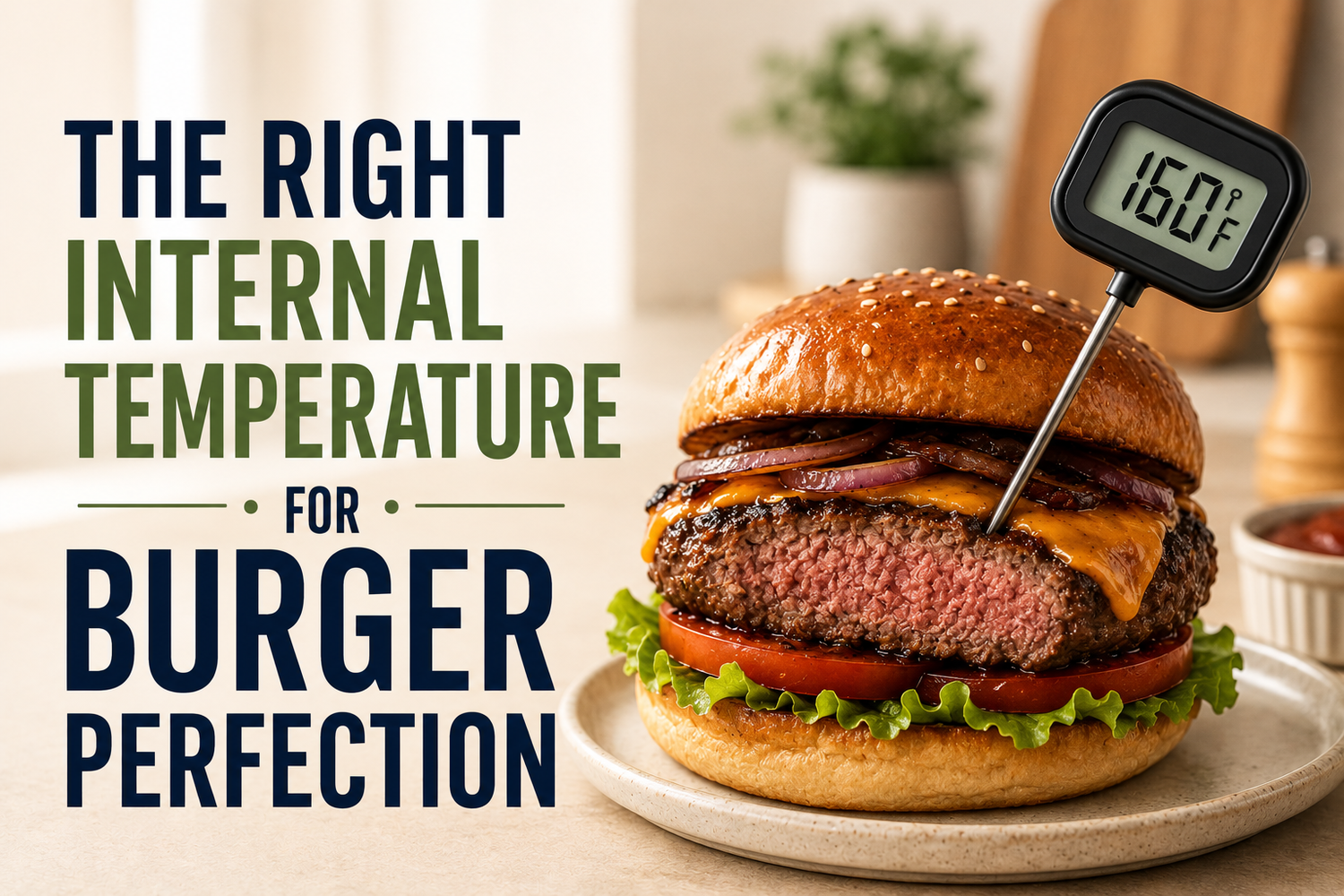

The USDA's recommended safe minimum internal temperature for ground beef burgers is 160°F (71°C). If you want burgers that are both safe and still juicy, pull them a little early and let carryover cooking bring them the rest of the way.
That's the moment many cooks find themselves in right now. The buns are toasted, the cheese is ready, and the patties look done enough. But the centre is where the true answer lives, and colour won't tell you much. A burger can look beautifully browned outside and still miss the temperature that matters.
The confusing part is that home cooks hear one rule, then go to a restaurant and see burgers served pink in the middle. That gap leaves a lot of people guessing. They end up doing one of two things: serving burgers too early because they trust the colour, or cooking them too long because they're afraid of getting it wrong.
A thermometer fixes both problems. It tells you when the burger is safe, and it helps you stop cooking before the meat turns dry. If you're building a more dependable setup, a practical kitchen essentials list can help you spot which tools earn their space.
Table of Contents
The Secret to a Perfect and Safe Burger
A good burger feels simple until the last minute. You've shaped the patties, heated the grill or pan, and now you're deciding whether to leave them on for another minute or rescue them before they dry out. That tiny decision is where most burgers go right or wrong.
The trick is understanding that juicy and safe aren't opposites. You don't have to choose between a burger that tastes good and one you trust serving to your family. You just need one reliable number and one reliable tool.
For home cooking, that number is 160°F in the centre of the patty. That's the point where the guesswork stops. Not “looks done.” Not “feels firm.” Not “the juices run clear.”
Practical rule: Cook by internal temperature, not by colour or cooking time alone.
This matters most with burgers because patties cook quickly, and they can go from underdone to dry in a very short stretch. If you've ever cut one open to check, only to watch the juices spill out on the plate, you've seen the downside of guessing.
A thermometer lets you keep the burger intact, check the centre, and pull it at the right moment. Once you start doing that, the whole process gets calmer. You stop poking, pressing, and second-guessing every patty.
Confidence in burger cooking usually doesn't come from more recipes. It comes from knowing exactly what the centre temperature means.
The Unmistakable Rule for Burger Safety
The rule for home-cooked ground beef burgers is straightforward: 160°F (71°C) in the centre. The USDA sets that as the safe minimum for ground beef burgers because harmful bacteria such as E. coli O157:H7 can survive in ground meat due to the mixing process, as explained in the USDA guidance on burger food safety.

Why ground beef is different
A steak and a burger don't behave the same way from a food safety point of view. With a whole cut like a steak, the main concern is the surface. Searing the outside deals with that risk.
Ground beef is different because grinding changes where bacteria can end up. The outer surface of the meat gets mixed all through the batch, so the centre of the burger can carry the same risk that only the exterior would have had in a whole cut.
The process is akin to shuffling a deck of cards. Once the meat is ground, what used to be “outside” is no longer only outside. It's distributed through the patty.
That's why the internal temperature for burger safety is stricter than what many people associate with beef in general.
What that means in your kitchen
This is also where people get tripped up by restaurant menus. They see “medium” burgers offered out in the world, then assume the same approach applies at home. It doesn't always. Restaurants can operate under food codes that differ from simple home guidance, and some may use procedures or products that change how they manage risk.
At home, the cleanest rule is still the safest one. Check the centre and cook ground beef to 160°F.
A few practical habits make that easier:
- Use a thermometer every time. It gives you a direct reading from the thickest part of the patty.
- Keep prep surfaces organised. Raw meat contact matters, so separating prep and cooked food areas helps.
- Don't rely on browning. Burgers can turn brown before they reach the safe temperature.
If you're sorting out prep tools, cutting board wood vs plastic is a useful comparison for handling raw ingredients sensibly. For example, the Combekk Recycled Paper Cutting Board 20x30 cm is described as being made from 100% recycled paper and dishwasher-safe, which fits the kind of easy-clean prep routine many home cooks want.
The safest burger isn't the one that looks done first. It's the one that reaches the right temperature at the centre.
A Guide to Burger Doneness Temperatures
You pull a burger off the heat because it looks medium, cut into it, and still wonder if it is safe. That uncertainty usually comes from mixing up two different ideas. Doneness tells you how the burger eats. Safety tells you whether the centre reached the temperature home cooks should trust.

How doneness and safety differ
For a steak, people often talk about rare, medium-rare, or medium as if those labels settle everything. Burgers are trickier because grinding changes the food safety picture. The outside and the inside are no longer separate in the same way, so a burger can look like a certain doneness level and still need more time.
Here is the doneness language many cooks use for beef burgers:
| Doneness | Temperature |
|---|---|
| Medium-rare | 130 to 135°F (54 to 57°C) |
| Medium | 135 to 140°F (57 to 60°C) |
| Medium-well | 140 to 150°F (60 to 66°C) |
| Well-done | 155°F (68°C) and above |
Those ranges describe texture, juiciness, and colour. They do not replace the home safety target for standard ground beef.
For home-cooked ground beef burgers, use 160°F (71°C) as the temperature that settles the question. That is why restaurant menus can be confusing. Some restaurants operate under different food codes and service rules, so the medium burger you see on a menu does not automatically match the safest at-home standard.
A simple way to remember it helps. Doneness is the burger's personality. Internal temperature is the safety check.
For ordinary shop-bought ground beef cooked at home, treat 160°F as your reliable finish point.
Quick reference for common burgers
Different ground foods do not share one universal target, so it helps to separate them clearly:
- Ground beef: Cook to 160°F (71°C).
- Ground turkey or chicken: Cook to 165°F (74°C).
- Plant-based burgers: Follow the package directions, since ingredients and cooking instructions vary by brand.
Health Canada lists those same home cooking targets for ground beef and ground poultry in its safe internal cooking temperatures guide.
Cooking method changes the path, not the destination. A burger cooked in a pan may brown faster than one on a grill. One from the oven may heat more gently. The centre still needs to hit the right number.
If you like precision cooking, learning how sous vide bags work in controlled-temperature cooking can make the idea of doneness easier to understand. Burgers still need careful handling and the right final temperature, but that low-and-slow mindset helps explain why appearance alone is never enough.
How to Measure Burger Temperature Accurately
A thermometer only helps if you use it in the right spot. Most bad readings come from probe placement, not from the thermometer itself.

Where to place the thermometer
For a burger, aim for the thickest part of the patty, which is the coolest point and the one that tells you whether the centre is done. In California food guidance for commercial settings, handlers are instructed to verify temperature with a calibrated thermometer placed in the thickest part of the patty, as noted in the Orange County Environmental Health food temperature chart.
The easiest method at home is usually to insert the probe from the side, pushing it into the centre rather than stabbing straight down from the top. That helps you hit the middle more accurately, especially on thinner patties.
Use this sequence:
- Wait until the burger is close. Don't check too early unless you're tracking several batches.
- Insert from the side. Slide the tip into the geometric centre.
- Pause for the reading. Digital thermometers usually settle quickly.
- Check more than one patty if needed. Burgers aren't always shaped identically.
Mistakes that throw off the reading
A few small errors can make a burger seem hotter than it is:
- Touching the pan or grill grate: The metal can give a falsely high reading.
- Missing the centre: If the probe doesn't reach the middle, you may read a hotter outer layer.
- Checking a very thin edge: Edges cook faster than the core.
- Using colour as a backup test: Once you have a thermometer, colour isn't the tie-breaker.
If you want a visual walk-through, how to use a meat thermometer covers the mechanics in more detail.
A quick demonstration helps if you've never done this before:
Once you get used to checking from the side, reading burger temperatures becomes second nature. It's one of those kitchen skills that feels fussy for one meal and then saves you trouble for years.
Mastering Carryover Cooking and Resting
The part that keeps burgers juicy happens after they leave the heat. That surprises a lot of people, because they assume cooking stops the second the burger comes off the grill or pan.
It doesn't. Heat stored in the outer layers keeps moving inward, and the centre temperature continues to climb during the rest.

Why the temperature keeps rising
For standard grilling, carryover cooking can raise a burger's internal temperature by 5°F to 10°F after removal from the heat. To finish at 160°F, ThermoWorks advises stopping the cook when the thermometer reads 150°F to 155°F, then letting the burger rest, as explained in this carryover cooking guide for burgers.
That's the missing piece for people who say, “I cooked it to 160 and it still came out dry.” In many cases, they likely cooked it to 160 on the heat, then let the resting period push it even higher.
Pull early, rest briefly, and let the final temperature arrive gently instead of forcing it over the line on the grill.
How to use resting to your advantage
This works best when you think in two temperatures:
| Your goal | Pull temperature |
|---|---|
| Final burger at 160°F | Remove at 150°F to 155°F |
A short rest gives you two benefits at once. First, the internal temperature finishes climbing. Second, the juices settle back through the patty instead of running out the moment you bite or cut into it.
A practical routine looks like this:
- Cook until nearly there. Watch for the reading to enter the mid-150s or a little lower, depending on how much carryover your setup creates.
- Move to a plate or board. Resting on a clean surface is enough. You don't need a complicated setup.
- Wait a few minutes before serving. The burger will finish more evenly.
If you cook often in cast iron, cast iron cookware care is useful reading because pan heat retention can affect how strongly carryover shows up after cooking.
Many home cooks think resting is only for steaks or roasts. Burgers benefit too, especially when you're trying to hit the safe internal temperature for burger cooking without overshooting into a dry, crumbly texture.
Frequently Asked Questions About Burger Temperatures
Why do restaurants serve pink burgers
Confusion often begins here. At home, people hear 160°F. In restaurants, they may see burgers offered medium or medium-rare.
In California commercial food settings, the code can be more nuanced than the simple home rule. According to the Orange County Environmental Health guidance based on the California Food Code, commercial establishments are required to heat raw ground, chopped, or formed meats to 155°F for 15 seconds, with listed alternative time and temperature combinations, unless a customer specifically requests a less thoroughly cooked item. That's not the same as saying every pink burger is automatically safe in every situation. It means restaurants can operate under food-service rules and procedures that differ from the plainest advice given to home cooks.
For home cooking, the least confusing approach is still to use a thermometer and finish ground beef burgers to 160°F.
Is pink always unsafe
No. Colour and safety don't line up neatly.
The USDA says colour is not a reliable indicator of burger safety, which is why a thermometer matters more than whether the centre looks pink or brown. A burger can brown before it reaches a safe temperature, and a burger can also retain some pink tones even when it's hot enough.
Don't judge safety by the centre colour. Judge it by the thermometer.
Does cooking method change the target
No. Grill, pan, oven, flat-top, or air fryer, the target temperature stays the same for the type of meat you're cooking. What changes is how fast the burger cooks and how much carryover heat it picks up after removal.
That's why one burger can need more resting than another even when both finish at the same safe temperature.
Do I really need a thermometer for burgers
If you want consistency, yes. Burgers cook fast, and they don't give reliable visual clues. A thermometer removes the two most common problems at once: undercooking and overcooking.
For households trying to standardise kitchen tools, GrifGlo offers decision-focused buying guides across kitchen and home categories, which can help narrow down practical essentials without sorting through an oversized catalogue.
If you're comparing thermometers, prep tools, or everyday kitchen gear for more reliable cooking, GrifGlo publishes practical guides that help households, hosts, and small teams choose tools based on real use rather than hype.

Leave a comment
This site is protected by hCaptcha and the hCaptcha Privacy Policy and Terms of Service apply.