

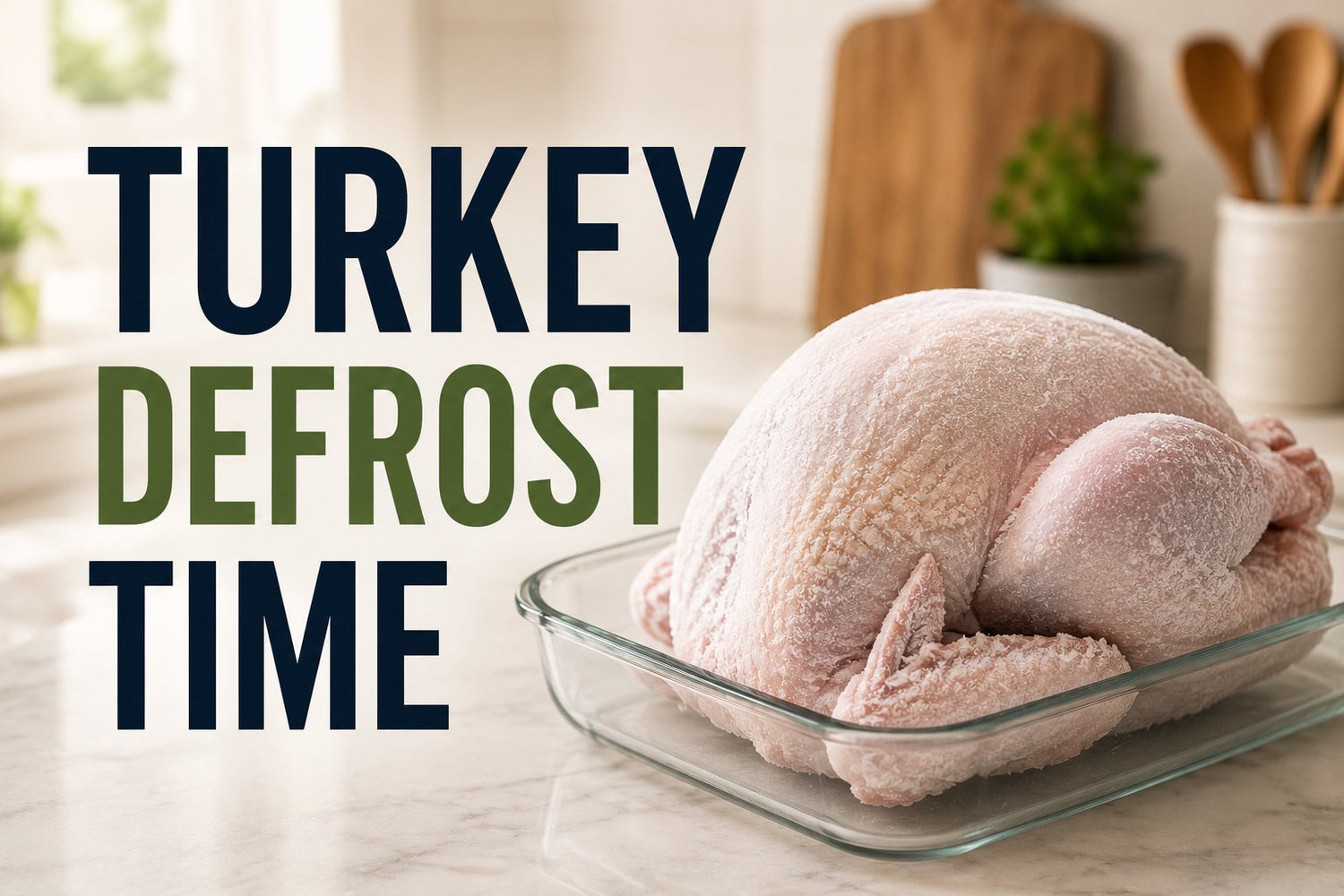
Plan for about 24 hours of defrosting time for every 4 to 5 pounds of turkey in the refrigerator. In practice, that means a 15-pound turkey needs 3 full days, while cold-water thawing takes 30 minutes per pound, or about 7 hours for a 15-pound bird.
If you're reading this with a frozen turkey still sitting in the freezer and a holiday meal already on the calendar, take a breath. This is one of the most common kitchen scrambles of the season, and it's usually fixable if you stop guessing and start counting backwards from dinner.
That's the missing piece in most turkey defrost time guides. They tell you the thawing rule, but not how to fit that rule into real life. You don't cook “sometime on Thursday”. You serve at a set hour, oven space gets tight, side dishes pile up, and one thawing mistake can create stress you feel for days.
A good plan solves that. Once you know your turkey's weight, your serving time, and which thawing method fits your schedule, the whole thing becomes much calmer.
Table of Contents
- That Moment of Panic The Turkey Is Still Frozen
- The Master Turkey Defrosting Time Chart
- The Refrigerator Method Slow Safe and Simple
- The Cold Water Method Your Fast Track Option
- Critical Food Safety for Thawing Any Meat
- Holiday Troubleshooting and Your Countdown to Dinner
- Frequently Asked Questions About Thawing Turkey
That Moment of Panic The Turkey Is Still Frozen
You open the freezer, pull out the bird, and realise it's still as solid as a paving stone. Dinner is close. The shopping's done. Guests are coming. This is the point where people start wondering if leaving it on the counter “just for a while” might be fine.
It isn't the moment to improvise. It's the moment to choose the right thawing lane.

There are three recognised options home cooks rely on. The first is the refrigerator, which is the easiest to manage and the safest for most households. The second is cold water, which works well when time is short but requires attention. The third is the microwave, which is usually only practical for smaller birds because whole turkeys often don't fit well and can thaw unevenly.
Practical rule: If you have the time, use the fridge. If you don't, use cold water properly. Don't try to invent a fourth method.
The reassuring part is that turkey defrost time is predictable once you stop treating it like a guess. Work backwards from the meal, not forwards from the freezer. If you're trying to get your kitchen under control before the holiday rush, a simple freezer reset helps too, especially if you need to make space for safe thawing in the first place. GrifGlo's guide on how to organise a freezer is useful for that practical prep.
The rest of this guide keeps the focus where it belongs. Clear timings, what works, and how to build a countdown to dinner that keeps you out of trouble.
The Master Turkey Defrosting Time Chart
Individuals looking for turkey defrost time often want the answer quickly. Use the chart below as your working reference, then choose the method that matches your calendar.

Turkey Defrost Time by Weight and Method
| Turkey Weight (lbs) | Refrigerator Thaw Time (Approx.) | Cold Water Thaw Time (Approx.) |
|---|---|---|
| 8 | about 2 days | about 4 hours |
| 10 | about 2 days | about 5 hours |
| 12 | about 3 days | about 6 hours |
| 15 | 3 full days | about 7 hours |
| 16 | about 4 days | 8 hours |
| 20 | 4 full days | 8 to 12 hours |
| 24 | about 5 days | about 12 hours |
The refrigerator column follows the standard rule of 24 hours for every 5 pounds for the method discussed in detail later. The cold-water column follows 30 minutes per pound, including the examples of a 12-pound turkey in 6 hours, a 15-pound turkey in about 7 hours, a 16-pound turkey in 8 hours, and a 20-pound turkey in 8 to 12 hours from the cited guidance in this article's method sections.
How to use the chart without getting tripped up
Read this chart as a planning tool, not a licence to cut things close. If dinner is important, leave yourself buffer time. A turkey that finishes thawing early in the fridge is much less stressful than one that's still icy when the oven should already be heating.
For cooks who like to prep aromatics and seasoning while everything else is moving, a tool such as the HAUTE CUISINE Stainless Steel Garlic Press - 80710-HC is a durable stainless steel garlic press with comfort grip handles and quick cleanup. It doesn't affect thawing, of course, but it does fit the reality of holiday prep where multiple small jobs happen at once.
Microwave thawing is the least flexible option for a whole turkey. It can help with small birds, but for large holiday turkeys, most home cooks are choosing between fridge time and cold water.
The Refrigerator Method Slow Safe and Simple
If you have enough lead time, this is the method to trust. It asks for planning, not babysitting, and it keeps the turkey in the safest temperature range during the long thaw.

In California households preparing turkeys for holidays, the USDA-recommended refrigerator thawing method requires exactly 24 hours per 5 pounds of turkey weight, which means a standard 15-pound bird needs a minimum of 3 full days to defrost completely before cooking, according to Food52's summary of the USDA refrigerator guideline.
How to set it up properly
Keep the turkey in its original wrapping. Put it on a tray, pan, or other rimmed surface that can catch juices. Then place it on the bottom shelf of the fridge, where any drips are less likely to reach foods that are ready to eat.
That bottom-shelf step matters more than many people think. A fridge is a shared space, not a sterile one. If you need to reorganise shelves and zones before thawing week starts, this guide on how to organise your fridge with bins and zones gives a practical setup approach.
What works well
A calm refrigerator thaw usually looks like this:
- Start earlier than feels necessary: If your bird's weight puts you near a deadline, add extra breathing room.
- Use a proper drip tray: A sheet pan, roasting pan, or large rimmed tray is far safer than trusting the store packaging alone.
- Leave it alone: Constant moving, unwrapping, and checking won't speed anything up.
What tends to go wrong
The most common mistakes are simple. People put the turkey on a crowded upper shelf. They leave it in the thin original tray with nothing underneath. Or they assume every fridge runs at the same temperature.
A refrigerator thaw is slow, but it's forgiving if you give it space, containment, and enough time.
One more practical issue deserves attention. Not every refrigerator holds the ideal temperature. That matters because turkey defrost time is based on a properly cold fridge. If your appliance runs warm, the schedule gets less reliable and food safety gets murkier.
For cooks who want the least stressful holiday morning, this is still the gold-standard path. You do your planning up front, then let the fridge do the steady work.
The Cold Water Method Your Fast Track Option
Sometimes the calendar wins. You meant to move the turkey sooner, got busy, and now you need a safe shortcut. Cold-water thawing then earns its place.

The cold water thawing method used in many California kitchens requires exactly 30 minutes per pound, which translates to about 7 hours for a 15-pound turkey and 8 hours for a 16-pound bird, based on the timing guidance in Taste of Home's turkey defrosting reference.
How to do it without cutting corners
Leave the turkey in leak-resistant packaging. Submerge it in a container large enough to hold the bird under cold water, or use a thoroughly cleaned sink if that's your only option. The water must stay cold throughout the process, and it needs to be changed regularly.
Los Angeles County Public Health holiday guidance also notes that a 12-pound turkey takes about 6 hours with this method when the water is changed every 30 minutes and kept below 40°F (4.4°C), with immediate cooking after thawing recommended in that same guidance for safety-sensitive fast thawing situations, as outlined in the Los Angeles County food safety holiday document.
The trade-off that matters
Cold water is faster because water transfers heat more effectively than cold air in a refrigerator. But speed comes with labour. You can't set it up and disappear for the afternoon.
Use this checklist:
- Keep it sealed: If the wrapping is compromised, bag the turkey securely before submerging.
- Change the water on schedule: Don't let it drift warmer and warmer while you get distracted.
- Cook it straight away: Once thawed by this method, the bird goes to the oven, not back into a holding pattern.
If you don't have a great sink setup, a food-safe container or cooler can make the process easier to manage. Storage and utility pieces like those discussed in GrifGlo's guide to freezer storage containers can also help when you're trying to organise space for a large bird and a full holiday prep station.
A quick visual walkthrough can help if you've never done this method before:
When I'd choose this method
Use cold water when the fridge window has closed but you still have the attention span to manage the process properly. Don't choose it if you know the day will pull you away every few minutes. In that case, a rushed fast thaw often turns into a sloppy one.
Critical Food Safety for Thawing Any Meat
A turkey can look fine on the outside and still be handled unsafely. That's why thawing isn't just about time. It's about temperature control and keeping raw juices away from everything else in the kitchen.

The core rule is simple. Meat shouldn't sit in the danger zone between 4°C and 60°C (40°F to 140°F) for extended periods, because that's where bacteria multiply rapidly. That's exactly why counter thawing is such a poor idea for a large bird.
The contamination problem most people miss
A common pitfall in California kitchens is placing the turkey on upper shelves or leaving it in the original Styrofoam tray without a drip pan, which leads to cross-contamination. Guidance cited here notes that 15 to 20% of household foodborne outbreaks involve improper thawing placement where juices leak onto ready-to-eat foods, as referenced in this food safety publication link provided with that claim.
That lines up with what experienced cooks see every year. The danger isn't just the turkey itself. It's the trail it leaves behind if you don't contain it.
Keep raw poultry physically separated from salad greens, desserts, cut fruit, leftovers, and anything else that won't be cooked again.
Non-negotiable safety habits
These habits prevent the usual holiday mistakes:
- Wash hands after handling raw poultry: Do it before touching cupboard handles, taps, spice jars, or your phone.
- Clean surfaces properly: Cutting boards, sinks, trays, and counters all need attention after contact.
- Use a thermometer when needed: It helps confirm thaw progress and later confirms the bird is cooked safely.
If you want a practical refresher on choosing and using that tool well, GrifGlo has a guide on how to use a meat thermometer.
What not to do
Don't thaw a turkey on the counter overnight. Don't leave it in warm water. Don't trust appearance alone. The outside can soften long before the interior is ready, and that's where home cooks get fooled.
Food safety doesn't need to make the holiday feel tense. It just needs a few firm rules you follow.
Holiday Troubleshooting and Your Countdown to Dinner
Holiday cooking rarely runs in a straight line. The bird thaws slower than expected, the fridge is packed, or you discover too late that your timeline was based on a refrigerator that runs warmer than you thought.
That last problem is more common than many people realise. A California Energy Commission study cited in this brief found that 32% of CA residential refrigerators operate between 42–45°F, which can slow thawing and create risk when people rely on standard timing assumptions, according to the USDA-linked reference provided for that claim.
If the schedule is getting tight
A warm-running fridge changes the practical plan. If your turkey should be thawed by now and still feels firm in key spots, don't keep hoping it will magically catch up. Shift to a safer response. Either keep giving it cold refrigerator time if the schedule allows, or move to the cold-water method and commit to monitoring it properly.
That's one reason I like a backward-planned dinner schedule. It removes the emotional part. You stop asking, “Do I think it'll be fine?” and start asking, “What does the clock allow safely?”
A simple countdown to dinner
Here's a practical way to build your timeline:
- Choose your serving time first: Start with the hour people will eat.
- Count back your cooking window: Include roasting, resting, carving, and oven preheat.
- Count back your thawing window: Match the method to the turkey's weight and your real schedule.
- Add buffer space: This protects you from fridge variability, kitchen delays, and last-minute chaos.
If the turkey is the centrepiece, it should be the first item on the calendar, not the last one squeezed in.
If you're also juggling oven performance and timing accuracy, GrifGlo's guide on an oven heat sensor is a useful companion. It's relevant because an uncertain oven plus an uncertain thaw creates a much harder day.
What works in the real world
The best holiday plan is rarely the most elaborate one. It's the one that gives the turkey enough time, keeps the raw bird contained, and leaves you room to recover if something runs late. A calm cook nearly always serves a better dinner than a rushed one.
Frequently Asked Questions About Thawing Turkey
Can I thaw a turkey on the counter
No. It's one of the easiest ways to lose temperature control. The outer layer warms long before the centre thaws, which is exactly the situation you're trying to avoid.
How long does a 15-pound turkey take to thaw
If you're using the refrigerator method, a 15-pound turkey needs 3 full days in the fridge, based on the USDA timing cited earlier. If you're using cold water, it takes about 7 hours, with active water changes and immediate cooking after thawing.
Do I need to keep the turkey in its wrapper
Yes, unless the packaging is damaged. The wrapper helps reduce mess and limits direct contact with thawing water if you're using the fast method. If it leaks, place the bird in a secure food-safe bag before continuing.
What if my turkey is still a bit icy
Check the cavity and the thicker parts of the bird. Small icy areas can mean it needs more thawing time. Don't force the schedule by leaving it out at room temperature.
Is cold water thawing safe
Yes, if you do it correctly. The water has to stay cold, the bird has to remain sealed, and the turkey needs to be cooked as soon as thawing is finished.
What is the safest way to manage turkey defrost time
The refrigerator remains the easiest method for safety and planning because it demands less hands-on attention. The cold-water method is useful when the schedule is tight, but it only works well if you can supervise it.
If you're building a more organised kitchen for holiday cooking, GrifGlo offers decision-friendly guides across kitchen tools, food storage, appliances, and home organisation so you can sort out the practical details before a busy meal puts pressure on the whole room.

Leave a comment
This site is protected by hCaptcha and the hCaptcha Privacy Policy and Terms of Service apply.