

You're cooking dinner with the windows closed because wildfire smoke has turned the skyline grey. The pan is sending a fine plume into the kitchen, someone has lit a candle, and the heating or cooling system is running. The room looks normal, but your nose can't tell you whether the main problem is outdoor smoke leaking in, particles from the cooking, or stale air building up indoors.
That's where an air quality monitor for home earns its place beside a thermostat or smoke detector. It can show patterns you can't see, connect a spike with an activity, and help you decide whether to filter, ventilate, reduce a source, or investigate the building itself. It can't diagnose illness, identify every hazardous substance, or replace a carbon monoxide alarm, professional testing, or medical advice.

The useful question isn't, “Is this number good?” It's, “What changed, where did it come from, and what action is likely to help?” This guide builds that skill from the basics, then applies it to renters, homeowners, bedrooms, kitchens, small offices, and other compact spaces. If you already compare electricity use with a home energy monitor, air monitoring follows a similar idea, but the output is exposure and ventilation rather than consumption.
Table of Contents
- Introduction to Home Air Monitoring Made Simple
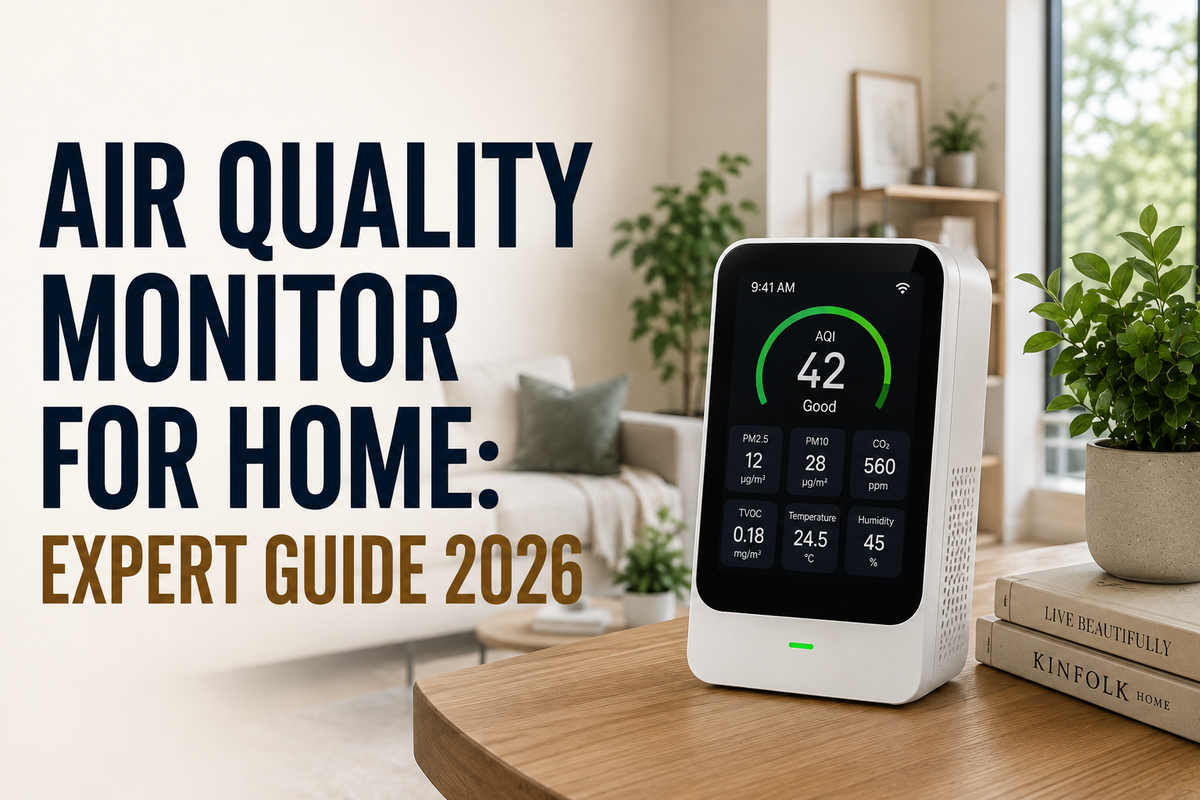
- What a Home Air Quality Monitor Measures
- How Home Air Sensors Work and Where They Fall Short
- How to Choose the Right Monitor for Your Home Use Case
- Placing Your Monitor and Reading the Numbers With Confidence
- Keeping Readings Accurate With Simple Maintenance and Smart Features
- Your Next Steps to Cleaner Air and Confident Buying
Introduction to Home Air Monitoring Made Simple
Indoor air changes constantly. Cooking, showering, cleaning, opening a door, running a filter, bringing in a pet, and filling a room with people all change the mixture. Outdoor conditions matter too, especially in California, where smoke, ozone, and fine particles can enter through windows, doors, ventilation systems, and building leakage.
California has maintained one of the world's most extensive air monitoring networks for more than 50 years, and the state's official air-quality portal provides real-time and historical information by air district, as documented by the California Air Resources Board air-quality monitoring programme. That public record gives households a useful comparison point, but an outdoor station can't tell you what happened beside your sofa or at the child's desk.
A monitor answers practical questions:
- Did cooking create a short PM2.5 spike?
- Did smoke enter when a window or door opened?
- Does the bedroom become stuffier overnight?
- Did filtration lower particles after a source stopped?
- Does a ventilation fan run when you expect it to?
It won't answer every question. A consumer sensor doesn't automatically identify the precise chemical in a VOC reading, prove that a room is safe, or tell you whether symptoms have a medical cause. Treat readings as evidence for decisions, not as a laboratory certificate.
Start with the problem you want to solve
A renter in a smoke-prone area may need a simple particle monitor that can move between the living room and bedroom. A homeowner with a tightly sealed house may gain more from PM2.5, CO2, VOC, humidity, and temperature together. A small business may need fixed placement, historical records, visible alerts, and a device that remains useful if an app or cloud service changes.
The strongest setup is the one you'll use. A clear display can help when you want an immediate answer, while an app is useful for trends. Portability matters when you're investigating several rooms, but a permanently placed monitor is better for learning what one occupied zone does throughout the day.
What a Home Air Quality Monitor Measures
A home monitor works more like a small room weather station than a single “cleanliness score.” Each signal describes a different condition. The useful answer comes from comparing their timing and direction, especially when a reading suddenly changes.

The six signals to understand
PM2.5 refers to fine particulate matter small enough to stay suspended, similar to dust motes in sunlight but far smaller. Cooking, candles, combustion, traffic, outdoor smoke, and wildfire smoke can all raise it. Health Canada advises keeping PM2.5 as low as possible and, at minimum, lower indoors than outdoors. Its guidance reports average indoor PM2.5 levels below 15 µg/m³ in smoke-free homes and below 35 µg/m³ in homes with smokers, as stated in Health Canada's residential PM2.5 guidance.
The timing helps identify the source. A sharp rise during frying points to an indoor event. A rise after opening a window during smoky weather suggests outdoor infiltration. A persistent elevation across rooms may indicate that ventilation or filtration is not keeping up.
PM10 includes larger particles such as coarse dust and pollen. It can reveal disturbance from vacuuming, renovation, tracked-in soil, or seasonal allergens, but the reading cannot identify the exact material.
CO2 is a clue about ventilation. In a closed bedroom, occupants add CO2 while outdoor air enters slowly, so the concentration can rise overnight. A steady increase alongside occupancy suggests insufficient air exchange, though CO2 does not represent every indoor pollutant.
VOCs, or volatile organic compounds, are gases released by some cleaners, paints, furnishings, fragrances, and other products. A general VOC signal can show that conditions changed after painting, cleaning, or bringing in a new item. It usually cannot name the compound or establish a health limit for the mixture.
Humidity measures moisture in the air. It affects comfort and condensation risk. Unusually damp readings give you a reason to inspect bathrooms, basements, windows, and plumbing.
Temperature supplies context. The same particle reading means something different during frying than in an empty room. Temperature can also help explain fogged windows, fan operation, or discomfort.
Practical rule: Read the signals as relationships. A particle spike during cooking suggests source control and range-hood use. A gradual CO2 rise in a closed bedroom points toward an air-exchange issue. A VOC change after painting calls for removing or limiting the source and improving ventilation.
A renter can use a portable monitor to compare rooms or check whether smoke enters through a window. A homeowner may track several signals together to assess a sealed house, while a small business may need fixed placement, records, and visible alerts.
The CLOROX 11031 Alexa Smart Medium Room True HEPA Air Purifier combines a real-time air-quality display with Alexa voice control, True HEPA three-stage filtration, and auto mode. It shows how measurement and response can share one household system, though a purifier display cannot replace source diagnosis.
For kitchen particle control, combine monitoring with range-hood use and limited candle or incense burning. This guide to an air purifier for the kitchen explains how filtration can support those source-control steps.
How Home Air Sensors Work and Where They Fall Short
The sensor inside a home monitor doesn't “taste” air in the human sense. It measures a physical effect, then software translates that effect into a displayed value. Understanding the mechanism helps you judge whether a device suits quick household decisions or more demanding long-term comparisons.

Matching sensor type to signal
For particles, a laser-scattering sensor shines light through an air sample. Particles scatter that light, and the device estimates particle concentration from the pattern. Smoke, dust, humidity, particle shape, and airflow can all influence the result, so a reading is an estimate rather than a direct weighing of every particle.
CO2 sensors commonly use infrared absorption. The instrument sends infrared light through the sample and estimates CO2 from how much light the gas absorbs. This approach is different from a broad gas sensor, which is why a genuine CO2 channel matters if ventilation is your primary concern.
VOCs are harder to simplify. Metal-oxide sensors respond to chemical changes at a heated surface, while photoionization methods use energy to ionise compounds and measure the resulting response. Neither automatically provides a complete inventory of every gas in the room. Humidity sensors detect changes in electrical behaviour associated with moisture, and temperature sensors infer warmth from changes such as electrical resistance.
Accuracy is a system property
Two devices can use similar sensor principles and still behave differently because of airflow design, placement, software, calibration, enclosure temperature, and maintenance. Cross-sensitivity can make a sensor respond to substances other than the one you had in mind. Drift can change the baseline over time. A clogged inlet or unstable connection can create missing data that looks like a quiet room.
California's public monitoring history is useful for a sanity check. The state's long-running network and air-district data provide an outdoor reference, but an indoor monitor should not be expected to match a station exactly. Outdoor and indoor locations differ, and indoor sources can dominate even when outdoor air appears calm.
Look for clear documentation about:
- Calibration: Does the maker explain what reference instrument or method it used?
- Data continuity: Can you see gaps, offline periods, and missing uploads?
- Local access: Does the device still show readings without a cloud account?
- Maintenance: Can you clean the inlet and obtain replacement parts?
- Response: Does the display react promptly to a known event such as cooking?
- Interpretation: Does the app show raw trends, or only a vague coloured grade?
Low-cost devices can be useful for identifying changes, but avoid treating one unexplained reading as proof of a specific hazard. If dampness, odour, staining, or suspected growth is the concern, the monitor can support documentation, while guidance on when to call a mold pro can help you decide when visual inspection and professional assessment are more appropriate.
If smart-home control matters, check whether the monitor works with the platform you already use. This overview of smart home devices with Alexa is relevant when voice control or automation is part of your selection.
How to Choose the Right Monitor for Your Home Use Case
Choose the job before choosing the device. A particulate-only monitor may be entirely suitable for wildfire smoke or cooking events, while a multi-sensor model makes more sense when ventilation, odours, humidity, and room comfort are part of the same problem.
For Canadian shoppers, a technically stronger multi-sensor monitor commonly includes PM2.5, CO2, VOCs, temperature, humidity, and pressure. One Canada-facing product describes a laser-scattering particle counter calibrated against a GRIMM reference instrument and lists a PM2.5 alert threshold of 25 µg/m³, details available from the Airthings View Plus product information. That specification can be useful, but calibration language still deserves careful reading.
| Use Case | Priority Sensors | Key Features to Prioritize | Budget Tip |
|---|---|---|---|
| Allergies or asthma | PM2.5, PM10, humidity | Clear history, alerts, easy placement, visible readings | Start with particle monitoring, then add ventilation data if the room feels stale |
| Pets and dust | PM2.5, PM10, temperature | Trend graphs, cleanable inlet, portable design | Pay for usable history before decorative features |
| Cooking, candles, and smoke | PM2.5, PM10, VOCs | Fast response, display, alerts, purifier integration | Prioritise particle response and source investigation |
| Bedrooms, offices, and crowded rooms | CO2, PM2.5, temperature, humidity | Continuous logging, quiet operation, overnight visibility | CO2 is more useful than extra features if ventilation is the question |
| Small business or rental property | PM2.5, CO2, VOCs, humidity | Multiple zones, exportable records, stable connectivity | Check support and data access before buying several units |
Use-case decisions in plain language
If your concern is seasonal smoke, choose PM2.5 first. You'll want to compare indoor trends with local outdoor conditions and see whether filtration lowers the indoor reading after windows remain closed.
If cooking is the trigger, choose a display you can see from the kitchen or dining area. A monitor that reacts quickly helps you test whether the hood, door position, cooking method, or portable filter changes the outcome.
If a bedroom feels heavy by morning, CO2 and temperature are more informative than particles alone. Place the device where people breathe, not directly beside a face, vent, window, or diffuser.
For renters, portability and a local display reduce dependence on landlord-installed systems. You can document patterns without modifying the building, then share a concise record when requesting repairs. Homeowners can go further by linking observations to ventilation equipment, filtration, window operation, or an energy-recovery system.
A structured air quality monitor buying guide can be useful when you want to compare models, but keep your own use case in charge. A long feature list doesn't compensate for an inaccessible display, unreliable app, or a device you won't maintain.
Placing Your Monitor and Reading the Numbers With Confidence
A well-designed monitor in the wrong location can produce a misleading story. Place it in the breathing zone of the room you're trying to understand, with air able to reach the inlet freely. Avoid setting it directly beside a stove, open window, supply vent, humidifier, diffuser, or purifier outlet unless you're deliberately testing that source.

Build a repeatable placement routine
Keep a fixed monitor in the main living zone if your first question is overall household exposure. Move a portable device between rooms only when you're comparing zones, and record where it was placed. A monitor that spends one day in the kitchen and the next in a bedroom can reveal differences, but its history becomes difficult to interpret if location changes aren't noted.
Use a simple loop:
- Observe the baseline. Look at the room before cooking, cleaning, opening windows, or bringing in extra occupants.
- Mark the event. Note the time of frying, showering, vacuuming, window opening, purifier use, or a change in HVAC operation.
- Watch the recovery. Ask whether the reading falls after the source ends, filtration starts, or outdoor air is introduced.
- Change one thing. Test the hood, close a door, replace a filter, or adjust ventilation rather than changing everything at once.
Diagnose the spike instead of chasing it
A rapid PM2.5 rise during frying that falls after cooking stops points toward an indoor source. A rise that tracks outdoor smoke conditions, especially when windows, doors, or mechanical systems are involved, suggests infiltration. If particles remain high after the visible activity ends, surfaces, fabrics, or settled material may be acting as an indoor reservoir.
PM2.5 and CO2 together add context. PM2.5 rising while CO2 stays fairly stable often points toward a particle source or incoming outdoor smoke. PM2.5 and CO2 rising together in a closed room with people suggests accumulation and inadequate air exchange. If neither signal changes as expected after an intervention, check the monitor's placement, inlet, power, connectivity, and the intervention itself.
A California study of 70 detached homes built between 2011 and 2017 found that homes complying with state mechanical ventilation requirements had lower indoor pollution levels. Mean and median formaldehyde concentrations were 44% and 38% lower, while PM2.5 was 44% and 54% lower, respectively; ventilation fans operated in only 26% of homes during the first visit, according to the study indexed by PubMed. The practical lesson is simple: installed equipment doesn't prove that air is exchanging properly today.
During smoke events, don't assume opening a window always helps. Compare the indoor trend with local outdoor information, keep windows closed when outdoor smoke is the problem, use appropriate filtration, and investigate whether the building is pulling smoky air through gaps or ventilation equipment. If you're considering a window unit, this window air conditioner sizing guide can help you assess fit before treating the appliance as an air-quality solution.
Keeping Readings Accurate With Simple Maintenance and Smart Features
Trust grows from boring habits. Keep the sensor inlet clear of dust, avoid covering the device, check that its power supply is stable, and install firmware updates when the manufacturer provides them. Review the history for missing periods rather than assuming a flat line means steady air.
California wildfire evidence shows why continuity matters. During the January 2025 Palisades and Eaton fires, indoor PM2.5 rose in Los Angeles homes, and real-time indoor sensors detected changes across 1,048 homes, as reported by LA Fire Health's wildfire air-quality data release. A separate California study found that wildfire days tripled indoor PM2.5, while infiltration was lower in newer buildings or homes using air conditioning or filtration. Those findings make a complete timeline more useful than a single screenshot.
Keep automation proportional
Set alerts for changes you'll act on. Too many notifications teach people to ignore the device, while a well-chosen alert can prompt a source check, purifier cycle, or ventilation review. Automation can connect a particle rise with a purifier, or a ventilation signal with a fan, but confirm that the monitor and appliance communicate reliably before depending on the routine.
For a seasonal check, clean the inlet, inspect the power connection, review data gaps, confirm the date and time, and compare a known event with the displayed response. If readings suddenly become implausible or disagree with repeated household observations, check documentation for recalibration, replacement, or support. Don't use a consumer monitor as a carbon monoxide safety device, and don't delay professional help when symptoms, smoke, dampness, or a suspected combustion problem demands attention.
A purifier can remove particles, but it can't repair a leaking duct, stop a source, or create fresh air in a sealed room. If you use one, maintain its filter and follow a practical air purifier filter cleaning guide alongside the monitor's own maintenance instructions.
Your Next Steps to Cleaner Air and Confident Buying
Start with the event you can observe. If smoke is the concern, choose PM2.5 and place the device in the main living zone. If stale bedrooms or crowded rooms are the issue, include CO2. If renovation, fragrance, or cleaning products are central, add VOC sensing, but interpret a general VOC signal as a prompt to investigate rather than a chemical diagnosis.
Renters can begin with one portable monitor, a written event log, and changes that don't alter the property. Homeowners can place monitors in meaningful zones, compare indoor patterns with local air-district and CARB information, and investigate ventilation or filtration when trends persist. Small businesses can prioritise stable records, visible alerts, straightforward maintenance, and support for more than one occupied area.
Before relying on readings for a long-term decision, check whether the device documents its sensor methods, shows data gaps, offers usable history, and remains functional without unnecessary cloud dependence. Then test it against ordinary events such as cooking, occupancy, window opening, and purifier use. Two or three high-impact habits, source control, sensible ventilation, and maintained filtration, will usually teach you more than chasing an isolated number.
GrifGlo's curated home and smart-living guidance can help shoppers compare practical equipment and route purchases through trusted third-party retailers. That approach suits households, rental properties, hospitality spaces, and small offices that need clear criteria rather than an overwhelming catalogue.
Choose the room and problem you want to understand first, then visit GrifGlo to browse decision-friendly guidance for air-quality and smart-home essentials. Start with a monitor you'll place correctly and check regularly, then build your filtration or ventilation setup around the patterns it reveals.


Laisser un commentaire
Ce site est protégé par hCaptcha, et la Politique de confidentialité et les Conditions de service de hCaptcha s’appliquent.