

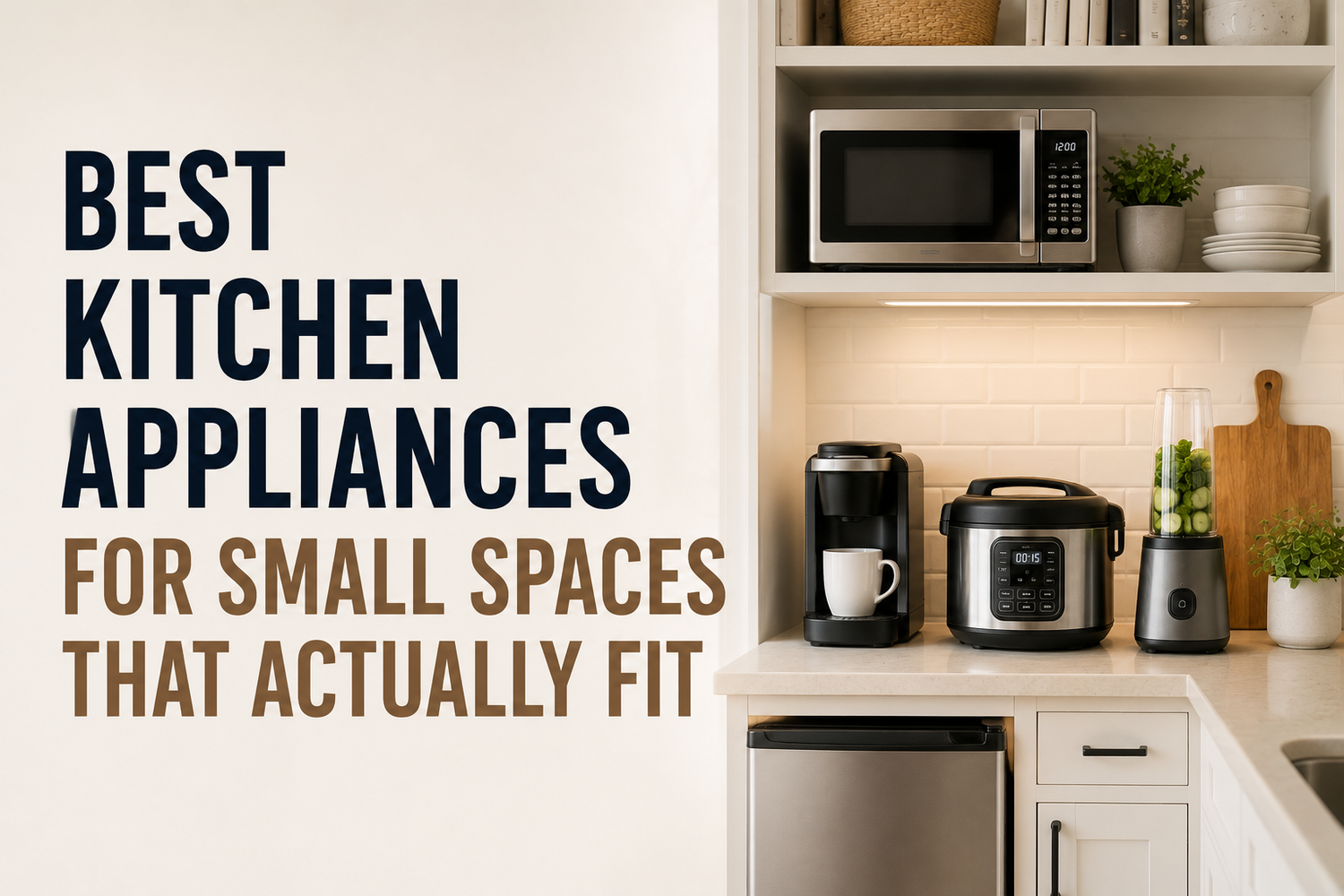
You're standing in a small kitchen with one free patch of counter, a sink that seems too close to everything, and a toaster, blender, and coffee maker all competing for the same square foot. Maybe you host often, maybe you cook every night, or maybe you're tired of moving appliances out of the way just to chop onions. The question isn't which gadget looks clever online, it's which one earns its footprint in a kitchen that already feels crowded.
Table of Contents
- Why Small Kitchens Deserve a Different Buying Mindset
- Measure Your Real Space Before You Browse Anything
- Multifunction Versus Single Purpose in a Tight Footprint
- Compact Appliance Categories Worth Knowing
- Energy, Durability, and the Filters That Matter
- Three Real Small-Kitchen Setups and What They Buy
- Layout and Storage Tricks That Make a Small Kitchen Feel Bigger
- Putting It All Together Into a Personal Shortlist
Why Small Kitchens Deserve a Different Buying Mindset
A tiny kitchen can fool you. A shiny appliance looks slim in a product photo, then it arrives on the counter and the prep space feels cut in half. The best kitchen appliances for small spaces are chosen the way you'd choose furniture for a room with hard limits, by measuring what fits and what still leaves room to cook.
A renter's kitchen makes that tradeoff even clearer. Fixed layouts, narrow counters, and storage that cannot be rearranged force every purchase to do real work. If cabinet space is tight, a second appliance often feels less like convenience and more like something you have to move around every day.
The common mistakes show up fast. Someone swaps a perfectly usable tool for a full-size version “just in case,” or they bring home overlapping gadgets, like a microwave, toaster oven, and air fryer, even though only one or two get used each week. The better filter is simple.
Practical rule: if an appliance does not save space, save steps, or replace another device you already own, it is probably taking up more than it gives back.
The key question is which appliance earns its footprint in a kitchen that already feels crowded.
For renters, hosts, and households with limited counter and cabinet space, the test changes by situation. A renter may need something that fits a fixed kitchen envelope and can be stored easily when it is off duty. A host may care more about a compact appliance that handles guests without overtaking the prep zone. A smaller household may want one machine that replaces two or three separate items, so the counter does not become a parking lot for gear.
That is also why a simple essentials list can be useful before you buy anything else. A reference like kitchen essentials list helps you spot duplicates before they stack up, and it keeps the focus on what belongs in the kitchen at all. The goal is not more gear. It is less friction.
Measure Your Real Space Before You Browse Anything
A small kitchen shopping trip should start with a tape measure, not a cart. Measure the usable counter width, the counter depth, the vertical clearance under upper cabinets, and the inside size of any cabinet or pantry that could store an appliance when it's off duty. The numbers on the box don't matter until you know the space they have to live in.

Map the envelope, not just the counter
Start with the counter stretch you cook on, the strip between the sink and the nearest wall usually tells the truth faster than any floorplan. Then check where a door opens, where a drawer slides, and whether a plug is too far back to use without a cord draping across prep space. In small kitchens, a few centimetres lost to a corner or outlet can change the whole shortlist.
Clearance matters just as much as footprint. Compact refrigerators still need breathing room, commonly about 10 cm at the sides, 15 cm at the rear, and 15 to 40 cm on top for airflow and safe operation (Best Buy). A “small” appliance that overheats or blocks a hinge isn't really small, it's badly sized.
That's also why a compact dishwasher guide like compact dishwasher Canada is worth reading before you buy, especially if you're deciding between under-counter and portable options. Installation envelope beats product marketing every time.
Make a one-page spec sheet
Write down the widest and deepest usable zones in your kitchen, then add the clearance the appliance needs to function, not just sit there. If a microwave, for example, will live under a cabinet, the door has to open without hitting the underside, and the body has to leave room for airflow. If a dishwasher door opens into a narrow aisle, the aisle width matters as much as the dishwasher itself.
A tiny measuring tool can help if you're checking ingredient portions, but it's not the star of the show here. Still, a device like the Mini Digital Pocket Scale 200g is the kind of compact tool that makes sense in the same mindset, because it's built for precision without taking over a drawer. That's the same logic you want from every appliance choice in a cramped kitchen.
Multifunction Versus Single Purpose in a Tight Footprint
A small kitchen punishes duplication. If two appliances solve nearly the same problem, the second one usually steals the space you need for chopping, plating, or turning around without bumping a handle. In a tight footprint, multi-function usually wins because one body can do the work of several separate machines.
One appliance, several jobs
A countertop convection oven that also air fries, toasts, bakes, and reheats can replace a toaster, a separate air fryer, and often some of the microwave's everyday reheating use. That leaves more open counter and fewer cords. Bosch's compact line shows the logic well, with 24 in wall ovens using European convection, an induction cooktop with an 11 in cooking zone with 3700 W, and an 18 in dishwasher with a third rack, RackMatic height adjustment, and AquaStop Plus leak protection (Bosch).
Here's the simplest filter. If two appliances overlap on most of what you'd use them for, one is probably enough. That doesn't mean every single-purpose tool is bad, though. It means the appliance has to justify the square inches it eats.
| Scenario | Multifunction Pick | Single-Purpose Alternative | Best Fit When |
|---|---|---|---|
| Daily reheating, toast, and small-batch baking | Countertop convection oven with air-fry function | Toaster plus air fryer plus compact oven | You cook quick meals and want one device to stay out on the counter |
| Fast weekday dinners in a narrow kitchen | Two-burner induction cooktop | Traditional full-width range | You need a flexible cooktop and can live without a large oven cavity |
| Cleanup in a rental apartment | 18 in dishwasher with adjustable racks | Countertop dishwashing unit plus hand-wash setup | You have under-counter space and wash dishes often |
When single purpose still earns its keep
Some tools are worth the footprint because the use case is constant. A stand mixer can make sense for someone who bakes every week, and a dedicated espresso machine may be the right call for a household that starts every morning the same way. The key is frequency, not novelty. If a tool works hard enough, it gets a pass.
For a quick comparison of hand and stand mixers, the basic trade-off is covered in hand mixer versus stand mixer. In a small kitchen, the winner is usually the one that does more than one job or the one you reach for every single day.
Compact Appliance Categories Worth Knowing
The first question in a small kitchen is not which appliance looks nicest, it is which category fits the room without crowding the work zones. A slim fridge, a drawer dishwasher, and a multi-cooker all save space in different ways, a bit like choosing between a narrow shelf, a pullout drawer, and a stackable bin. The right choice depends on whether you are trying to preserve counter width, cabinet depth, or both.

Categories that earn their place
Countertop convection ovens work well when a full wall oven would take too much room from the rest of the kitchen. They suit households that bake, roast, and reheat in one place, because one box can cover several repeat tasks. The trade-off is simple. They still need counter space and a nearby outlet, so a compact oven that fits the meal but blocks the prep area is not really saving you anything.
Slim refrigerators make sense in apartments and accessory dwelling units where a standard refrigerator would overwhelm the layout. For California renters, that matters because apartment-heavy housing often leaves little margin for wide appliances, and a narrower fridge can be the difference between useful storage and a cramped path through the kitchen (Consumer Reports). Capacity is the part that needs careful judgment, so grocery habits matter as much as measurements. A fridge that fits the opening but forces constant grocery runs is a poor match.
18 in dishwashers are one of the clearest space-for-comfort upgrades in a compact kitchen, especially when the sink area already feels crowded. An 18 in unit gives real cleanup help without taking the width of a standard model, so it works like a smaller folding table that still holds the meal. A drawer-style model can also fit well, but the right choice usually depends on how the cabinetry is arranged and how often dishes stack up after dinner.
Modular induction cooktops are a strong fit when you want precise heat control and want to keep the cabinet space below open for storage. They also pair well with a separate oven or combi unit, because they split cooking tasks across the kitchen instead of forcing everything into one bulky appliance. In a shallow kitchen, depth can matter as much as width, so a cooktop that leaves room to move around the edge of the counter can make the whole space feel easier to use.
Multi-cookers are worth a close look when storage space matters more than having a different machine for every job. They can pressure cook, slow cook, and handle rice without asking for three separate appliances, which makes them useful for households that want one base unit on the shelf and not a stack of gadgets. The limit is also clear. They cannot replace every crisp, browned, or oven-finished result, so they work best as a compact utility tool rather than a full replacement for every cooking style.
The useful filter here is: choose categories by the task you repeat, then pick the smallest version that still handles that task without making storage worse.
A guide like best microwave ovens Canada helps because a microwave is often a storage decision first and a cooking decision second. If it can mount on the wall, sit under a cabinet, or combine with another function, it stops competing with prep space. That is often the win in a tight kitchen, not the appliance itself but the square inches it leaves behind.
Energy, Durability, and the Filters That Matter
A small kitchen leaves little margin for waste. If an appliance runs hot, sounds harsh, or turns cleaning into a chore, you notice it quickly because there is nowhere for that friction to fade into the background. The buying filter should go beyond “Will it fit?” and include efficiency, durability, and serviceability.

Start with the energy question
Compact appliances often make sense because they heat less space and do one job with less excess. A toaster oven or air fryer can handle a small meal without warming a full-size oven, which saves heat, time, and a little patience in a cramped kitchen. California's appliance-efficiency policy has a long history, with the state updating appliance standards since the first Title 20 framework was established in the 1970s (Kitchaneers).
That logic matters in tighter homes and rentals, where the appliance should match the meal and the room, not overwhelm either one. A compact refrigerator or a right-sized cooking appliance can help keep operating costs in check because it is not working against a cavity that is much larger than the food it needs to handle.
Then check the durability signals
Look at the parts that get touched every day. A sealed induction surface is easier to wipe down than a cooktop with a lot of seams, and an appliance with a clear service path is less likely to become dead weight after a minor fault. Replacement parts, repair access, and a brand's local service network matter more when there is no spare corner for a backup unit.
If you are comparing cooking tools, use the mess test. A device that is easy to clean gets used more. A device that is awkward to maintain gets pushed to the back of the cabinet, where it becomes clutter instead of help. The same logic applies to air quality gear as well. A small kitchen can benefit from a device that stays out of the way and does its job without demanding extra attention, which is why a kitchen air purifier guide can be useful before you commit to a model.
Short checklist: does it fit the kitchen envelope, does it run efficiently for its size, and can someone service it where you live?
That last question is easy to ignore and expensive to learn the hard way. In a compact kitchen, a dead appliance does more than stop working. It can also block the only place left to prep dinner, dry dishes, or set down groceries. A small appliance that overheats or blocks a hinge is badly sized, even if the box says compact.
Three Real Small-Kitchen Setups and What They Buy
A useful shortlist starts with the room, then the routine. A studio renter, a short-term rental host, and a family cook may all be working in a small kitchen, but each one is asking the space to do a different job. The right appliance set follows that job first, then the brand or feature list.
The studio renter with one wall of counter
This setup needs discipline. A 24 in counter-depth refrigerator, a microwave-convection combo, an 18 in dishwasher, and a multi-cooker cover the basics without taking over the only prep zone. The multi-cooker can live on a shelf when it is not in use, which matters when the counter also serves as the landing spot for keys, mail, and groceries.
The buy here is less about choice and more about fit. If the kitchen is one straight run, every object on the counter has to earn its place twice, once as a tool and once as part of the room. A compact appliance that does several jobs usually makes more sense than several single-purpose devices that each claim a corner.
The short-term rental host
Here the goal is consistency. Guests need appliances that are easy to understand, easy to clean, and hard to break. A host might standardise on a compact fridge, a reliable countertop oven, and a simple cooktop, then keep extras locked away so the kitchen looks the same between stays.
Uniformity matters more than gadget appeal. A property manager does not want a different control layout in every unit or a crowded appliance lineup that leaves guests guessing how to make coffee or reheat food. The best set is the one that survives turnover and still looks orderly.
The family cook in a 90-square-foot galley
This layout is about movement. A slim induction cooktop, a drawer dishwasher, a countertop oven that doubles as an air fryer, and a stacked washer-dryer in a closet keep the working surfaces clear enough for actual meal prep. In a narrow galley, a door swing can matter as much as the appliance body, so every choice has to respect the aisle.
That household usually needs one rule above all others. Keep hot zones, wet zones, and storage from colliding. If the dishwasher opens into the only walking path, or the oven blocks the drawer next to it, the kitchen starts fighting back every time dinner begins.
A practical kitchen guide from GrifGlo can help households compare appliances and storage products together instead of treating them as separate decisions. That matters when the kitchen is so small that a shelf, cart, or appliance choice changes how the whole room functions.
Layout and Storage Tricks That Make a Small Kitchen Feel Bigger
The right appliance can't rescue a kitchen that wastes its own corners. A narrow room starts feeling larger when the tools move with the cook instead of against the cook. That usually means a few layout changes beat buying one more gadget.

Recover inches before you buy again
An appliance garage hides small gear without forcing it into a deep cabinet hunt. A slide-out shelf brings a heavy countertop appliance forward so you don't drag it across the counter. A slim rolling cart can park between the fridge and the wall, which turns dead space into storage without blocking the working aisle.
Wall-mounted magnetic strips and over-the-door organisers do the same kind of work for tools and sheet pans. They move flat, awkward items off the counter and into vertical space, where they're easier to grab and less likely to pile up.
Avoid the traps that make small kitchens worse
Open shelving looks airy until every mug, jar, and bowl starts collecting visual noise. Stackable storage can also backfire if it blocks a dishwasher door or makes a drawer impossible to open in one motion. In a small kitchen, storage that saves space on paper but adds friction in real use isn't a win.
Practical rule: if a storage trick makes you move three things to reach one thing, it's probably not helping.
That's why many cooks get more value from one layout change than from another appliance. Slide-out storage under a counter, a better home for sheet pans, or a wall rail for tools can free up enough room that the appliances you already own finally work the way they should.
Putting It All Together Into a Personal Shortlist
Start with the kitchen envelope. Measure the counter, cabinet, and clearance space, then decide whether the new appliance replaces something you already own or duplicates it. After that, use the multifunction test, check energy and durability, and only then compare brand features.
A good shortlist usually contains fewer items than you first expect. That's not a compromise, it's the point. The best kitchen appliances for small spaces are the ones that fit the room, earn their footprint, and leave you enough space to cook without fighting your own setup.
If you want help choosing appliances, storage helpers, and practical kitchen essentials without sifting through endless clutter, GrifGlo pulls the options into clearer categories and sizing guidance. Browse the guides there when you're ready to turn your measurements into a shortlist that fits your kitchen and your routine.


Laisser un commentaire
Ce site est protégé par hCaptcha, et la Politique de confidentialité et les Conditions de service de hCaptcha s’appliquent.