


You're halfway through an onion, your eyes are watering, and the board keeps skating toward the edge of a wet counter. You stop, dry your hands, wedge a damp towel underneath, and start again. That's the moment many cooks start looking at a cutting board with feet, not because it looks better, but because a board that moves makes simple prep feel harder than it should.
Table of Contents
- What a Cutting Board with Feet Is and Why It Matters
- How Feet Add Stability and Airflow for Drying
- Choosing Materials and Sizes That Hold Up
- Cleaning and Caring for the Underside and Feet
- Matching a Footed Board to Your Kitchen and Tasks
- Buying Guidance and Where GrifGlo Fits
- Your Next Step for Choosing a Footed Board
What a Cutting Board with Feet Is and Why It Matters
A lightweight board on a slick counter behaves like a plate on ice. Each downward cut pushes it a little further, so you're steering the board and guiding the knife at the same time. A footed board changes that setup by lifting the main surface on small raised supports instead of letting the whole underside sit flat.
Those supports might be low silicone pads, integrated bumps, short legs, or attachable feet. The shape matters less than what they do. They create contact points that grip the counter, raise the board out of shallow puddles, and leave space for your fingers when you lift it.
A Quick Way to Picture the Difference
Think of a flat board as a book placed directly on a damp sponge. It picks up moisture across its base and can slide as the surface underneath shifts. A footed board is closer to the same book resting on four small bottle caps. Less of the base touches the wet area, and you can see underneath more easily.
That picture also reveals the trade-off. Bottle caps have edges and hollows that collect crumbs. Feet can do the same if they're poorly sealed or hard to clean.
- Stability question: Do the feet keep the board steady for your usual chopping, slicing, and carving?
- Material question: Will the surface and the feet hold up to knives, water, and repeated washing?
- Hygiene question: Can you clean the underside, seams, and attachment points as easily as the top?
If you're still deciding between surface materials, the comparison of wood and plastic cutting boards gives useful background before you focus on feet. For home cooks, renters, and small kitchen teams, a footed design matters most when it solves movement and drying without adding hidden cleaning work. A board that's stable on top but grimy underneath hasn't really solved your problem.
How Feet Add Stability and Airflow for Drying
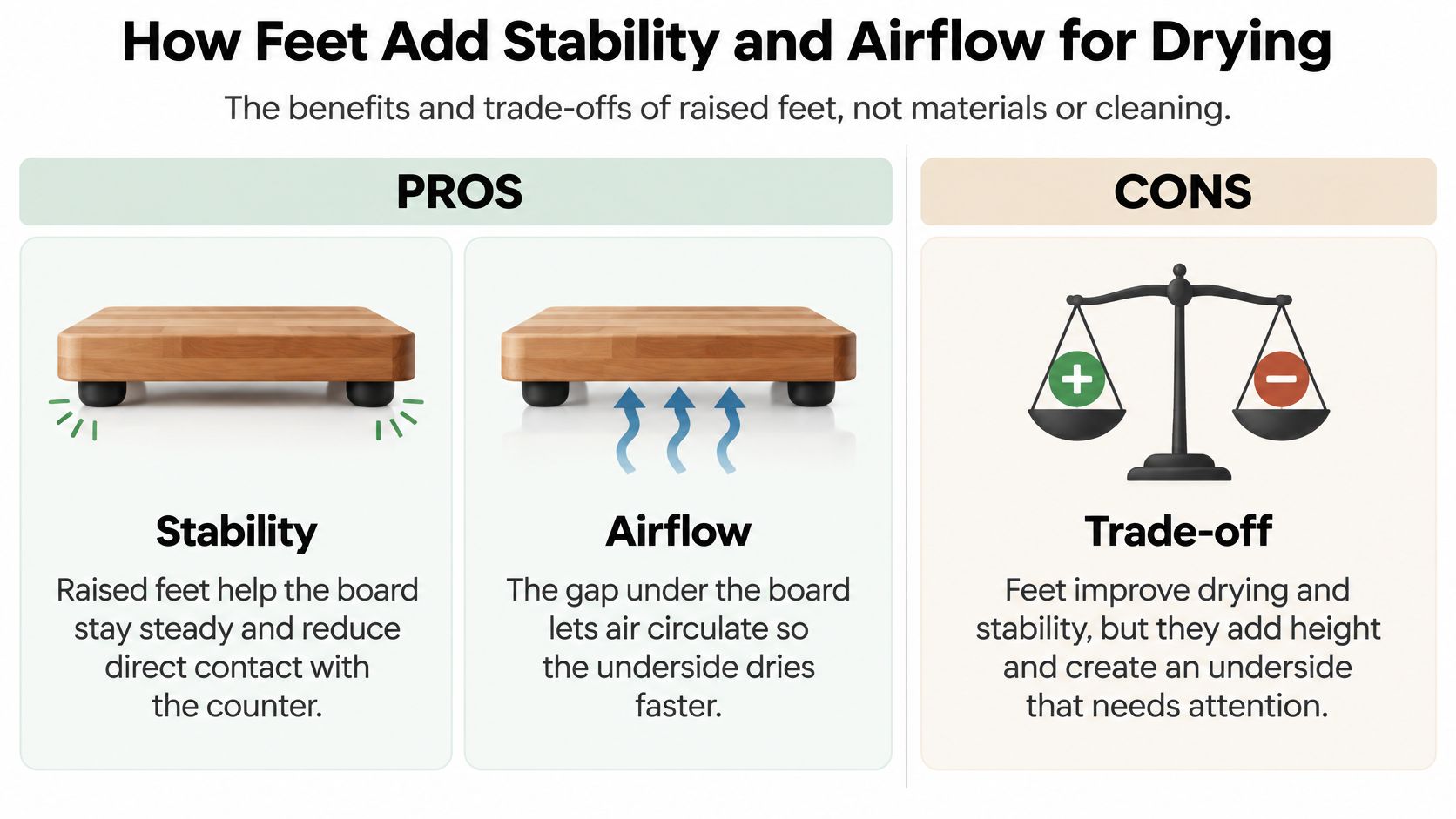
Feet do two different jobs, and keeping them separate helps you judge a board. Stability is what happens while you cut. Airflow is what happens after you wash the board and set it down.
Under a knife, a flat board spreads contact across the whole counter. On a dry, even surface that holds fine, but water, flour, or vegetable juice can turn that broad contact into a sliding layer. Feet concentrate contact at a few grippy points, so the board is less likely to drift while you chop herbs, break down a squash, or carve with steady pressure.
The stability benefit depends on the feet. Tiny hard feet can skitter on polished stone, and tall narrow legs can wobble on an uneven counter. Wider, low-profile feet usually feel calmer during forceful chopping because they resist both sliding and tipping.
A stable board should stay put without rocking. If you have to hold it down with your guide hand, the feet aren't doing their job.
Why the Gap Underneath Helps Drying
Set a wet flat board on the counter and a thin film of water gets trapped underneath. The board works like a sealed lid on a damp pot: the top looks finished while the base stays wet.
Feet lift the board so air circulates and water drains away instead of sitting against the base. The gap also turns the underside into something you can check at a glance rather than a hidden surface where chicken juice or beet stain spreads unnoticed. California food equipment requirements allow a raised board to separate the food-contact surface from the countertop, provided the feet leave no hard-to-clean gaps.
What the Gap Costs You and What to Check
- What improves: less direct contact with puddles, easier lifting, better underside visibility, and more even drying.
- What needs a closer look: sealed seams where feet meet the board, drainage space under the base, and any hollows or screw recesses that can hold rinse water.
- What depends on design: grip on your counter material, drawer clearance for the added height, and whether the feet stay tight after repeated washing.
Light produce prep gains convenience. Heavy chopping and carving gain control, but only if the feet are sturdy and don't flex under pressure. Serving can also benefit because raised boards are easier to pick up, though tall legs may feel less secure when carried loaded.
Choosing Materials and Sizes That Hold Up
Material choice decides how a footed board ages. A surface that looks smooth in a product photo can become scored, cracked, or absorbent after months of knives and washing. The feet age too, and they're often the first part to loosen or trap residue.
Start with the cutting surface. You want it smooth, durable, and intact, without open seams or deep grooves you can't scrub clean. California law specifically permits hard maple or an equivalently hard, close-grained wood for cutting boards, and the California Retail Food Code points shoppers toward sealed, nonporous feet with no hollow cavities, peeling pads, or unsealed fasteners.
Material and Feet Choices for Footed Boards
| Feature | Better Choice | Watch Out For |
|---|---|---|
| Wood surface | Hard maple or similarly hard, close-grained wood | Soft or decorative wood that dents and scores quickly |
| Foot material | Nonporous, corrosion-resistant feet | Porous rubber, exposed fabric, or peeling adhesive pads |
| Attachment | Sealed or integrated joins you can inspect | Open screw recesses and gaps that hold moisture |
| Surface condition | Smooth and free of cracks | Deep scoring, pits, and crevices |
| Cleaning fit | Tolerates your normal washing routine | Feet that loosen, absorb water, or block drainage |
Hard maple suits cooks who want a substantial board and will hand wash and dry it carefully. If you're comparing species and grain, common cutting board wood types helps explain why hardness and close grain matter. Nonporous plastic and paper-composite styles can suit cooks who prioritise easier washing, but you still need to check scoring and foot attachments rather than assuming the material solves everything.
Sizing by the Job in Front of You
A 20 x 30 cm board suits a single task, such as slicing fruit, trimming herbs, or preparing a sandwich on a small counter. It's easier to lift, wash, and store, which matters in a rental or shared kitchen. The limit shows up quickly when ingredients pile up and start falling off the edges.
A 28 x 38 cm board gives more working room for a pile of potatoes, a whole chicken, or batch prep with separate ingredient piles. The larger footprint can feel steadier, but it also needs sink space for washing and storage space that accommodates the added height of the feet.
Don't buy size based on counter space alone. Check the drawer, cupboard, drying rack, and sink as one system. A board that fits the counter but can't be washed comfortably will annoy you every day.
Cleaning and Caring for the Underside and Feet
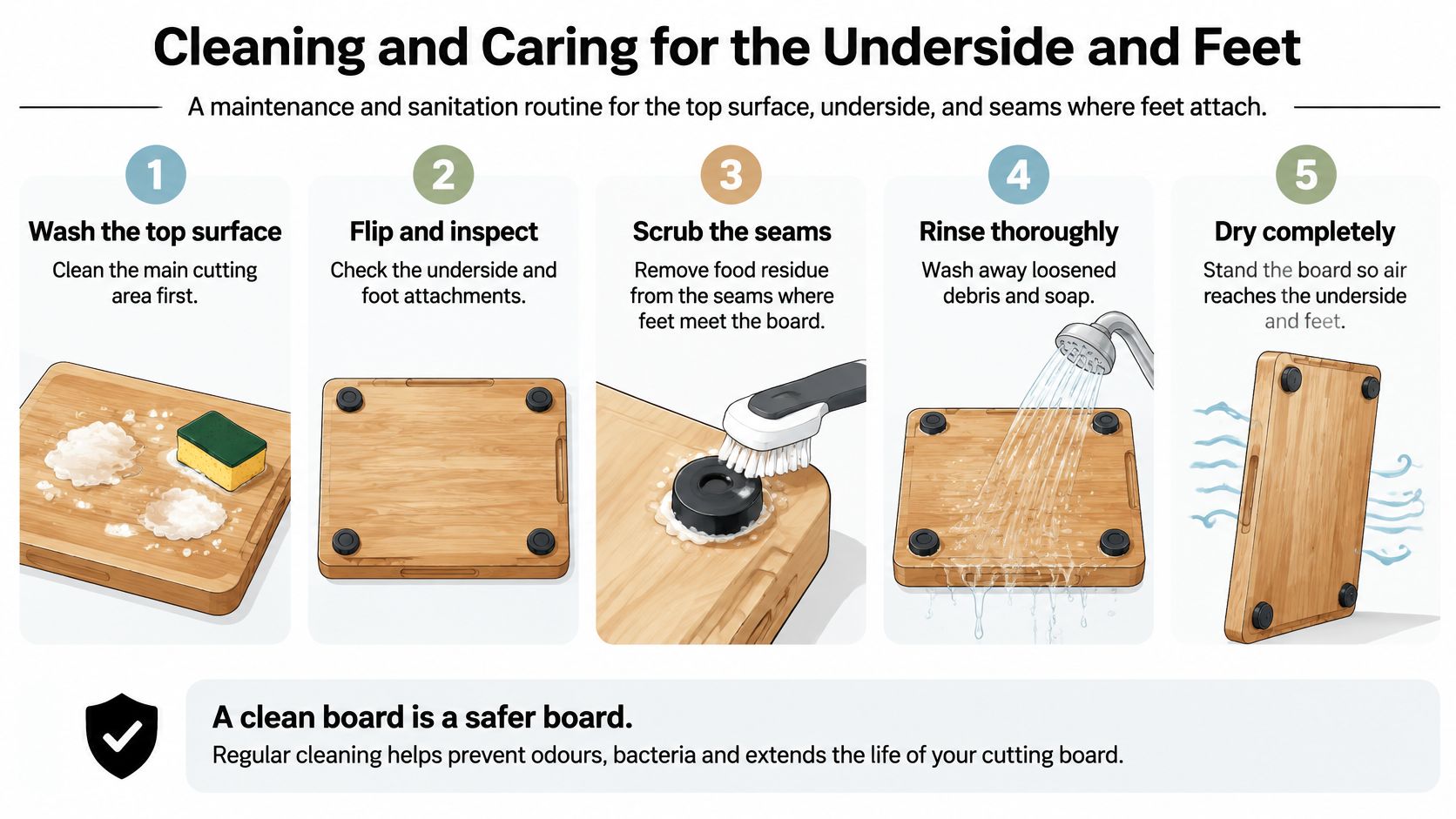
Clean a footed board as if it has three zones, not one. The top catches knife work, the underside can pick up counter moisture, and the seams where feet attach can collect juice and crumbs. If you only scrub the top, you're doing part of the job.
Wash the main surface first with hot soapy water and a brush or sponge that reaches into knife marks. Rinse it, then flip the board over and look before you scrub. That inspection step sounds obvious, but it's where you'll spot a loosening pad, a dark seam, or food residue hiding beside a foot.
A Routine You Can Repeat Without Thinking
- Wash the top surface: Scrub away food and juice before it dries into the cuts.
- Flip and inspect: Check each foot, seam, and fastener area under good light.
- Scrub the seams: Use a small brush where the foot meets the board.
- Rinse thoroughly: Remove soap and loosened debris from both sides.
- Dry completely: Stand or rest the board so air reaches the underside and feet.
Feet don't replace sanitizing. California rules require food-contact surfaces to be cleaned and sanitized before switching between raw animal foods and before moving from raw to ready-to-eat foods, and at least every four hours with potentially hazardous food, with manual options including chlorine at 100 ppm for at least 30 seconds or hot water at 171°F or above for at least 30 seconds, as set out in California's cleaning and sanitizing section.
Those benchmarks are written for food operations, but the home lesson is clear. Sanitize after raw meat or poultry and before ready-to-eat foods, and don't let a raised design create false confidence. The whole board, feet included, must tolerate your cleaning method without loosening, absorbing sanitizer, or preventing drainage.
Replacement trigger: Deep scoring, cracks, peeling pads, or damaged feet mean the board may no longer clean effectively, even if it still feels stable.
For wood care beyond daily washing, wood cutting board maintenance guidance covers the longer-term habits. At home, keep the board dry between uses and inspect the underside after cleaning. If scoring becomes deep enough to prevent effective sanitation, resurface it where appropriate or retire it.
Matching a Footed Board to Your Kitchen and Tasks
A board that grips a dry laminate counter can skate across polished stone once rinse water gets underneath. Moisture changes grip, an uneven rental counter changes balance, and forceful chopping tests whether the feet flex or compress. Match the board to the surface and the cook, not just to the ingredient.
Low-profile silicone feet are a sensible default for everyday slicing because they add grip without much height. Suction-style feet work like a board set on a clean plate: they hold firmly on smooth, dry counters. On a textured or flour-dusted worktop they behave more like a board resting on a sponge, losing their seal wherever dust and grain break contact. Raised legs give more finger clearance and airflow, yet they take more storage room and can feel less steady under heavy chopping.
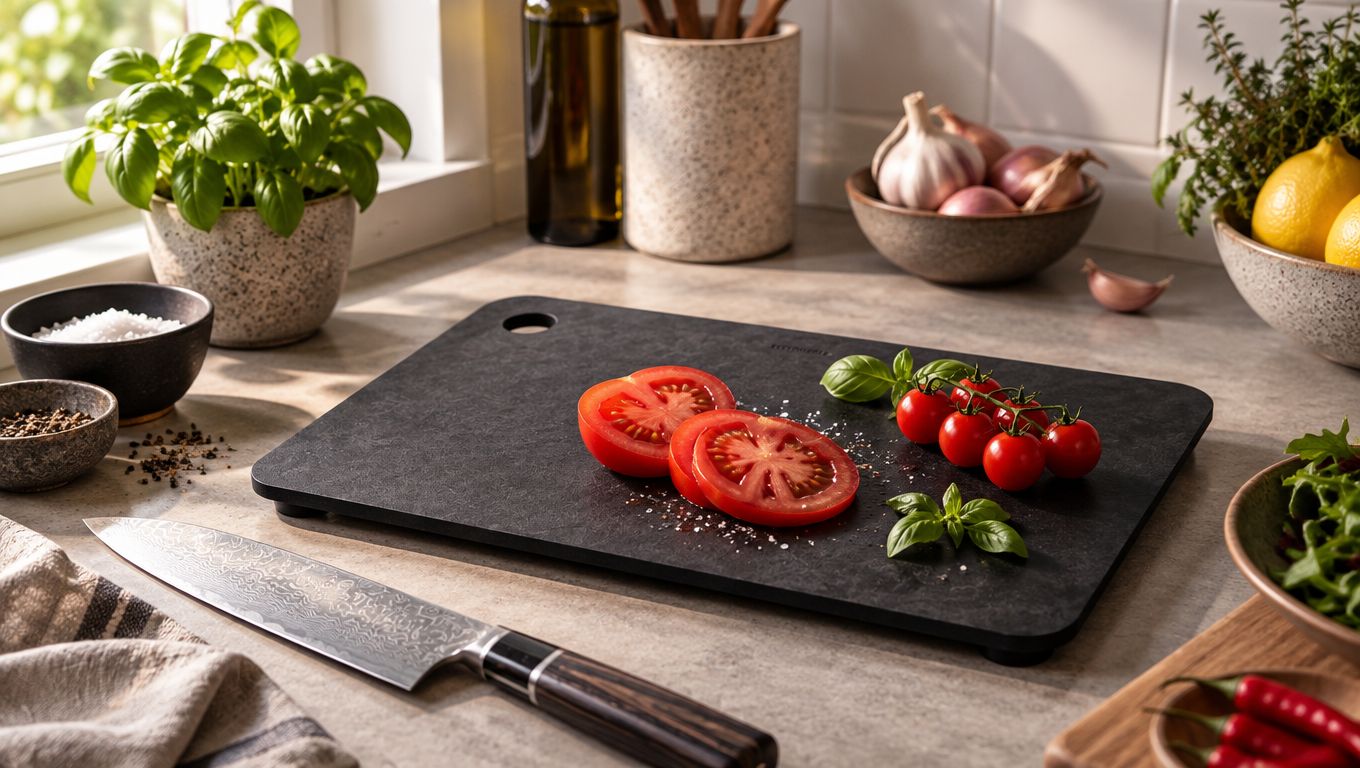
A compact example from the catalogue is the Combekk Recycled Paper Cutting Board 20x30 cm, a 20 x 30 cm board listed at 73 and in stock. Its footprint makes it a useful reference point for a single-task board in a small kitchen, whether or not your final choice has feet. Check the product page for care instructions before you put it in the dishwasher. When comparing footprints, practical cutting board dimensions can help you avoid buying a board that overwhelms your sink or drawer.
Questions That Reveal the Fit
- Can you lift it safely: Can you pick it up with wet hands or limited grip strength without touching a contaminated underside?
- Can you store it easily: Does the added height fit your drawer, rack, or cupboard?
- Can you wash it fully: Does it fit in the sink and drain without hidden pockets?
- Do the feet suit your counter: Will soft pads grip your surface, or does the style you want depend on a smooth, dry seal you cannot guarantee?
Canadian guidance also recommends replacing boards that are worn or hard to clean, and that is a fit question as much as a cleaning one. An underside you cannot inspect closely is an underside you cannot judge, so the foot design itself becomes part of the answer. BC food safety guidance supports checking whether a board can be lifted without touching a contaminated underside and washed and dried completely. For renters, that may favour a lighter, lower board. For a small team standardising boards by use, easy inspection matters more than a decorative raised profile.
Buying Guidance and Where GrifGlo Fits
A footed board works like a plate lifted above a wet sponge: the air gap helps only when the feet and joints stay dry enough to clean.
Judge the base before the top, because seams, fasteners, pads, and drainage decide the work after dinner.
Open the product photos and look for a close-up of the base. If no underside image exists, ask the seller for one before you buy. While you are there, check whether the feet are integrated, glued, screwed, removable, or sealed, and whether a brush can reach around each one.
A Short Buying Checklist
- Replaceable feet: Confirm whether the feet can be replaced and whether the replacement is sold separately.
- Solid foot material: Choose nonporous, corrosion-resistant feet that do not peel or feel spongy.
- No hidden cavities: Avoid hollow feet and loose caps that can hold wash water.
- Secure under pressure: Check that feet do not twist, rock, or compress unevenly.
- Cleaning compatibility: Confirm dishwasher suitability from the product page rather than guessing.
- Drying position: Make sure the board can drain and dry with air reaching the base.
A hidden base is a gamble on the part most likely to trap moisture. If meat prep drives the purchase, apply the same underside checks while comparing cutting boards suited to meat preparation. Health Canada's food safety tips treat worn, cracked, or hard-to-clean boards as replacement candidates, so access for cleaning and a path to new feet both matter.
GrifGlo's category pages list boards side by side, so you can compare feet and sizes before you open each retailer. Use the guides to mark which listings show the base, name the foot material, state cleaning limits, and explain spare parts, then click through only the ones that answer those points. The platform routes shoppers to third-party retailers, and some links may earn commissions at no extra cost; it also supports bulk and structured purchasing for organisations that need the same board and the same cleaning routine across sites.
Buy the board you can clean on your busiest night, the one that still drains when the sink is full and the counter is crowded.
Your Next Step for Choosing a Footed Board
Take two boards with the same footprint and compare the foot material, the seam depth, and the drying angle on your own counter. The one that drains better and shows no gaps at the feet is the stronger buy. A listing that leaves the underside unclear is a listing to skip.
Weigh the finalists against your routine. A cook working in a small kitchen may prefer a lower, lighter board, while someone in a shared household may value quick washing and easy storage. A hospitality team may need several boards and a routine everyone can follow.
Once the board is home, treat the feet as a maintenance checkpoint. After the first three washes, inspect each foot and note any movement. A foot that rocks after a few weeks is the signal to replace the board, not to tighten a screw.
Choose the board that stays steady, drains completely, and can be sanitized after a raw-meat dinner.
Visit GrifGlo to browse its cutting board category, compare sizes and materials with clear buying guides, and check the underside details before you choose. Bring your counter measurements and your inspection checklist, then pick the footed board that fits the way you cook.


Laisser un commentaire
Ce site est protégé par hCaptcha, et la Politique de confidentialité et les Conditions de service de hCaptcha s’appliquent.