

You're standing in the kitchen with a dulling chef's knife, a board that rocks slightly on the counter, and a faint onion smell that never quite left after last night's prep. Wear and tear often gets blamed. But the issue starts earlier, with the wood itself.
A cutting board isn't just a flat surface. It's the place where your knife edge lands over and over, where moisture sits, where food residue can hide, and where small design choices affect cleaning, maintenance, and how confident you feel using it every day. That's why cutting board wood types matter more than many home cooks realise.
Table of Contents
- Introduction to Cutting Board Wood Types and Why They Matter
- How Wood Hardness Porosity and Grain Affect Your Board
- Most Common Cutting Board Wood Types Compared
- Why Board Construction Matters More Than Species Alone
- Food Safety Cleaning and Compliance for Wood Boards
- Choosing the Right Wood Board for Your Kitchen Needs
- Caring for Your Wood Cutting Board So It Lasts for Years
Introduction to Cutting Board Wood Types and Why They Matter
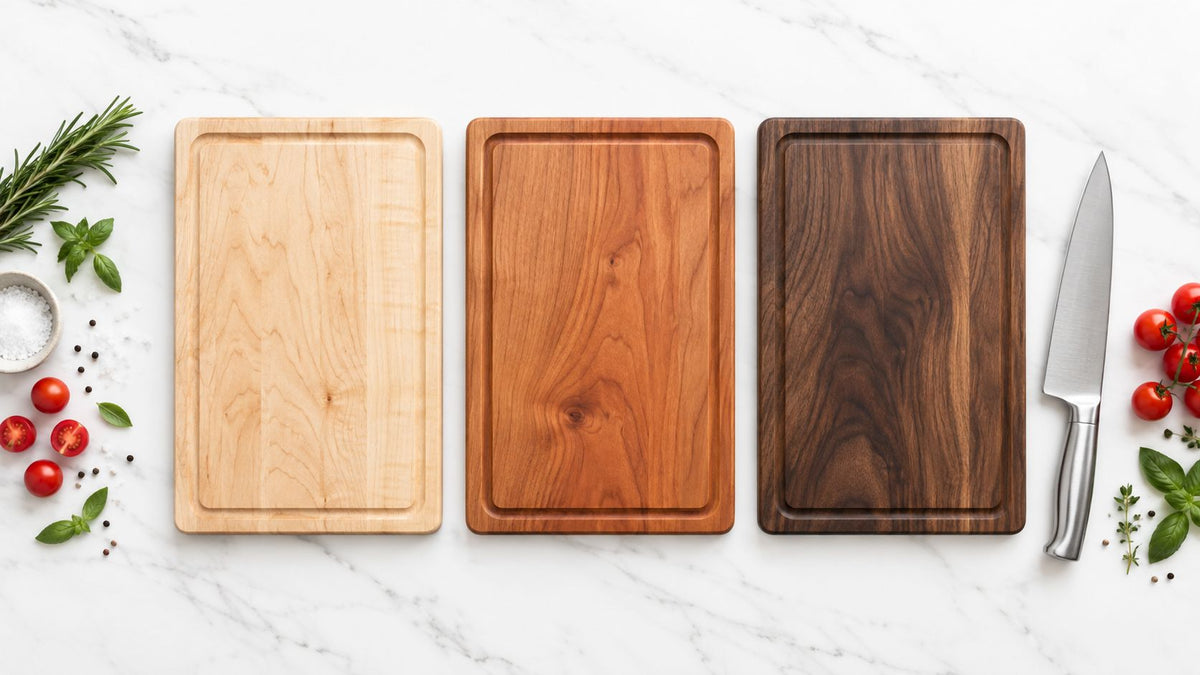
A lot of people shop for a board the same way they shop for a serving tray. They notice colour first. A pale maple board looks clean. A dark walnut board looks warm. Cherry feels classic. Then the board gets home, and the practical questions start.
Does it scar too quickly? Does it feel rough after washing? Is it hard on knives? Does it need constant care?
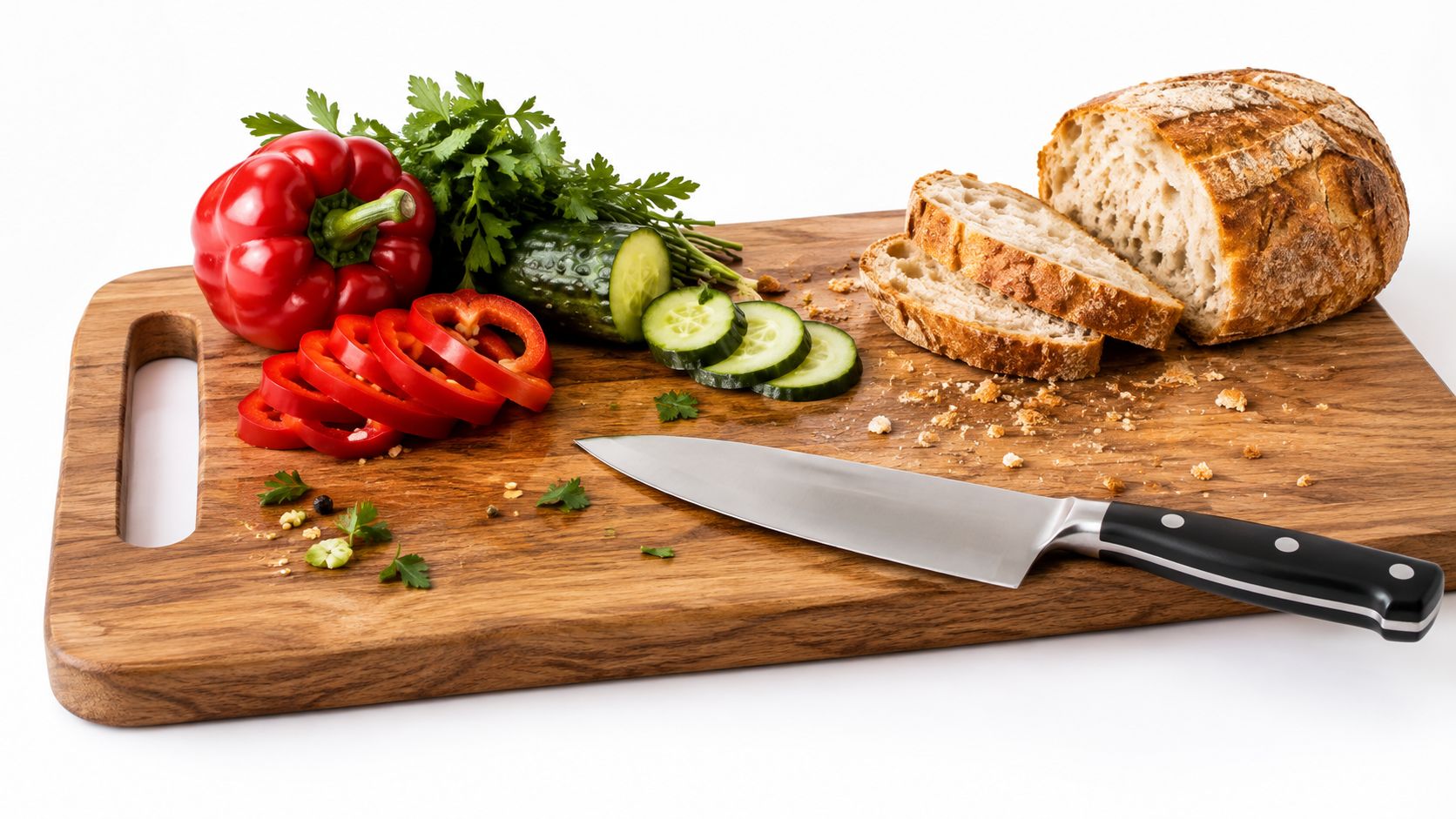
Those frustrations usually come down to four things: hardness, porosity, grain structure, and construction. Species matters, but not in the simple way many buying guides suggest. “Maple versus walnut” isn't the full question. A better question is this: how hard is the wood, how tightly packed is its grain, how is the board built, and how will you use it?
The wrong wood creates daily annoyances
Think of two very different boards. One is made from a dense, close-grained hardwood. It resists deep scoring, cleans up well, and stays dependable if you care for it properly. The other is softer or more porous. It picks up marks faster, can hold onto stains and odours more easily, and may become harder to keep in good condition.
That doesn't mean every dark board is bad or every light board is good. It means looks don't tell you enough.
Kitchen rule: A good cutting board should protect your knife, stay stable during prep, and still be easy to clean when you're tired and in a hurry.
What home cooks often overlook
Many readers get stuck on species names because that's what product listings highlight. But cooks usually live with the consequences of structure, not just species label. Dense, close-grained hardwoods tend to be easier to defend as everyday prep surfaces. Boards built with the right grain orientation can also wear very differently over time.
That's especially useful if you cook often, host regularly, share a kitchen, or want one board that feels reliable instead of fussy. The smart way to compare cutting board wood types is to start with performance, then move to appearance. That approach makes shopping simpler and usually leads to a board you'll keep using rather than replacing.
How Wood Hardness Porosity and Grain Affect Your Board
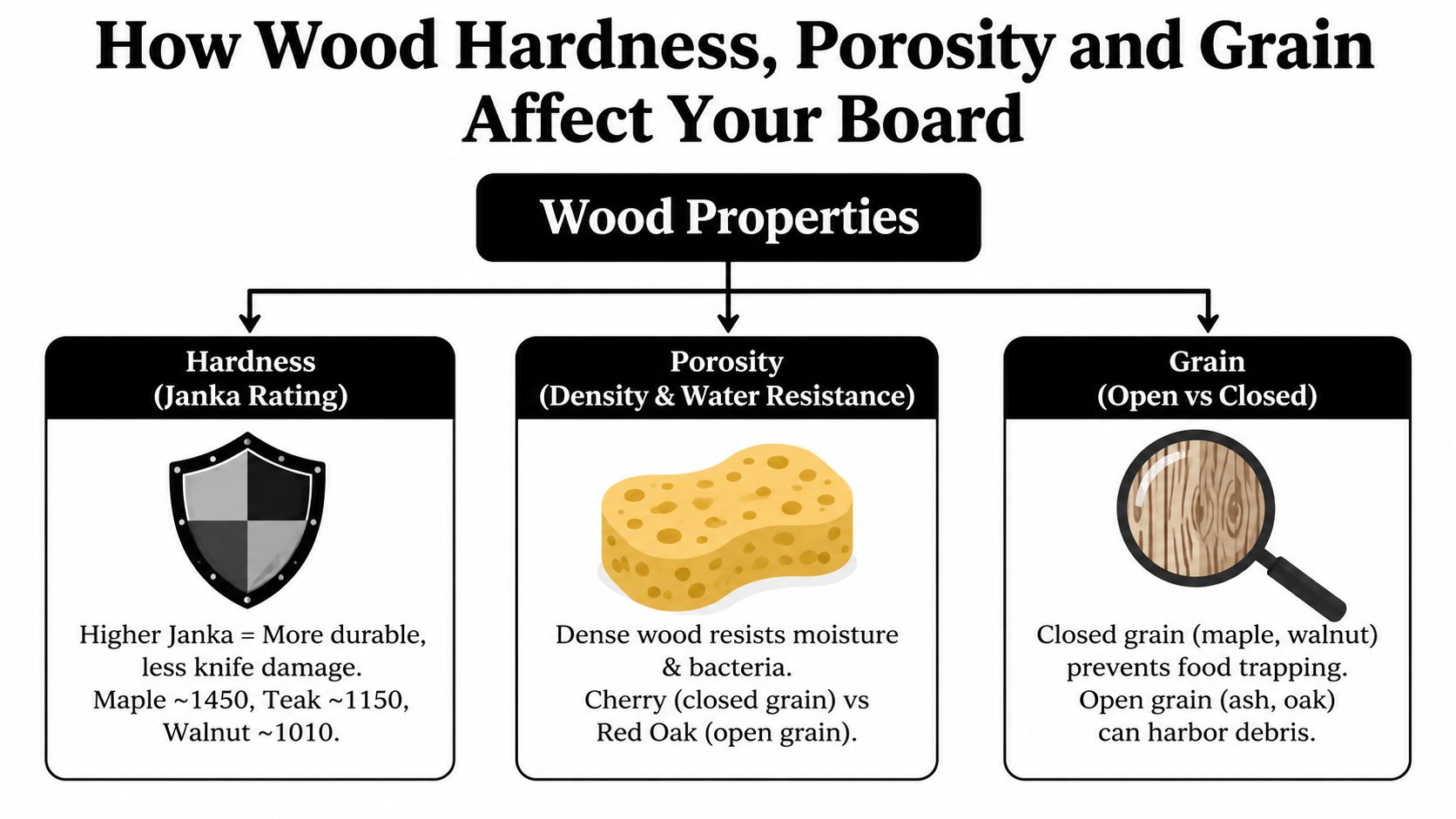
If you want to understand cutting board wood types, start with the three properties that decide most of the day-to-day experience: hardness, porosity, and grain. These are the reasons one board feels steady and long-lasting while another feels tired after a short stretch of use.
Hardness decides how the surface takes wear
Hardness is often discussed using the Janka scale. You don't need to memorise the science behind it. In kitchen terms, it tells you how resistant a wood is to denting and scoring.
In supplier guidance for cutting boards, Canadian hard maple is about 1,450 lbf, black walnut about 1,010 lbf, and cherry about 950 lbf according to Windsor Plywood's cutting board hardwood guide. That matters because a harder board usually resists visible knife damage better, while still being suitable for frequent prep.
A useful way to picture this is to think about flooring. A very soft floor shows every dropped chair leg. A very hard floor hides wear better. Boards behave similarly, except they also interact with your knife edge.
Porosity affects moisture and cleanup
Porosity is about how easily a material takes in moisture, staining, and residue. A porous board can act a bit like a sponge. A denser board behaves more like tightly woven fabric. Both may get wet, but one is easier to clean and dry thoroughly.
That's why close-grained hardwoods get so much attention. Their tighter structure makes them a more practical surface for repeated washing and sanitising. For many households, that translates into less stress over garlic odour, beet stains, or rough patches left by repeated chopping.
If you're also comparing construction styles, this guide on end-grain cutting board design helps show how the wood's orientation changes wear patterns beyond species alone.
Grain tells you what the surface can hide
Grain structure is where readers often get confused. “Grain” can mean visual pattern, but for performance, it's better to think of it as how open or closed the wood's surface is.
- Closed or close-grained wood tends to trap less residue at the surface.
- Open-grained wood can create more places for food particles and moisture to settle.
- Visible grain pattern doesn't always tell you enough on its own, because construction also changes how the surface behaves.
A board isn't safer or better because it looks smooth in a product photo. It matters whether the wood is dense and close-grained where your knife actually lands.
Material alternatives can make sense too
Some shoppers don't want solid wood maintenance at all. That's a separate decision, and it's a fair one. For example, the Combekk Recycled Paper Cutting Board 20x30 cm is listed as a cutting board made from 100% recycled paper, and the catalogue snapshot describes it as knife-friendly and dishwasher-safe. That kind of option suits buyers who care more about easy care and less about traditional hardwood feel.
For a wood board, though, the basic lesson stays the same. Choose a surface that is hard enough to resist damage, close-grained enough to clean well, and built for the way you cook.
Most Common Cutting Board Wood Types Compared
Most shopping lists start with maple, walnut, and cherry. That's a useful starting point, but it helps to widen the view. Some woods are popular because they look beautiful. Some because they're durable. Some because they're widely available. The trick is knowing which traits matter in a prep-heavy kitchen and which matter more for light use or serving.
Common cutting board woods at a glance
| Wood Species | Janka Hardness | Grain and Porosity | Best For |
|---|---|---|---|
| Hard maple | About 1,450 lbf | Close-grained and dense | Daily chopping, general-purpose prep |
| Black walnut | About 1,010 lbf | Commonly treated as suitable and moderately durable | Cooks who want a darker board and gentler feel |
| Cherry | About 950 lbf | Commonly chosen for a smoother everyday prep surface | Light to moderate prep and serving crossover |
| Beech | Not specified here | Included in practical food-board guidance alongside maple and yellow birch | Buyers looking for a hardwood option in the same practical class |
| Yellow birch | Not specified here | Included in the same practical food-board standard discussion | Everyday prep when well made |
| Acacia | Not specified here | Varies by product and source | Budget-conscious shoppers who inspect build quality carefully |
| Teak | Not specified here | Often chosen for a distinctive look and different maintenance profile | Buyers prioritising appearance and moisture tolerance |
| Oak | Not specified here | Often discussed cautiously because grain openness can be a concern | Better evaluated case by case, not as a default first choice |
Maple remains the benchmark
California law is unusually specific here. The state's retail food code generally bars wood as a food-contact surface, but it allows hard maple or an equivalently hard, close-grained wood for cutting boards, with cedar separately allowed for grilling or baking seafood on planks, as stated in California Health and Safety Code section 114132. That legal wording matters because it frames wood choice as a durability and grain requirement, not just a style preference.
For home cooks, that gives maple a special role. It isn't just popular. It's the named benchmark.
Walnut and cherry are attractive, but they play slightly different roles
Walnut is often chosen by cooks who want a darker surface and a board that looks at home on the counter. Cherry appeals to people who want warmth without going very dark. Both can be sensible choices, but the hardness figures above show why maple is often favoured for frequent prep.
That doesn't mean walnut or cherry are wrong. It means they may suit different priorities. If visual style matters almost as much as chopping endurance, they can still make a lot of sense.
If you cook every day, durability usually matters more than colour. If you entertain often, appearance may deserve more weight.
Woods people ask about beyond the usual three
Beech and yellow birch don't always get top billing in mainstream buying guides, yet one practical guide argues that hard maple, beech, and yellow birch fit the same food-board standard better than many species shoppers ask about, and that board construction can matter more than species alone in predicting wear, as discussed in this analysis of wood choice, hardness, and end grain.
Acacia and teak need a more cautious, product-by-product view. Many people buy them because they're easy to find and visually appealing. The challenge is consistency. Build quality, finish, and grain structure matter a great deal.
If you're weighing wood against faster-care materials, this comparison of bamboo versus wood cutting boards can help clarify what changes when you move away from traditional hardwoods.
Why Board Construction Matters More Than Species Alone
A maple board and a walnut board can behave more similarly than you'd expect if they share the same construction. That surprises shoppers because species names dominate most listings. In practice, how the wood is arranged often has a larger effect on visible wear, knife feel, and longevity.
End-grain, edge-grain, and face-grain behave differently
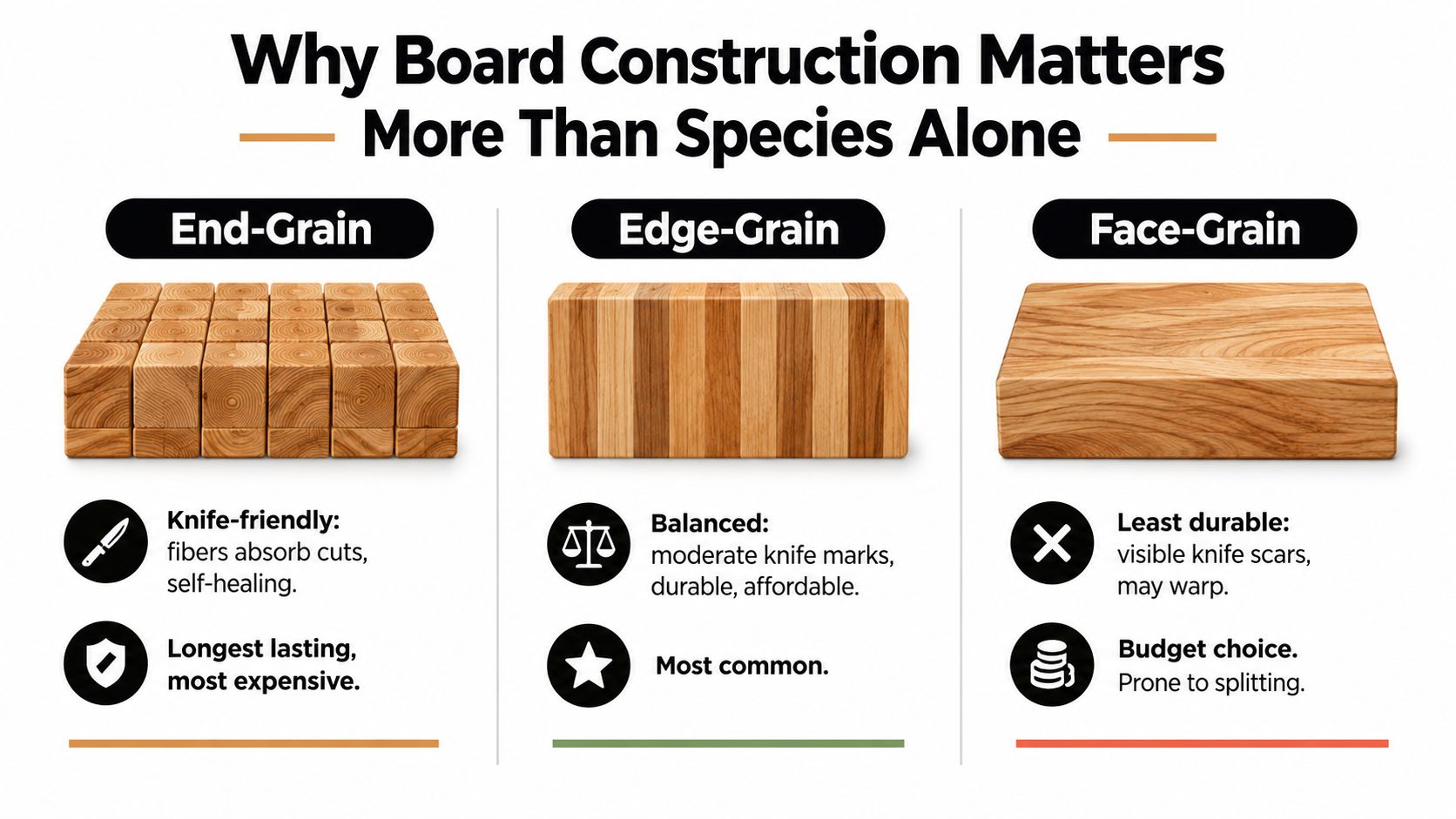
End-grain boards show the ends of the wood fibres on the cutting surface. Edge-grain boards place long strips side by side. Face-grain boards show the broad face of the board.
A recent guide makes the key point clearly: end-grain versus edge-grain changes durability more than walnut-versus-maple on its own, which is why species-only advice often leaves buyers with an incomplete picture. That same source also notes growing interest in thermoform wood-fibre composite boards that are lightweight, dishwasher-safe, and more heat-resistant than most plastic boards, signalling that many shoppers now compare construction and material format alongside wood species.
What each construction style feels like in use
- End-grain boards are often preferred by serious cooks because the surface tends to show wear differently and can feel friendlier under the knife.
- Edge-grain boards usually offer the most practical balance for home kitchens. They're common, versatile, and easier to shop for.
- Face-grain boards can look striking, but they're often better suited to serving or lighter prep than heavy chopping.
This quick visual makes the differences easier to spot:
Construction changes the buying decision
If you've ever wondered why one board develops obvious scars quickly while another seems to age more gracefully, construction is often the answer. That's why a well-made edge-grain maple board may be a better everyday buy than a more exotic species built in a less practical format.
Construction also opens the door to non-traditional materials. Some cooks want the feel of a board that's still knife-friendly, but they don't want to oil wood or hand wash every time. In that case, wood-fibre or recycled-paper style boards can be worth considering. The main point is simple: don't let species name crowd out build style. The board's structure affects daily use just as much.
Food Safety Cleaning and Compliance for Wood Boards
Raw chicken on one side of the sink, salad vegetables on the other, dinner moving fast. That is the moment when cutting board safety is decided. The main question is not whether a board is maple or walnut. It is whether the board's surface is still easy to clean, whether you keep food tasks separate, and whether your cleaning routine matches what touched the board.
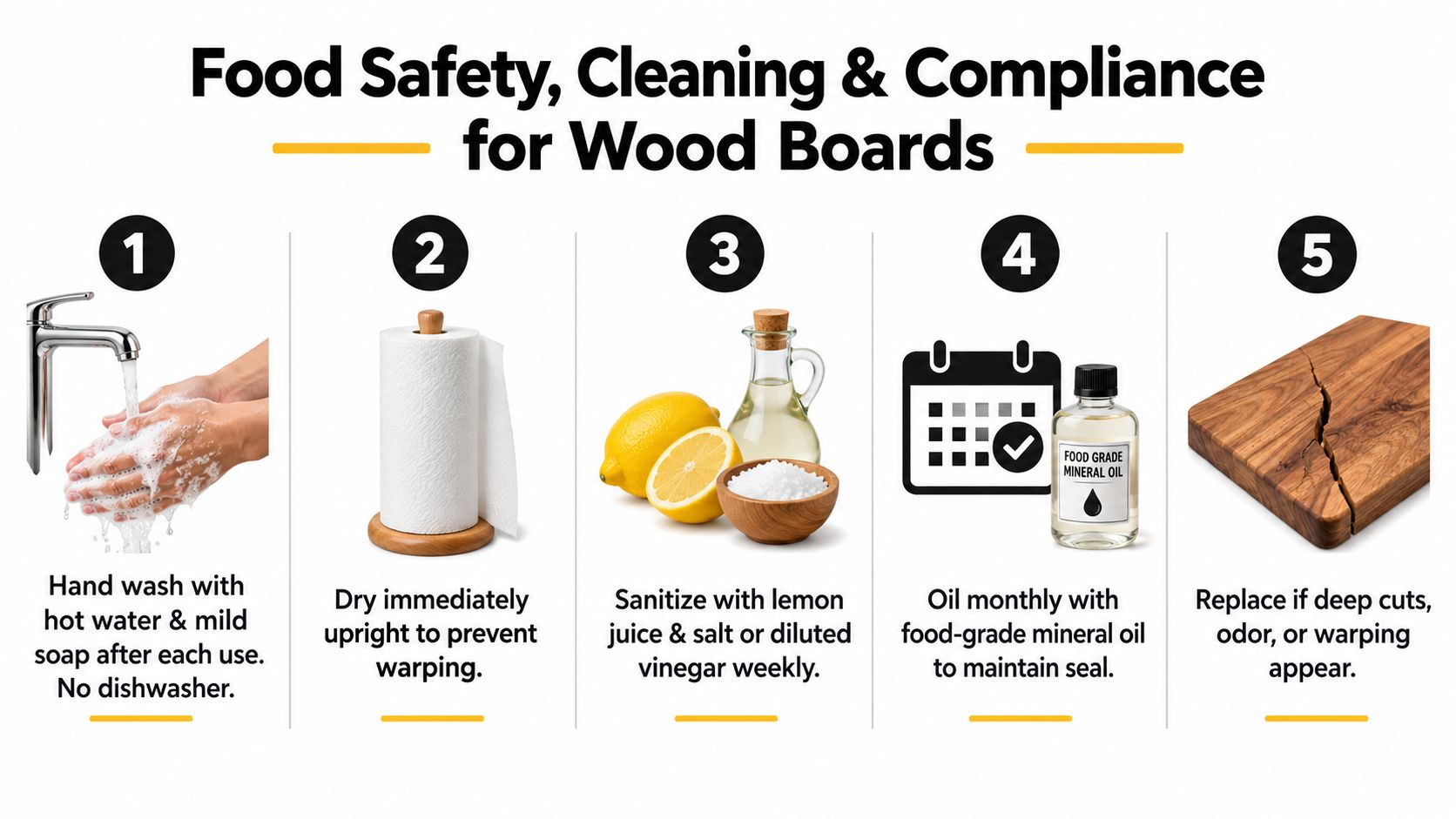
Separate boards by food type
Wood safety starts with workflow. A board works like a countertop work zone. If raw poultry and ready-to-eat produce share that zone without proper washing in between, the risk comes from cross-contact during prep.
The University of California Agriculture and Natural Resources advises using separate cutting boards for different food categories, washing boards before and after food preparation, and, when possible, keeping one board for fruits and vegetables and another for meat, poultry, and fish, as outlined in this UC food-safety guide.
That advice fits the way home kitchens function. During a rushed meal, a second board often protects you more than a more expensive wood species.
Cleaning and sanitising the board you actually own
Hardness and grain structure affect food safety because they affect condition over time. Dense, close-grained hardwoods are usually easier to keep in good shape. Deep knife scars, raised grain, and warping create more places for moisture and residue to hang around. A smooth board is easier to wash well, just as a smooth pan is easier to wipe clean than a scratched one.
A simple routine keeps the board serviceable:
- Wash with soap and hot water after use.
- Use separate prep surfaces for raw proteins and ready-to-eat foods.
- Sanitise after high-risk tasks such as preparing raw meat, poultry, or fish.
- Dry the board fully on edge or in an area with airflow.
For wood boards, sanitising methods need to be effective without soaking the board. The UC guidance above recommends a 20-second boiling-water treatment or a bleach solution made with 1 teaspoon of chlorine bleach per 1 quart, or 4 cups, of water. If you want a fuller routine for different board materials and everyday cleanup, see this guide on how to sanitise cutting boards.
Compliance, condition, and common sense
For home cooks, “food-safe” is partly about habits and partly about whether the board still passes a basic inspection. If it smells sour after washing, rocks on the counter, has cracks near glue lines, or stays damp for hours, it is no longer easy to keep sanitary. That matters more than a species popularity contest.
Current research also supports the idea that wood choice should be judged by surface behavior, not by reputation alone. A 2025 hygienic evaluation listed in PubMed found that sugar maple boards reduced detectable E. coli to the method detection limit after two hours even without cleaning, while HDPE boards showed higher overall detection rates. That does not replace washing and sanitising. It does show why dense, well-maintained hardwood boards remain acceptable prep surfaces in many kitchens.
Practical takeaway: Choose a board with a tight, durable surface. Keep raw and ready-to-eat foods separate. Clean promptly, sanitise when needed, and retire boards that become cracked, warped, or hard to wash well.
Choosing the Right Wood Board for Your Kitchen Needs
The right board depends less on “best wood” and more on how your kitchen works on an ordinary Tuesday. A person who cooks twice a day needs something different from someone who mostly slices fruit, assembles sandwiches, and lays out cheese for guests.
Match the board to your cooking pattern
If you prep vegetables daily, break down herbs often, and use a proper chef's knife, a hard, close-grained hardwood board makes the most sense. Maple is the obvious practical fit for many households because it balances durability and a familiar kitchen feel.
If your board also doubles as a serving surface, walnut or cherry may appeal more. They bring more visual character to the counter and table. The trade-off is that some cooks may accept a bit more visible wear in exchange for appearance.
Use these buyer questions to narrow the field
Ask yourself:
- How often do you chop heavily? Frequent prep usually pushes you toward harder, more durable woods.
- How much maintenance will you do? If you know you won't hand wash and dry carefully every time, an alternative material may be more realistic.
- Will this board live on the counter? If yes, appearance and weight matter more.
- Do you need one board or a small system? Many kitchens work better with a main prep board plus a second board for raw proteins or quick tasks.
Small kitchens and low-maintenance setups
Renters and compact kitchens often need lighter boards that store easily and don't feel precious. In those kitchens, the smartest choice may be one solid wood board for produce and everyday prep, plus a second lower-maintenance board for messier tasks.
That's where broader material comparisons help. If you're deciding whether easy-care convenience matters more than traditional wood feel, this guide on wood versus plastic cutting boards can help sort out the trade-offs.
A practical shopping path might look like this:
- Daily home cook: Hard, close-grained hardwood in a stable everyday size.
- Occasional cook: A simpler edge-grain board that's easy to lift and store.
- Host or entertainer: A board that can prep lightly and serve well.
- Shared kitchen: More than one board, with tasks separated clearly.
The best choice is the board you'll maintain, reach for often, and trust during busy prep.
If you want a more decision-friendly way to compare categories and kitchen essentials, GrifGlo organises buying guides and product groupings around fit-for-purpose use rather than endless browsing.
Caring for Your Wood Cutting Board So It Lasts for Years
A good board can stay useful for a long time, but only if your care routine is simple enough to repeat. Most board damage comes from neglect that feels harmless in the moment. Leaving it wet. Leaning it near heat. Letting food residue sit too long.
The routine that protects the board
Wash the board by hand soon after use. Dry it promptly, then let it finish drying with airflow around it. Don't leave it soaking in the sink, and don't treat a solid wood board like a dishwasher-safe tray.
If the surface starts to look dry, condition it with a food-safe board oil. Storage matters too. Keep it upright or in a way that lets both sides stay dry, especially if you use it often.
What to watch for
A board is asking for attention when you notice roughness, persistent odour, or visible drying. Those signs don't always mean replacement, but they do mean the surface needs care and closer inspection.
Use this checklist:
- After each use: Hand wash, rinse, and dry.
- After raw protein prep: Sanitise using a method appropriate for wood boards.
- When the wood looks thirsty: Apply a food-safe conditioning oil.
- If damage builds up: Assess whether sanding or replacement makes more sense.
For a fuller upkeep routine, this guide to wood cutting board maintenance covers the basic habits that help prevent warping and early wear.
A well-chosen board doesn't need pampering. It needs steady, sensible care. If you pair that care with a hard, close-grained wood and a construction style that fits your cooking habits, your board becomes one of the easiest tools in the kitchen to rely on.
GrifGlo helps shoppers compare practical kitchen essentials without getting lost in endless options, including guidance on board materials, maintenance, and fit-for-purpose tools. If you're choosing between hardwood, composite, or easy-care prep surfaces, visit GrifGlo for decision-friendly recommendations and buying guides built around real kitchen routines.


Laisser un commentaire
Ce site est protégé par hCaptcha, et la Politique de confidentialité et les Conditions de service de hCaptcha s’appliquent.