

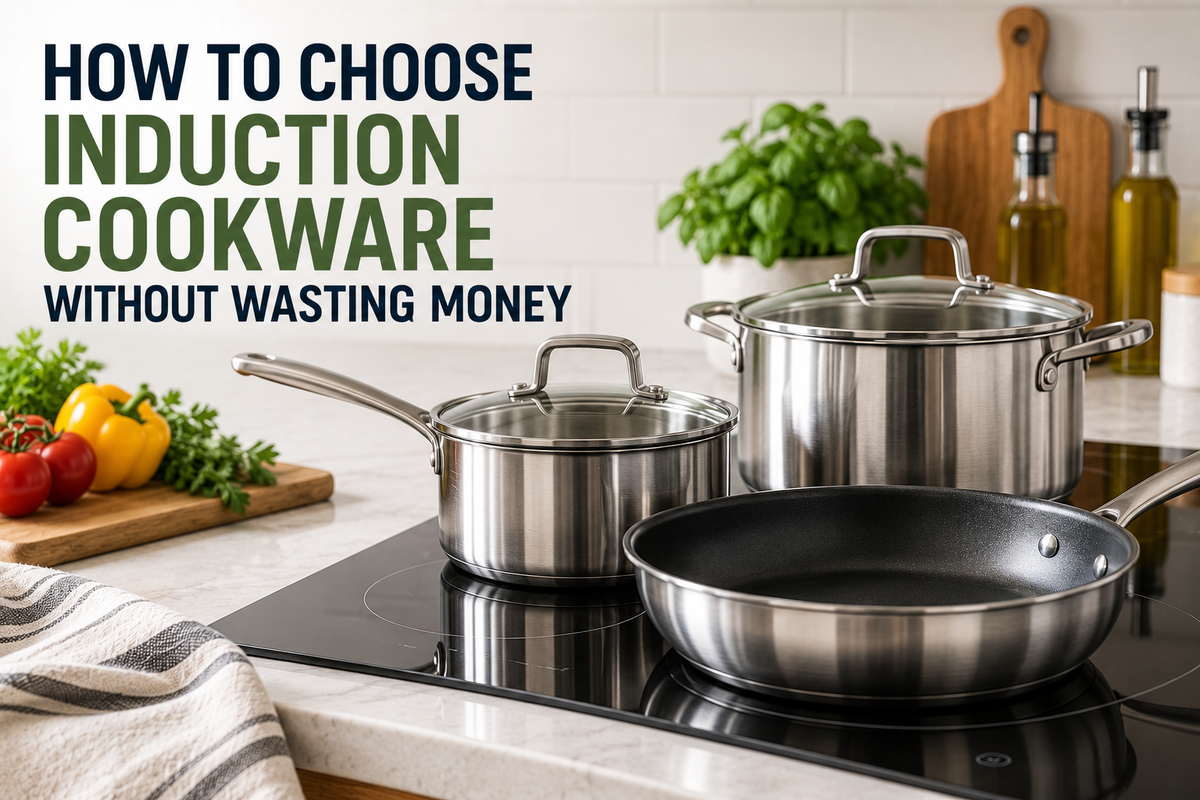
You've just installed an induction cooktop, placed your favourite frying pan on the glass, and waited for dinner to heat. Nothing happens. The pan looks perfectly respectable, but the cooktop stays cold because the metal underneath doesn't respond to induction. That's frustrating, but it isn't a sign that you chose badly. Most pans were bought for gas or conventional electric elements, where magnetism doesn't matter.
Learning how to choose induction cookware means building a practical kitchen system, not replacing every pan in one afternoon. You need compatible metal, a stable flat base, sensible sizes, and materials that suit the food you cook. The right collection may include stainless steel, cast iron, carbon steel, and a carefully chosen coated pan. No single material handles every job well.
Table of Contents
- Why Your Current Pans Might Not Work on Induction
- Comparing Cookware Materials for Real Cooking
- Running the Magnet Test and Reading the Markings
- Base Thickness, Flatness, and Heat Distribution
- Building a Smart Set Without Buying Everything
- Care and Maintenance That Extends Pan Life
- Your Induction Cookware Buying Checklist
Why Your Current Pans Might Not Work on Induction
Induction cooktops heat the pan through a magnetic field. The cookware must contain ferromagnetic material so the field can generate heat in the pan itself. That's why a pan can look heavy, expensive, and completely unsuitable.
The easiest first check is the magnet test. Hold a magnet against the underside. If it sticks firmly, the pan is a candidate for induction. Cast iron, enameled steel, carbon steel, and induction-specific stainless steel generally work, while glass, ceramic, aluminium, copper, and non-magnetic stainless steel don't work unless they have a magnetic base, as explained in this California induction cookware fact sheet.
The second check is flatness. A pan can pass the magnet test and still cook poorly if its base rocks, bows, or touches the glass unevenly. Induction needs dependable contact between the cookware and the cooking zone. A warped frying pan may heat in patches, vibrate, or fail to respond consistently.
Remember this rule: If the magnet doesn't hold firmly and the base isn't flat, don't buy the pan for induction.
If you're replacing a range rather than changing cookware, compare the appliance layout with your existing kitchen in this guide to choosing a range for your kitchen. The cooktop's zone sizes matter because a pan that is too small or poorly matched to a zone may not perform as you expect.
Induction compatibility at a glance
| Material | Works on induction | Notes |
|---|---|---|
| Cast iron | Yes | Naturally magnetic, heavy, and heat-retentive |
| Enameled cast iron | Yes | Magnetic core with an enamel surface |
| Carbon steel | Yes | Magnetic, lighter than cast iron, requires seasoning |
| Magnetic stainless steel | Yes | Check the base, because not all stainless steel is magnetic |
| Glass or ceramic | No | Won't work unless paired with a magnetic base |
| Aluminium or copper | No | Needs a magnetic layer or induction base |
| Non-magnetic stainless steel | No | Looks suitable but won't heat by itself |
Don't blame yourself for a failed pan. Gas and radiant electric cooktops heat by transferring energy through flame or a hot element, so they don't require this magnetic relationship. Induction exposes a property that older cooking surfaces allowed you to ignore.
Comparing Cookware Materials for Real Cooking
Compatibility only answers whether a pan will heat. It doesn't tell you whether you'll enjoy using it. A heavy cast-iron skillet may be superb for searing but irritating when you're lifting it one-handed. A light coated pan may be convenient every morning but won't tolerate the same abuse as stainless steel.

Cast iron and carbon steel
Cast iron is the workhorse for browning, frying, baking, and dishes that benefit from steady retained heat. It's naturally magnetic and durable, but it's heavy, slow to change temperature, and can scratch a glass cooktop if you drag it. Lift it instead of sliding it.
Enameled cast iron keeps much of cast iron's heat retention while giving you a smoother surface that's easier to clean. It's particularly useful for braises, soups, and acidic recipes because the enamel separates the food from uncoated iron. It still weighs a lot, and the enamel can chip if you knock the pot against a hard surface or expose it to abrupt temperature changes.
Carbon steel is the more agile option. It heats quickly, weighs less than cast iron, and develops a seasoned cooking surface with regular use. It's excellent for eggs once properly maintained, stir-frying, frying, and high-heat cooking. It can rust if neglected, and acidic ingredients can strip seasoning, so it's not the pan I'd choose for a long tomato simmer.
For a fuller comparison of these two materials, use this guide to cast iron versus carbon steel. If you care for your knives while cooking, the King Japanese Whetstone, #800/#6000 Dual Grit uses an #800 side for restoring dull blades and an #6000 side for polishing, and it's made in Japan for kitchen knives, pocket knives, and high-carbon steel blades.
Stainless steel and magnetic aluminium
Multi-clad stainless steel is my default recommendation for a long-term core collection. It handles sauces, browning, boiling, oven cooking, and daily scraping without relying on a fragile surface coating. Look for magnetic stainless steel with a well-built internal core or base. It demands better heat control than nonstick, but it rewards you with longevity and a broad range of uses.
Hard-anodized aluminium with a magnetic base deserves more attention in Canadian kitchens. Aluminium itself won't work on induction, but a magnetic layer makes the pan compatible. This construction can offer a lighter alternative to all-stainless or cast iron, which is useful in smaller kitchens, condos, and households that need to move cookware between induction and another stove. Check the base rather than trusting the word “aluminium” alone.
Coated pans and safety trade-offs
A coated nonstick pan earns its place for eggs, delicate fish, pancakes, and quick low-to-medium-heat meals. It's easy to clean, but the coating is the part most likely to wear out. Don't treat “PFOA-free” or “PFAS-free” as a complete decision. Read the manufacturer's material disclosures and care instructions, then decide whether easy release is worth replacing the pan sooner than an uncoated stainless or enameled piece.
Health Canada's cookware guidance, referenced in this Canadian cookware market analysis, warns that worn or pitted aluminium cookware can transfer more aluminium to food. It also warns against storing or cooking acidic foods long-term in uncoated cast iron. That means material choice depends on the recipe, not just the marketing claim.
Running the Magnet Test and Reading the Markings
Take a small magnet with you when you shop. A fridge magnet works for a first pass, and the test takes less time than reading a page of vague product copy.

Test the whole base
Turn the pan over and place the magnet at the centre of the cooking base. Move it across the middle, then toward the sides. A strong, consistent pull across the usable base is more reassuring than a magnet that catches only at the outer rim.
A disc-bottom pan may have a separate magnetic plate attached underneath. That can work, but the contact area and construction matter. If the magnet only catches at one edge, treat the pan as questionable rather than assuming it will heat evenly.
Read the product language carefully
Look for induction-ready, induction-compatible, or magnetic stainless steel. These phrases are useful only when they describe the actual product you're buying, not merely a product family or a similar model. The induction symbol on the base is another helpful signal, but it shouldn't replace checking the manufacturer's guide.
Terms such as “premium”, “professional”, “quick heating”, and “heavy duty” don't prove compatibility. Neither does a shiny stainless finish. Stainless steel comes in magnetic and non-magnetic forms, so the base remains the deciding factor.
Use this stainless steel versus nonstick cookware comparison when you're weighing easy release against durability. Before paying, confirm four things:
- Magnetic coverage: The magnet holds across the cooking area, not only the rim.
- Induction marking: The pan carries an induction symbol or clear compatibility statement.
- Flat contact: The base doesn't rock on a level surface.
- Clear construction details: The listing explains whether the pan is clad or has a bonded disc base.
If you're buying online, save the product page until the pan arrives. Test it before removing labels or using it. A vague listing is a reason to pause, not a reason to guess.
Base Thickness, Flatness, and Heat Distribution
A pan can be magnetic and still be a poor induction pan. The base has to transfer heat evenly, stay flat on the glass, and feel manageable when full. A paper-thin base may respond quickly but can create hot areas and warp more easily. A substantial base generally offers steadier cooking, though excess weight becomes a daily nuisance.

Clad versus disc-bottom construction
Fully clad cookware layers metals through the walls and base. It tends to distribute heat more broadly and makes the pan feel consistent from centre to edge. Disc-bottom cookware attaches a separate heat-spreading and magnetic plate to the underside. It can be perfectly serviceable, but the transition between the disc and pan may produce different heating behaviour, particularly at the edges.
Don't buy by construction label alone. Put the pan on a flat counter and press gently around the rim. It shouldn't rock. In a shop, hold it at eye level and look across the underside for a visible bulge, dip, or uneven disc.
At home, place a ruler across the base in several directions. If light shows beneath the ruler or the pan wobbles, contact the seller before cooking with it. A warped base is especially troublesome on glass because you can't correct the contact problem by moving the pan closer to a flame.
A cookware guide for gas stoves can help if your kitchen still has a second cooking surface. That backup changes your priorities. A pan that works on induction and gas gives you flexibility, while a pan chosen only for one burner may leave an awkward gap in your cooking system.
Weight matters as much as engineering. Cast iron may be ideal for a steak but frustrating for someone with limited grip strength, a compact sink, or a habit of cooking while holding a child. Choose the heaviest pan you can comfortably lift, turn, wash, and store. If you can't reach for it on a busy night, its heat retention won't help you.
The video below offers another visual reference for induction cookware handling and setup.
Building a Smart Set Without Buying Everything
A boxed set looks efficient because every piece matches. It often isn't. You may end up paying for duplicate small saucepans, an oversized pot that doesn't fit your storage, and skillets with shapes you never reach for.
Build around the meals you cook. A useful core usually includes a skillet, a saucepan, and a larger covered pot. Add speciality pieces only after you know what your routine demands.

Three practical starting layouts
For one person or a compact kitchen, start with a 10-inch induction-ready skillet, a 3-quart saucepan, and a 5-quart Dutch oven. Choose clad stainless for the skillet and saucepan if you want maximum range, then choose enameled cast iron for the Dutch oven if you regularly make stews or bread.
For a family kitchen, use a 10 to 12-inch skillet, a 3 to 4-quart saucepan, and a 5 to 7-quart Dutch oven. Add a stockpot only if you regularly cook large batches, and choose a sauté pan if you make meals that need both browning space and a lid.
For a hybrid kitchen, make the everyday pieces induction-compatible first. Keep a favourite non-induction pan for the gas or electric backup, but don't let it dictate the main collection. This approach works well during renovations, in rental homes, and in households that may change appliances later.
What to do with incompatible favourites
An adapter plate can let incompatible cookware work on an induction surface, but it adds another heat-transfer step. Treat it as a fallback for a sentimental or speciality pan, not as the foundation of your collection.
Donate pans you never use, move them to the backup stove, or keep one only if it performs a job your induction pieces cannot handle. The aim isn't to own compatible cookware for its own sake. It's to make the next meal easier, with fewer pans competing for limited storage.
Care and Maintenance That Extends Pan Life
Induction doesn't remove ordinary cookware problems. It can expose them faster because the pan responds directly to the cooking zone. Care starts with matching the pan to the task and ends with storing it so the base and surface don't take unnecessary damage.
Season bare cast iron and carbon steel with a thin layer of cooking oil, then heat it according to the manufacturer's instructions. Avoid leaving water in either material. Dry them promptly and apply a light protective coating when needed. Enameled cast iron doesn't need seasoning, but it still dislikes thermal shock. Let a hot pot cool before washing it with cold water.
Stainless steel needs technique more than pampering. Preheat it sensibly, add oil before delicate food, and loosen stuck residue with warm water rather than attacking the surface with abrasive tools. A dishwasher may be allowed by the manufacturer, but hand-washing usually preserves handles, finishes, and coatings for longer.
Protect surfaces during storage
Stack stainless pieces carefully. Put felt or paper liners between coated pans and enamel surfaces, and don't slide cast iron across the cooktop. Store lids where they won't strike pan rims. A small amount of organisation prevents the chips, scratches, and dents that make a good set look worn before its time.
If a coated pan starts flaking, retire it rather than trying to rescue the surface. If a pan warps, stop using it on the induction zone until you've checked the return policy or manufacturer guidance. If the magnetic base separates or loses contact, replacement is safer than improvisation.
For more detailed seasoning and cleaning guidance, see this resource on cast iron cookware care.
Common induction cookware problems and fixes
| Symptom | Likely cause | First-line fix |
|---|---|---|
| Cooktop doesn't detect the pan | Base isn't magnetic or contact is poor | Repeat the magnet test and inspect the base |
| Pan heats in a narrow area | Small magnetic disc or uneven construction | Use a pan with broader magnetic coverage |
| Pan rocks on the glass | Warped base | Stop using it and contact the manufacturer |
| Food sticks to stainless steel | Pan or oil temperature is poorly controlled | Preheat carefully and use sufficient cooking fat |
| Carbon steel develops rust | Moisture left on the surface | Dry immediately and re-season lightly |
| Coating flakes or blisters | Surface has worn or overheated | Replace the pan |
| Enamel chips | Impact or sudden temperature change | Retire it if the cooking surface is damaged |
Maintenance isn't about treating cookware like museum pieces. It's about preventing small failures from turning into a replacement bill.
Your Induction Cookware Buying Checklist
Save this list before you shop:
- Test the base: A magnet should hold firmly across the cooking surface.
- Confirm the marking: Look for an induction symbol or explicit induction-ready wording.
- Check flatness: The pan shouldn't rock on a level counter.
- Match the material to the job: Use stainless for versatility, cast iron for retained heat, carbon steel for high-heat agility, and coated cookware for delicate foods.
- Inspect the construction: Prefer a well-designed clad or broad disc base over a thin magnetic patch.
- Choose usable weight: You need to lift, turn, wash, and store the pan comfortably.
- Match the size to your cooking zone: A large rim doesn't guarantee a large effective base.
- Plan for acidic food: Use enamel or stainless for long acidic cooking rather than uncoated cast iron.
- Read care instructions: Coatings, enamel, seasoning, and dishwasher guidance all affect longevity.
- Buy the first pieces strategically: A 10-inch clad stainless skillet and a 3-quart saucepan make a strong starting pair before you expand.
Think of cookware as a long-term kitchen system, not a single purchase. The right pan isn't the one that looks most impressive in a catalogue. It's the one you'll reach for on a busy Tuesday, clean without resentment, and still trust when dinner has to work.
GrifGlo brings cookware and other household essentials into clear categories with decision-friendly guides, comparisons, and sizing advice. Visit GrifGlo to compare practical kitchen options and build an induction setup around the way you cook.

Laisser un commentaire
Ce site est protégé par hCaptcha, et la Politique de confidentialité et les Conditions de service de hCaptcha s’appliquent.