

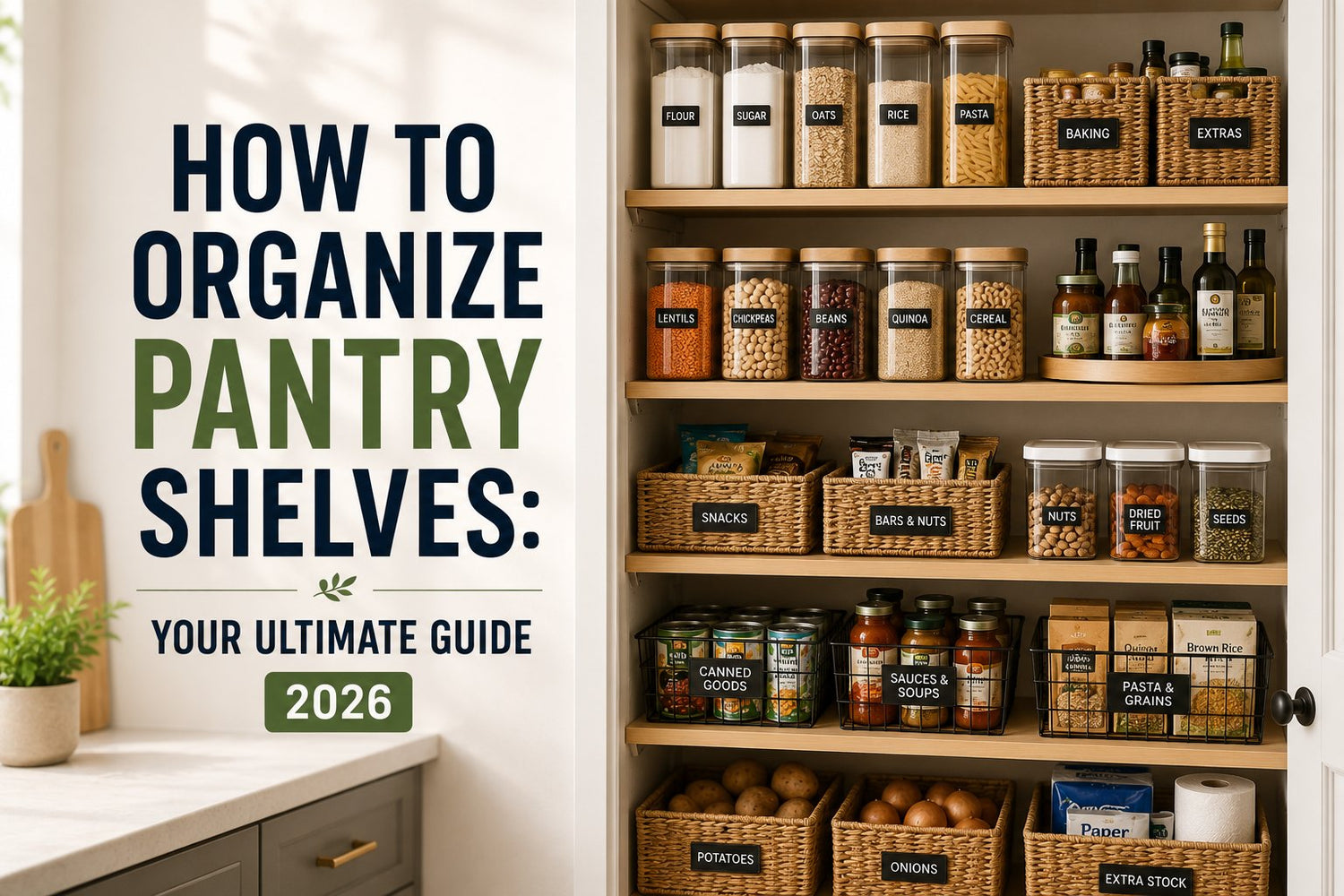
You open the pantry to grab one thing and a bag falls forward, a half-used box is hiding behind three newer ones, and somehow the snack shelf has become a junk drawer for food. That's the point when bins are often bought too early.
A pantry stays organised when the system matches how you live. That means planning for the person who cooks every night, the child who tears open snack packs, the renter with shallow shelves, and the household trying to store different foods for different diets in one tight space. If you want to learn how to organize pantry shelves in a way that still works next month, focus less on the makeover and more on the rules.
Table of Contents
- Prepare Your Pantry for a Total Reset
- Declutter and Categorize Your Food Inventory
- Design Your Strategic Pantry Zones
- Select the Best Storage for Your Space
- Implement Your System and Keep It Organized
Prepare Your Pantry for a Total Reset
Start with a complete reset. Take everything out. Not half a shelf. Not just the messy bits. If you leave items behind, you'll build a new system around old clutter.

Empty first, sort later
Put food on a table or counter where you can see it all at once. Hidden duplicates often show up. You'll also notice the open pasta bag, the stale crackers, and the baking ingredients you forgot you owned.
Then clean the shelves properly. Wipe crumbs, sticky corners, oil drips, and dust. If a shelf feels slick, clean it again. A clean surface matters because containers slide more when shelves are greasy, and labels don't stay put on dusty bins.
Practical rule: If you're asking whether you can skip the full empty-out, the answer is no. You can't organise what you can't see.
A lot of households buy organisers before they know what they need. That's one reason the category keeps growing. The Grand View Research kitchen storage and pantry organization products market report says the market was valued at $131.4 billion globally in 2023 and is projected to reach $182.1 billion by 2030, growing at a 4.8% CAGR. More products don't automatically create a better pantry. Better planning does.
For ideas on common pantry pain points before you start shopping, this round-up of pantry storage tips is useful as a reference point.
Measure before you buy anything
This is the step people resist, then regret. Measure:
- Shelf width so bins fit side by side without wasted gaps
- Shelf depth so containers don't overhang or disappear at the back
- Shelf height so lids open and items can be removed easily
- Door clearance if the pantry has an inward swing or tight frame
Write the measurements down shelf by shelf. Don't assume every shelf is identical.
Use centimetres if that's how you think, but keep product dimensions in one unit when you compare. If a shelf is shallow, avoid mentally rounding up. A container that “almost fits” usually turns into a daily annoyance.
A good pantry blueprint isn't glamorous, but it saves money and stops the most common mistake in organising: buying a set because it looks tidy online and discovering it doesn't suit your shelves or your food.
Declutter and Categorize Your Food Inventory
A pantry gets easier to manage when you stop treating every package as equal. Some things deserve storage space. Some don't.

Use three decisions only
Don't overcomplicate the sort. Every item goes into one of three groups:
-
Keep
Food your household eats, in a condition you'd still want to use. -
Toss
Expired items, stale food, crushed open packets, or ingredients no one reaches for anymore. -
Consolidate
Duplicate half-empty bags, multiple open boxes of the same item, loose snack packs, and small leftovers that need to be combined or contained.
Check dates as you handle each item. If a package is nearly empty but awkward to store, that's a clue to decant it or use it up soon. If a food has been moved from shelf to shelf for months, it probably doesn't deserve prime space.
A tidy pantry isn't built by storing more neatly. It's built by keeping less that doesn't serve you.
This is also the moment to separate packaging from food. Bulky cardboard often wastes shelf room. Thin internal bags, sealed into a canister or clip-top container, usually store more cleanly.
If you keep produce in the pantry, use a storage method that suits short-term freshness rather than dumping loose onions, avocados, or potatoes into one basket. For some households, a reusable produce option like AS SEEN ON TV 8-Piece Green Fresh Food Bags - 80426 can fit naturally into that workflow because the product is described as having a reusable storage design, a wide-seal zipper closure, and ethylene-gas absorption.
For a practical zoning mindset while you sort, see these notes on organizing your pantry with bins and zones.
Build categories around real eating habits
Most pantries need the obvious groups: baking, breakfast, grains, sauces, snacks, canned goods. But plenty of households need more specific categories than that.
A 2025 California-specific survey found that 68% of multi-generational households struggle with food storage conflict and cross-contamination, while 92% of online pantry guides offer no zoning templates for separating multiple dietary needs within a single space. That's exactly why generic categories often fail in shared homes.
If you live in a multi-generational household, sort by dietary function as well as food type. That might mean:
- Grandparent shelf: low-sodium staples, soft snacks, tea, easy-access breakfast items
- Child zone: lunchbox snacks, cereals, pouches, after-school grab items
- Diet-specific bin: kosher, vegan, gluten-aware, or allergy-separated foods
- Shared cooking staples: oils, rice, tinned tomatoes, pasta, stock, flour
Keep these zones visibly separate. Different bins, different labels, different shelf positions. Don't mix them in one large basket and assume everyone will sort politely later. They won't.
When households ignore this step, the pantry may look neat for a day, but daily use breaks it fast.
Design Your Strategic Pantry Zones
If you only do one thing beyond decluttering, do this. Zoning is what turns a pantry from storage into a working system.

Give prime shelf space to daily-use items
The middle of the pantry is your power zone. Items used often should live where your hand lands naturally, not where you need to crouch or reach blindly.
Placing frequently used items at eye level, roughly 45 to 60 inches, can improve daily retrieval efficiency by 55%, and consistent use of air-tight containers can reduce food spoilage by 40%. That's why cereal, everyday grains, lunch items, oils, and common cooking ingredients belong in the easiest-to-reach band.
Put your pantry into zones that match tasks, not just categories. A strong layout often looks like this:
- Cooking essentials: oils, salt, spices, stock, flour, sugar
- Breakfast and snacks: cereal, bars, crackers, spreads
- Baking: extracts, chocolate chips, baking powder, decorative toppings
- Grains and pasta: rice, noodles, lentils, quinoa
- Tinned and jarred goods: beans, tomatoes, soups, sauces
- Backstock: duplicates, bulk refills, less-used extras
This kind of structure is easier to maintain because people can put things back without thinking too hard.
Later in the process, if you want to compare physical shelf helpers for each zone, this guide to pantry storage racks helps narrow down options.
A quick visual can help when you're planning your shelf map:
Make top and bottom shelves earn their keep
Bad pantry layouts waste the top and bottom shelves in opposite ways. The bottom becomes a random dumping ground. The top becomes a black hole.
Store heavier items on lower shelves. That means drinks, bulk flour, large jars, canned goods, and dense baskets. It's safer and easier to handle.
Use the top shelf for things you don't need every day, such as backup paper goods, holiday baking items, duplicate sauces, or unopened bulk purchases. Top shelves are for storage, not convenience.
Keep the pantry like a small shop. The fastest-moving items go in front, the heavy stock goes low, and backup lives up high.
Air-tight canisters work well in the middle zone for dry goods because they create cleaner lines and make quantity visible. Open bins work better for wrappers, packets, and items with irregular shapes. Mixing those two storage types is usually smarter than forcing everything into matching containers.
Select the Best Storage for Your Space
Storage tools should solve a specific problem. If they don't, they become clutter wearing a tidy costume.
Choose the tool by food type
Use sealed containers for pourable dry goods, open bins for grouped packets, and shelf helpers for visibility.
| Storage Type | Best For | Sizing Tip | Reliability Cue |
|---|---|---|---|
| Clear air-tight canisters | Flour, sugar, rice, cereal, pasta, oats | Leave room above the lid so it opens without scraping the shelf | Secure seal, straight sides, easy-to-read contents |
| Open-front bins | Snacks, pouches, seasoning packets, baking extras | Choose a width that allows one hand to grab the whole bin cleanly | Firm base, not flimsy, easy to pull forward |
| Tiered risers | Tins, jars, short sauces | Make sure the rear row is still reachable | Stable feet, no wobble under weight |
| Turntables | Oils, vinegar, condiments, small jars | Only use where there is enough clearance to spin properly | Smooth rotation and a raised edge |
| Shelf inserts | Mugs, jars, short packets, small tins | Match insert height to the wasted vertical gap above items | Flat top, stable legs, no bowing |
| Low-profile stackers | Flat packets, ramen, wraps, rental pantries with shallow shelves | Stay inside the real shelf depth, not the advertised ideal | Straight stack, easy visibility from above |
A few practical rules matter more than matching sets:
- Use clear containers for staples so you can see quantity without opening them.
- Use uniform shapes where possible because odd footprints waste shelf space.
- Don't decant everything. Tea bags, sealed crackers, and pouches often work better grouped in bins.
- Reserve turntables for suitable shelves. If the shelf is too shallow or crowded, they become annoying.
What works in shallow rental shelves
A significant disconnect exists in much online advice. California's 2025 Rental Market Report shows 7.3 million renters have shallow, non-adjustable shelves with an average depth of 12 to 14 inches, yet 89% of pantry guides recommend products requiring 18+ inches of depth. That mismatch is why a lot of renter pantry projects fail before they begin.
If your shelves are shallow, skip bulky pull-out drawers and deep lazy Susans. They're often designed for a pantry you don't have.
Use these instead:
- Low-profile rectangular containers that sit front to back without overhang
- Flat stackable bins for packets, tortillas, wraps, and snack bags
- Short risers that lift tins without pushing the front row too far forward
- Narrow handled bins that can slide out like makeshift drawers
- Door-mounted or over-the-door storage for light items if your setup allows it
What doesn't work well in shallow shelves? Tall round containers, oversized baskets, and any organiser that forces you to leave dead space behind it.
If you're comparing options and dimensions, pantry storage containers offers a decision-focused way to sort through common container styles. GrifGlo groups home and kitchen products into clearer buying categories, which is useful when you're trying to match organiser size to a real shelf instead of buying by appearance alone.
Implement Your System and Keep It Organized
A good pantry system should survive a grocery run, a rushed school morning, and someone putting the crackers back in the wrong spot. That only happens if the maintenance is built in.
Label for use, not decoration
Load the pantry by zone first, then by container. Don't label empty jars before you know what's going into them.

Labels should answer three questions fast:
- What is it
- Where does it belong
- When should it be used
Labeling containers with expiration dates can prevent 50% of food waste, and 60% of households discard food due to unknown expiration. In small pantries, shelf inserts can increase storage capacity by 35%. Those two habits matter because they solve the two most common maintenance problems: forgotten food and wasted vertical space.
Use simple removable labels. Put the product name on the front. Put the expiry or purchase date somewhere visible enough to check while cooking. If multiple people use the pantry, label the shelf as well as the bin.
For households that need to use door space wisely, over-the-door pantry organisers can help move light items out of the main shelves and keep daily zones clearer.
Labels should guide behaviour. If a label is too pretty to update, it's the wrong label.
Follow a short maintenance rhythm
You don't need a huge reset every week. You need a short routine that stops the slide back into disorder.
Weekly tidy, about 10 minutes
- Face items forward: pull products to the front edge
- Return strays: put misplaced food back into its home zone
- Check one high-use bin: snacks or breakfast usually need the fastest reset
- Wipe obvious crumbs: especially under flour, cereal, and crackers
Monthly reset, about 30 minutes
- Scan dates: pull anything nearing expiry into the use-soon area
- Refill canisters: top up staples before you end up storing duplicates behind them
- Edit the system: if one bin is always overflowing, it needs a new category
- Review top shelves: backstock has a way of becoming forgotten stock
The pantry should be easy to restore, not impossible to disturb. That's the sign the system is realistic.
If you're building a pantry system and want decision-friendly help with storage types, sizing, and practical household tools, GrifGlo is a useful place to compare options without wading through an overwhelming catalogue. It focuses on fit-for-purpose guidance across home, kitchen, and organisation, which makes it easier to choose tools that suit the pantry you have.

Laisser un commentaire
Ce site est protégé par hCaptcha, et la Politique de confidentialité et les Conditions de service de hCaptcha s’appliquent.