

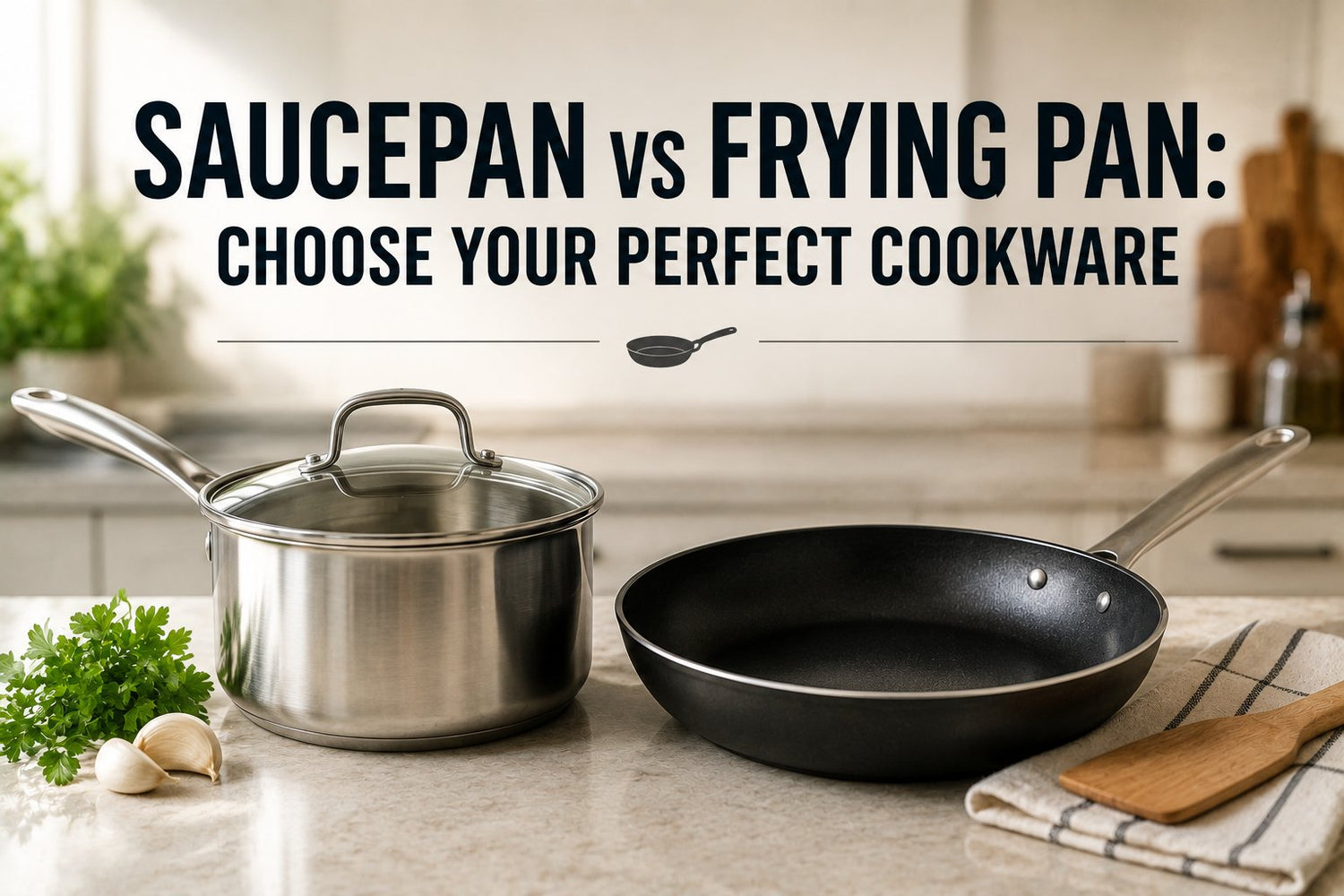
You're probably standing at the hob with both pans in reach, wondering whether it really matters which one you grab. It does. A tomato sauce can turn tight and over-reduced in the wrong pan. Chicken that should brown can end up pale and damp because the pan trapped more moisture than the recipe expected. Most of those frustrations aren't about skill. They come from using a pan whose shape is working against the result you want.
That's why the saucepan vs frying pan question matters more than most cookware comparisons. The difference isn't cosmetic. It's geometry, and geometry changes how heat moves, how steam escapes, how fast liquid evaporates, and how easily food browns. If you're building out a more functional kitchen, a solid kitchen essentials list for everyday cooking should treat these as separate tools, not substitutes with different handles.
Table of Contents
- Why Your Pan Choice Matters More Than You Think
- The Anatomy of a Pan Shape Depth and Design
- Heat Behaviour and Common Materials
- Ideal Cooking Tasks for Each Pan
- Choosing Your Cookware A Practical Buying Guide
- Care Maintenance and Storage Solutions
Why Your Pan Choice Matters More Than You Think
A common mistake looks harmless at first. You start onions and garlic in a frying pan, add stock and tomatoes, and expect a gentle simmer while pasta cooks. Ten minutes later, the sauce has spread thin, reduced too hard at the edges, and needs rescuing with extra liquid. The opposite happens just as often. Someone tries to sear chicken in a saucepan because it's already on the cooker, and the meat releases moisture faster than the pan can shed it. Browning stalls.
Those outcomes aren't random. They come from the pan's shape controlling two things at once: contact with heat and escape of moisture. A wider, shallower pan exposes more food and liquid to direct heat and open air. A deeper pan with straighter walls contains liquid and slows the rate at which moisture leaves. Once you notice that pattern, a lot of recipe behaviour starts to make sense.
The wrong pan changes the whole method
Recipes often assume a pan without saying why. “Simmer until reduced” means one thing in a straight-sided vessel and another in a shallow one. “Sear over high heat” works better when steam can leave quickly instead of bouncing off tall walls and settling back around the food.
A pan doesn't just hold ingredients. It sets the environment those ingredients cook in.
That's the dividing line in saucepan vs frying pan. One creates control over liquid. The other creates exposure. If you understand that, you stop guessing. You start matching the vessel to the result, which is usually the difference between food that merely cooks and food that cooks cleanly.
The Anatomy of a Pan Shape Depth and Design
| Feature | Saucepan | Frying pan |
|---|---|---|
| Side shape | Straight, vertical sides | Sloped, flared sides |
| Typical depth | Deeper body for holding liquid | Shallow body for fast access |
| Main cooking behaviour | Contains moisture and volume | Promotes evaporation and browning |
| Best suited to | Sauces, grains, soups, reheating liquids | Searing, sautéing, eggs, cutlets |
| Pouring and flipping | Better for contained pouring of liquids | Easier for turning and tossing food |

In California, the distinction is unusually precise. A saucepan is defined by straight, vertical sides at 90° ±2° and a depth of 8–12 cm, while a frying pan uses sloped sides with a 10°–25° taper and a shallow depth of 1.5–2 inches (3.8–5.1 cm). That shape allows the saucepan to retain up to 20–30% more liquid volume during simmering, while the frying pan is engineered for rapid evaporation at 15–25 ml per minute per 30 cm diameter under high heat, according to this cookware geometry reference on skillets, fry pans, and sauté pans.
How saucepan walls change the cook
Straight walls do three practical jobs.
First, they increase usable depth without forcing you into a huge base. That matters when you're reducing stock, cooking rice, reheating soup, or making porridge. Liquid stays gathered instead of spreading thinly across a broad hot surface.
Second, tall vertical walls reduce splatter. When bubbles break at the surface, more of that motion stays inside the pan. That doesn't make a saucepan mess-free, but it does make it calmer.
Third, the wall shape changes stirring and temperature control. A spoon can reach corners cleanly, and the concentrated footprint helps keep delicate preparations together. Custards, oatmeal, small-batch sauces, and melted butter all benefit from that contained cooking zone.
Practical rule: If the dish depends on controlling moisture, a saucepan starts with an advantage before material even enters the conversation.
There's a prep angle here too. Good pan performance often gets blamed or praised when the problem lies with knife work. Uneven onion pieces or thick garlic slices cook at different speeds no matter which vessel you use. Something like the King Japanese Whetstone – #800/#6000 Dual Grit is relevant for that reason alone. Its #800 grit restores and sharpens dull blades, while #6000 grit polishes, and that kind of edge control makes pan behaviour easier to read because the food is cut more consistently.
Why frying pans are built to lose moisture
A frying pan does the opposite job. The sloped sides lower the barrier between the food and the room, so moisture escapes more freely. That's what you want when trying to brown mushrooms, crisp bacon, fry eggs, or get colour on chicken thighs.
The same California reference notes that the common 30 cm frying pan has about 707 cm² of cooking surface, while a typical 15 cm saucepan base offers about 177 cm², a 4:1 ratio that strongly affects how much heat-exposed surface the food gets in use. That larger open area is why frying pans handle crowding better when the goal is surface browning, not simmering.
A frying pan also gives your tools more room. Fish slices slide under cutlets more easily. A spatula can reach the edge without fighting steep walls. If you toss vegetables or move food constantly, the flare helps.
The wall angle is the hidden variable many cooks miss. It doesn't just change appearance. It changes whether heat drives moisture out fast enough for browning, or keeps enough humidity around the food to soften that effect.
Heat Behaviour and Common Materials

Shape decides the cooking environment first. Material decides how steadily or aggressively that environment behaves. In essence, geometry tells you what the pan wants to do. Material tells you how sharply it does it.
That's why “stainless vs cast iron” or “non-stick vs uncoated” isn't the full question. A stainless steel saucepan and a cast iron frying pan can both be excellent because each pairs material behaviour with the job the shape already supports.
Shape first material second
For saucepans, a heavier base usually matters more than dramatic heat retention. You want even heat and predictable response, especially for milk, cream, grains, or anything that can catch at the bottom. Stainless steel is popular here because it's durable, non-reactive in everyday cooking, and comfortable with repeated simmering.
For frying pans, heat retention can be an asset. Cast iron holds onto heat well, which helps when cold food hits the surface and you still want a firm sear. Stainless frying pans work well too, especially if you want to build fond for pan sauces. Lighter non-stick pans make sense for eggs, delicate fish, or low-fat cooking where release matters more than crust.
A useful middle category is the sauté pan. In California retail, it's often lumped in with frying pans, but it behaves differently. A sauté pan offers 20% greater liquid capacity than a standard frying pan, and those higher straight sides trap more steam, which changes both sauce reduction and protein cooking dynamics, while a frying pan's sloped sides favour the faster evaporation needed for caramelisation and high-heat searing, as described in this comparison of sauté and fry pan design.
If you cook on multiple hob types, shape and material should also match the burner. A broad frying pan asks more from weak or uneven burners than a compact saucepan does. For more on matching cookware to burner patterns, this guide to cookware choices for gas stoves is a useful companion.
Which surface helps and which gets in the way
Non-stick is excellent when sticking is the main risk. That means omelettes, fried eggs, thin fish fillets, or reheating sticky grains with minimal fat. It's less useful when you want a proper fond on the bottom of the pan, because that browned residue is the beginning of many good pan sauces.
Uncoated stainless is more demanding, but it rewards better technique. Preheat properly, use enough fat, and let proteins release naturally. You'll get stronger browning and more flavour on the pan surface itself.
Cast iron sits in another lane. It's less responsive than thinner pans, so it won't pivot quickly if heat is too high. But for cornbread, chops, steaks, and hard sears, that stored heat is a feature, not a flaw.
A slick surface makes food easier to release. A more reactive cooking surface often makes flavour easier to build.
Ideal Cooking Tasks for Each Pan

If you want a quick visual overview before getting into edge cases, this short demonstration helps clarify the most common jobs each pan handles well.
When a saucepan is the right call
Use a saucepan when the dish depends on contained liquid, steady simmering, or reduced splatter.
That includes:
- Sauces and gravies: Straight sides keep liquid gathered, which makes texture easier to control.
- Rice, oats, and other grains: Depth helps maintain even contact between grain and cooking liquid.
- Soups and reheating: You can stir comfortably without sloshing over the edge.
- Custards or milk-based cooking: The contained footprint helps with gentler control.
- Small-batch frying: Tall walls hold oil more securely than a shallow open pan.
The deep-frying point surprises people, but it's a practical one. For the question of whether you can deep-fry in a saucepan, a useful California-specific note is that saucepans hold oil better because of their vertical sides, and guidance for compact stovetops points to a ½-inch oil depth rule. The same source notes that 60% of California rental units have 3-burner electric ranges with limited surface area, which can make saucepan-based frying a safer fit in small kitchens, according to this discussion of saucepan and frying pan use cases.
A saucepan also earns its keep in kitchens where space is tight. If one burner is occupied and another is partly blocked by a kettle or stockpot, a compact saucepan footprint is easier to live with. That matters even more in smaller homes where every pan has to do honest work. If you're also comparing other multipurpose heavy vessels, this guide on what a Dutch oven is used for helps sort out where each piece overlaps and where it doesn't.
When a frying pan earns its space
A frying pan is for food that benefits from surface contact, open exposure, and easy movement.
Reach for it when cooking:
- Eggs and pancakes, where a shallow edge makes sliding and flipping easier.
- Chicken cutlets, chops, or steak, where open heat helps moisture leave before it turns into steam.
- Vegetables that need colour, such as mushrooms, courgettes, or sliced peppers.
- Quick sautés, where you want to shake or toss ingredients rather than stir deep in a vessel.
- Bacon and flat fish fillets, because access matters as much as heat.
The biggest mistake in a frying pan is crowding. Once food overlaps or covers too much of the base, it stops behaving like frying and starts behaving like steaming. The pan isn't failing. It's telling you that it was designed for exposed cooking, not bulk volume.
Browning needs room. If moisture can't escape, the pan shifts from searing to steaming whether you intended it or not.
The grey area and smart substitutions
Yes, you can fry in a saucepan. No, it won't behave exactly like a frying pan.
For shallow frying small items, a saucepan can work well because the higher sides contain splatter. For thicker cuts, it gets trickier. After the initial sear, straight walls keep more steam near the food than sloped frying-pan sides do, so you need to reduce the heat once colour develops or the meat can drift into a damp, semi-braised state.
You can also make sauces in a frying pan, and many people do. It's often a good move for pan sauces built from fond after searing. But if the sauce needs a quiet reduction or starts in a larger volume, a saucepan is easier to control because the liquid isn't spread so thinly.
A simple substitution guide:
| If the main goal is... | Better choice | Why |
|---|---|---|
| Reduce and hold liquid | Saucepan | Less exposed surface, more containment |
| Build crust on meat | Frying pan | Better evaporation and easier access |
| Fry eggs or pancakes | Frying pan | Shallow profile helps turning |
| Heat soup or cook porridge | Saucepan | Depth prevents spills and hot splashes |
| Small-batch oil frying | Saucepan | Tall walls hold oil more securely |
Choosing Your Cookware A Practical Buying Guide

You are standing in the cookware aisle, holding two pans that look close enough to do the same job. They will not cook the same way once heat, steam, and weeknight timing get involved. Shape decides more than the label does.
Buy for the food you cook, and for the behaviour you need from the pan. A saucepan's depth and upright walls keep liquid gathered, which helps with simmering, reheating, and any job where you want steadier moisture and less slosh. A frying pan spreads food across a wider floor and exposes more surface to the air, which makes it better at driving off moisture quickly and keeping ingredients in contact with direct heat.
That difference shows up fast in daily cooking.
If breakfast is oats, porridge, boiled eggs, instant noodles, soup, or small batches of rice, a saucepan usually earns its place first. If dinner often means eggs, fish fillets, cutlets, burgers, mushrooms, or vegetables you want browned rather than softened, put more money into the frying pan. In mixed-use kitchens, owning one of each is usually cheaper than buying the wrong pan and fighting it for years.
Shared kitchens need even less romance and more tolerance. In rentals, office kitchens, and B&Bs, pans get overheated, scrubbed too hard, and used by people who will not adjust technique to suit delicate cookware. A medium stainless saucepan and a solid frying pan with a stable base are easier to live with than a cupboard full of specialised pieces. If easy release matters for the way you cook, this guide to choosing the best non-stick cookware helps sort out where a coated surface earns its keep.
Features worth caring about
Ignore most packaging language. Check the parts that change how the pan feels and performs.
- Handle shape and balance: A pan can have good materials and still be annoying if the handle twists when lifted full. Balance matters as much as grip.
- Base thickness and flatness: A thicker, flatter base usually heats more evenly and is less likely to rock on ceramic or induction hobs.
- Wall height relative to diameter: This is one of the clearest clues to how the pan will behave. More depth means more containment and less evaporation. More width means faster moisture loss and more room to brown.
- Lid fit on saucepans: A well-fitting lid gives you control. You can trap heat for boiling and hold moisture when reducing the hob setting.
- Helper handle on larger pieces: Once a pan is loaded with stock, pasta water, or a large batch of food, a second grip stops awkward pouring and wrist strain.
- Interior corners: Rounded corners are easier to whisk, stir, and clean, especially in saucepans used for porridge, custard, or reduced sauces.
Material still matters, but only after shape matches the job. I would rather use a well-made stainless saucepan with sensible depth than a premium shallow pan for soup, and I would rather sear in an average heavy frying pan than in a tall-sided saucepan that keeps moisture hovering around the food.
Brand comparison can help once you know your priorities. GrifGlo, for example, groups cookware and home essentials into buying guides that make side-by-side selection easier. That is useful when you are choosing by pan geometry, material, and handling instead of scrolling through near-identical listings.
Care Maintenance and Storage Solutions
Good cookware usually dies from routine damage, not dramatic accidents. Metal tools chip non-stick coatings. High heat warps lighter pans. Stacking scratches cooking surfaces. A little care goes further than expensive replacement.
Cleaning by material not by habit
Match the cleaning method to the pan.
- Non-stick pans: Use softer utensils and avoid abrasive scrubbers. If food sticks badly, the heat was often too high or the coating is wearing.
- Stainless steel: Let the pan cool slightly before washing. Stuck-on browning usually loosens better with soaking than aggressive scraping.
- Cast iron frying pans: Clean promptly, dry thoroughly, and maintain seasoning over time. This guide to cast iron cookware care covers the basics well.
- Saucepans used for starches or dairy: Don't leave residue sitting for hours. Rice glue and scorched milk become far more stubborn once fully set.
Clean for the surface you own, not the pan you wish it were.
Storage that prevents damage
Storage matters just as much as washing.
If you stack pans, place a liner, cloth, or pan protector between them. Keep lids from rattling against rims. Store heavier cast iron low, where lifting is safe and accidental drops are less likely. If cupboard space is awkward, a vertical rack often protects pan interiors better than piling one inside another.
The basic lesson in saucepan vs frying pan is simple. Shape creates behaviour. Material refines it. Once you choose pans for the job they were built to do, cooking gets more predictable, and the cookware lasts longer because you stop asking each piece to be everything at once.
If you're comparing cookware, kitchen tools, or storage essentials and want fewer tabs open while you decide, GrifGlo offers practical guides that organise options by real use case so households, rentals, and small teams can buy with clearer criteria.

Laisser un commentaire
Ce site est protégé par hCaptcha, et la Politique de confidentialité et les Conditions de service de hCaptcha s’appliquent.